Industrial Thermal Transfer Barcode Printer Canada: The 2026 Buying Guide
18th Sep 2026

Can your current labelling system withstand the rigours of a Canadian winter or the humidity of a busy production floor? Many business owners realize that a standard printer often fails when faced with condensation or sub-zero temperatures. You've likely dealt with the frustration of labels that degrade in the cold or equipment that grinds to a halt because of dust and debris. Investing in an industrial thermal transfer barcode printer Canada allows you to take control of your production while ensuring compliance with the latest 2026 Health Canada and CFIA mandates.
We understand that choosing hardware is a strategic decision for your company's growth. This guide will show you how to select a machine that balances high-speed output with rugged reliability. We'll compare high-performance models like the VP610, which reaches 12 ips, against the water enhanced dye ink series like the VP750 designed for great durability in wet environments. You'll discover how features like internal label unwinders protect your media from environmental debris and why moving production in-house is the most fiscal way to reduce your long-term cost-per-label.
Key Takeaways
- Learn how to distinguish between standard Memjet dye ink and the water enhanced series to ensure your labels maintain great durability in frozen food or high-condensation environments.
- Discover why selecting an internal unwinder, found on models like the VP700 and VP750, is essential for protecting media rolls from environmental debris in dusty facilities.
- Compare precise performance specifications, such as the 12 ips speed of the VP610 versus the 8 ips output of the VP500, to right-size your hardware investment.
- Identify the ideal industrial thermal transfer barcode printer Canada has to offer by matching specific ribbon-substrate bonds to your unique logistical challenges.
- Understand how to transition from outsourced production to in-house printing to significantly reduce your long-term cost-per-label while meeting 2026 Health Canada mandates.
Why Choose an Industrial Thermal Transfer Barcode Printer in Canada?
Canadian logistics hubs require labels that don't fail under pressure, regardless of the province where you operate. An industrial thermal transfer barcode printer Canada is more than just a piece of hardware; it is the backbone of your traceability system. With the January 1, 2026, Health Canada Front-of-Package (FOP) nutrition symbol regulation now in full effect, the demand for high-resolution, compliant labels has never been higher. These machines are designed to handle the rigorous duty cycles that standard desktop printers simply cannot manage.
When does a desktop unit stop being enough for your business? If your daily output exceeds a few hundred labels or if your environment is prone to dust and temperature swings, it's time to upgrade. Choosing an industrial thermal transfer barcode printer Canada ensures you have the rugged chassis and high-capacity ribbon handling needed to keep lines moving without constant intervention. This transition is a strategic move toward operational maturity and fiscal responsibility for any growing Canadian enterprise.
The ROI of In-House Barcode Production
Outsourcing might seem convenient initially, but the hidden costs of lead times and minimum order quantities add up quickly. By bringing production in-house, you realize immediate fiscal benefits and gain total control over your inventory. You can print exactly what you need, when you need it, avoiding the waste of obsolete pre-printed stock. This is especially critical for meeting the CFIA Safe Food for Canadians Regulations (SFCR) traceability mandates, where lot-tracking accuracy on wet or frozen packaging is a daily requirement. Using industrial label printers sourced from DuraFast Label Company Canada allows you to respond to market changes instantly while reducing your long-term cost-per-label.
Durability Standards for Canadian Industry
Direct thermal printing often fails in high-friction shipping environments or cold storage facilities across the country. Labels can smudge or turn black when exposed to heat or scraping during transit. The thermal-transfer printing process solves this by using a heated printhead to melt a ribbon onto the substrate, creating a permanent bond. Whether you are using thermal transfer ribbons made of wax, resin, or a hybrid blend, the result is a barcode that survives the supply chain. Resin formulations are particularly effective for our climate; they are rated to withstand freezer environments down to -40°C, ensuring your GS1 barcodes remain scannable from the warehouse to the retail shelf without degradation.
Standard vs. Water-Enhanced Ink: Selecting for Durability
While many facilities rely on an industrial thermal transfer barcode printer Canada for high-durability monochrome tags, modern digital systems now provide colour-coded alternatives that meet the same rigorous standards. Memjet technology has revolutionized the speed of inkjet colour label printing, but the choice of ink chemistry is what determines if your labels survive the supply chain. Understanding these ink tiers is vital to meeting GS1 barcode standards for legibility, especially when products face temperature fluctuations.
Standard Dye Ink: Efficiency for Dry Logistics
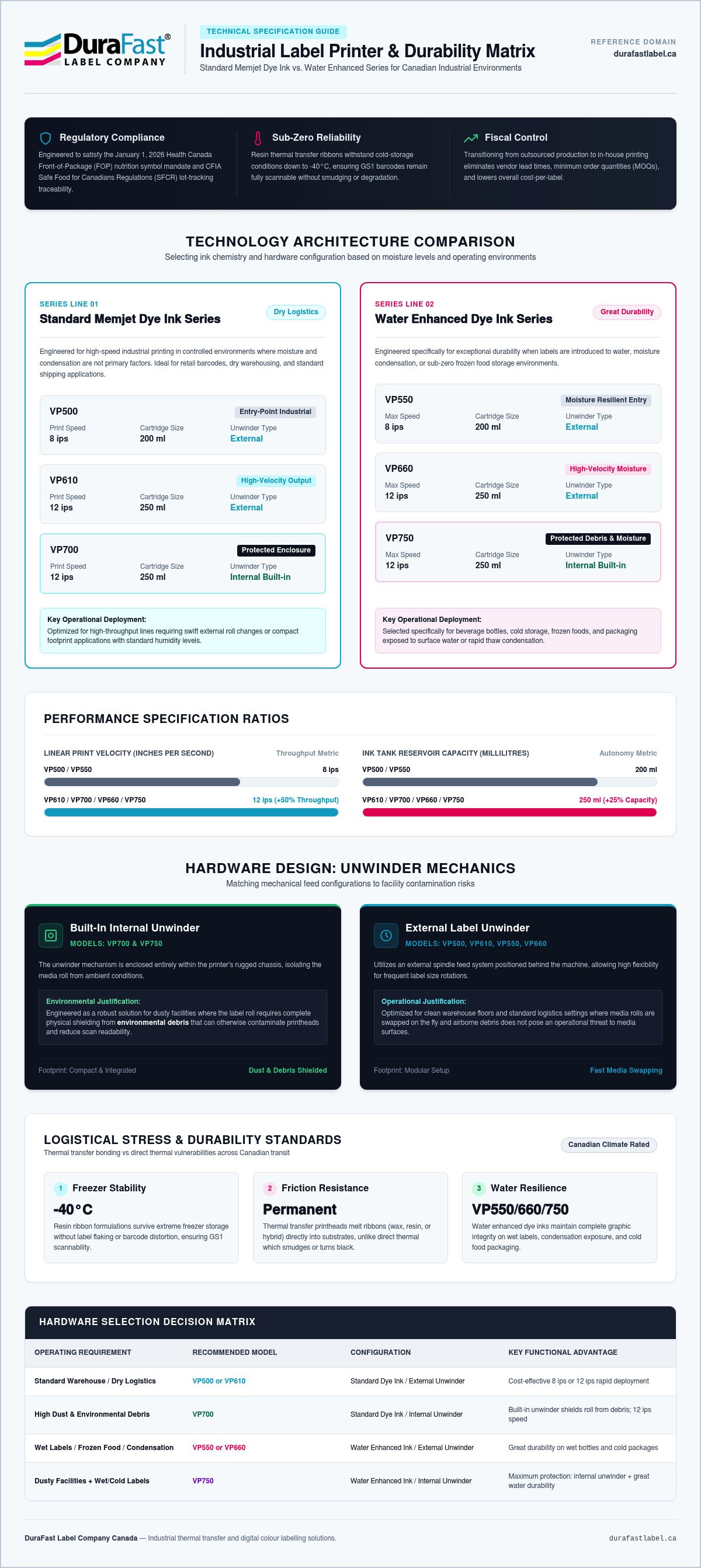
The standard Memjet dye ink series is engineered for high-speed applications where moisture isn't a primary concern. The VP500 serves as a reliable entry-point industrial solution, offering a print speed of 8 ips and using 200ml ink cartridges. It utilizes an external label unwinder, making it suitable for standard warehouse environments where media is swapped frequently. For higher volume needs, the VP610 increases performance to 12 ips with larger 250ml ink cartridges and also features an external unwinder. If your facility requires a more compact footprint or extra protection, the VP700 maintains that 12 ips speed and 250ml capacity but includes a built-in internal label unwinder. These models are ideal for retail barcodes, dry storage, and standard shipping labels where the environment remains controlled and dry.
Water-Enhanced Dye Ink: Surviving Wet and Cold
When labels are introduced to water or condensation, standard inks can bleed or smudge, compromising scannability. This is where the water enhanced dye ink series provides a necessary upgrade. These models are specifically intended for durability in applications involving wet labels, condensation, or frozen foods. The VP550 offers a max print speed of 8 ips with 200ml ink cartridges and an external unwinder. For faster workflows, the VP660 delivers a max print speed of 12 ips using 250ml ink cartridges, also with an external unwinder. The VP750 stands out by offering an internal label unwinder while keeping the 12 ips speed and 250ml capacity. This series is the direct solution when "great durability" is a requirement, ensuring your barcodes remain intact in Canadian cold storage or beverage bottling lines. If you aren't sure which ink chemistry fits your specific environment, we can help you evaluate your labelling needs to ensure long-term reliability and compliant production.
Hardware Design: Internal vs. External Unwinders
When selecting an industrial thermal transfer barcode printer Canada, the physical configuration of your media path is as critical as the print engine itself. Many business owners focus solely on resolution or speed, but the placement of the label unwinder dictates how well your equipment survives its environment. External unwinders, found on models like the VP500 and VP610, offer flexibility for high-capacity rolls and quick media changes in standard office or clean warehouse settings. However, in more demanding industrial zones, an open media path can become a liability that threatens your operational seamlessness.
Protecting Your Investment in Dusty Environments
Facility managers often overlook the impact of airborne dust on long-term hardware health. In dusty manufacturing plants or abrasive milling facilities, environmental debris can settle on the label roll before it even reaches the printhead. This contamination often leads to premature printhead failure and inconsistent barcode quality, resulting in costly downtime. The VP700 and VP750 address this risk by featuring a built-in internal label unwinder. By enclosing the media within the printer's chassis, you ensure that the labels remain clean until the moment of printing. This level of protection is vital for maintaining WHMIS label durability requirements and ensuring that safety warnings remain legible in harsh Canadian work environments.
Speed and Capacity Trade-offs
Choosing between these models also requires a look at your specific shift demands and volume requirements. Entry-level industrial units like the VP500 and VP550 provide a max print speed of 8 ips and utilize 200ml ink cartridges, making them efficient for smaller, precise batches. If your workflow requires high-volume output during busy shifts, the 12 ips performance of the VP600 and VP700 series is more appropriate. These higher-tier models use 250ml ink cartridges, which reduces the frequency of operator intervention for ink swaps.
Balancing speed with physical footprint is a pragmatic step for any growing business. While the VP610 and VP660 deliver impressive 12 ips speeds with external unwinders, they require more horizontal bench space for the media roll setup. In contrast, the VP700 and VP750 integrate that same 12 ips speed and 250ml capacity into a more compact, enclosed design. Matching your industrial label printers to both your available workspace and environmental challenges ensures a steady production rhythm that prioritizes uptime and longevity.
Selecting Ribbons and Labels for Canadian Environments
Success with an industrial thermal transfer barcode printer Canada depends entirely on the integrity of the ribbon-substrate bond. If the ink doesn't fuse perfectly with the label material, your barcodes will smudge or fade during transit. This bond is created through a specific thermal process where a heated printhead melts the ribbon onto the label. Choosing the right combination of wax, resin, or wax-resin hybrid is a pragmatic step toward ensuring your logistics remain seamless and compliant. For Canadian businesses, this selection is often the difference between a successful delivery and a rejected shipment due to unreadable data.
Matching Ribbons to Industrial Printers
Are you using the correct ribbon for your specific hardware? Different brands require unique formulations to achieve optimal print quality and prevent head wear. We provide specialized thermal transfer ribbons designed to work with leading names like Zebra, Honeywell, and Toshiba. Using brand-specific supplies, such as Godex ribbons or SATO ribbons, ensures that the tension and ink melting points are perfectly calibrated for your machine. This prevents common "ribbon-label mismatch" errors that lead to premature fading. When you pair high-quality ribbons with our industrial thermal transfer labels, you create a mark that stands up to friction and handling across long-haul Canadian routes.
Specialized Substrates for Harsh Conditions
Standard paper labels often fail when exposed to the elements. If your products are stored outdoors or in high-moisture areas, you need substrates engineered for longevity. For example, horticulture tags and tire labels require aggressive adhesives and durable face stocks to remain affixed and legible. In environments where extreme weather is a factor, Ultramax DT Direct Thermal labels offer excellent outdoor durability.
Adhesive selection is particularly vital for Canadian warehouses. Many standard adhesives lose their tack in sub-zero temperatures, causing labels to peel off. By selecting weatherproof and UL-certified labels, you ensure your barcodes remain secure even in freezing condensation. This reliability is essential for maintaining GHS and WHMIS compliance, where safety information must be permanent. If you're struggling to find a material that survives your specific environment, contact our team for a strategic consultation on the best ribbon and label pairing for your workflow.
Your Partner for Industrial Printing Solutions in Canada
Selecting the right industrial thermal transfer barcode printer Canada is a decision that impacts your entire logistical chain. At DuraFast Label Company Canada, we don't just sell equipment; we act as a knowledgeable consultant to help you navigate the intricate challenges of production and distribution. By moving away from the high costs of outsourced labels, you gain the ability to adapt to shifting market demands while maintaining strict fiscal responsibility. We're here to ensure your transition to in-house printing is both seamless and curative for your operational hurdles, providing the pragmatic solutions your business requires to scale effectively.
Comprehensive Support Across Canada
Our commitment to your success includes national shipping and specialized support for businesses across the country. We provide access to industrial label printers from world-leading brands, ensuring you have the hardware required for high-volume shifts. Beyond the machines, DuraFast Label Company Canada offers essential training and software resources for Loftware and Bartender integration. This ensures that your system is not only hardware-ready but fully optimized for the complex data requirements of modern supply chains. Whether you're managing a warehouse or a manufacturing facility, our technical expertise helps you maximize your resources from the first print, ensuring your labels meet every industry standard for legibility and adhesion.
The DuraFast Advantage
What sets DuraFast Label Company Canada apart is our spirit of empowerment. We encourage you to take full control of your marking and distribution processes to achieve better long-term results. We understand that a printer is an investment in longevity, which is why we prioritize helpful, advisory communication over high-pressure sales. Our team helps you evaluate functional differences; for instance, we'll help you decide if the VP610 is right for its 12 ips performance or if your application requires the "great durability" of the VP750 in wet environments. We also maintain a scalable inventory of ink and labels to ensure your production never grinds to a halt due to supply shortages. Browse our full range of industrial thermal transfer printers today. We invite you to reach out for a technical consultation to request samples or discuss how our specialized hardware and consumables can support your company's growth for years to come.
Optimize Your Production for the 2027 Migration
Is your facility ready for the upcoming shift to 2D barcodes and current CFIA traceability standards? Choosing an industrial thermal transfer barcode printer Canada requires balancing raw speed with environmental protection. You've discovered how the water enhanced series offers the durability needed for cold storage, while internal unwinders safeguard your investment from debris. These strategic hardware choices ensure your labels remain legible and compliant through every stage of the supply chain.
As an authorized Canadian retailer for Zebra, VIPColor, and Honeywell, we provide the expert technical support needed to transition your production in-house. We help you realize fiscal responsibility by matching hardware like the 12 ips VP660 or the protected VP750 to your specific volume demands. Our goal is to empower your business with reliable, high-performance tools that reduce long-term costs and prevent operational disruption.
Request a strategic consultation and technical support to find the right solution for your unique logistical challenges. We look forward to supporting your business growth and ensuring your labelling operations are built for longevity.
Frequently Asked Questions
What is the difference between direct thermal and thermal transfer printing?
Direct thermal printing uses heat-sensitive media that darkens when heated, making it susceptible to light, heat, and friction. In contrast, thermal transfer uses a ribbon to create a permanent, smudge-proof bond on the substrate. This method is the standard for an industrial thermal transfer barcode printer Canada because it ensures labels survive long-haul logistics and temperature fluctuations common in the Canadian supply chain without fading or degrading during transit.
How do I choose between the VIPColor VP700 and the VP750?
The choice depends on your moisture exposure and durability requirements. Both models print at 12 ips, use 250ml ink cartridges, and feature built-in internal label unwinders. However, the VP700 uses standard Memjet dye ink for dry environments, while the VP750 utilizes the water enhanced dye ink series. If your labels face condensation or freezing, the VP750 is the strategic choice to ensure the "great durability" required for food and beverage applications.
Why do I need an internal unwinder for my industrial printer?
An internal unwinder is a primary defense against environmental debris in your facility. In areas prone to dust or abrasive particles, an enclosed media path protects the label roll before it even reaches the printhead. This prevents contamination that can lead to premature hardware wear or inconsistent print quality. Models like the VP700 and VP750 integrate this feature to maximize uptime and protect your long-term investment in harsh industrial zones.
Can I use standard dye ink for labels that will be exposed to water?
Standard dye ink, used in the VP500, VP610, and VP700, is not intended for wet applications. For products exposed to water, moisture, or freezing, you must select the water enhanced dye ink series found in the VP550, VP660, and VP750. These models are specifically engineered to maintain legibility when labels are introduced to condensation, preventing the ink bleed and smudging that typically occurs with standard dye formulations in cold storage.
How do I match the right thermal transfer ribbon to my label material?
Success requires pairing the ribbon's chemistry with the specific label substrate. Wax ribbons are efficient for paper, while resin ribbons are necessary for synthetic labels used in chemical or outdoor settings. DuraFast Label Company Canada provides specialized wax-resin and resin ribbons for Zebra, Honeywell, and Godex hardware. This ensures a permanent bond that meets WHMIS compliance and survives high-friction handling during national distribution without compromising the integrity of the barcode.
What print speed do I need for a high-volume Canadian warehouse?
High-volume operations typically require a print speed of 12 ips to maintain a steady production rhythm during demanding shifts. The VP610, VP700, VP660, and VP750 all meet this 12 ips threshold while utilizing large 250ml ink cartridges to reduce the frequency of operator intervention. For smaller batches or less frequent printing, an 8 ips model like the VP500 or VP550 with 200ml cartridges offers a more cost-effective entry point for your facility.
Are these industrial barcode printers compatible with Bartender software?
Yes, the industrial printers we offer are fully compatible with leading design software like Bartender and Loftware. This allows you to generate complex 1D and 2D barcodes that meet GS1 standards and current Health Canada FOP requirements. DuraFast Label Company Canada provides the necessary drivers and technical support to ensure your software and hardware work in operational seamlessness, empowering your team to manage professional barcode production in-house with total confidence.
Do you ship industrial thermal transfer printers across all of Canada?
DuraFast Label Company Canada provides national shipping and support to businesses across the entire country. We maintain a comprehensive inventory of hardware and consumables, ensuring you have access to the latest VIPColor, Afinia, and Zebra technology regardless of your location. Our team acts as a strategic partner, offering the technical consultation and supply chain reliability needed to support your company's growth and production efficiency from coast to coast.