What Warehouse Labelling Ideas Boost Workflow Accuracy?
17th Jul 2026
Key Highlights
-
Structured warehouse labelling ideas reduce picking errors and improve workflow speed
-
Rack labels support long-range barcode scanning from forklifts using barcode scanners.
-
Shelf labels improve bin-level accuracy in high-density storage
-
Floor labels guide traffic flow, zoning, and safety compliance
-
Signs add vertical visibility in large warehouse layouts
-
Durable materials directly affect label lifespan and scan reliability
-
Protective overlays extend floor label performance in high-traffic areas
Walk into a warehouse where labels are faded, peeling, or inconsistent, and the slowdown is immediate. Pickers hesitate before scanning. Forklift drivers pause to confirm rack numbers. Inventory ends up in the wrong location. Small identification issues quietly build into delays, rework, and safety risks that affect daily performance.
Today’s facilities are under pressure to move faster while maintaining accuracy and traceability. There is little room for confusion on the floor. Clear, structured warehouse labelling ideas remove guesswork by linking physical storage locations directly to digital systems. When locations are visible and scannable, teams work with more confidence, fewer errors, and smoother operational flow.
This guide explores practical warehouse labelling ideas for racks, shelves, floor zones, and signs, along with strategies for selecting durable materials. You will also see how protective solutions like Label Armour help labels withstand heavy traffic and real warehouse conditions across Canadian operations.
Why Do Warehouse Labelling Systems Directly Impact Efficiency?
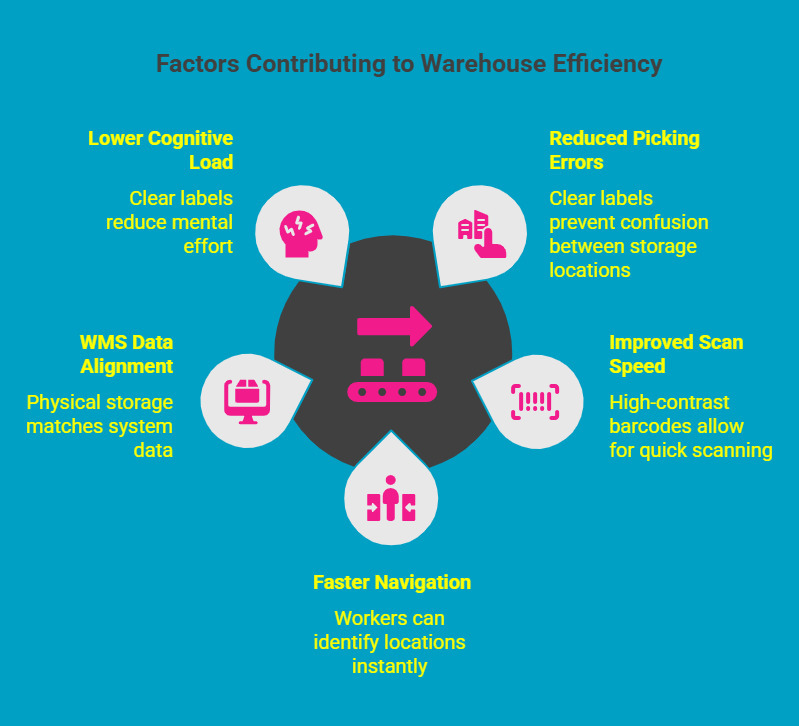
In fast-moving warehouses, small delays multiply quickly. A structured labelling system connects physical locations with digital instructions, reducing hesitation and correction work. When labels provide a clear visual structure, movement becomes more confident, consistent, and operationally controlled across shifts.
-
Reduces picking errors by clearly distinguishing aisles, bays, and levels, preventing confusion between similar-looking storage locations and lowering the risk of inventory being picked or placed incorrectly
-
Improves scan speed and accuracy through high-contrast barcodes and consistent placement, allowing operators to scan quickly without adjusting position or making repeated attempts
-
Supports faster navigation because workers can identify locations instantly, minimizing travel hesitation and unnecessary backtracking
-
Aligns physical storage with WMS data so system-directed tasks match real-world layouts, maintaining inventory accuracy and reducing reconciliation effort
-
Lowers cognitive load on workers by replacing guesswork with clear identification, which helps sustain productivity during long shifts
When labelling works as a system, movement becomes more fluid and less error-prone. Efficiency improves not by working harder, but by removing friction from every task.
What Are the Best Warehouse Rack Labelling Ideas?
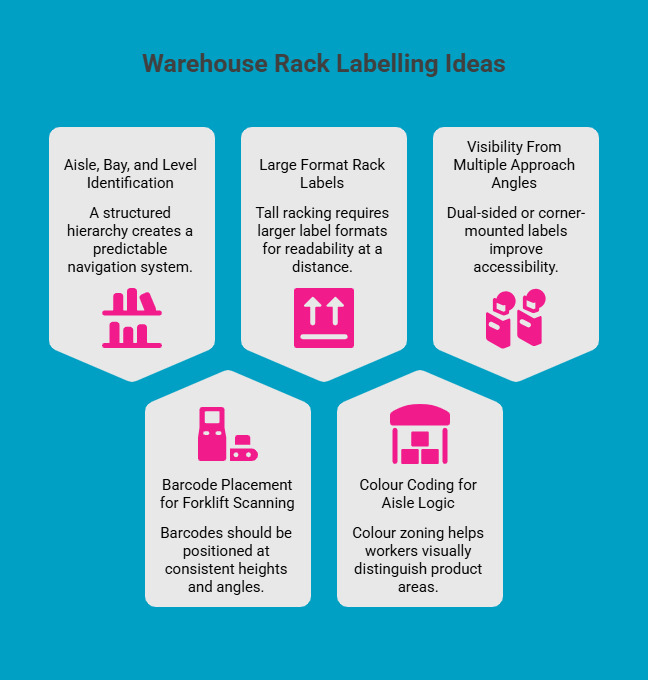
In fast-moving warehouse environments, rack identification must work at a glance, not after a second look. Effective warehouse rack labelling ideas focus on visibility, structure, and scan performance, especially in high-bay storage, where operators rely on distance reading while navigating forklifts through active aisles.
1. Aisle, Bay, and Level Identification
A structured hierarchy, such as Aisle, Bay, and Level, creates a predictable navigation system. This reduces search time, supports faster onboarding for new staff, and ensures physical rack locations stay aligned with Warehouse Management System location logic.
2. Barcode Placement for Forklift Scanning
Barcodes should be positioned at consistent heights and angles that match forklift operator sightlines. Proper placement allows scanning without repositioning equipment, reducing aisle congestion and improving pick speed in active storage zones.
3. Large Format Rack Labels
Tall racking requires larger label formats for readability at a distance. Oversized, high-contrast labels improve scan accuracy, minimize misreads, and help operators confirm locations quickly in facilities with long sightlines.
4. Colour Coding for Aisle Logic
Colour zoning helps workers visually distinguish product areas, temperature zones, or operational sections. This reduces navigation hesitation and supports faster movement through wide or complex warehouse layouts.
5. Visibility From Multiple Approach Angles
Operators rarely approach racks from a single direction. Dual-sided or corner-mounted labels improve accessibility from cross aisles, reducing repositioning time and unnecessary equipment movement.
Well-planned rack identification reduces hesitation, rescans, and travel time across storage zones.
When visibility and structure work together, rack labelling becomes a direct driver of picking speed and accuracy.
Industrial building, large warehouse interior with forklift, pallet and goods shelves, highlighting the use of durable warehouse racking labels for clear inventory identification.
What Are Effective Warehouse Shelf Labelling Ideas for Bin Accuracy?
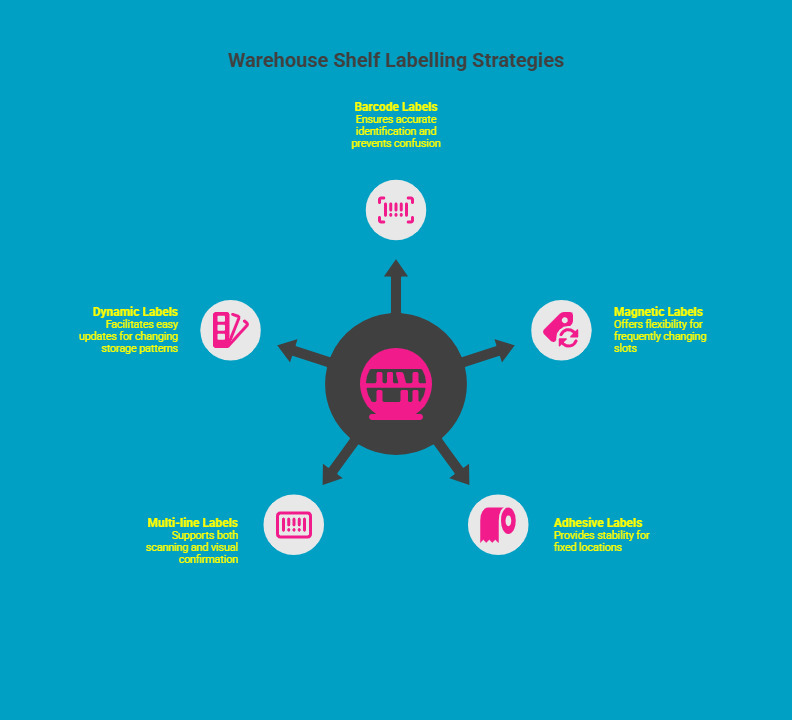
Shelf-level labelling is where precision matters most because small-item storage creates dense locations and higher pick frequency. Weak identification at this level leads to repeated mis-picks, slow verification, and inventory discrepancies. Strong warehouse shelf labelling ideas focus on scannability, durability, and flexibility to support changing storage patterns.
1. Bin Location Barcode Labels
Each bin should have a unique scannable location ID tied directly to WMS data. This prevents adjacent-bin confusion, supports accurate replenishment, and ensures pick confirmations reflect the correct physical slot, especially in high-density shelving where visual similarity is common.
2. Magnetic vs Adhesive Shelf Labels
Magnetic labels work best where slots change frequently, allowing fast repositioning without residue. Adhesive labels suit fixed bin locations, plastic totes, or areas with vibration where magnets may shift, providing more stable, long-term identification.
3. Multi-Line SKU and Description Labels
Including location code, SKU, and a short description supports both scanning and visual confirmation. This dual-check approach helps reduce errors during manual picks, audits, or replenishment when operators rely on both barcode data and human-readable information.
4. Labelling For Fast-Moving vs Slow-Moving Inventory
High-velocity pick zones require larger text, stronger contrast, and more durable materials due to constant handling. Slower areas may use standard formats, but visibility and scannability should still remain consistent across the shelving system.
5. Changeable Label Systems for Dynamic Slots
Insert-style holders or replaceable panels reduce relabelling time when layouts shift. These systems support flexible slotting strategies without damaging shelves or leaving adhesive buildup that interferes with future label placement.
Well-structured shelf labelling reduces bin-level errors and supports faster, more confident picking.
When labels match inventory behaviour and storage dynamics, accuracy improves without slowing operations.
How Do Warehouse Floor Labels Support Navigation and Safety?
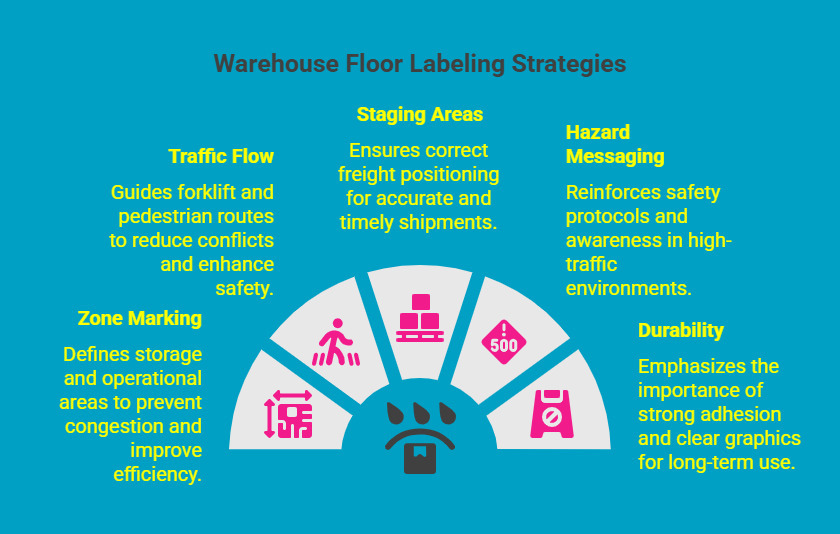
Among all warehouse labelling ideas, floor labels influence how movement happens across the facility. They shape traffic flow, space usage, and safe behaviour at ground level, where forklifts, pallets, and pedestrians constantly interact. Clear floor communication reduces confusion and supports smoother, safer operations.
1. Zone and Area Marking
Floor labels define storage zones, staging areas, and operational boundaries. This prevents congestion, reduces misplaced inventory, and helps teams understand how each space should function within the workflow.
2. Traffic Flow Indicators
Directional arrows and pathway markings guide forklift and pedestrian routes. Structured traffic flow lowers cross-traffic conflicts, reduces sudden stops, and helps maintain safer movement patterns across busy warehouse aisles.
3. Staging and Dock Areas
Clearly marked staging lanes and dock zones ensure freight is positioned correctly before loading. This improves shipment accuracy and reduces delays caused by last-minute re-sorting or misplaced pallets.
4. Hazard Messaging
Safety floor labels mark pedestrian walkways, fire equipment clearance areas, and restricted zones. These visual reminders reinforce protocols and improve awareness in fast-moving environments where verbal instructions may be missed.
5. Floor Labels vs Floor Tape
Printed floor labels often deliver sharper graphics and stronger adhesion than tape, especially in facilities with frequent cleaning and equipment traffic. They maintain clearer messaging over time when built with industrial-grade materials.
Floor graphics face heavy wear from wheels and abrasion, making durability critical. Protective overlays like Label Armour help extend label life and maintain readability in high-traffic warehouse zones.
Want floor labels that survive forklifts, scrubbing, and daily traffic? See heavy-duty warehouse floor label solutions.
How Should Warehouse Signs and Labels Work Together?
Strong warehouse labelling ideas depend on a coordinated visual system where signs and labels support different visibility ranges. When planned together, they guide movement, confirm locations, and reduce hesitation, helping workers navigate large facilities quickly while maintaining accuracy at the point of handling.
-
Long-range guidance: Overhead or hanging signs identify aisles, zones, and departments from a distance, helping workers orient themselves before entering storage areas
-
Mid-range confirmation: Rack-level identifiers ensure workers know they are in the correct aisle and bay before scanning or picking
-
Close-range precision: Bin and shelf labels provide exact scannable IDs where items are handled
-
Consistent visual logic: Fonts, colours, numbering formats, and barcode styles should match across signs and labels
-
Reduced blind spots: Coordinated placement prevents gaps where navigation is clear but final identification is not
-
Faster movement: Workers spend less time searching when directional and location cues align
When warehouse signs and labels function as one system, navigation becomes intuitive, and errors decrease. This layered approach turns the layout into a clear communication tool at every distance.
How Do You Choose Durable Materials for Warehouse Labels?
Strong warehouse labelling ideas only work long term if the materials match real operating conditions. Warehouses expose labels to mechanical impact, chemicals, and constant handling. Choosing the wrong material leads to faded barcodes, peeling edges, and frequent relabelling.
Start by evaluating where the label will live and what it will face daily.
Key durability factors to assess:
-
Abrasion from equipment
Forklifts, pallet jacks, and dragged pallets create repeated surface friction. Floor labels and low-position rack labels are especially vulnerable to scuffing and edge lift. -
Moisture and cleaning exposure
Spills, humidity, and industrial washdowns can weaken adhesives and blur printed information. Materials and adhesives must resist both water and chemical cleaners. -
Thermal transfer printing performance
Thermal transfer printing produces more durable, smudge-resistant, and chemical-resistant images than standard print methods. This is critical for barcodes that must remain scannable over time. -
Need for surface protection
In high-traffic zones, print durability alone is not enough. Protective overlays add a physical barrier between the label and mechanical wear.
Protective solutions like Label Armour act as a shield over warehouse floor labels, reducing abrasion damage and extending usable life in heavy-traffic areas.
If you are producing labels in-house, using a warehouse-grade label printer ensures barcodes remain sharp, durable, and resistant to warehouse conditions.
What Common Warehouse Labelling Mistakes Reduce Effectiveness?
If labelling is working properly, it disappears into the background and supports smooth movement. When it starts causing hesitation, rescans, or confusion, those are warning signals. Small labelling flaws quickly create system-wide inefficiencies.
If you see the following, your labelling system is likely underperforming:
-
Workers repeatedly rescanning locations
Poor contrast, glare, or small barcode sizes make scanning unreliable, forcing extra attempts and manual corrections. -
Operators adjusting position just to read labels
Labels placed too high, too low, or outside natural sightlines interrupt motion and slow task flow. -
Frequent location confusion or double-checking
Inconsistent naming, coding, or formatting structures break alignment with WMS logic and increase cognitive load. -
Labels peeling, fading, or tearing quickly
Using light-duty materials in high-contact zones leads to constant replacements and unreliable identification. -
Floor labels are wearing down fast
Without protective layers, floor markings degrade under traffic, creating visibility issues and ongoing maintenance costs.
When these signs appear, the issue is rarely the worker. It is the labelling system creating friction. Fixing design, materials, and placement restores speed, accuracy, and workflow confidence.
How Does DuraFast Label Canada Support Professional Warehouse Labelling Systems?
Warehouse labels only work when materials, print quality, and durability match real operating conditions. Labels must withstand equipment traffic, scanning distance, cleaning routines, and constant handling. DuraFastLabel.ca specialises in industrial identification built for these demands. Their solutions include heavy-duty warehouse floor labels, high-contrast racking identification labels for long-range scanning, and thermal transfer systems that produce abrasion-resistant, chemical-resistant barcodes.
Label Armour protective overlays extend floor label life in high-traffic areas. For facilities managing layout changes or growth, industrial-grade printers support consistent in-house label production. The focus is simple: durable, scannable labelling that improves accuracy, safety, and operational speed.
Upgrade your warehouse identification system with durable rack, shelf, and floor labelling solutions built for real industrial use. Contact us at DurafastLabel.ca to improve accuracy, safety, and operational speed.
Final Thoughts
The best warehouse labelling ideas create a structured, durable system where racks, shelves, floors, and signs work together in effective warehouse operations management. When labels are clear and built for industrial conditions, it's essential to update the types of warehouse labels regularly so efficient operations run safer, faster, and with fewer costly errors.
Upgrading to professional-grade materials and protective overlays ensures your labelling system performs reliably long term.
Frequently Asked Questions
What size should rack labels be?
Rack labels in a warehouse labelling system should match viewing distance and be placed at eye level where possible. High-bay racks need large location labels with a unique identifier to support quick scanning, improve inventory management, and maintain operational efficiency.
How long do warehouse floor labels last?
Floor label lifespan depends on traffic, cleaning, and the types of labels used. In heavy areas, unprotected pallet labels and floor markings wear quickly. Proper labelling, durable materials, and protective overlays support accurate labelling, better inventory control, and longer performance.
Are magnetic labels reliable in warehouses?
Magnetic labels support inventory changes in flexible warehouse labelling environments. They allow quick repositioning without adhesives, helping staff members update labels efficiently. However, they may not suit high-vibration areas where accurate labelling and permanent placement are required.
What label material works in cold storage?
Cold storage requires synthetic materials with low-temperature adhesives. Thermal transfer labels maintain product information, product descriptions, and barcode clarity despite moisture. This supports quick identification, accurate inventory tracking, and stable stock levels in temperature-controlled environments.
How do you protect labels from forklift wear?
Labels in traffic zones need durable materials, correct placement, and protection. Overlays like Label Armour shield surfaces from abrasion and wheel contact. This improves effective warehouse labelling, supports quick scanning, and helps maintain customer satisfaction through fewer identification failures.
Can you suggest effective naming schemes for my warehouse layout?
Use structured codes like aisle, bay, level, and position, creating a unique identifier for each slot. This warehouse labeling system supports order fulfillment, inventory management, and accurate inventory tracking while helping staff members navigate faster with minimal confusion.
Are there examples of unique warehouse labelling systems I can use?
Facilities use color coding, alphanumeric grids, qr code labels, or radio frequency identification. These types of labels, including rfid tags, support quick identification, faster picking, and smoother inventory control across large or complex layouts.
Where can I find inspiration or templates for warehouse label designs?
Templates come from industrial labeling suppliers and warehouse labeling system specialists. Designs often include product information, product descriptions, barcodes, and location labels, helping teams update labels easily while maintaining accurate labeling and operational consistency.