Thermal Card Grading Labels: A Professional Quality Guide
19th Sep 2026
What if the long-term value of your most prized trading cards is being compromised by a single strip of low-quality adhesive? You already understand that in the world of high-stakes grading, presentation and preservation are everything. It's frustrating to watch a perfectly slabbed card suffer because the label begins to fade or peel away over time. Smudging during the encapsulation process or struggling with Thermal Card Grading Labels that don't fit your printer shouldn't be part of your daily operations.
You can produce archival-quality labels in-house that rival the industry's biggest names. This guide provides the technical roadmap to help you achieve crisp, high-contrast subgrades and total operational efficiency. We'll compare precision hardware like the Seiko SLP850 with the high-volume capabilities of the VIPColor series. Whether you need the 12 ips speed of a VP610 or the protection from environmental debris offered by the internal unwinder on a VP700, you'll learn how to select the right tools for a professional finish. We will also examine why water-enhanced models like the VP660 are essential when you require great durability for your colour labels.
Key Takeaways
- Learn why thermal transfer technology is the gold standard for archival longevity to ensure your labels remain legible for decades.
- Discover how to produce high-precision Thermal Card Grading Labels in-house to maintain complete control over subgrade quality and slab aesthetics.
- Understand the functional differences between internal and external unwinders to protect your label rolls from environmental debris in dusty workspaces.
- Identify when to utilize water enhanced ink series, such as the VP660, to achieve great durability and professional colour results in moist environments.
- Streamline your operational efficiency by sourcing specialized printers and labels within Canada to eliminate cross-border duties and shipping delays.
Understanding the Role of Thermal Card Grading Labels
Why do professional graders shun standard office printers? It comes down to a combination of precision, longevity, and chemical stability. Thermal Card Grading Labels are high-precision identifiers used to display subgrades, serial numbers, and essential card data. Unlike standard paper labels found in a home office, these are engineered to fit within the tight tolerances of a sonic-welded slab or a high-clearance toploader. They provide the professional finish that collectors expect when they invest in a graded asset.
Standard office printers rely on liquid ink or toner that can bleed into the label stock or smudge during the encapsulation process. By leveraging thermal printing technologies, you ensure that the text is chemically bonded to or embedded within the material. This prevents the text from fading after exposure to UV light, which is a common complaint among collectors who display their cards in well-lit rooms or under LED spotlights. For a business, this reliability means fewer returns and a stronger reputation for quality.
Using archival-safe adhesives is another non-negotiable requirement. If an adhesive is too aggressive or contains acidic compounds, it can yellow the label over time or even cause "ghosting" on the interior of the plastic holder. This ruins the clarity of the slab and directly decreases the card's marketability. For Canadian grading startups, providing a label that remains pristine for decades is a key differentiator. It shows you value the fiscal responsibility of the collector by protecting their long-term investment.
The Aesthetic vs. Functional Balance
A professional label must look the part. You want a "heritage" aesthetic with deep, high-contrast blacks that make subgrades easy to read at a glance. Functionally, these labels must also support high-density QR codes and barcodes. If a scanner can't read the code for a population report, the grading process fails its most basic utility. Smudge-resistance is the most critical factor during the slabbing phase. While standard ink might stay wet for seconds, thermal prints are dry and durable the moment they leave the printer. This level of professional quality is also a hallmark of the personalized memorabilia and custom trading cards created by Custom Sports Products.
The Standard Sizes for Slabs and Toploaders
Maintaining a uniform look across a collection requires precision die-cut labels. Most internal slab labels follow industry-standard dimensions, but you might also need external identification tags for toploaders or semi-rigid holders. Using specialized products like Seiko SLP850 labels allows for consistent results across every card you process. You can even customize shapes to fit specific company standards, ensuring your brand stands out while maintaining a professional, factory-finished appearance that increases the perceived value of the card.
Choosing Your Tech: Direct Thermal vs. Thermal Transfer
Does your business prioritize speed for shipping or longevity for the slab? Selecting the right printing method is the first technical hurdle you'll face. While both technologies use heat, they produce very different results for Thermal Card Grading Labels. Direct thermal printing uses heat-sensitive paper that darkens when it passes under the printhead. It's efficient for high-turnover inventory or 4x6 shipping labels, but it has a significant drawback for collectors: it eventually fades when exposed to light or heat. For archival card grading, this isn't an acceptable compromise.
Thermal transfer is the gold standard for labels that need to last decades. This process uses thermal ribbons to fuse ink directly onto the label material. By matching the ribbon type to your stock, you create a bond that resists smudging, chemicals, and UV rays. Wax-resin ribbons offer a balance of durability and cost, while full resin ribbons provide the highest level of scratch resistance for labels that might face frequent handling before encapsulation. If you're unsure which combination fits your specific slab material, you can speak with our technical team to find the perfect match.
Seiko SLP850: The Precision Advantage
When you're printing subgrades for centering, corners, and edges, every pixel matters. The Seiko SLP850 series has become a leader for grading workstations because of its 300 DPI resolution. This high density is necessary to keep tiny text sharp and barcodes scannable. A lower resolution printer often produces "fuzzy" edges that look unprofessional under a collector's magnifying glass. The SLP850 also offers flexible connectivity options, including USB, Serial, and Bluetooth, allowing you to organize your workspace without being tethered by cables.
Operational seamlessness is vital when processing hundreds of cards. Using genuine Seiko SLP850 labels ensures jam-free operation and consistent adhesive performance. These labels are specifically designed to work with the SLP850's internal sensors, preventing the alignment issues that often plague generic third-party supplies. This precision protects your hardware and ensures your grading process remains efficient.
When to Use Thermal Transfer Ribbons
The science of heat-fusing ink is what separates a professional grading company from a hobbyist. Because thermal transfer doesn't rely on chemically treated paper, the labels don't "yellow" or turn black over time. This is critical for high-value cards where the label's condition is part of the overall grade. By investing in industrial-grade ribbons, you're guaranteeing that the serial number and grade will remain as crisp thirty years from now as they are on the day of encapsulation. This fiscal responsibility builds trust with your Canadian customer base, ensuring they return to your grading service for their future collection needs.
Standard vs. Water Enhanced Labels for Grading
Have you considered how a sudden change in humidity might affect your label's presentation? While high-contrast black text is essential for subgrades, many professional grading companies now incorporate full-colour branding to distinguish their slabs in a crowded market. This shift requires a move toward high-speed inkjet technology. The VIPColor series provides a strategic solution by offering two distinct paths: the standard Memjet dye ink series and the water enhanced dye ink series. Choosing the right one ensures your Thermal Card Grading Labels remain vibrant regardless of the environment.
The primary difference lies in how the ink reacts to external stressors. Standard dye inks offer incredible colour depth and are perfect for controlled office settings. However, if your slabs are shipped through varied climates or stored in high-humidity areas, water enhanced models are essential. These printers provide great durability when labels are introduced to water or condensation, preventing the bleeding or smudging that can occur with standard inks. This is a critical consideration for Thermal Card Grading Labels that must maintain a factory-fresh look during long-distance transit.
The Standard Series: Efficiency and Speed
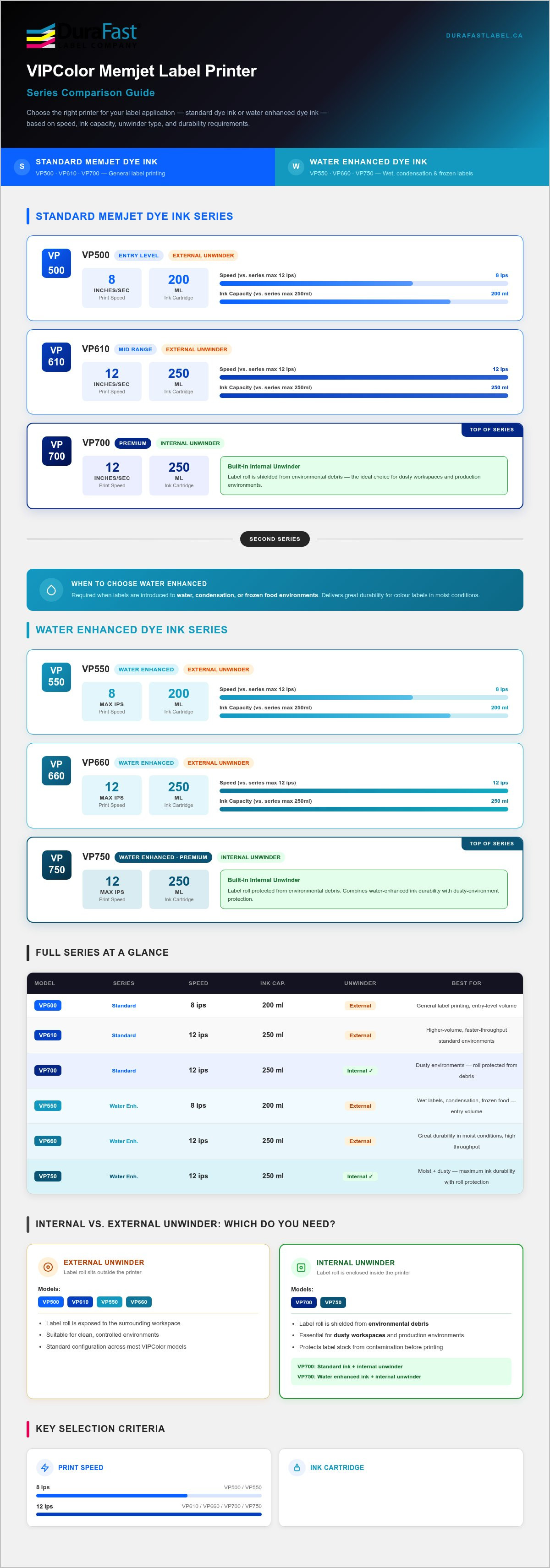
For most grading startups operating in climate-controlled centres, the standard series offers a balance of speed and fiscal responsibility. The VP500 is an entry-level powerhouse with a print speed of 8 ips and uses 200ml ink cartridges. It utilizes an external label unwinder, making it easy to swap rolls during small production runs. If your volume increases, the VP610 steps up with a 12 ips speed and larger 250ml ink cartridges, also featuring an external unwinder.
When your workspace isn't perfectly sterile, the VP700 becomes the logical choice. It maintains the 12 ips speed and 250ml ink cartridge capacity of the VP610 but adds a built-in internal label unwinder. This feature is a vital solution for dusty environments where the label roll needs protection from environmental debris. By keeping the media enclosed, you ensure that every print is free from surface imperfections that could mar the final look of a graded card.
The Water Enhanced Series: Maximum Protection
If your grading business involves high-humidity storage or international shipping where packages face moisture, the water enhanced series is a necessary investment. The VP550 offers a max print speed of 8 ips and uses 200ml ink cartridges with an external unwinder. For high-capacity professional graders, the VP660 delivers a max print speed of 12 ips and uses 250ml ink cartridges, also paired with an external unwinder. These models are specifically intended for durability in applications involving wet labels or condensation.
The flagship VP750 mirrors the robust build of the VP700, featuring an internal label unwinder to protect your media from environmental debris while offering the same 12 ips speed and 250ml cartridges. Selecting a model from our colour label printers lineup ensures that your branding remains as resilient as the cards you protect, providing a professional finish that stands up to the elements.
Setting Up Your In-House Card Grading Station
How do you transform a workspace into a high-throughput production centre? Establishing an in-house station requires more than just hardware; it demands a logical workflow that ensures every card is slabbed with precision. When you produce your own Thermal Card Grading Labels, you're taking control of the most visible part of your service. Success starts with a methodical setup that prioritizes accuracy and equipment longevity.
Follow these five steps to organize your grading station for maximum efficiency:
- Step 1: Select your printer based on your branding needs. Use a Seiko for crisp monochrome subgrades or a VIPColor model for full-colour labels.
- Step 2: Choose your unwinder configuration. External unwinders work well for clean offices, but internal unwinders are necessary for industrial or dusty environments.
- Step 3: Integrate professional design software. This allows you to automate serial numbering and pull data directly from your grading database.
- Step 4: Calibrate your sensors. Precise alignment is vital for die-cut labels to ensure the text is perfectly centred within the slab's window.
- Step 5: Perform a barcode scannability check. Use a high-quality scanner to verify that every QR code or barcode links correctly to your population report.
Protecting Your Equipment from Debris
Dust is the enemy of high-resolution printing. If you're operating in a workspace prone to environmental debris, choosing a printer with an internal label unwinder, such as the VP700 or the water enhanced VP750, is a strategic necessity. These models keep the label roll enclosed; this prevents particles from settling on the media surface before it reaches the printhead. When debris gets trapped, it can cause "voids" in the print or permanently damage your thermal printheads. Regular maintenance, including cleaning the rollers and sensors, will prolong the life of your equipment and ensure your Thermal Card Grading Labels remain flawless.
Software Solutions for Graders
Efficiency in a grading business comes from automation. Using industry-standard software like Bartender or Loftware NiceLabel allows you to create dynamic templates where subgrades and serial numbers update automatically. You don't want to manually type data for every card. By linking your software to a spreadsheet or database, you eliminate human error and ensure a uniform look across every slab. If you need assistance choosing the right software or hardware for your specific volume, you can contact our technical specialists for a tailored consultation. This ensures your templates are perfectly aligned with the 12 ips speed of a VP610 or the 8 ips output of a VP500, keeping your production line moving without interruption.
Sourcing Card Grading Supplies in Canada
Why should Canadian grading startups look past international vendors? Sourcing your Thermal Card Grading Labels from a national supplier eliminates the logistical headaches of cross-border duties and unpredictable shipping delays. It's about fiscal responsibility and operational seamlessness. DuraFast Label Company Canada acts as a strategic partner; we offer custom label manufacturing for those unique slab dimensions that standard sizes simply won't fit. You get direct access to technical consultations, ensuring your hardware investment matches your production goals.
Reliability in your supply chain prevents downtime. When your grading line is moving at 12 ips, you can't afford to wait three weeks for a customs clearance. We provide fast delivery across all provinces, from British Columbia to Newfoundland. This local presence allows you to access a wide range of blank labels for testing before you commit to a high-volume order. It's a supportive approach that values your long-term efficiency.
National Shipping and Support
We also understand the evolution of grading hardware. Many Canadian businesses still rely on legacy systems like the SLP650. We provide the support needed to keep these units operational while helping you realize the benefits of an upgrade path to the SLP850. This ensures your transition to higher resolution and better connectivity is smooth and cost-effective. Having a local partner means you aren't just buying equipment; you're gaining a consultant who understands the intricate logistical challenges of the Canadian market.
Eco-Friendly and Linerless Options
Sustainability is no longer a niche concern; it's a business advantage. Reducing waste in your production process can be achieved with Seiko SLP720RT linerless labels. These labels eliminate the silicone-coated liner, which significantly reduces the environmental footprint of your slabbing process. It's a pragmatic step toward the future of sustainable labelling in the collectibles industry. By choosing linerless options, you minimize waste disposal costs and demonstrate a commitment to responsible production.
Taking control of your production process leads to better results and higher margins. Our team is ready to help you organize a workflow that scales with your ambition. Contact our Canadian experts today to find your perfect grading setup!
Elevate Your Grading Standards Today
You've seen how the right technical setup—from the 300 DPI precision of the SLP850 to the 12 ips speed of the VP610—transforms a grading business. Producing professional Thermal Card Grading Labels in-house gives you total control over the final presentation of your collection. By choosing between standard and water enhanced ink series, you ensure every slab remains pristine regardless of environmental challenges like humidity or condensation.
As an authorized Canadian dealer for Seiko and VIPColor, DuraFast Label Company Canada provides the specialized archival-safe materials and expert technical support required to scale your operations. We act as your strategic partner, offering the hardware and consumables that guarantee long-term legibility and fiscal responsibility. Our goal is to empower you with the tools to produce industrial-quality results from your own workstation.
Shop Professional Thermal Card Grading Labels at DuraFast Label Company Canada to secure the equipment your business needs to thrive. We look forward to helping you build a legacy of quality and precision in the Canadian grading industry.
Frequently Asked Questions
Can I use a standard desktop printer for card grading labels?
You should avoid standard desktop printers because they rely on liquid inks that smudge easily during the slabbing process. Professional results require thermal transfer technology to ensure the text is chemically stable and smudge-resistant. This prevents the ink from bleeding into the label stock or ghosting on the interior of the plastic holder. Investing in a dedicated thermal or high-speed inkjet printer ensures your subgrades remain sharp and professional for years to come.
Do thermal labels fade over time inside a plastic slab?
Direct thermal labels will eventually fade when exposed to UV light or heat, making them unsuitable for long-term collection. However, thermal transfer labels use a ribbon to fuse ink into the material; this creates an archival-safe bond that lasts for decades. If you use high-quality resin ribbons, your labels will resist fading even when displayed under spotlights. This ensures the card's grade and serial number remain legible for the entire life of the plastic slab.
What is the best label size for a standard card grading slab?
Label dimensions vary by grading company, but most standard slabs utilize labels roughly 1 inch by 2.625 inches. Because precision is vital for a factory-finished look, many businesses choose custom die-cut labels to match their specific holder dimensions perfectly. DuraFast Label Company Canada specializes in manufacturing custom sizes; this allows you to maintain a uniform appearance across your inventory while ensuring the label fits securely within the slab's internal window without any overlapping.
What is the difference between the Seiko SLP850 and older SLP650 models?
The Seiko SLP850 provides a significant resolution upgrade with 300 DPI, whereas older models often lack the clarity needed for tiny subgrade text. It also offers modern connectivity like Bluetooth and USB, making it easier to organize a clean grading workstation. While legacy models served the industry well, the SLP850 ensures that QR codes and barcodes are high-density and easily scannable for population reports, providing a more reliable solution for modern professional grading requirements.
Are water enhanced labels necessary for card grading?
Water enhanced labels are essential if your graded cards are stored in high-humidity areas or shipped through climates where condensation occurs. Models like the VP550 or the VP660 offer great durability against moisture. These printers use specialized dye inks that won't run or bleed when introduced to water, protecting your Thermal Card Grading Labels from environmental damage during transit. This is a vital consideration for maintaining slab aesthetics over long distances.
How do I prevent my grading labels from smudging?
You can prevent smudging by switching to thermal transfer printing or using water enhanced inkjet models. Thermal transfer technology uses heat to bond ribbon ink to the label, resulting in a dry, smudge-proof finish immediately. For colour labels, printers like the VP750 feature an internal label unwinder that protects rolls from environmental debris. This ensures that no dust or oil interferes with the ink's ability to bond properly to the label surface during production.
Can I print QR codes on thermal card grading labels?
Yes, printing QR codes is a standard practice for linking slabs to online population reports and verification databases. To ensure these codes are scannable, you need a high-resolution printer like the Seiko SLP850 or a VIPColor model. These units produce the high-contrast, crisp edges required for scanners to read high-density data accurately. Using professional design software further simplifies the process of generating unique, automated codes for every individual card you process.
Where can I buy card grading labels in Canada without high shipping costs?
DuraFast Label Company Canada is the preferred national supplier for businesses looking to avoid cross-border duties and expensive international shipping. We ship across all provinces, ensuring you receive your Thermal Card Grading Labels and hardware without the delays associated with customs. By sourcing locally, you also gain access to Canadian technical support and hardware consultations; this helps you maintain operational efficiency and fiscal responsibility as you scale your in-house grading production.