The Strategic Benefits of In-House Label Printing for Canadian Businesses in 2026
5th Jun 2026
Is your storage room currently filled with thousands of obsolete labels that don't meet Health Canada's mandatory front-of-package nutrition symbol requirements? For many Canadian manufacturers, the January 1, 2026, deadline turned existing inventory into expensive waste overnight. You likely recognize the frustration of being tied to high minimum order quantities and long lead times that delay your product launches. Relying on external print houses often feels like a gamble with your own speed-to-market. Understanding the benefits of in-house label printing is the first step toward regaining operational agility and protecting your bottom line.
At DuraFast Label Company Canada, we're here to help you realize that you don't have to be at the mercy of a third-party schedule. Transitioning to your own production setup reduces your cost-per-label and gives your brand total creative control. This article provides a clear roadmap for Canadian businesses to lower inventory overhead and achieve faster distribution. We'll explore how modern equipment can transform your labelling process into a strategic advantage that keeps you compliant and competitive.
Key Takeaways
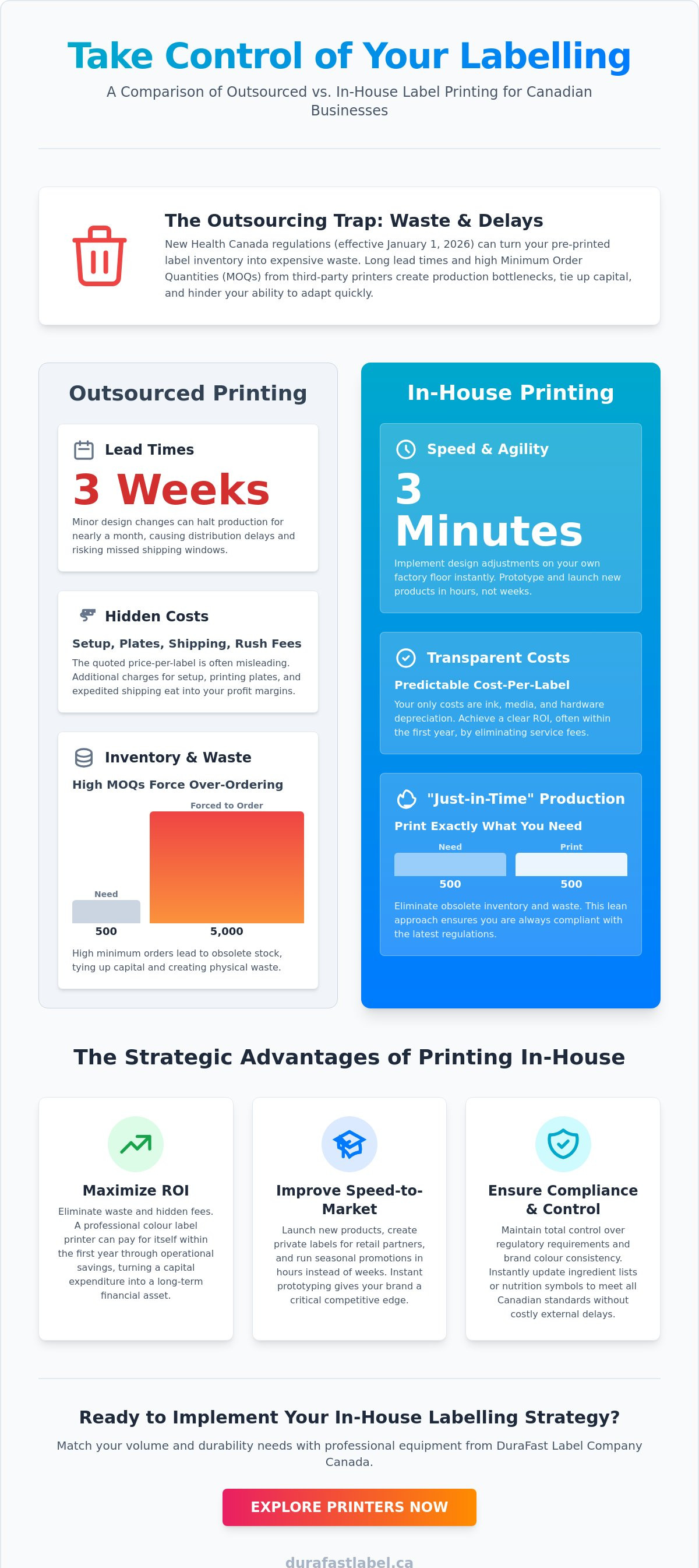
- Learn how to replace three-week external lead times with three-minute in-house adjustments to eliminate production bottlenecks and improve speed-to-market.
- Discover the true benefits of in-house label printing by calculating actual cost-per-label beyond the misleading unit prices often quoted by external print houses.
- Gain the operational agility to launch new products or create custom private labels for retail partners in hours rather than weeks through instant prototyping.
- Ensure total regulatory compliance with Health Canada's 2026 standards while maintaining strict colour consistency across your entire product line without external delays.
- Identify the ideal hardware strategy for your business by matching specific volume and durability requirements to professional equipment from brands like Afinia, VIPColor, or Epson.
Moving Beyond the Limitations of Outsourced Label Printing
Why does a minor text change on your packaging often lead to a three-week production standstill? It's a question many Canadian operations managers ask when they find themselves caught in the "outsourcing trap." When you rely on a third-party print house, your production schedule is essentially at the mercy of their existing queue, machine availability, and shipping logistics. This dependency creates a bottleneck that stifles growth. One of the primary benefits of in-house label printing is the immediate reclamation of your time. Instead of waiting twenty-one days for a shipment to arrive from a distant facility, you can realize design adjustments in less than three minutes on your own factory floor.
Beyond the schedule, the burden of Minimum Order Quantities (MOQs) often forces small-to-medium enterprises to over-order. Print houses require high volumes to offset their own setup costs, which means you might be forced to purchase 5,000 labels when you only need 500. This ties up your capital in physical inventory that may never be used. By taking control of the process, you print exactly what you need, when you need it, ensuring your cash flow remains liquid and your warehouse space stays clear.
The Real Cost of Lead Times
A fourteen-day delay in label delivery isn't just an inconvenience; it's a disruption that can halt national product distribution. If your labels aren't ready, your finished goods can't leave the warehouse. This often leads to "rush fees" that eat into your margins during peak seasons. Investing in a professional label printer acts as an insurance policy against these external failures. When you own the technology, you eliminate the risk of missing a shipping window because of a third-party courier delay or a print house backlog.
Eliminating Obsolete Label Waste
Does your business struggle with "dead inventory" every time a regulation changes? The financial drain of discarding thousands of pre-printed labels is significant, especially with Health Canada's January 1, 2026, front-of-package labelling requirements now in full effect. Many businesses found themselves with pallets of useless stock because their outsourced orders were too large to pivot quickly. Transitioning to colour label printers allows for a "Just-in-Time" inventory model. This lean manufacturing approach means you only produce labels for the batch currently on the line. It's a more sustainable way to work that reduces physical waste and ensures your brand is always compliant with the latest Canadian standards. You'll enjoy the benefits of in-house label printing every time you update an ingredient list or a QR code without throwing money into the recycling bin.
Financial Advantages: Reducing Costs and Maximizing ROI
Is that low unit price on your last invoice actually saving you money? Many Canadian business owners find that the "all-in" cost of outsourcing labels is often obscured by hidden fees. Print houses frequently quote an attractive price-per-unit that doesn't account for setup charges, plate fees, or the shipping costs required to get the product to your door. When you take production into your own hands, these peripheral expenses vanish. One of the most significant benefits of in-house label printing is the ability to achieve a transparent, predictable cost-per-label. By accounting for ink, media, and hardware depreciation, you can accurately forecast your margins without worrying about fluctuating service fees.
The timeline for a return on investment is often shorter than most entrepreneurs realize. A high-quality colour label printer can frequently pay for itself within the first year of operation simply by eliminating the waste of high minimum orders. As your volume grows, you can scale without a linear increase in overhead by utilizing high-speed industrial label printers. These robust machines are designed for longevity and high-output environments, ensuring your fiscal responsibility matches your production ambitions.
Capital Expenditure vs. Operational Savings
While the initial purchase of professional-grade hardware requires a capital investment, the long-term operational savings are substantial. For Canadian entities, there are often tax advantages to owning equipment, such as the Capital Cost Allowance (CCA), which allows you to deduct the depreciation of your hardware over time. Choosing between inkjet and thermal transfer technology depends on your specific needs, but both paths offer a lower total cost of ownership than repeated outsourcing. By adopting lean practices for printing companies, your team can eliminate the financial drain of excess stock and "dead" inventory.
Optimizing the Consumables Ecosystem
Maximizing your ROI also involves managing your consumables effectively. Using high-yield inkjet ink cartridges in bulk can significantly lower the price of every millilitre of ink used. It's equally vital to match the right blank labels to your specific printer model to prevent premature wear on the printhead, which is often the most expensive component to replace. For high-volume barcode production, utilizing thermal transfer ribbons provides a cost-effective solution that maintains crisp, scannable quality without the expense of full-colour ink. If you are unsure which technology fits your budget best, you can reach out for a customized cost analysis to see the numbers for your specific application.
Operational Agility: Speed to Market and Customization
How quickly can your business pivot when a new retail opportunity arises? In the traditional outsourcing model, even a "quick" change typically requires weeks of back-and-forth communication and shipping time. One of the standout benefits of in-house label printing is the ability to launch new products in hours instead of months. By utilizing Memjet technology, found in many professional systems, you can produce photo-quality, vibrant labels at industrial speeds. This capability allows you to prototype a design, print a production run, and have products on shelves before a competitor even receives their first digital proof from a print house. It's about transforming your labelling from a logistical hurdle into a competitive advantage.
Capitalizing on seasonal trends or limited-edition runs becomes a low-risk endeavour when you control the press. If a local festival or a holiday weekend presents a sales opportunity, you can create a dedicated product line without the fear of being left with thousands of unused, dated labels. This on-demand approach ensures your brand stays relevant and responsive to the Canadian market's shifting demands.
Private Labelling as a Growth Strategy
Have you considered the revenue potential of bespoke packaging for corporate clients or boutique retailers? Private labelling is no longer reserved for large-scale manufacturers with massive budgets. With your own equipment, you can create custom-branded versions of your products for specific partners without the risk of over-production. This flexibility lets you test new markets with small-batch runs to see what resonates with consumers. For businesses requiring high versatility for these small-batch projects, you can explore the VIPColor VP550 Memjet Color Label Printer, which is specifically designed to handle diverse designs with minimal setup time. It's a strategic way to expand your reach without the burden of excess inventory.
Dynamic Data and Serialization
Modern distribution requires more than just an attractive design; it requires precision and traceability. Can your current process handle unique QR codes, batch numbers, and expiry dates for every single unit? Printing this dynamic data in a single pass is a core advantage of modern digital systems. By automating data input through professional design software, you significantly reduce the risk of human error that leads to costly product recalls or shipping mistakes. High-performance barcode label printers are essential for this level of sophisticated warehouse management. They ensure that every item is traceable and compliant with Canadian retail standards, allowing your operations to run smoothly as you scale. This level of customization ensures that you aren't just printing labels; you're building a smarter, more responsive supply chain.
Quality Control and Regulatory Compliance Management
How do you ensure every shipment meets the rigorous standards of Canadian retailers and federal inspectors? When you outsource, you're essentially trusting a third party with your legal compliance. One of the most critical benefits of in-house label printing is the absolute control it provides over quality assurance. By integrating barcode verification directly into your production line, you can achieve 100% scan success rates, eliminating the risk of rejected shipments at the distribution centre. This level of oversight extends to colour consistency; you no longer have to worry about slight variations in ink mixing from an external vendor that could dilute your brand's visual identity across different batches.
For businesses in the chemical or manufacturing sectors, meeting GHS and WHMIS standards is a non-negotiable requirement. Producing durable industrial labels on-site allows you to adapt instantly as Health Canada updates its labelling regulations. Whether it's the January 1, 2026, front-of-package nutrition requirements or revised safety data sheets, having the hardware on your floor means you're never more than a few clicks away from total compliance. You don't have to wait for an external printer to update their templates or ship new stock.
Industrial Durability and Compliance
Selecting the right technology is vital for long-term performance. For applications requiring chemical resistance and UV stability, utilizing pigment-based inks is a superior choice over standard dye inks. This is particularly relevant for niche sectors; for instance, horticulture label printers must use specialized weatherproof media to survive outdoor exposure in varied Canadian climates. Similarly, the garment industry relies on textile labels that meet strict wash-test standards. Controlling this process in-house ensures that every label remains legible throughout the product's entire lifecycle, protecting your brand's reputation and consumer safety.
The Power of Professional Label Software
The "brain" behind a successful in-house operation is the design software. While many competitors overlook this integration, professional tools like Loftware and Bartender are essential for simplifying complex regulatory hurdles. These platforms allow you to manage global standards, such as GHS or BS5609, from a centralized digital library. By using template-based workflows, you significantly reduce the risk of mislabelling caused by manual data entry. You can pull information directly from your existing database, ensuring that the data printed is as accurate as your master records. If you're ready to modernize your compliance strategy and eliminate labelling errors, speak with our specialists today to find the right software and hardware combination for your facility.
Implementing Your In-House Labelling Strategy with DuraFast Label Company Canada
How do you move from understanding the theory to executing a high-performance production line? Successfully realizing the benefits of in-house label printing requires more than just purchasing a machine; it demands a diagnostic approach to your specific operational hurdles. You must first identify your primary drivers. Are you prioritizing high-speed logistics, or is the visual shelf-appeal of your prime products the main concern? By matching your hardware to these specific applications, you transform your labelling department from a necessary cost-centre into a value-added asset that drives efficiency. This transition ensures that your packaging is never the reason for a delayed shipment or a missed revenue target.
Choosing the Right Technology
The first step in your strategy involves selecting the print technology that aligns with your environment. For short-term logistics and shipping, direct thermal labels offer a simple, ribbon-free solution that is ideal for high-volume warehouse tasks. However, if your products face harsh conditions or require long-term legibility, thermal transfer systems remain the industry standard. Regarding prime branding, the choice between dye and pigment inkjet systems is critical. Dye inks provide the most vibrant colours for indoor retail, while pigment inks offer the chemical and moisture resistance needed for industrial settings. Looking ahead, many Canadian businesses are already integrating RFID labels into their workflows to automate inventory tracking and reduce manual scanning errors. This forward-thinking approach ensures your facility is ready for the technological demands of the next decade.
Partnering for Long-Term Success
Reliability in your production line depends heavily on the quality of your consumables. Sourcing your Epson or Zebra supplies from a single, knowledgeable Canadian expert matters. Partnering with DuraFast Label Company Canada ensures that your media and ink are perfectly calibrated for your hardware. This prevents unnecessary downtime caused by incompatible materials or premature printhead failure. A reliable partner doesn't just sell you a printer; they provide the technical context required to maintain peak performance during your busiest production cycles. Specialized industries often require unique solutions, such as high-tack tire labels designed to adhere to rough, oily surfaces in automotive warehouses. Having access to this niche media through an expert guide allows you to solve logistical challenges before they disrupt your distribution.
If you're ready to modernize your operation and take full control of your production, contact our labelling experts today for a professional consultation tailored to your business goals. Taking this step allows you to enjoy the long-term benefits of in-house label printing while securing your supply chain against future disruptions with the support of DuraFast Label Company Canada.
Securing Your Production Future in the Canadian Market
Is your business ready to stop reacting to external supply chain disruptions and start leading your market? Transitioning your labelling process to a self-managed model isn't just about immediate savings; it's about building a resilient operation that can pivot the moment a new retail opportunity or regulatory requirement emerges. By removing the friction of third-party dependencies, you reclaim your most valuable resources: time and operational focus. The long-term benefits of in-house label printing extend far beyond the printer itself, influencing your warehouse efficiency and your brand's reputation for precision.
As an authorized dealer for industry leaders like Epson, Afinia, and VIPColor, we provide the hardware and expert technical support you need to maintain peak performance. Our comprehensive Canadian inventory of labels and ink ensures your facility remains fully operational without the stress of international shipping delays. It's time to transform your production into a strategic asset. Request a Custom Quote and ROI Analysis from DuraFast Label Company Canada to discover how we can help you take full control of your packaging future. We're here to ensure your transition is seamless, professional, and profitable.
Frequently Asked Questions
How much can I actually save by printing labels in-house?
You can achieve significant savings by eliminating the high minimum order quantities and setup fees associated with outsourced printing. Instead of paying for 5,000 labels when you only need 500, you pay only for what you use. This shift reduces waste from obsolete stock, especially when regulations change. Most businesses find their cost-per-label drops because they aren't subsidizing the print house's overhead or paying for shipping on every batch.
Is it difficult to learn how to operate a digital label printer?
Operating a modern digital label printer is remarkably similar to using a standard office inkjet or laser printer. Most systems feature intuitive interfaces and straightforward media loading processes. While industrial presses require more setup, desktop units from brands like Afinia or Primera are designed for ease of use. With a brief orientation, your existing team can manage production, allowing you to realize the benefits of in-house label printing without hiring specialized technicians.
What is the difference between direct thermal and thermal transfer printing for business?
Direct thermal printing uses heat-sensitive media and no ink or ribbon, making it ideal for short-term applications like shipping labels. Thermal transfer printing uses a heated ribbon to melt a durable image onto the label, providing superior resistance to heat, chemicals, and abrasion. If your products face harsh Canadian winters or long shelf lives, thermal transfer is the more reliable choice for maintaining barcode legibility and compliance.
Can in-house printers produce the same quality as professional print shops?
Modern in-house printers offer photo-quality resolution that rivals traditional print shops, often reaching up to 1600 dpi. Technologies like Memjet allow for vibrant, full-colour graphics and crisp text on various media types. This ensures your prime product labels maintain a high-end look that builds consumer trust. You gain the advantage of professional aesthetics while maintaining total control over colour consistency across every production run you manage.
What kind of maintenance do industrial label printers require?
Industrial label printers require simple, routine maintenance to ensure longevity and print quality. This primarily involves cleaning the printheads and sensors with isopropyl alcohol to remove dust and adhesive buildup. You'll also need to monitor wear on rollers and replace printheads periodically based on your usage volume. Following a consistent cleaning schedule prevents most common production delays and ensures your hardware continues to perform at its peak technical specifications.
Do I need special software to design and print my own barcodes?
Using professional design software like Bartender or Loftware NiceLabel is essential for generating compliant, high-quality barcodes. These platforms automate the creation of various barcode types, such as UPC or QR codes, while pulling data directly from your spreadsheets. This integration reduces the risk of manual entry errors that lead to shipping rejections. These tools also include templates for regulatory standards, ensuring your packaging always meets the latest Canadian retail and safety requirements.
How do I choose between an inkjet and a thermal label printer?
Your choice depends on whether you prioritize vibrant branding or industrial durability. Inkjet printers are the preferred choice for high-end, full-colour product labels that require photo-quality graphics. Thermal printers are better suited for high-speed logistics, black-and-white barcodes, and environments where labels must withstand extreme temperatures or chemicals. Assessing your primary application, whether it's shelf appeal or supply chain tracking, will lead you to the most efficient hardware solution.
Are in-house labels durable enough for outdoor or chemical use?
In-house labels are exceptionally durable when you pair the right technology with specialized media. By using pigment-based inkjet printers or thermal transfer systems with synthetic materials like polyester or polypropylene, you can create labels that resist UV exposure, moisture, and harsh chemicals. This is particularly important for Canadian businesses in the horticulture or industrial manufacturing sectors. These labels are designed to remain legible and adhered even in demanding outdoor or laboratory environments.