Guide to White Resin Ribbons for Durable Industrial Labels
11th Jul 2026
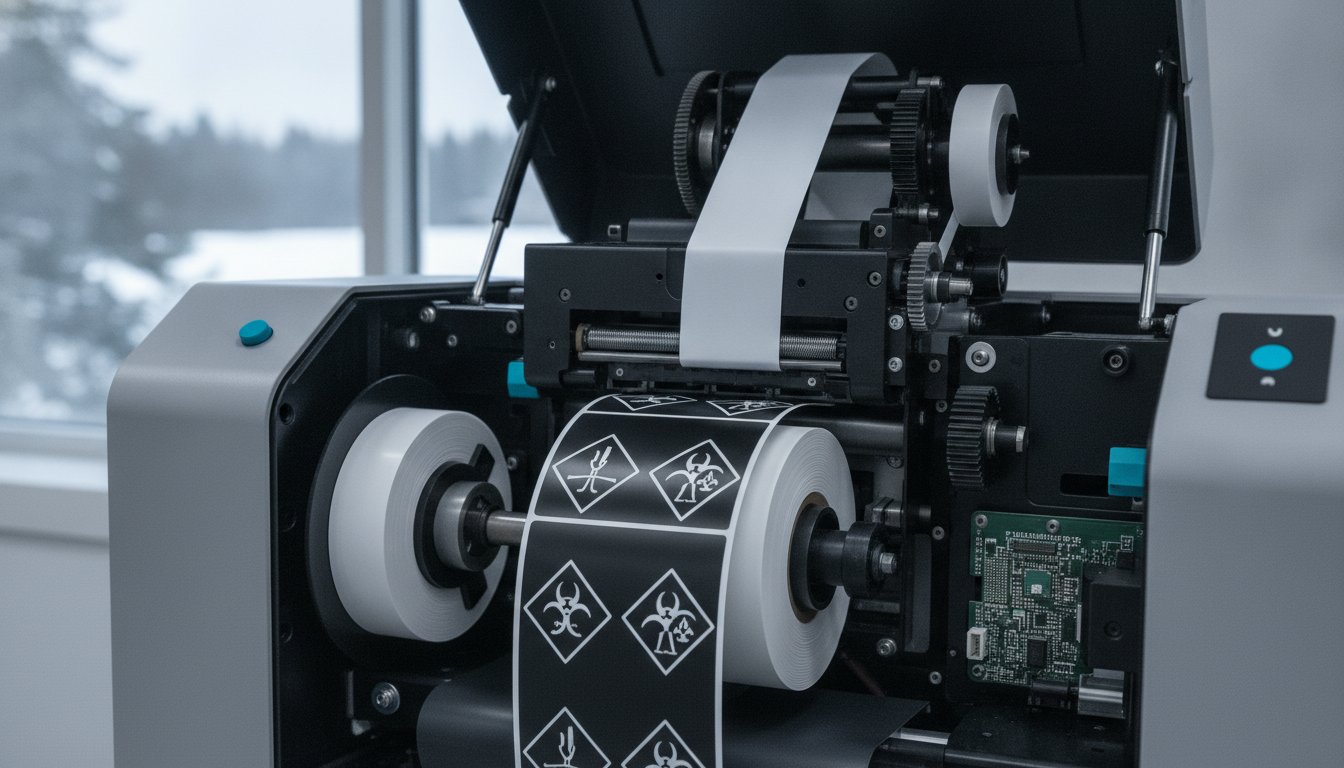
Your most durable industrial labels are essentially invisible if the data on them fades the moment it encounters a harsh solvent or a week of Canadian winter. Have you ever struggled with white text that looks translucent or smudges off your black polyester labels during routine handling? It's a common hurdle for businesses trying to maintain professional branding and safety compliance on dark substrates. Investing in a high-quality white resin ribbon is the direct solution to these opacity and durability challenges.
We understand that achieving a crisp, high-contrast finish requires more than just the right ink; it requires a strategic match between your ribbon formulation and your specific synthetic materials. You'll discover how to select and optimize white resin ribbons for high-contrast, industrial-grade labelling that withstands Canada’s harshest environments. We'll walk through the process of ensuring seamless integration with your existing Zebra or Toshiba printers while maintaining maximum chemical and UV resistance. This structured approach helps you take control of your production marking to achieve better, more reliable results.
Key Takeaways
- Learn why pure resin formulations are the industry standard for high-contrast printing on dark synthetic materials to prevent smudging and data loss.
- Discover how to select the correct white resin ribbon for GHS and WHMIS compliance, ensuring labels remain legible during chemical exposure or saltwater immersion.
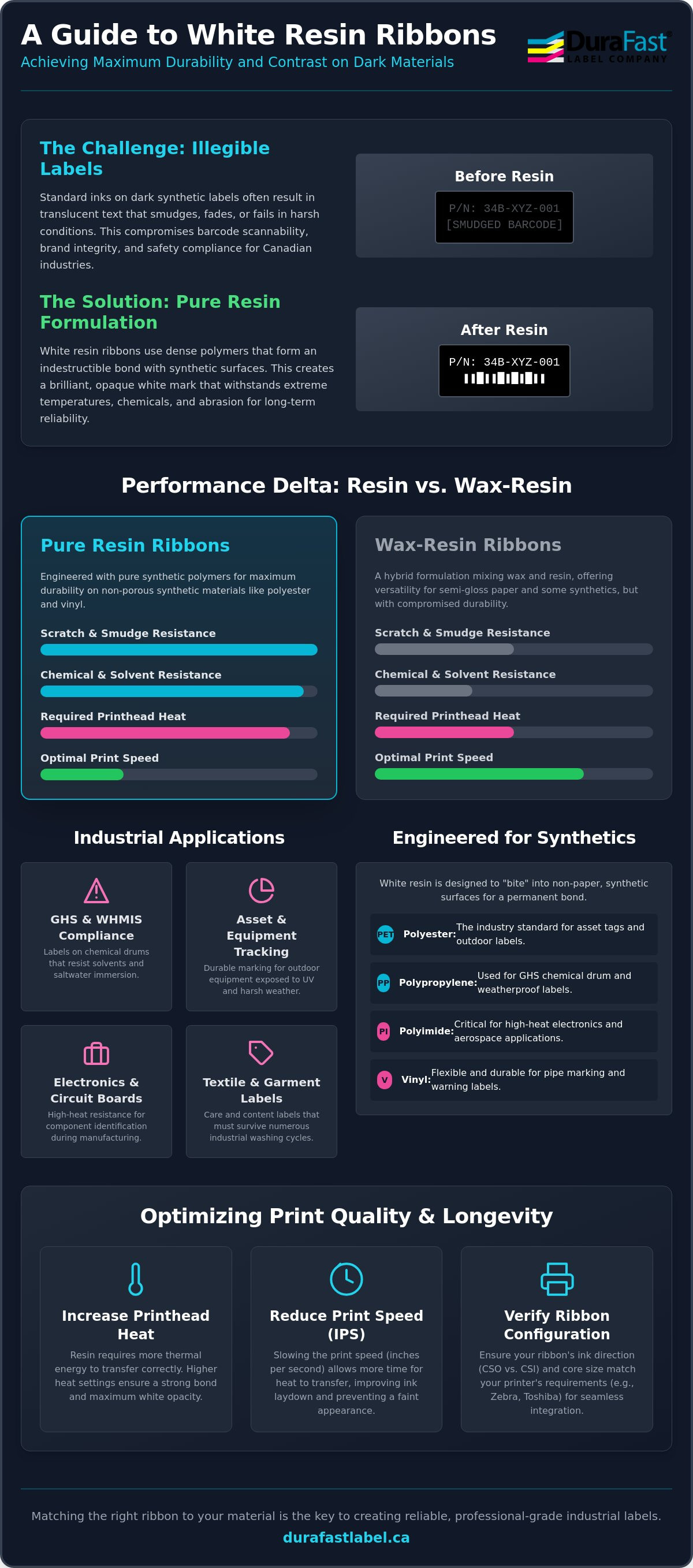
- Understand the performance delta between resin and wax-resin types to determine the specific level of heat and chemical resistance your application requires.
- Identify necessary printer configurations, including CSO versus CSI ink directions and core sizes, to ensure seamless integration with Zebra or Toshiba hardware.
- Gain practical insights on adjusting printhead heat and ips settings to maximize white opacity while protecting the longevity of your thermal printhead.
Understanding White Resin Ribbon: When Durability Meets High Contrast
A white resin ribbon is a premium thermal transfer consumable engineered for environments where standard wax or wax-resin inks fail. Unlike wax, which melts at lower temperatures, resin formulations consist of complex polymers that create a nearly indestructible bond with synthetic materials. This durability is essential for Canadian manufacturers operating in sectors ranging from automotive assembly to outdoor horticulture. Thermal-transfer printing allows for this precise application of spot colours like white, providing a level of legibility that is impossible to achieve with direct thermal technology. It acts as a specialized tool for any business that needs its identification to remain intact for years, not just days.
Why does resin require higher printhead heat settings? The chemical structure of resin is significantly denser than wax; it needs more energy to transition from a solid state on the ribbon to a permanent mark on the label. While this requires a slightly slower print speed, usually measured in ips, the result is a label that resists smearing and chemical abrasion. For Canadian businesses, this performance is a non-negotiable requirement for equipment that spends winters outdoors or in industrial facilities where grease and harsh cleaners are present. It's the difference between a label that stays legible and one that becomes a liability.
The Role of Opacity in Industrial Labelling
Opacity is the primary differentiator between a professional-grade mark and a failed scan. A high-quality white resin ribbon provides a true white finish that remains opaque even when applied to jet-black polyester or transparent films. If the ink is too thin, the dark background bleeds through, which significantly reduces the contrast ratio required for barcode scanners to function correctly. Achieving this high contrast ensures that your prime product labels maintain a premium appearance while remaining functional throughout the supply chain. It's about maintaining both brand integrity and operational efficiency.
Common Substrates for White Resin Applications
Selecting the right ribbon is only half the battle; it must also be compatible with your substrate. White resin is specifically designed for non-paper materials like Polypropylene (PP) and Polyester (PET). These materials are often used for GHS and WHMIS compliant labels on chemical drums because they don't tear or degrade when wet. The following substrates rely on resin for maximum adhesion:
- Vinyl and Polyimide: These are ideal for electronics and circuit boards where heat resistance is critical.
- Polyester: This is the standard for asset tracking and outdoor equipment marking.
- Textiles: Resin is often the only viable choice for textile labels that must survive industrial washing processes.
The main difference between resin and other formulations is its ability to "bite" into these smooth surfaces. This creates a permanent identification solution that won't flake off under physical stress or environmental debris. By matching the ribbon to the substrate, you ensure a seamless production flow and long-term label reliability.
Resin vs. Wax-Resin: Analyzing the Performance Delta for White Ink
The main difference between a white resin ribbon and its wax-resin counterpart is the ratio of synthetic polymers to petroleum-based wax. While wax-resin acts as a versatile hybrid for semi-gloss labels, a pure resin ribbon is engineered for maximum adhesion on non-porous synthetics. This "performance delta" isn't just about price; it's about the physical bond created during the thermal transfer process. For businesses using dark polyester or vinyl substrates, choosing the correct formulation determines whether your data survives the first week of handling or remains legible for years.
Smudge and scratch resistance are the primary areas where full resin excels. While wax-resin offers a baseline level of protection, it can still be compromised by heavy abrasion or contact with solvents. Pure resin ribbons are essentially immune to these stresses once cured. This makes the premium cost of resin a strategic investment for applications where label failure is not an option. If your labels are subject to friction during shipping or constant handling in a warehouse, the durability of resin prevents the need for costly reprints and relabelling efforts.
Chemical and Environmental Resistance
Resin provides superior protection against alcohols, oils, and aggressive industrial cleaners that would quickly dissolve a wax-based ink. This level of performance is a necessity for maintaining GHS labeling requirements on chemical containers and hazardous materials. Beyond chemical exposure, Canadian businesses must account for UV stability. White resin formulations are specifically designed to resist yellowing or flaking under the intense summer sun. Whether your labels are in cryogenic storage or a high-heat manufacturing bay, resin maintains its "true white" opacity across extreme temperature fluctuations.
Print Speed and Efficiency Trade-offs
Efficiency in a production environment often comes down to ips (inches per second). The only difference that might favour wax-resin in high-volume settings is its ability to print at higher speeds. Because wax-resin melts at a lower temperature, it can often reach speeds of 10 to 12 ips. Other than this speed advantage, a white resin ribbon is superior in every durability metric. It typically requires a slower speed, usually between 4 and 6 ips, to ensure a complete and opaque transfer. This slower pace is a calculated trade-off for durability. Using excessive heat to force resin at high speeds can lead to premature printhead wear and increased maintenance costs. If you need help determining the optimal heat settings for your specific hardware, contact our experts to discuss a tailored solution for your printer model.
Industrial Applications: From GHS Compliance to Horticulture
Identifying hazardous materials on dark industrial drums requires a specific level of contrast and chemical resistance. A white resin ribbon is the standard for producing high-opacity text on black or dark blue synthetic substrates. This ensures that safety warnings remain legible even after exposure to corrosive contents. Compliance with OSHA's Hazard Communication Standard requires that labels remain intact and readable throughout their service life. For Canadian facilities, using GHS and WHMIS compliant labels with resin ink is the most reliable way to meet these legal obligations.
Automotive and logistics sectors present unique physical challenges. Under-the-hood components are subject to extreme heat and oily residues. Resin ink bonds permanently to polyimide or heat-stabilized polyester to prevent data loss during engine operation. In logistics, tire labelling requires an ink that won't flake off when the label flexes on rough rubber surfaces. The only difference between a standard shipping label and an industrial tire label is the aggressive adhesive and the durability of the ink. Other than this, the printing process remains similar, provided you use the correct resin formulation. High-contrast white resin is also the preferred choice for asset tracking on silver polyester labels used in high-end electronics.
Horticulture and Outdoor Nursery Labelling
Why is white resin preferred for horticulture tags and pot stakes? Garden centres face a mix of irrigation moisture, fertilizer chemicals, and intense UV exposure. Standard inks often fade or smudge, rendering barcodes useless by the end of a single season. A white resin ribbon maintains barcode integrity through multiple Canadian weather cycles, from humid summers to freezing winters. It prevents the "ghosting" effect often seen with lower-quality inks exposed to sunlight. This reliability allows for accurate inventory management from the nursery to the retail checkout without the need for manual data entry.
Electrical and Electronics Identification
Electronics manufacturing involves intense heat during soldering and reflow processes. Circuit board labelling requires high-temperature resin that won't melt or discolour when exposed to these conditions. This performance is also critical for cable wrapping and wire marking, where long-term identification is a safety requirement for maintenance crews. Many of these applications must meet UL and CSA certification standards for durable industrial labels. Using a brand-specific resin ensures that your tracking system remains compliant with these stringent safety benchmarks while maintaining professional legibility on small-scale components.
Selecting the Right Configuration for Your Thermal Transfer Printer
Have you ever loaded a new roll of white resin ribbon only to find that your printer won't produce a single character? This frustration usually stems from a configuration mismatch between the ribbon and the printer's mechanical requirements. Selecting the correct ribbon involves more than just picking a colour; you must verify the ink direction, the core size, and the physical width to ensure operational seamlessness. While industrial printers from Zebra and Toshiba are designed for high-performance output, they require specific consumable configurations to maintain their warranty and print quality. We're here to help you identify these technical deltas before they disrupt your production flow.
Understanding CSO vs. CSI Configurations
The main difference between Coated Side Out (CSO) and Coated Side In (CSI) ribbons is the physical location of the ink layer on the polyester film. Most Zebra, Honeywell, and Intermec printers are engineered to use CSO ribbons, where the ink faces away from the core. Conversely, Datamax and some SATO models often require CSI configurations. If you're unsure which version you have, you can perform a simple "tape test" to realize which side holds the ink. Simply press a piece of adhesive tape against the outer surface of the roll; if the ink transfers to the tape, you have a CSO ribbon. Using the wrong ink direction won't just result in blank labels; it can cause the resin to melt directly onto your printhead, leading to expensive repairs and downtime.
Sizing Your Ribbon for Optimal Protection
Why should your ribbon always be slightly wider than your label liner? It's a common misconception that matching the ribbon width exactly to your blank labels is more efficient. In reality, the ribbon acts as a lubricant and a protective barrier for the thermal printhead. If the label liner is wider than the ribbon, the abrasive edges of the paper or synthetic material will grind directly against the printhead. This leads to "printhead burn" and permanent pixel failure. For a standard 4-inch label, a 110mm width is the industry-standard choice in Canada to ensure full coverage.
Other than the width, you must also match the core size to your printer's spindle. The only difference between desktop and industrial core requirements is the internal diameter of the spindle; this dictates the total ribbon length you can load at once. Desktop models typically utilize a 0.5-inch core, while industrial models like those from Godex require a 1-inch core to accommodate larger 450m rolls. These larger rolls are essential when printing at a high ips to maintain production momentum in busy warehouses. If you're ready to optimize your setup, contact our team for a compatibility audit of your current hardware and label stock.
Optimizing Your Print Quality and Ribbon Longevity
Selecting a high-quality white resin ribbon is only the first step in achieving industrial-grade results. To ensure your labels maintain maximum opacity and durability, you must calibrate your printer settings to account for the unique properties of white pigment. The main difference between calibrating for white versus black ink is the required thermal energy; white resin often necessitates a slower print speed, typically between 2 and 4 ips, to allow the ink to transfer fully onto dark synthetic surfaces. If you attempt to print at higher speeds, you'll likely encounter ink flaking or inconsistent coverage that compromises barcode scannability.
Routine maintenance is another critical factor in protecting your investment. White thermal transfer ink can leave behind a slightly more abrasive residue than standard black wax. Cleaning your printhead every time you replace a ribbon is a simple yet effective way to prevent buildup that leads to dead pixels or streaking. Troubleshooting issues like ribbon wrinkle often comes down to mechanical tension. If you see diagonal lines across your print, it's usually an indication that the ribbon supply spindle is too loose or the printhead pressure is unevenly distributed. These small adjustments prevent downtime and ensure your labels remain legible in the field.
Calibrating Heat and Pressure
Why does white resin often require a higher than standard heat setting? The density of the white pigment necessitates more energy to reach its melting point compared to traditional black resin. You'll need to increase your darkness settings in the printer driver until the text appears solid and opaque. However, you must balance this heat with the longevity of your thermal printheads. Excessive heat can cause premature wear or even burn through the ribbon film. Fine-tuning the mechanical pressure on the printhead assembly also helps ensure even ink distribution, especially on textured or heavy-duty synthetics like polyimide or vinyl.
Storage and Handling Best Practices
Maintaining ribbon integrity in varying Canadian humidity levels is essential for consistent performance. If your warehouse experiences significant temperature fluctuations between seasons, your ribbons can become brittle or lose their adhesive properties. It's best to store your white resin ribbon rolls in a climate-controlled area, away from direct sunlight and environmental debris. Dust is the enemy of high-resolution printing. Even a small amount of airborne particulate can create artifacts on your labels, leading to failed inspections or unreadable safety data. Keeping your rolls in their original packaging until the moment of use is a practical way to ensure a clean, professional result every time you hit print.
Future-Proof Your Industrial Labelling Operations
Successfully implementing a white resin ribbon into your production workflow is about more than just aesthetics; it's a strategic move toward operational reliability. You've learned that the key to durability lies in matching the resin formulation to your specific synthetic substrate and precisely calibrating your printer's heat settings. Whether you're managing GHS compliance for chemical drums or tracking assets across a global supply chain, high-contrast legibility is the foundation of a safe and efficient workplace. We're here to help you navigate these technical requirements with confidence.
DuraFast Label Company Canada is an authorized reseller for top brands like Zebra, Toshiba, and Honeywell. We provide expert Canadian support for all thermal transfer applications and offer fast national shipping on high-durability consumables to keep your business moving. Don't let poor opacity or ribbon-printer incompatibility slow you down. Browse our full selection of White Resin Ribbons at DuraFast Label Company Canada and take control of your marking process today. We look forward to helping you achieve a high-performance finish that lasts through even the harshest environments.
Frequently Asked Questions
Can I use white resin ribbon on standard paper labels?
No, white resin ribbon is not compatible with standard uncoated paper labels. Resin requires a smooth, synthetic surface like polyester or polypropylene to create a permanent bond. If you attempt to print on paper, the ink won't adhere properly and will likely flake off or smudge under minimal contact. For paper substrates, a wax or wax-resin formulation is the appropriate choice.
Why does my white resin print look grey or translucent on black labels?
This usually happens because the printhead heat is too low or the print speed is too high. A white resin ribbon requires significant thermal energy to achieve maximum opacity on dark substrates. If the settings aren't optimized, the black background bleeds through the ink. You should increase the darkness setting in your driver and reduce the ips to ensure a crisp, opaque finish.
What is the difference between white resin and white wax-resin ribbons?
The main difference is the level of durability and chemical resistance. Full resin ribbons are engineered for extreme environments and harsh chemicals; wax-resin is a hybrid designed for general-purpose synthetic labelling. While wax-resin is more cost-effective, it doesn't offer the same smudge or solvent resistance as a dedicated resin. Other than this, resin requires higher printhead temperatures to transfer correctly.
How do I know if my printer needs "Ink In" or "Ink Out" white ribbon?
You can determine the required configuration by checking your printer's manual or performing a "tape test" on your current ribbon. Most Zebra and Honeywell models use Ink Out (CSO), where the ink faces away from the core. Datamax and some SATO printers often require Ink In (CSI). Loading the wrong configuration will result in no ink transfer and can potentially damage your printhead assembly.
Does white resin ribbon require a special thermal transfer printer?
No, it doesn't require a unique printer model, but it does require a thermal transfer capable machine. You can't use resin ribbons with direct thermal printers as they lack the ribbon spindles and heat settings needed for transfer. Ensure your printer can reach the higher temperatures necessary to melt resin polymers onto synthetic stock without causing the ribbon film to snap.
Is white resin ribbon resistant to outdoor UV exposure in Canada?
Yes, white resin is specifically formulated to withstand intense UV exposure and extreme Canadian weather cycles. Unlike wax-based inks that can fade or yellow over time, resin maintains its "true white" colour and structural integrity over multiple seasons. This reliability makes it the ideal choice for horticulture tags, outdoor asset tracking, and heavy equipment identification in variable climates.
What is the best way to clean my printhead after using resin ribbons?
The only difference between cleaning for resin versus wax is the frequency required to prevent buildup. You should clean the printhead using a lint-free cloth moistened with 99% isopropyl alcohol every time you change a ribbon roll. Resin ink can leave behind a harder residue than wax, which can lead to "dead" pixels if left unaddressed. Consistent cleaning protects your hardware and ensures consistent quality.
Can white resin ribbon be used for GHS/WHMIS chemical labelling?
Yes, white resin ribbon is the industry standard for GHS and WHMIS compliant labelling on dark chemical containers. It provides the necessary resistance to solvents, oils, and marine conditions required by international safety regulations. When paired with the correct synthetic label material, it ensures that critical safety data remains legible throughout the product's service life, even in the harshest industrial environments.