Epson C6500 vs Neuralabel Callisto: Speed Comparison Guide
22nd Jun 2026
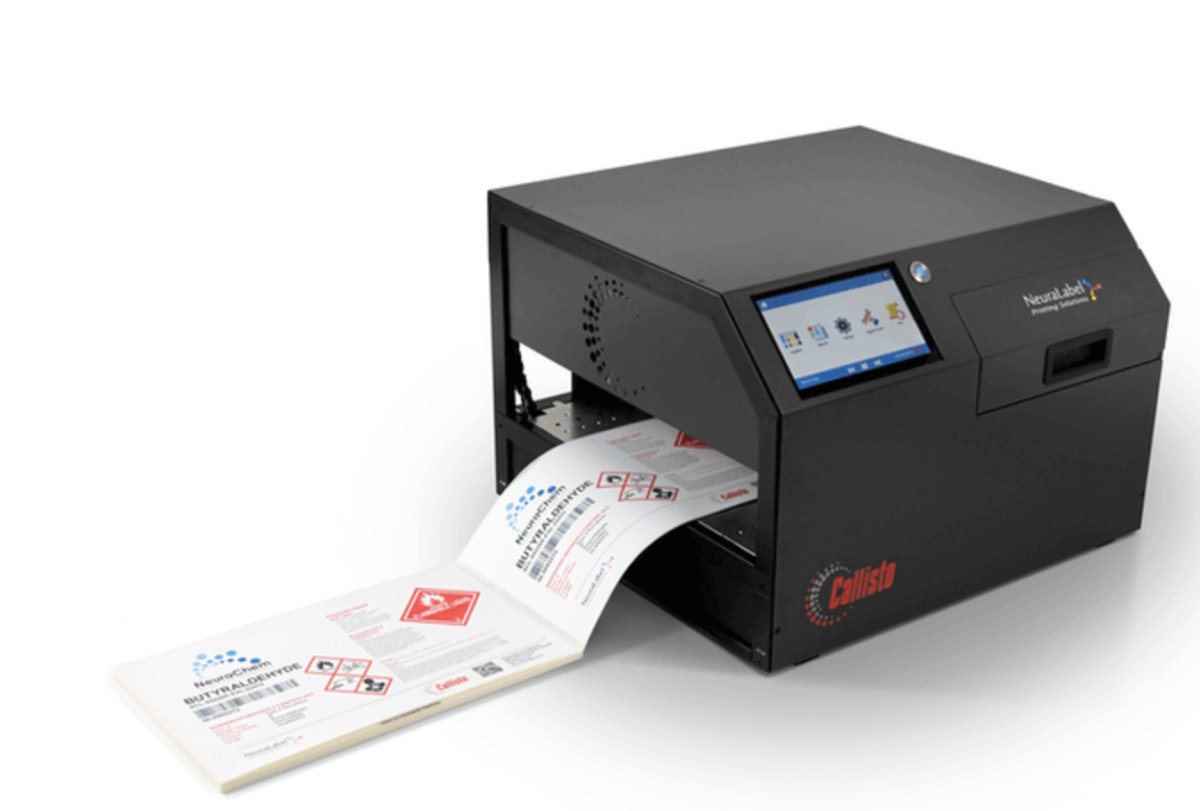
Table of Contents
-
Understanding the Speed Gap: Epson C6500 vs. NeuraLabel Callisto
-
Choosing Your Production Partner: Volume Dictates the Winner
Understanding the Speed Gap: Epson C6500 vs. NeuraLabel Callisto
When comparing the Epson C6500 and the NeuraLabel Callisto , the question "Which printer is faster?" seems straightforward, but the answer reveals a fundamental difference in printing technology. The speed gap isn't just a matter of a few inches per second; it's a chasm created by two entirely different engineering philosophies. The core of this difference lies in their printhead architecture: the Epson C6500 uses a traditional serial (moving) printhead, while the NeuraLabel Callisto is powered by a stationary HP PageWide printhead.
-
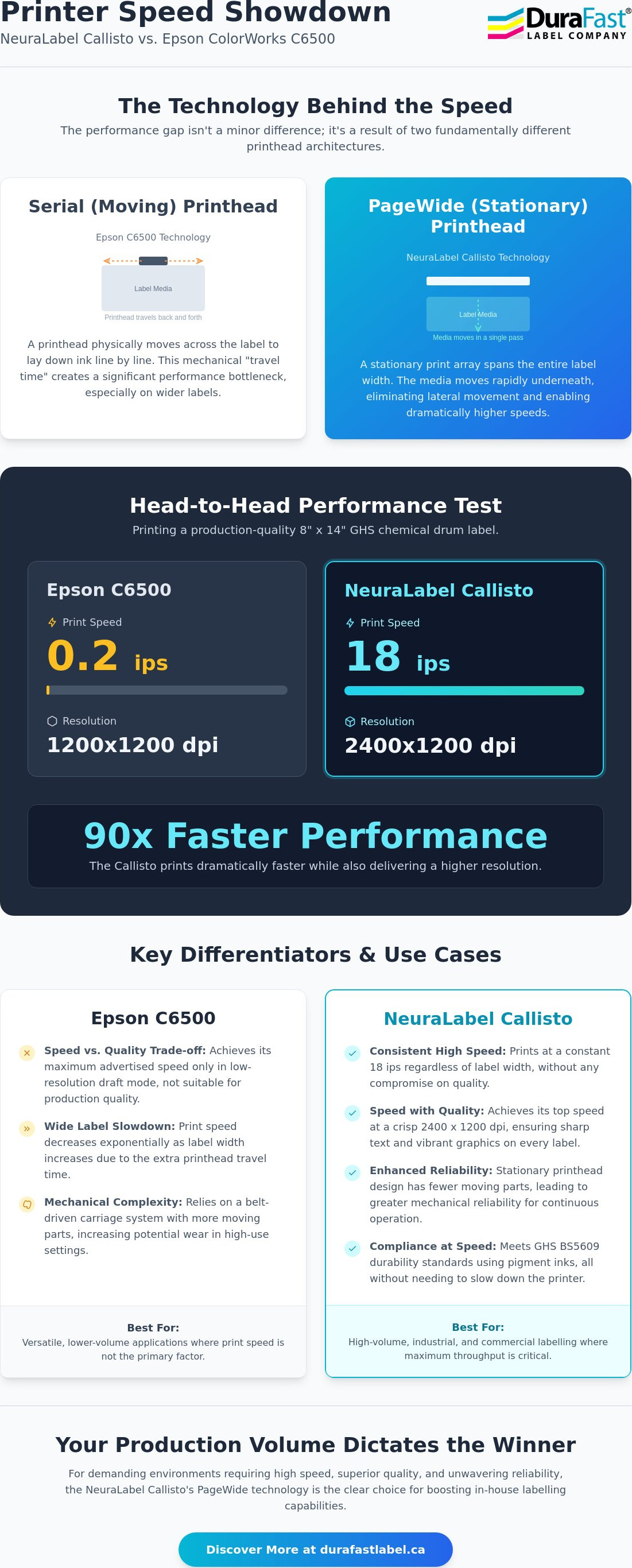
The Serial Printhead (Epson C6500): This technology features a printhead that physically moves back and forth across the width of the label media, laying down ink line by line. This mechanical "travel time" is a significant bottleneck, especially on wider labels.
-
The PageWide Printhead (NeuraLabel Callisto): This is a stationary print array that spans the entire width of the label. The media moves rapidly underneath it in a single pass, with no lateral printhead movement. This design eliminates travel time, enabling dramatically higher speeds.
This architectural distinction is why simply comparing the top-line "inches per second" (ips) can be misleading. The advertised speed of the Epson C6500 is often based on "draft mode" settings at low resolutions. As you will see, for high-quality, production-ready labels, the real-world speed difference is far greater than the spec sheets suggest. The Callisto is a high-speed commercial press designed for volume, while the Epson is a versatile, but mechanically limited, desktop unit.
The Serial Printhead Limitation of the Epson C6500
The Epson C6500's speed is dictated by its carriage mechanism. The printhead is mounted on a belt-driven assembly that must accelerate, print a line, decelerate, and repeat the process in the opposite direction. This constant back-and-forth motion is inherently time-consuming and inefficient, particularly as the label width increases.

-
Exponential Slowdown on Wide Labels: The wider the label, the farther the printhead must travel for each pass. For an 8-inch wide label, this travel time is substantial. A real-world example illustrates this perfectly: when printing a large 8" x 14" GHS chemical drum label at a production-quality resolution of 1200x1200 dpi, the Epson C6500 slows to a crawl, printing at just 0.2 inches per second.
-
The Quality vs. Speed Trade-off: To achieve its maximum advertised speed of 5 ips, the C6500 must operate in a low-resolution draft mode (e.g., 300x600 dpi). However, most businesses purchase a colour label printer for crisp text and vibrant graphics, which requires 1200 dpi. At this resolution, the printer is, by necessity, a very slow machine due to its serial technology.
-
Bidirectional vs. Unidirectional Printing: While bidirectional printing (printing in both left-to-right and right-to-left passes) is faster, it can sometimes lead to minor alignment issues. For the highest precision, users may switch to unidirectional mode, which further halves the already slow print speed.
The Stationary Power of HP PageWide Technology
The NeuraLabel Callisto sidesteps the mechanical limitations of a serial printhead entirely by using HP PageWide technology. This system employs a fixed printhead array with over 200,000 nozzles that spans the full potential width of the media. The only major moving part during printing is the media itself, which is fed under the stationary head.
-
Consistent Speed, Regardless of Label Width: Because the printhead doesn't move side-to-side, the Callisto prints an 8-inch wide label just as fast as a 2-inch wide label. It maintains its remarkable speed of 18 inches per second consistently.
-
Speed Without Quality Compromise: The same 8" x 14" GHS label that slows the Epson to 0.2 ips is printed on the Callisto at 18 ips—a 90x speed increase. Critically, this speed is achieved at a higher resolution of 2400 x 1200 dpi, resulting in sharper text and more detailed graphics. The label doesn't just print; it flies out of the printer, ready for application.
-
Enhanced Reliability: By eliminating the high-wear carriage and belt system of a serial printer, the PageWide design significantly reduces the number of moving parts. This leads to greater mechanical reliability and less downtime, especially in high-volume production environments.
NeuraLabel Callisto: Engineering Maximum Velocity
The NeuraLabel Callisto is purpose-built for one primary goal: maximum throughput without compromising quality. Its top speed of 18 ips, which translates to an impressive 90 feet per minute, is a direct result of its sophisticated PageWide architecture. This isn't just raw speed; it's intelligent, high-resolution performance designed for the demands of industrial and commercial labelling.
-
High-Speed, High-Resolution Output: The Callisto consistently delivers its 18 ips speed at a crisp 2400 x 1200 dpi. This means businesses no longer face the difficult choice between printing quickly and printing beautifully. You get both, every time.
-
Durable Pigment Inks: To support this velocity, the Callisto uses advanced pigment inks. These inks are engineered to dry instantly upon contact with the label media, preventing smudging or smearing even as labels exit the printer at 90 feet per minute. This rapid curing is essential for maintaining GHS BS5609 durability.
-
Massive Throughput Potential: With a media width capacity of up to 12 inches on certain models, the Callisto is a production powerhouse. The combination of high speed and wide format allows businesses to produce tens of thousands of labels in a single shift, fundamentally changing in-house labelling capabilities.
High-Volume Production and GHS Compliance
For Canadian businesses in the chemical, pharmaceutical, or industrial sectors, speed cannot come at the expense of compliance. The NeuraLabel Callisto excels in this area, providing a solution that is both incredibly fast and fully compliant with stringent standards like GHS BS5609 for chemical labelling.
-
BS5609 Durability at Full Speed: The Callisto’s pigment ink formulation, when paired with certified media, meets the rigorous demands of BS5609 for abrasion, saltwater immersion, and UV resistance. This compliance is achieved without needing to slow the printer down, ensuring production deadlines are met.
-
Optimized for Continuous Runs: The printer is designed for non-stop operation. With optional roll-to-roll and fan-fold ("Z-fold") media handling, you can run large batches of durable industrial labels for hours without interruption, maximizing operator efficiency.
Advanced Ink Management for Long Runs
A fast printer is only effective if it isn't constantly stopped for maintenance. The Callisto's design prioritizes uptime with an ink system built for long, unattended print jobs.
-
Large-Capacity Ink Tanks: The Callisto utilizes large, individual 250ml ink tanks. This generous capacity minimizes the frequency of cartridge swaps, reducing downtime and labour costs compared to the smaller cartridges found in desktop models.
-
Versatile Ink Formulations: NeuraLabel offers both pigment and water-enhanced dye ink options, allowing businesses to choose the best formulation for their specific application, from ultra-durable chemical labels to vibrant prime product labels for the Canadian retail market.
-
Fueling the Engine: High-performance NeuraLabel ink cartridge s are the lifeblood of this system, ensuring consistent colour and durability from the first label of a large batch to the last.
Epson ColorWorks C6500: Precision and Versatility
The Epson ColorWorks C6500 is a highly capable and versatile printer, but its strengths lie in areas other than raw speed. Positioned as a "Swiss Army Knife" for labelling, it offers a range of features that make it ideal for specialized, lower-volume applications where throughput is not the primary concern.
-
Advertised vs. Realistic Speed: The C6500's maximum stated speed is 5 ips. However, it is crucial to understand this is achieved only in a low-quality "draft" mode at 300x600 dpi. For the crisp, professional look that requires "Quality" or "Max Quality" modes (1200x1200 dpi), the real-world speed drops precipitously, especially on wide labels.
-
The Integrated Peeler Advantage: The C6500P model comes with a built-in automatic label peeler. This feature, which the Callisto lacks, is invaluable for "print-and-apply" workflows where an operator takes a single, peeled label and applies it to a product immediately.
-
A Tool for Variety, Not Volume: The Epson C6500 excels when a business needs to print a wide variety of label sizes and types in small batches. Its flexibility, precision colour matching, and robust feature set make it a reliable workhorse for on-demand tasks.
When the Epson C6500 is the Right Choice
Despite its speed limitations in high-volume scenarios, there are many situations where the C6500 is the superior choice for a Canadian business.
-
Print-and-Apply Automation: In a semi-automated packaging line, the speed of the operator, not the printer, is often the bottleneck. The C6500P's peeler presents a perfectly peeled label, ready for application, which can streamline the workflow more effectively than a faster printer producing a roll of labels.
-
Seamless Workflow Integration: With native ZPL II (Zebra Programming Language) support, the C6500 can be a drop-in replacement for legacy thermal transfer printers, allowing businesses to upgrade to full-colour labelling without overhauling their existing software or ERP systems.
-
Consistent Colour and Reliability: Epson is renowned for its colour accuracy and the reliability of its printheads and Epson ink cartridges . For brand-sensitive applications where precise colour matching is paramount on every small run, the C6500 delivers exceptional consistency.
The Quality vs. Speed Trade-off
For any business considering the Epson C6500, it is essential to have a realistic understanding of the trade-off between print quality and speed. The physics of its serial printhead technology impose unavoidable limitations.
-
A Reality Check on 1200 DPI: Achieving 1200 dpi resolution on the Epson C6500 for a wide label will result in a print speed significantly slower than the Callisto—in some cases, as low as 0.2 ips. This can become a major production bottleneck if label demand exceeds a few hundred per day.
-
Brand Standards vs. Draft Mode: While the 5 ips "draft" mode is fast, the output may not be suitable for customer-facing product labels. The lower resolution can result in pixelated images and less-than-crisp text, which may not meet retail brand standards.
-
Environmental Considerations: The moving parts of a serial printhead can be more susceptible to issues in dusty environments, such as a warehouse or manufacturing facility. Debris can potentially interfere with the carriage mechanism over time, requiring more frequent maintenance.
Performance Comparison: Real-World Throughput
Let's move beyond theoretical maximums and compare the practical, real-world throughput of these two printers. The difference is not incremental; it is an order-of-magnitude leap in production capability. The core reason is simple: HP PageWide technology is a stationary printhead array that enables up to 90 feet per minute throughput by eliminating the mechanical travel time required by a serial printhead.
To put this into perspective, let's calculate the potential output over an hour for a wide, high-quality label:
-
NeuraLabel Callisto (at 18 ips): 18 inches/second * 3600 seconds/hour = 64,800 inches/hour, or 5,400 feet per hour.
-
Epson C6500 (at 0.2 ips): 0.2 inches/second * 3600 seconds/hour = 720 inches/hour, or just 60 feet per hour.
The production delta is staggering. In a single hour, the Callisto can produce what would take the Epson C6500 a full 90-hour work week to print.
Speed at Various Resolution Settings
The mental map for speed and resolution is simple: the Callisto maintains its high speed at its highest resolution, while the Epson's speed is inversely proportional to its quality setting. When printing complex graphics or gradients, this difference is even more pronounced, as the Epson's onboard processor and printhead mechanics must work harder, further slowing down output.
When evaluating colour label printers, it's also important to consider the "Duty Cycle"—the manufacturer's recommended maximum number of prints per month. The Callisto is an industrial machine built for a much higher duty cycle, capable of handling tens or even hundreds of thousands of labels per month, whereas the C6500 is designed for more moderate, on-demand use.
Consumables and Maintenance Downtime
Throughput is also affected by how often a printer must be stopped for service. The larger 250ml ink tanks of the Callisto mean far fewer interruptions for ink swaps compared to the C6500. Furthermore, the stationary PageWide head has fewer moving parts that can wear out or fail. This "Baseline and Delta" of maintenance means the Callisto is engineered for more uptime and less hands-on intervention.
Regardless of the printer, using high-quality, certified blank Inkjet labels is crucial. Poor quality media can lead to dust and adhesive buildup, which can cause nozzle clogs and print quality degradation in any inkjet printer.
Choosing Your Production Partner: Volume Dictates the Winner
The decision between the NeuraLabel Callisto and the Epson C6500 ultimately comes down to your production volume and workflow. There is no single "best" printer, only the right printer for your specific operational needs. The key is to honestly assess your weekly label demand.
-
For High-Volume Production (5,000+ labels/week): The NeuraLabel Callisto is the clear winner. Its incredible speed transforms labelling from a potential bottleneck into a seamless, on-demand part of your production line.
-
For Specialized Versatility (Under 5,000 labels/week): The Epson C6500 is the superior choice. Its feature set, including the peeler option and ZPL II compatibility, offers flexibility that is more valuable than raw speed in low-volume or print-and-apply scenarios.
Before investing, Canadian businesses should analyze their current and projected label volumes. As your business grows, the cost of labour and production delays caused by a slow printer can quickly outweigh the initial price difference. At DuraFast Label, we are experts in helping businesses analyze these factors to realize their production goals.
The Callisto Advantage for Large Batches
For businesses that run large, continuous batches, the Callisto's speed delivers a significant return on investment. Finishing a print run four times faster (or more) directly translates to saved labour hours. This velocity enables "Just-in-Time" labelling, reducing the need for large inventories of pre-printed labels and minimizing waste. The ability to pivot production quickly is a massive competitive advantage that only high-speed industrial label printers can provide.
Procuring Your Solution in Canada
Whether your operations require the industrial speed of the Callisto or the on-demand versatility of the Epson, DuraFast Label is your trusted Canadian partner. We provide national shipping and expert technical support for both brands, ensuring you get the right machine for the job and the ongoing support to maximize its value.
We stock a full range of consumables, from inks and GHS-certified labels to thermal transfer ribbons for other parts of your operation. The best way to understand the performance difference is to see it for yourself.
Contact DuraFast Label today to request a sample print from both printers!