Durable Tire Shipping Labels for UPS and FedEx Shipments
9th Aug 2026
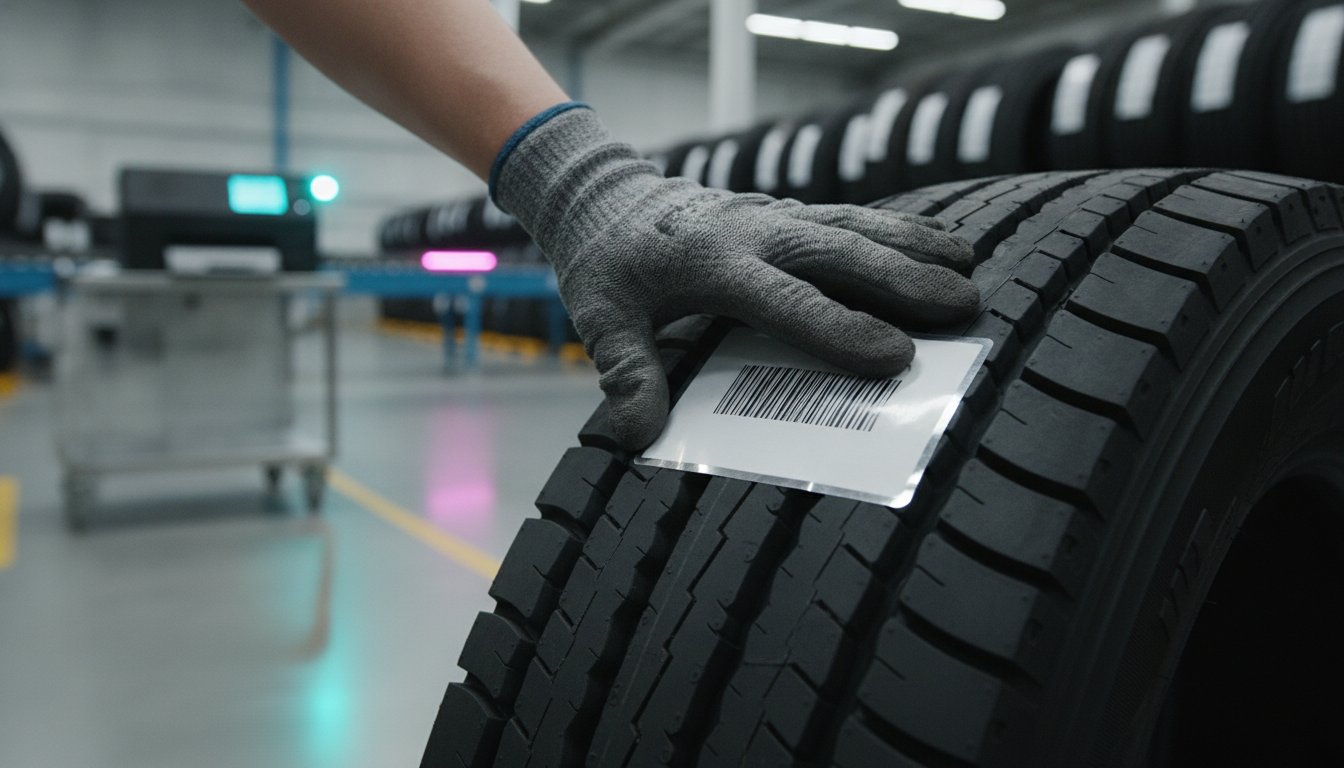
Effective tire labelling is actually a chemistry problem rather than a logistical one. If you have ever had a shipment rejected because a barcode peeled off an oily sidewall, you know that standard adhesives simply aren't built for porous rubber. Finding the right tire shipping labels for ups and fedex is the only way to prevent your inventory from being stranded in a sorting facility. Between the chemical wax coatings on new tires and the extreme temperature swings of a Canadian winter, the odds are often stacked against your labels staying put.
We understand how quickly re-shipping costs and carrier penalties can erode your operational margins. You need a reliable solution that ensures your barcodes remain scannable from the warehouse floor to the customer's doorstep. This guide will help you discover how to select and apply carrier-compliant tire shipping labels that bond permanently to rubber and survive the rigours of Canadian transit. We will examine the technical differences between aluminized films and standard papers, providing you with the clarity needed to maintain full compliance with UPS and FedEx automated sorting systems while protecting your bottom line.
Key Takeaways
- Identify why tire "blooming" and low surface energy cause standard label failure and how an aluminized barrier layer prevents chemical migration.
- Select high-tack rubber-based tire shipping labels for ups and fedex that are engineered to meet strict carrier barcode scan grade requirements.
- Evaluate hardware differentiators between industrial Zebra, Honeywell, and Toshiba printers to determine the best fit for your high-volume shipping environment.
- Implement the "press-and-hold" application technique to ensure pressure-sensitive adhesives achieve a permanent bond even in cold Canadian climates.
- Reduce operational overhead and re-shipping costs by utilizing fanfolded 1000-count formats designed for maximum efficiency and carrier compliance.
The Unique Challenges of Labelling Tires for UPS and FedEx
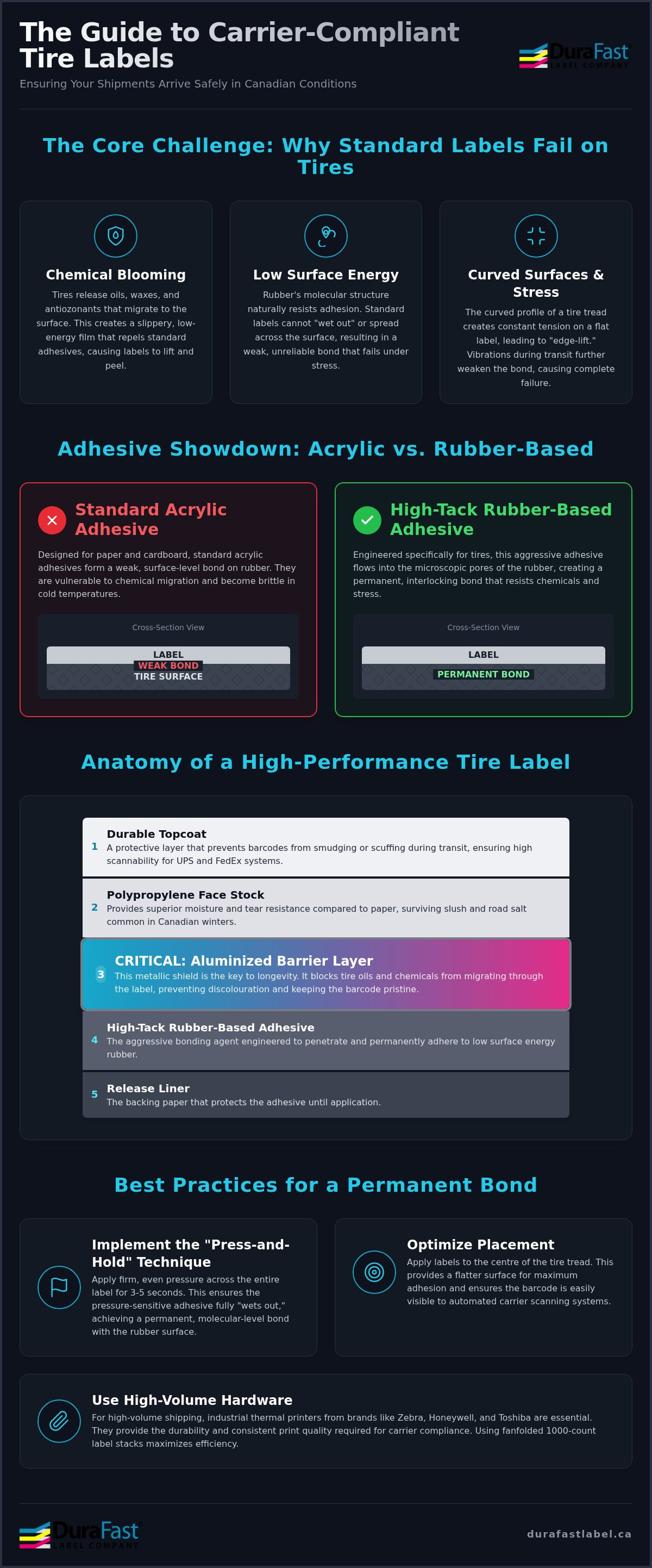
Why is it so difficult to make a label stick to a tire? The answer lies in the molecular structure of the rubber itself. Rubber is classified as a low surface energy material; this means that standard adhesives struggle to "wet out" across the surface, leading to a weak bond that can easily fail under stress. Unlike cardboard, which is porous and welcoming to adhesives, rubber acts more like a non-stick pan, repelling anything that isn't specifically engineered to grab hold of its surface.
Beyond surface energy, tires present a chemical minefield for logistics managers. Manufacturers use mold release agents to pull tires from their forms, and "blooming" occurs when antiozonants migrate to the surface to prevent cracking. These oils and waxes create a slippery layer that effectively repels typical shipping labels. Additionally, the curved profile of a tire creates constant tension on label edges. A flat label naturally wants to return to its original shape, leading to "edge-lift" where the label begins to peel away from the tread or sidewall before the package even leaves your dock.
Why Standard 4x6 Labels Fail on Tires
If you use standard paper labels for your inventory, you've likely seen them fail within hours of application. This happens because of chemical migration. The oils in the rubber penetrate the label, softening standard acrylic adhesives until they lose their grip entirely. Mechanical stress also plays a major role; the constant vibration of long-haul trucking on Canadian highways causes micro-movements that snap the bond of brittle adhesives. During a Canadian winter, road salt and slush can seep into the edges of a failing label, accelerating the detachment process. Choosing specialized tire labels is essential to ensure your shipments don't become "lost in transit" items that are impossible for carriers to identify.
Carrier Requirements for Tire Shipments
UPS and FedEx utilize high-speed automated sorting systems that rely on perfect barcode scannability. If your label is scuffed, wrinkled, or peeling, the scanner will reject it, leading to manual handling delays and potential surcharges. Carriers require specific adhesives and materials that can maintain high contrast under harsh warehouse lighting. Placement is also critical; labels should typically be applied to the centre of the tread to maximize scanner visibility. To meet these standards, you need tire shipping labels for ups and fedex that feature a durable topcoat. This protective layer prevents the barcode from smudging when tires are stacked or dragged across concrete floors during the sorting process, ensuring your data remains readable from the point of origin to the final destination.
Technical Specifications: Adhesives and Materials That Work
Selecting the right tire shipping labels for ups and fedex isn't just about picking a size; it's about matching the chemical properties of the label to the volatile nature of the tire. Most shipping labels use acrylic adhesives designed for flat cardboard boxes. However, tires require a high-tack rubber-based adhesive. Unlike acrylics, which sit on top of the surface, rubber-based formulations flow into the microscopic pores of the rubber. This process creates the aggressive bond needed to withstand the friction and movement of the industrial supply chain.
Another critical component is the aluminized barrier layer. Rubber constantly outgasses oils and plasticizers. Without a barrier, these chemicals migrate through the adhesive into the face stock, causing the label to turn grey and the barcode to become unreadable. An aluminized polypropylene film acts as a shield, keeping the printing surface clean and ensuring you remain in compliance with FedEx guidelines for shipping tires. This material choice also provides the moisture and tear resistance to survive the slush and road salt typical of Canadian transit.
The Chemistry of Specialized Tire Adhesives
Specialized adhesives are engineered to resist automotive compounds, maintaining their structural integrity even when exposed to the heavy oils found in new tread. These deep-tack formulations are specifically built to penetrate the uneven, porous texture of vulcanized rubber. Specialized adhesives create a permanent, high-performance bond with vulcanized rubber by aggressively interlocking with the surface texture at a molecular level.
Temperature resilience is vital for Canadian distributors. Your labels must maintain their bond in environments ranging from -40°C during a Prairie winter to +40°C in a humid Ontario warehouse. Polypropylene film is superior to paper because it doesn't shrink or expand with moisture changes, preventing the edge-lift that leads to lost shipments. If you aren't sure which material fits your storage environment, speak with our technical team for a recommendation.
Aluminized Polypropylene vs. Standard Film
The main difference between standard synthetic labels and specialized tire labels is the inclusion of a metallic barrier. This layer ensures the barcode remains crisp by preventing "greying" from tire oils over long-haul durations. In terms of durability, these labels offer high resistance to abrasion. This is essential because tires are frequently stacked and moved using mechanical grabbers that would scuff a standard paper label. By choosing a film-based solution with a durable topcoat, you ensure that every barcode remains scannable through every automated sorting gate in the carrier network.
Choosing and Optimizing Your Thermal Printer for Tires
Can any thermal printer handle the unique demands of automotive logistics? The short answer is no. While standard desktop units are excellent for paper shipping labels, the thick, aluminized film used for tire shipping labels for ups and fedex requires a printer with specific mechanical and thermal capabilities. You must first decide between Direct Thermal and Thermal Transfer technology. Direct Thermal is the industry favourite for high-volume shipping because it simplifies the workflow by removing the need for ribbons. However, if your tires are stored in environments where they face prolonged UV exposure, Thermal Transfer may be the better choice to prevent the image from fading.
Success with these specialized materials depends on your ability to calibrate the hardware. Because polypropylene film and metallic barrier layers dissipate heat differently than paper, you'll need to adjust your printer's darkness settings. If the heat is too low, the barcode lines will appear faint or "dusty," causing them to fail carrier scan grade requirements. High-quality thermal printheads from brands like Zebra, Honeywell, and Toshiba are essential for maintaining the consistent heat distribution needed to produce scannable labels on every single print job.
Industrial vs. Desktop Printers for Tire Distribution
Why do we recommend industrial models for tire labelling? The main difference is the motor torque. Tire labels are significantly heavier than standard paper labels, and a desktop printer's motor often lacks the power to pull these dense rolls consistently. This leads to slipping and misaligned prints. You should also consider the hardware footprint. Many industrial models offer a choice between internal label unwinders for a compact workspace and external label unwinders to support oversized rolls. To ensure your hardware can keep up with the physical demands of your warehouse, explore our range of industrial label printers for Canada.
Calibrating Your Workflow for 2026
For 2026, UPS and FedEx have reinforced their automated sorting protocols, making barcode clarity more important than ever. We recommend setting your print speed to a moderate 4-6 ips (inches per second). While it's tempting to print faster, moderate speeds provide the thermal head with the necessary "dwell time" to create sharp, scannable edges on film media. Another efficiency tip is to switch to fanfolded labels. Feeding labels from a carton behind the printer reduces mechanical strain on the drive rollers and significantly cuts down on the time spent swapping out media. For a deeper look at hardware configurations, see our comprehensive guide to thermal label printers.
Application Best Practices for the Canadian Climate
Even the most advanced tire shipping labels for ups and fedex will fail if they aren't applied with the correct technique. While the aluminized film and rubber-based adhesive provide the necessary chemistry, the physical application determines whether that bond holds through the rigours of transit. Pressure-sensitive adhesives require a specific amount of force to "wet out" and create a permanent anchor. This is why we advocate for the "press-and-hold" technique; by applying firm, even pressure across the entire label surface, you force the adhesive to flow into the tire's tread pattern, preventing the edge-lift that often leads to carrier rejection.
Step-by-Step Tire Label Application
To achieve zero label failures, your warehouse team should follow a standardized application protocol. Proper preparation is the only way to ensure the high-tack adhesive isn't fighting against surface contaminants that act as a barrier to adhesion.
- Clean the tread surface: Use a dry, lint-free cloth to remove dust, road film, or mold release agents from the specific area where the label will be applied.
- Apply firmly: Start from the centre and work outwards to ensure no air bubbles are trapped under the film. Air pockets expand and contract with temperature changes, which can snap the adhesive bond.
- Allow for dwell time: The adhesive needs time to build its maximum bond strength. Allow the label to "dwell" at warehouse temperature for at least 20 minutes before loading the tire into a cold truck or moving it to an outdoor dock.
Winter Shipping Considerations in Canada
Canadian logistics managers face a unique challenge: condensation. When you move a tire from a warm, humid warehouse to a frigid loading dock in the Prairies or the Maritimes, a microscopic layer of moisture forms on the surface. If the label hasn't already achieved its full bond strength, this moisture can seep under the edges and cause "flagging." This is where the label peels back like a flag in the wind, making it a prime target for getting caught in automated sorting belts. Using weatherproof and UL-certified labels ensures the face stock won't degrade when exposed to the slush and road salt typical of Canadian winter transit.
The ideal application temperature is usually 4°C or warmer, but once the bond is set, our specialized labels can handle service temperatures as low as -40°C. If your facility frequently operates in sub-zero conditions, you need a labelling strategy that accounts for these thermal shocks. To find the right adhesive for your specific regional climate, consult with our Canadian logistics experts for a tailored recommendation.
Maximizing Efficiency with DuraFast Tire Labelling Solutions
How much does a single labelling failure actually cost your business? When you consider that shipping a 30 lb package via FedEx Ground in 2026 can range from C$28.50 to C$78.50, and UPS Ground rates can reach up to C$200 for certain services, the financial stakes of a detached label are incredibly high. DuraFast Label Company Canada acts as more than just a supplier; we are a strategic partner helping Canadian distributors eliminate these hidden costs. By providing high-performance tire shipping labels for ups and fedex, we ensure your shipments reach their destination without the need for expensive manual intervention or re-shipping fees.
Efficiency in high-volume environments is often measured by uptime. This is why we recommend bulk ordering our fanfolded 1000-count cartons. Unlike small rolls that require frequent changes, fanfolded formats allow for continuous printing and easier feeding through industrial printers. This setup reduces mechanical wear on your printer's drive rollers and simplifies inventory management for busy distribution centres across Canada. We also offer customization options for distributors requiring specific sizes or unique branding to stand out in a competitive market.
Why Canadian Distributors Partner with DuraFast
We understand the specific requirements of the Canadian market, including compatibility with domestic carriers like Purolator and Canpar alongside global leaders. Our tire labels are designed to integrate seamlessly with industry-standard software like BarTender and Loftware. This ensures that your barcode scannability grades meet the strict 2026 carrier standards. By partnering with a local expert, you gain access to quick turnaround times for essential shipping consumables, ensuring your production line never grinds to a halt due to a supply shortage.
Get a Professional Consultation for Your Tire Labelling
Are you still using standard adhesives and hoping for the best? We encourage you to evaluate your current cost-per-label against the total cost of shipping failures and carrier surcharges. Our team provides expert support for printer calibration and material selection, ensuring your hardware and consumables work in perfect harmony even in extreme temperatures. Contact our experts today for a custom tire labelling quote and request samples to test on your specific tire brands in your own warehouse environment. Taking control of your labelling process is the fastest way to reduce operational friction and protect your bottom line.
Streamlining Your Tire Logistics for 2026 and Beyond
Navigating the complexities of automotive shipping requires more than just a standard label; it demands a solution engineered for the specific chemical and physical traits of vulcanized rubber. By prioritizing aluminized barrier technology and specialized rubber-bond adhesives, you ensure that your barcodes remain scannable through every high-speed sorting gate in the carrier network. We have explored how the right hardware calibration and standardized application techniques prevent the edge-lift that often leads to costly shipping failures and manual handling surcharges.
Investing in high-performance tire shipping labels for ups and fedex is a strategic move that protects your operational margins and strengthens your carrier relationships. DuraFast Label Company is proud to offer national Canadian support to help you optimize your print speeds and material selection for our unique climate. If you're ready to eliminate "lost in transit" shipments and reduce re-shipping overhead, we are here to assist with expert guidance and proven industrial materials.
Request a Custom Quote for Tire Shipping Labels today to see how our specialized products can transform your distribution efficiency. Take control of your production process and deliver your inventory with complete confidence.
Frequently Asked Questions
Will standard 4x6 shipping labels work for tires?
No, standard paper shipping labels will almost certainly fail because they lack the aggressive rubber-based adhesive required for low surface energy materials. Tires also outgas oils and plasticizers that dissolve standard acrylic adhesives, causing the label to detach during sorting. Using the wrong tire shipping labels for ups and fedex often results in lost inventory and expensive carrier penalties for manual handling.
Do I need a special printer to print tire shipping labels?
You don't need a proprietary technology, but an industrial thermal printer is highly recommended over basic desktop models. The thick, aluminized film used for these labels requires higher motor torque and specific darkness settings to ensure scannable barcodes. Brands like Zebra, Honeywell, and Toshiba are ideal because they provide the consistent heat distribution necessary for heavy synthetic tire media.
Why do FedEx and UPS have specific requirements for tire labels?
Carriers enforce strict scannability standards because their automated sorting belts move at high speeds. If a label is scuffed, wrinkled, or peeling, the scanner cannot read the barcode, which forces a manual intervention. UPS and FedEx require durable labels that maintain high contrast and permanent adhesion to ensure your packages move seamlessly through their global logistics networks without delays.
What is the difference between direct thermal and thermal transfer tire labels?
The main difference is that direct thermal labels don't require a ribbon, while thermal transfer labels use a ribbon to bake the image onto the surface. Direct thermal is generally more efficient for high-volume shipping environments. However, if your tires are stored outdoors in direct sunlight for months, thermal transfer offers superior UV resistance to prevent the barcode from fading over time.
How do I prevent my tire labels from falling off in the winter?
Preventing winter detachment starts with proper dwell time in a temperature-controlled environment. You must apply the label to a clean, dry surface and allow the pressure-sensitive adhesive to cure for at least 20 minutes before exposing it to sub-zero temperatures. This ensures the bond is fully set before condensation or road salt can interfere with the adhesive's grip on the rubber.
Can I use these labels for other rubber products besides tires?
Yes, these specialized labels are excellent for other low surface energy rubber items such as industrial hoses, conveyor belts, and heavy-duty floor mats. The high-tack adhesive is engineered to bond with vulcanized surfaces that typically repel standard labels. If you're marking industrial rubber components for long-haul transit, these labels provide the same durability and chemical resistance found in automotive applications.
Are these labels compatible with Purolator and Canpar as well?
Absolutely, our labels are fully compatible with domestic Canadian carriers like Purolator and Canpar. While the barcode formatting and software integration might differ slightly, the physical requirements for adhesion and durability remain the same across all major Canadian logistics providers. Using a single high-quality tire label stock simplifies your inventory management for all outbound shipments across the country.
What should I do if my barcode is not scanning on the tire label?
If your barcode isn't scanning, the first step is to check your printer's darkness and speed settings. A faint or "dusty" barcode usually indicates that the printhead isn't hot enough to properly activate the thermal layer on the film. Reducing your print speed to 4 ips often improves edge definition, ensuring your tire shipping labels for ups and fedex meet the required scan grades.