140Xi4 Ribbons: A Canadian Business Guide to High-Performance Thermal Labelling
16th Sep 2026
Could an oversight in your ribbon selection be the silent bottleneck in your high-volume production? For many Canadian industrial operations, the Zebra 140Xi4 is a reliable workhorse, yet the performance of this machine depends entirely on the quality of your 140xi4 ribbons. You likely realize that low-quality consumables don't just compromise scan rates; they lead to premature printhead wear and costly downtime. Finding a strategic balance between industrial reliability and fiscal responsibility is the key to maintaining operational seamlessness.
This guide promises to help you maximize your hardware's life by selecting the ideal thermal transfer formulations for your specific environment. While the 140Xi4 handles monochrome industrial tasks, many modern facilities also utilize VIPColor inkjet solutions for colour-coded logistics. It's vital to distinguish between the standard Memjet dye ink series (VP500, VP610, VP700) and the water enhanced dye ink series (VP550, VP660, VP750). We will explain why the water enhanced models are specifically intended for durability in applications involving wet labels, condensation, or frozen foods. We'll then preview the technical specifications required to achieve crisp barcodes and reliable replenishment from a trusted Canadian supplier.
Key Takeaways
- Understand why selecting premium 140xi4 ribbons is the most effective way to extend the lifespan of your thermal printhead and avoid expensive industrial repairs.
- Determine whether a wax, wax/resin, or resin formulation is best suited for your specific application, from general shipping to high-durability chemical labelling.
- Learn how to optimize high-volume production by using 450-metre rolls and matching ribbon widths to your label stock to prevent mechanical damage.
- Gain the diagnostic skills needed to resolve persistent "Ribbon Out" errors and minimize static-related sensor interference in your Zebra 140Xi4.
- Explore the logistical benefits of sourcing consumables from a dedicated Canadian partner to maintain consistent quality and regulatory compliance across your operations.
Optimizing Industrial Output with Zebra 140Xi4 Ribbons
How does your choice of consumables influence the long-term reliability of your production line? In high-volume Canadian logistics, the Zebra 140Xi4 is celebrated for its ability to handle mission-critical tasks 24/7. However, the efficiency of this hardware is tethered to the quality of your 140xi4 ribbons. While the thermal-transfer printing process provides the foundation for durable monochrome marking, many modern facilities now integrate colour inkjet technology to complement their thermal fleets. Understanding the functional differences between these systems is essential for optimizing your total industrial output.
The Science of Thermal Transfer Labelling
Thermal printing relies on a precise heat exchange to bond ink to a substrate. High-performance 140xi4 ribbons utilize advanced back-coatings that dissipate static and reduce friction, which protects the ceramic heating elements of the printhead. This is particularly vital when operating at high speeds, as improper heat settings or low-grade ribbons can cause abrasive wear. By selecting a ribbon with a calibrated melting point, you ensure that barcodes remain sharp and scannable even at the 140Xi4's maximum velocity, preventing the scanning failures that stall distribution.
Matching Hardware to Environmental Demands
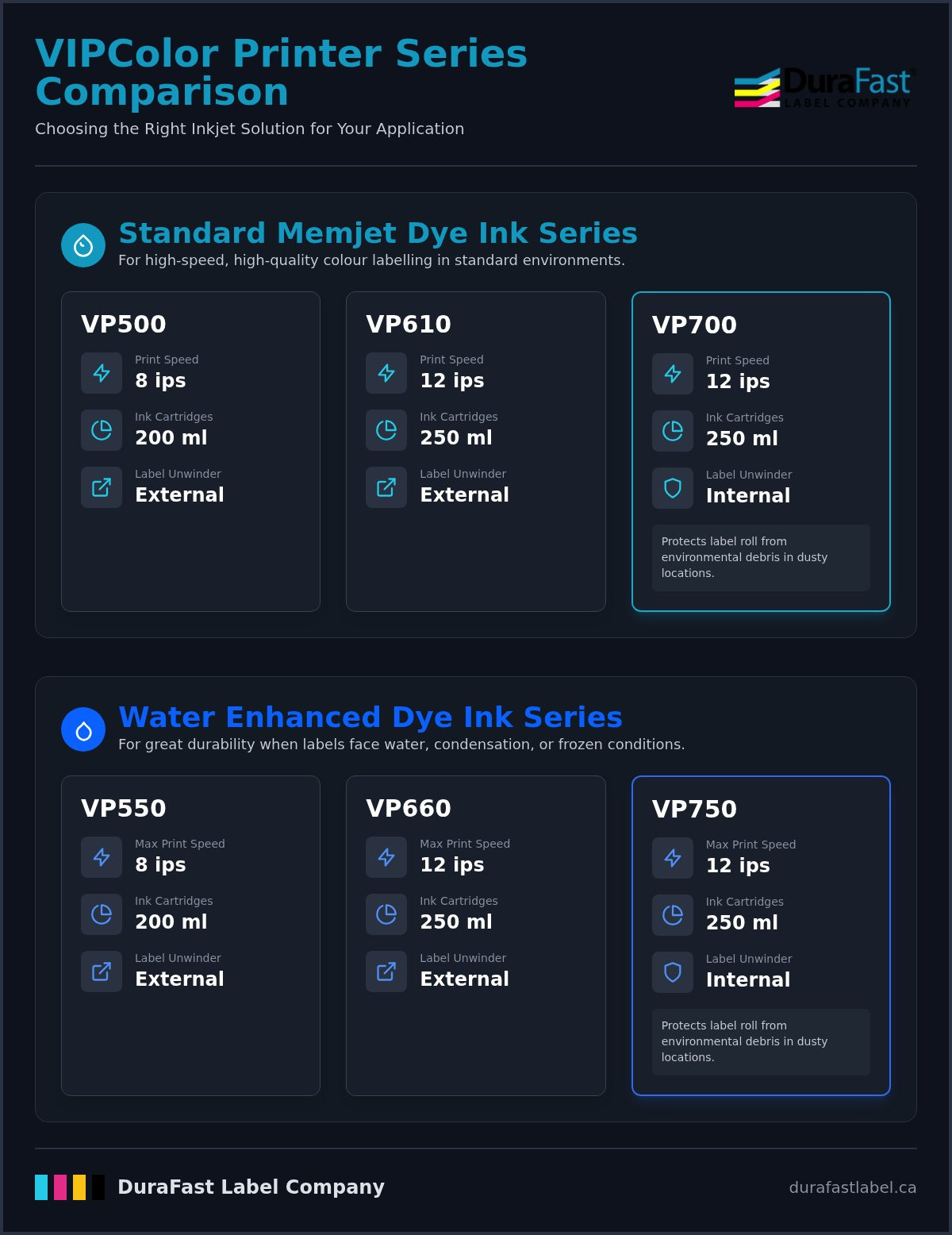
When evaluating industrial output, it's helpful to compare the 140Xi4's thermal capabilities with versatile inkjet alternatives like the VIPColor series. For standard applications, the Memjet dye ink series offers varying specifications to meet specific throughput needs. The VP500 prints at a speed of 8 ips and utilizes 200ml ink cartridges, while the VP610 increases performance to 12 ips with 250ml ink cartridges. Both the VP500 and VP610 are designed with external label unwinders, making them suitable for standard clean-room environments. However, for dusty warehouse floors where rolls require protection from "environmental debris," the VP700 is the superior choice. It features an internal label unwinder built in while maintaining the 12 ips speed and 250ml cartridge capacity of the VP610.
Durability for Specialized Applications
Do your labels face moisture, condensation, or frozen food environments? In these scenarios, the water enhanced dye ink series provides a specialized solution. The VP550 offers a max print speed of 8 ips with 200ml ink cartridges, and the VP660 delivers 12 ips using 250ml cartridges; both models utilize external unwinders. For the most demanding industrial settings, the VP750 includes an internal label unwinder to shield stock from debris. These water enhanced models are specifically intended for "great durability" when labels are introduced to water. By matching your hardware features and 140xi4 ribbons to your specific environmental hurdles, you realize a more resilient and cost-effective labelling operation.
Choosing the Right Formulation: Wax, Wax/Resin, or Resin
Which chemical formulation is best suited for your label's lifecycle? While the previous section detailed the hardware configurations of the 140Xi4 and the VP series, the actual permanence of your print depends on the ribbon's ink composition. Selecting the wrong 140xi4 ribbons can lead to failed compliance audits or unreadable barcodes in the field. To achieve operational seamlessness, you must match the ribbon type to your substrate material and the environmental stressors it will encounter, whether that involves standard warehouse handling or extreme industrial exposure.
Wax Ribbons for Standard Logistics
If you are primarily printing high-volume shipping labels or inventory tags on paper stock, wax ribbons are the most cost-effective solution. These ribbons are designed for high-speed application on thermal transfer labels, where they provide excellent contrast and deep black levels. Despite being an "economy" choice, high-quality wax formulations are essential for maintaining USPS barcode standards. They ensure that barcodes remain crisp and scannable throughout standard transit, making them the preferred choice for Canadian logistics providers focused on fiscal responsibility and high throughput.
Wax/Resin for Enhanced Durability
What happens when your labels face frequent handling or moisture in a bustling distribution centre? In these scenarios, a standard wax ribbon may smudge, leading to logistical errors. Wax/resin ribbons incorporate a percentage of resin that bonds more aggressively to semi-gloss paper and synthetic materials like polypropylene. This formulation provides a significant upgrade in smear and scratch resistance. It acts as a durable middle ground for labels that must survive friction and varying humidity levels as they move across different Canadian provinces.
Resin Ribbons for Extreme Environments
For applications requiring absolute permanence, resin is the only viable option. This is critical for businesses complying with amended WHMIS regulations, which require labels to remain legible for the entire life of a hazardous product. Resin 140xi4 ribbons are engineered to withstand harsh chemicals, heavy abrasion, and extreme temperature fluctuations. They are the essential choice for weatherproof and UL-certified labels.
It's important to realize that this need for permanence extends to colour labelling as well. Just as resin is required for thermal transfer, the choice of the VP550, VP660, or VP750 is explicitly linked to the need for "great durability" when labels are introduced to water or condensation. Whether you are using thermal or inkjet technology, ensuring your labels survive their environment is a strategic priority. If you are unsure which formulation fits your specific application, our team can provide a tailored recommendation to help you maintain compliance and efficiency.
Technical Specifications for 140Xi4 Thermal Transfer Ribbons
The Zebra 140Xi4 is a precision instrument. To maintain its high-speed performance, you must adhere to specific technical requirements when sourcing consumables. It's not just about the ink formulation; the physical dimensions and winding configuration of your 140xi4 ribbons determine whether your production line runs smoothly or grinds to a halt. Ensuring a perfect fit for Zebra industrial spindles prevents mechanical strain and sensor errors. Because this printer model is now a legacy product, getting these specifications right is more important than ever to protect your existing hardware investment.
Sizing for Printhead Protection
Did you know that the width of your ribbon should always exceed the width of your label stock? This is a critical rule of thumb for printhead longevity. When the ribbon is wider, it acts as a protective barrier between the delicate printhead and the abrasive edges of the labels. Common widths for the 140Xi4 range from 40mm to 131mm. If you use a ribbon that's too narrow, you risk "burn-in" where the printhead is permanently damaged by direct contact with the label backing or the rough edges of the paper. We recommend a ribbon that's at least 4mm wider than your label to ensure operational seamlessness.
Maximizing Roll Capacity
In high-volume environments, every minute spent changing a roll is a minute of lost productivity. Most industrial label printers like the 140Xi4 are designed to handle 450-metre rolls. By maximizing roll length, you reduce changeover frequency, labour costs, and packaging waste. While the 140Xi4 typically uses an internal unwinder, some high-capacity setups may involve external unwinders to accommodate larger rolls. Following AIM Global technical guidelines ensures that your printer settings, such as tension and darkness, align with these high-capacity supplies for optimal image transfer and scannability.
Winding and Core Specifications
Is your ribbon Coated Side Out (CSO) or Coated Side In (CSI)? For the 140Xi4, you must use CSO ribbons. This means the ink is on the outside of the roll. Using CSI ribbons will result in the ink facing the wrong way, potentially coating your printhead in wax or resin and causing immediate failure. Additionally, these 140xi4 ribbons must be wound on a standard 1-inch (25.4mm) core to fit the industrial spindles. Verifying these specs before you order helps you avoid "Ribbon Out" errors and maintains the steady, methodical rhythm of your distribution centre.
Troubleshooting the 140Xi4: Resolving Ribbon Errors
How many times has your production line halted due to a "Ribbon Out" error when the roll is clearly half-full? While the Zebra 140Xi4 is renowned for its industrial reliability, it's also sensitive to the quality of the consumables you feed it. Low-grade 140xi4 ribbons often lack the advanced antistatic back-coating found in premium formulations. This leads to a build-up of static electricity that can physically interfere with the printer's optical sensors, causing false empty-roll readings or intermittent "check ribbon" warnings. Addressing these hurdles requires a mix of mechanical calibration and a commitment to high-performance supplies that respect the printer's technical tolerances.
Fixing the 'Ribbon Out' Error Code
When your 140Xi4 displays a ribbon error, start by verifying the physical seating of the roll. The ribbon must be perfectly centred on the supply spindle and wrapped tightly around the take-up spindle. Even slight wrinkles can disrupt the sensor's ability to track the ribbon's movement correctly. If the error persists, you likely need to re-calibrate the sensors. This process involves navigating the printer's menu to the "Media and Ribbon Calibration" section. By following the prompts, you teach the sensors to distinguish between the ribbon and the backing material. Ensuring proper tensioning is also vital; a loose ribbon will slip, while one that's too tight can snap or cause the motor to strain unnecessarily.
Printhead Maintenance and Cleaning
Consistent print quality depends on a clean environment. Every time you change your 140xi4 ribbons, you should perform a quick cleaning of the printhead. Adhesive residue from labels and microscopic dust from ribbons can accumulate, creating a barrier that blocks efficient heat transfer. For those using wax ribbons, a cleaning swab dipped in isopropyl alcohol after every roll is usually sufficient. However, if you're running resin formulations at higher heat settings, you might need to clean the head more frequently to prevent "caking" of the ink.
Always check your labels for thin, vertical white lines. These are often signs of "dead" pixels where the heating elements have failed. While regular cleaning extends the life of these components, eventually every printhead reaches its end of life. Maintaining your thermal label printers through proactive care reduces the risk of sudden failure during peak shipping seasons. If you're experiencing persistent quality issues or need help selecting the right maintenance supplies for your fleet, contact our technical support team for professional guidance.
Procuring Reliable 140Xi4 Ribbons Across Canada
Sourcing consumables for legacy hardware like the Zebra 140Xi4 shouldn't be a logistical hurdle. While many vendors treat thermal supplies as a sideline, we view them as the heartbeat of your industrial operations. Choosing a dedicated Canadian supplier ensures that your 140xi4 ribbons are not only compatible but also engineered for the specific environmental challenges of the Canadian market. From the humidity of coastal ports to the sub-zero temperatures of distribution centres across the country, your choice of supplier directly impacts your total cost of ownership. High-performance ribbons must maintain their integrity through varying moisture levels and friction during transit; a reality we understand through years of supporting Canadian logistics.
Why Canadian Businesses Choose DuraFast Label Company Canada
Canadian businesses face unique labelling demands that generic international suppliers often overlook. Whether you need specialized tire labels for the automotive sector or chemical-resistant resin for GHS compliance, having local expertise matters. DuraFast Label Company Canada provides national coverage with a deep understanding of regional industry standards. We maintain an extensive inventory of wax, wax/resin, and resin formulations, ensuring that industrial fleets across the country have access to consistent, high-quality supplies. This proximity reduces shipping lead times and eliminates the customs delays often associated with cross-border procurement, keeping your 24/7 operations running without interruption.
Customized Replenishment Strategies
A successful labelling strategy requires more than just buying rolls; it requires expert guidance on material compatibility. Our advisory role focuses on helping you match 140xi4 ribbons to your specific substrates, whether you're using paper, polypropylene, or specialized synthetic stocks. This diagnostic approach ensures that your heat settings are optimized, which in turn maximizes the longevity of your equipment. By streamlining your supply chain with customized replenishment strategies, you can significantly reduce inventory overhead and eliminate the stress of "Ribbon Out" emergencies. We help you realize better fiscal responsibility by maintaining reliable stock levels and providing predictable lead times across the country. This pragmatic approach allows you to focus on your core production goals while we handle the intricacies of your thermal consumables.
Ready to optimize your 140Xi4 output and protect your hardware investment? Contact our labelling experts today to discuss your specific industrial requirements and find the perfect ribbon-label combination for your business.
Future-Proof Your Industrial Labelling Operations
Maintaining a high-speed production line requires more than just functional hardware; it demands a synergy between your Zebra 140Xi4 and the consumables you select. By prioritizing high-performance 140xi4 ribbons, you realize significant long-term savings through extended printhead life and reduced downtime. Whether you require the cost-effectiveness of wax for standard logistics or the extreme durability of resin for WHMIS-compliant chemical labels, the right formulation ensures your barcodes remain scannable in even the harshest Canadian environments.
Success in high-volume marking depends on precise technical alignment. Ensuring your ribbons are wider than your label stock and correctly wound for your industrial spindles prevents the mechanical friction that leads to premature equipment failure. As the 140Xi4 moves further into its legacy phase, securing a reliable Canadian partner for replenishment becomes a strategic necessity. DuraFast Label provides specialized support and an extensive inventory of formulations compatible with all Zebra Xi-series industrial printers.
Contact DuraFast Label for Expert 140Xi4 Ribbon Advice to streamline your supply chain and protect your hardware investment. We are here to help you achieve operational excellence with confidence.
Frequently Asked Questions
Why does my Zebra 140Xi4 keep saying 'Ribbon Out' when there is still ribbon left?
False 'Ribbon Out' errors often stem from sensor calibration issues or static interference from low-quality supplies. Ensure the roll is loaded correctly and seated firmly on the spindles. If the problem persists; perform a manual calibration through the printer menu. Premium 140xi4 ribbons with antistatic back-coatings help prevent these disruptions by ensuring the optical sensors can accurately track the roll's movement during high-speed production cycles.
Can I use wax ribbons on synthetic or polypropylene labels?
No; wax ribbons are not recommended for synthetic materials because the ink will not bond properly to the non-porous surface. This results in significant smudging or the ink simply wiping off. For polypropylene or other synthetic labels; you should use wax/resin or full resin formulations. These provide the chemical bond necessary for durability, ensuring your labels remain legible even when exposed to moisture or frequent handling in industrial environments.
What is the difference between CSO and CSI ribbons for Zebra printers?
CSO (Coated Side Out) means the ink is on the outside of the roll, while CSI (Coated Side In) means the ink is on the inside. Zebra printers, including the 140Xi4; are designed specifically for CSO ribbons. If you attempt to use CSI ribbons, the ink will face the printhead instead of the label. This can cause the ribbon to stick to the head; leading to poor print quality or permanent mechanical damage.
How do I know if I need a wax/resin or a full resin ribbon for my application?
Your choice depends on the required durability and the specific environment the label will face. Wax/resin is ideal for semi-gloss paper or synthetics that need scratch and moisture resistance. Full resin is necessary for extreme conditions; such as chemical exposure, high heat, or outdoor applications. If your labels must meet WHMIS standards for hazardous products; a resin ribbon is typically required to ensure information remains legible for the product's entire lifespan.
Does the width of the ribbon really matter if it covers the barcode?
Yes; ribbon width is critical for more than just barcode coverage. The ribbon must be slightly wider than the label stock to act as a protective barrier for the printhead. If the label edges are exposed; they can cause abrasive wear or "burn-in" on the ceramic heating elements. Using 140xi4 ribbons that extend roughly 2mm beyond each side of the label liner is a standard industry practice to maximize the life of your equipment.
How often should I clean the printhead on my 140Xi4?
You should clean the printhead every time you replace the ribbon roll to maintain optimal heat transfer. Use a cleaning swab with 99.9% isopropyl alcohol to remove adhesive residue and microscopic dust. If you are using resin ribbons at higher darkness settings; you may need to clean it more frequently. Regular maintenance prevents the build-up of debris that causes "dead" pixels and ensures consistent, high-contrast barcode scans across your fleet.
Are these ribbons compatible with GHS or WHMIS labelling requirements?
Yes; specific resin ribbon formulations are fully compatible with GHS and WHMIS labelling requirements in Canada. These regulations demand that labels remain durable and legible throughout the product's life. When paired with the correct synthetic label stock; resin ribbons provide the necessary resistance to chemicals, solvents, and abrasion. This ensures your hazardous material labelling remains compliant with the Hazardous Products Regulations that came into full effect in December 2025.
Can I use 140Xi4 ribbons in other Zebra Xi-series printers?
Most ribbons designed for the 140Xi4 are compatible with other printers in the Zebra Xi-series, such as the 110Xi4 or 170Xi4; provided the widths are appropriate. These printers all utilize a standard 1-inch core and require a Coated Side Out (CSO) configuration. You must always verify that the ribbon width is wider than your specific label stock for each different printer model to ensure you are protecting every printhead in your facility.