How To Improve Operations with Smart Warehouse Floor Labels?
14th Jul 2026
Key Highlights
-
Warehouse floor labels place location IDs, barcodes, and safety cues directly on the floor, helping teams move faster and reduce picking and put-away errors.
-
Common types include floor location labels, barcode floor labels, and adhesive floor labels, each serving navigation, scanning, and organization needs.
-
Floor labels face constant wear from forklifts, pallets, foot traffic, and cleaning, which can cause fading, peeling, and scan failures.
-
Adding a protective overlay like Label Armor helps labels resist abrasion, moisture, and edge damage, extending usable life in high-traffic areas.
-
Floor labels work best alongside overhead signs, delivering precise, point-of-use guidance in aisles, pick zones, staging, and traffic lanes.
-
DuraFast Label supports in-house printing of durable warehouse floor labels and offers Label Armor to reduce replacements and keep operations running smoothly.
When warehouse locations are not clearly marked, small mistakes add up fast. Missed picks, slower movement, and higher safety risk can quickly impact daily operations in busy facilities with constant equipment and foot traffic.
That is why many warehouses use floor-level labeling instead of relying only on overhead signs. Floor labels place location IDs, barcodes, and safety cues exactly where teams are already looking. The challenge is that these labels face heavy wear and can degrade quickly without proper protection.
This blog explains how warehouse floor labels help improve navigation and efficiency, the common types used in warehouses, and how adding a protective layer like Label Armor can extend label life, preserve readability, and reduce frequent replacements.
What Are Warehouse Floor Labels and How Do They Work?
Warehouse floor labels are heavy-duty labels applied directly to warehouse floors to identify locations, guide movement, and support scanning-based workflows. They are commonly used to mark aisles, rack positions, pick zones, staging areas, and safety pathways, keeping information visible right where work happens.
These labels work by combining clear print, strong adhesives, and durable materials that bond to concrete or sealed floors. Once applied, they act as permanent visual reference points that teams rely on throughout daily operations, from receiving and put-away to picking and shipping.
In practice, floor labels for warehouse help by:
-
Providing instant location identification without looking up
-
Supporting barcode scanning for inventory accuracy
-
Reinforcing traffic flow and safety zones
-
Reducing hesitation and decision time on the floor
When paired with protective solutions like Label Armor, warehouse floor labels continue to perform even in high-traffic areas, maintaining readability and adhesion despite constant movement and wear.
What Types of Warehouse Floor Labels Are Commonly Used?
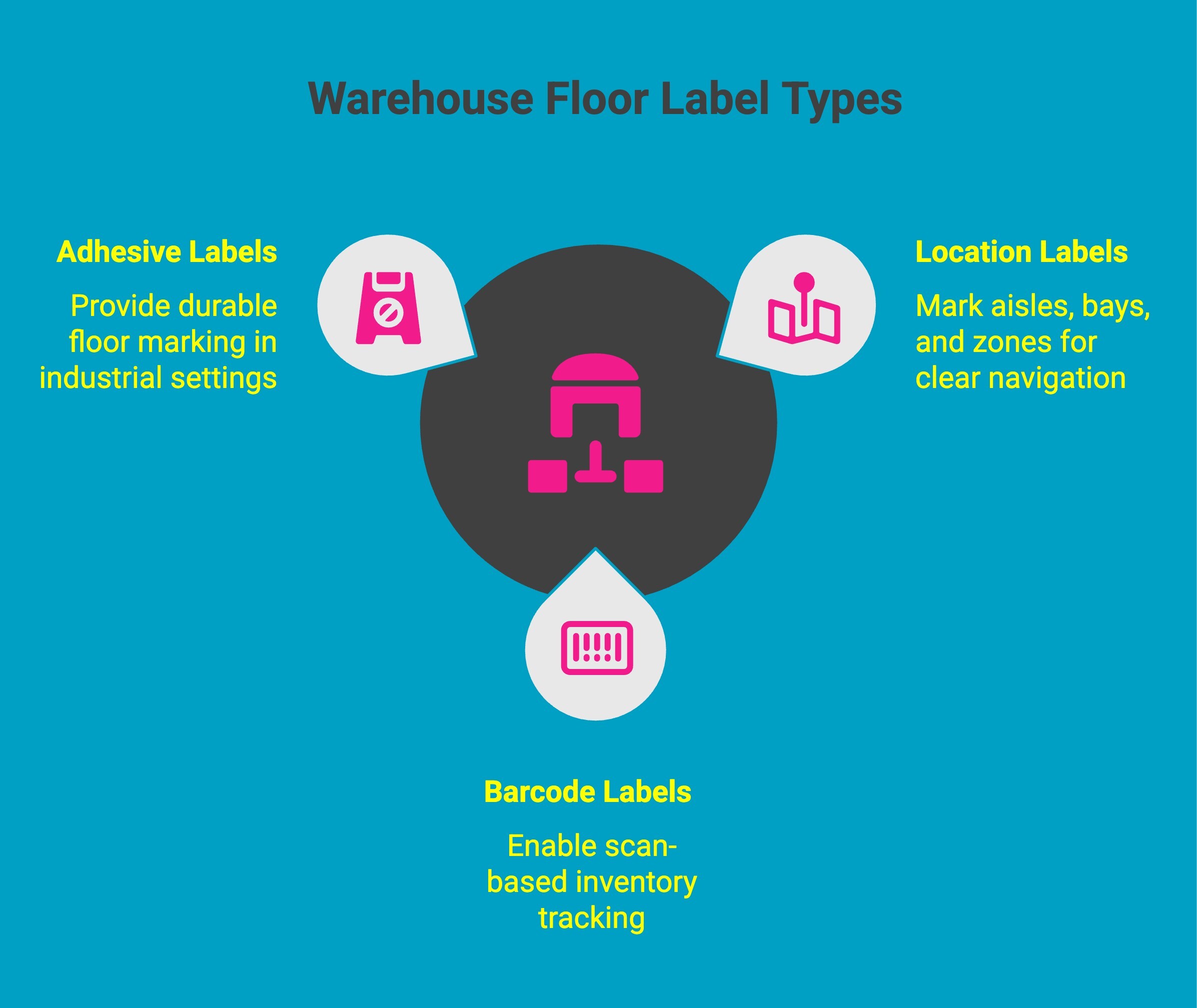
Warehouses use different types of floor labels depending on how the space is organized and how information is accessed on the floor. Choosing the right type helps improve accuracy, speed, and overall workflow consistency.
1. Warehouse Floor Location Labels
These labels are used to mark aisles, bays, racks, and zones. They create a clear location system that helps workers move quickly and reduces errors during picking and put-away.
-
Ideal for aisle numbering and zone identification
-
Improves navigation in large or dense layouts
-
Supports consistent location naming across teams
2. Warehouse Floor Barcode Labels
Barcode labels are designed for scan-based operations where accuracy matters most. Placed directly on the floor, they allow workers to scan locations without slowing down or changing posture.
-
Supports WMS and inventory tracking systems
-
Reduces manual entry and scanning errors
-
Keeps location data accessible even in busy areas
3. Warehouse adhesive floor labels
These labels rely on strong adhesives to bond securely to concrete or sealed floors. They are commonly used in general-purpose and industrial environments where durability is essential.
-
Designed to withstand foot and equipment traffic
-
Suitable for smooth and properly prepared surfaces
-
Can be enhanced with protective layers for longer life
Using the right combination of label types ensures warehouse floor labels remain clear, functional, and easy to maintain across different operational zones.
Why Is Durability Critical for Warehouse Floor Labels?
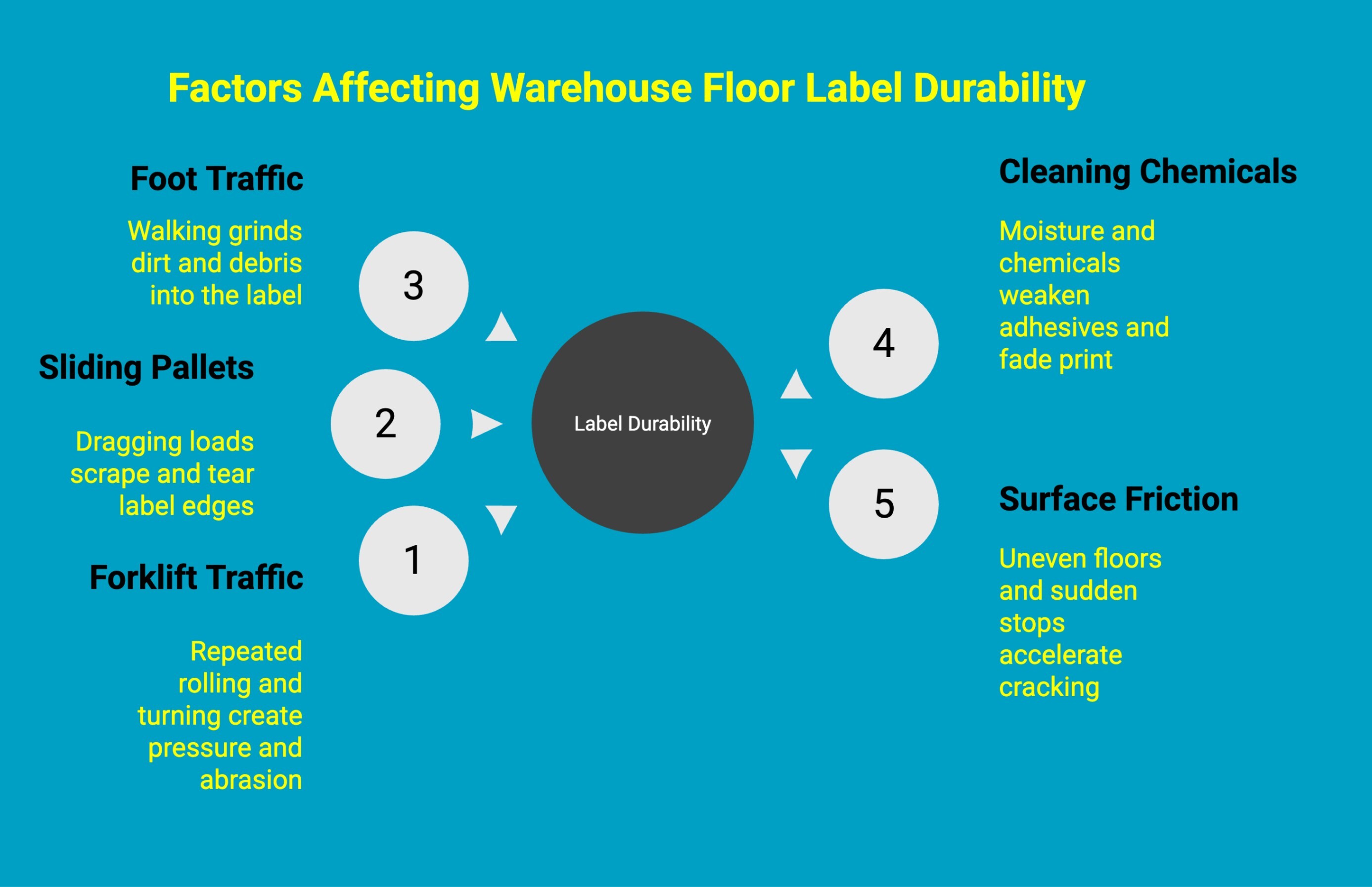
Warehouse floor labels are exposed to more stress than almost any other type of signage. Every day, forklifts, pallet jacks, carts, and foot traffic pass directly over them. Without sufficient durability, labels can fade, crack, or peel, making them difficult to read and unreliable for daily operations.
The most common causes of warehouse floor label wear include:
-
Forklift and pallet jack traffic: Repeated rolling and turning create constant pressure and abrasion that can wear down printed surfaces.
-
Sliding pallets and skids: Dragging loads across the floor scrapes label edges and corners, causing lifting and tearing.
-
Foot traffic: Continuous walking grinds dirt and debris into the label surface, dulling print and reducing contrast.
-
Cleaning and washdowns: Moisture and cleaning chemicals can weaken adhesives and fade print over time.
-
Surface friction and impact: Uneven floors and sudden stops create friction that accelerates cracking and peeling.
Because of these conditions, durability is not just about the label material itself. Added protection is often necessary to keep warehouse floor labels readable, secure, and reliable in demanding environments.
How Does Label Armor Increase the Lifespan of Warehouse Floor Labels?
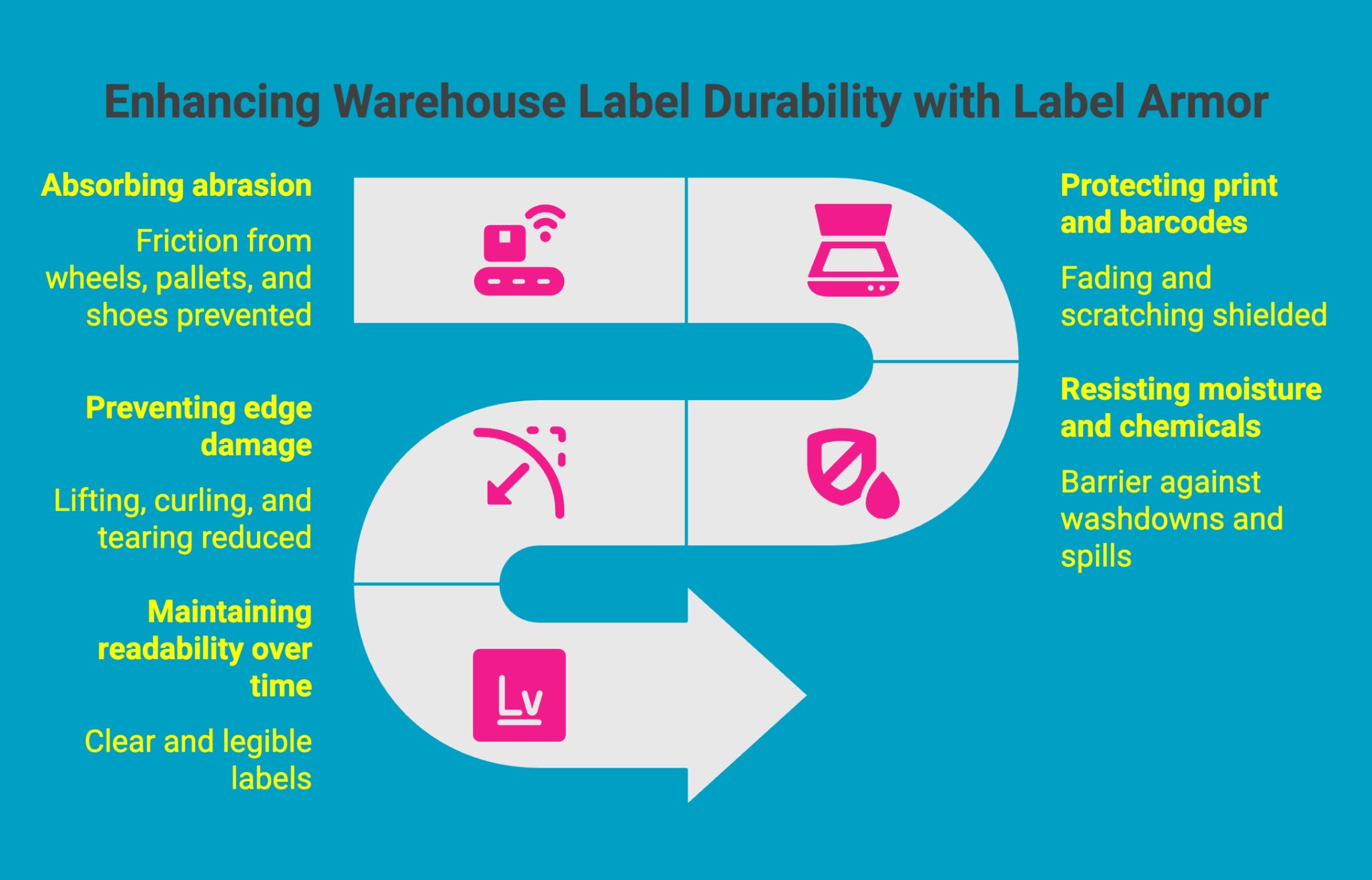
High-traffic warehouse areas can wear down floor labels quickly, even when durable materials are used. Label Armor adds a protective layer over the label, helping it withstand daily wear and stay readable longer. It is commonly used as one of the most effective warehouse floor label protectors.
Label Armor extends label life by addressing common wear issues:
-
Absorbing abrasion: It takes the friction from wheels, pallets, and shoes, preventing scuffing of the printed label.
-
Protecting print and barcodes: The overlay shields text and barcodes from fading and scratching, keeping scans reliable.
-
Resisting moisture and chemicals: It forms a barrier against washdowns, spills, and cleaning agents that can degrade labels.
-
Preventing edge damage: By reinforcing the label surface, it reduces lifting, curling, and tearing at the edges.
-
Maintaining readability over time: Labels remain clear and legible even in busy aisles and pick zones.
By acting as a protective buffer, Label Armor helps warehouse floor labels last longer, perform consistently, and require fewer replacements.
When Do Warehouse Floor Labels Work Better Than Overhead Signs?
Warehouse floor labels are especially effective in situations where quick, ground-level visibility matters more than long-distance viewing. Placed directly in the path of movement, they align naturally with how workers navigate aisles and work zones during daily tasks.
Warehouse floor labels work best when:
-
Operators are focused on the floor while driving forklifts or pallet jacks
-
Aisles, bays, or pick locations need fast identification
-
Layouts change, and signage must be updated with minimal disruption
-
Overhead space is limited or difficult to access
Overhead signs still play an important role in general navigation. Used together, overhead signage provides orientation, while warehouse floor labels deliver precise, point-of-use guidance where accuracy and speed matter most.
Where Are Warehouse Floor Labels Most Effective?
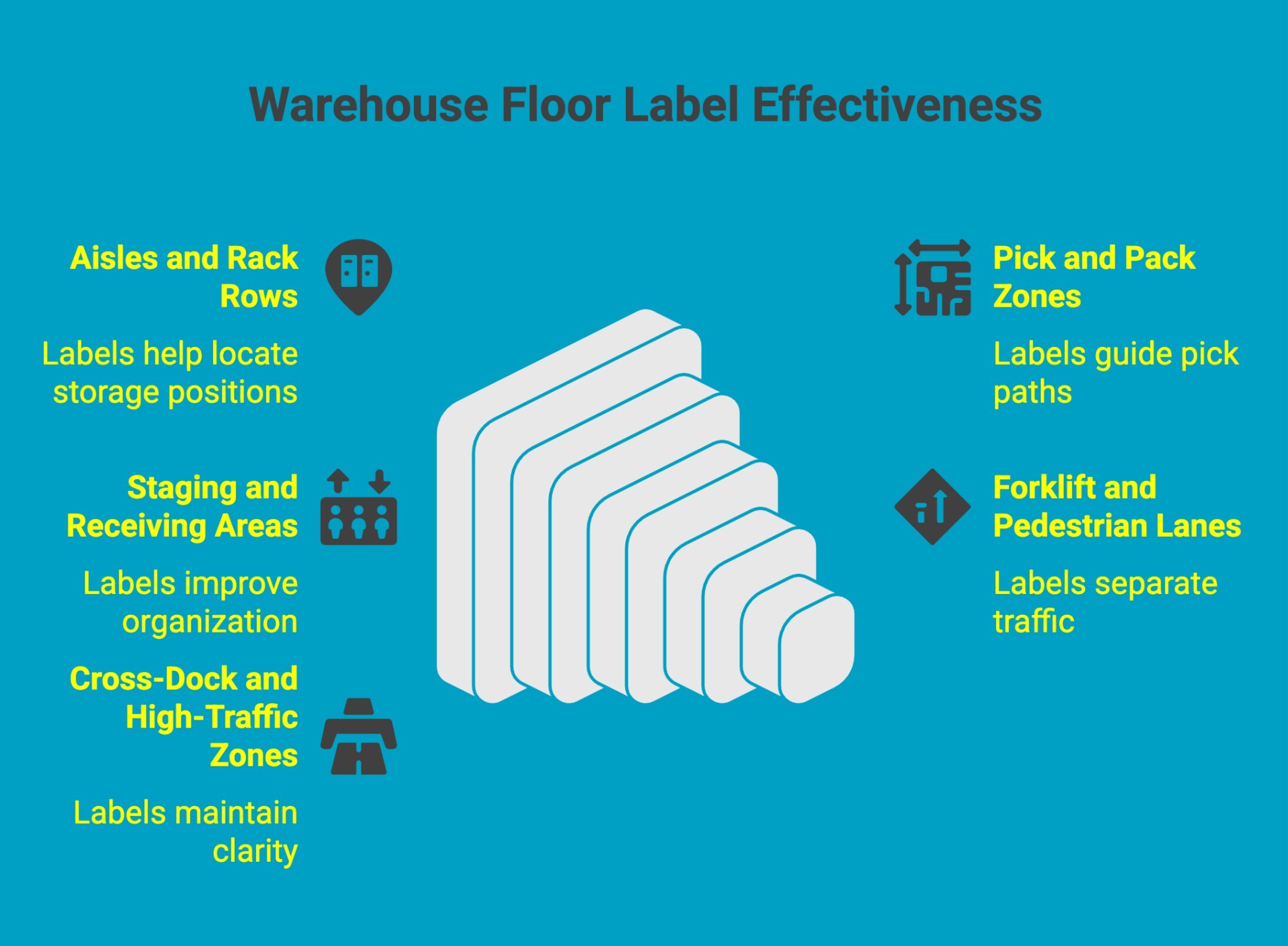
Warehouse floor labels deliver the most value in areas where movement is constant and clear guidance is essential. These are the spaces where workers make quick decisions and where visual clarity directly affects speed and accuracy.
Common areas where warehouse floor labels are most effective include:
-
Aisles and rack rows: Clear location labels help workers identify the correct storage positions without slowing down.
-
Pick and pack zones: Floor labels guide pick paths and reduce hesitation during order fulfillment.
-
Staging and receiving areas: Marked zones improve organization and prevent congestion or misplacement.
-
Forklift and pedestrian lanes: Visual floor cues help separate traffic and support safer movement.
-
Cross-dock and high-traffic zones: Durable labels maintain clarity even where traffic is constant.
By placing information exactly where work happens, warehouse floor labels improve flow, reduce confusion, and support more consistent operations across the facility.
How Can You Maximize the Lifespan of Warehouse Floor Labels?
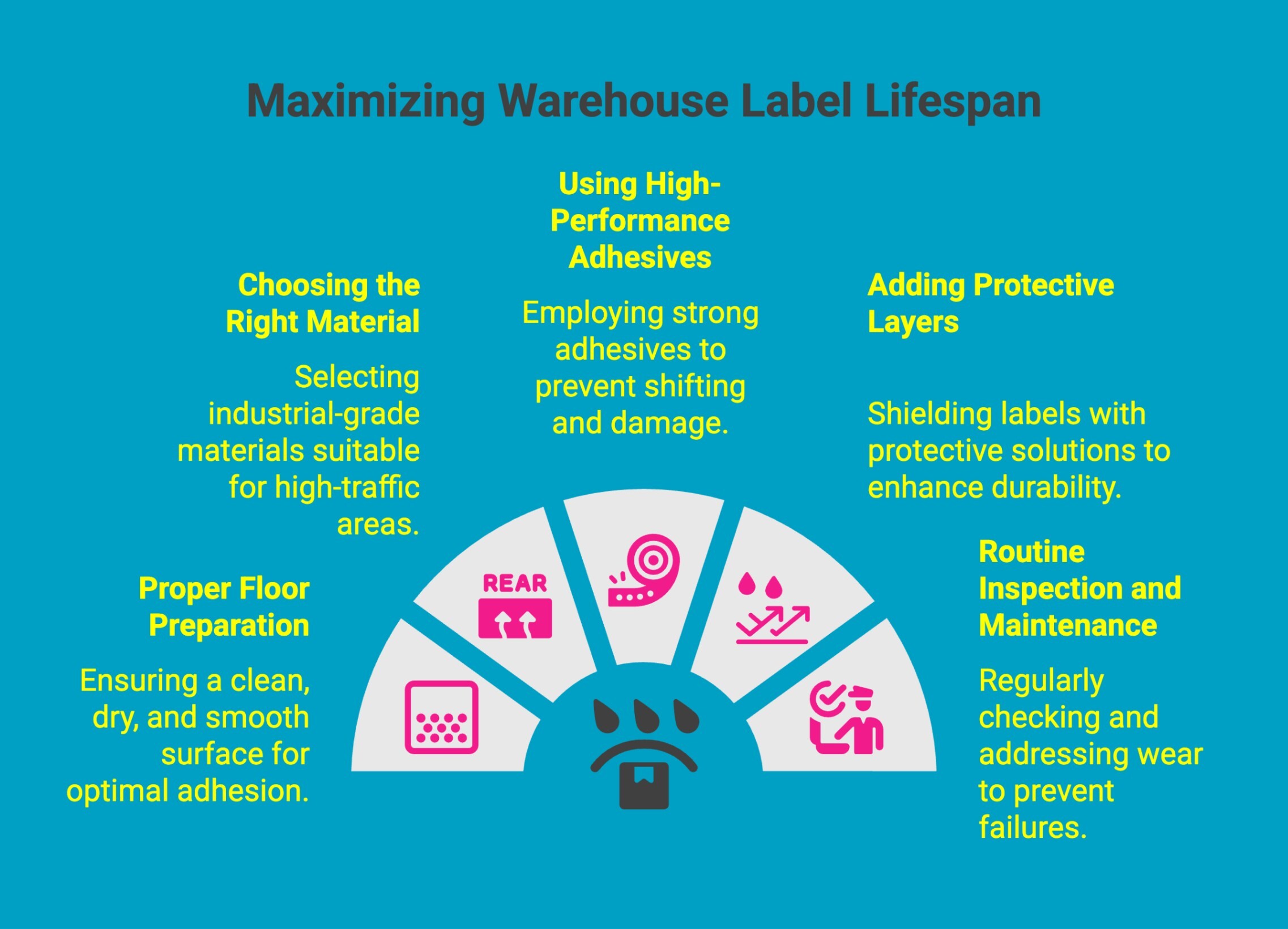
Long-lasting warehouse floor labels depend on how well they are prepared, installed, and protected. Focusing on these fundamentals helps reduce premature wear and keeps labels functional in busy environments.
1. Proper Floor Preparation
A clean, dry, and smooth surface is essential for strong adhesion. Dust, moisture, oil, or uneven concrete can prevent the label from bonding correctly, leading to early peeling or lifting once traffic resumes.
2. Choosing the Right Label Material
Different areas of the warehouse experience different levels of wear. High-traffic zones require thicker, industrial-grade materials that can handle repeated abrasion without cracking or fading.
3. Using High-Performance Adhesives
Warehouse adhesive floor labels rely on strong adhesives to stay in place under constant movement. Quality adhesives reduce shifting, curling, and edge damage caused by forklifts, carts, and foot traffic.
4. Adding Protective Layers
Protective solutions like Label Armor help shield labels from friction and impact. By taking the wear instead of the printed surface, the protective layer keeps labels readable and extends their usable life.
5. Routine Inspection and Maintenance
Regular checks allow teams to spot early signs of wear, such as scuffing or lifting. Addressing small issues early helps avoid scan failures, safety concerns, and frequent replacements.
Following these steps helps warehouse floor labels remain durable, legible, and reliable throughout daily operations.
How Do Warehouse Floor Labels Improve Safety and Efficiency?
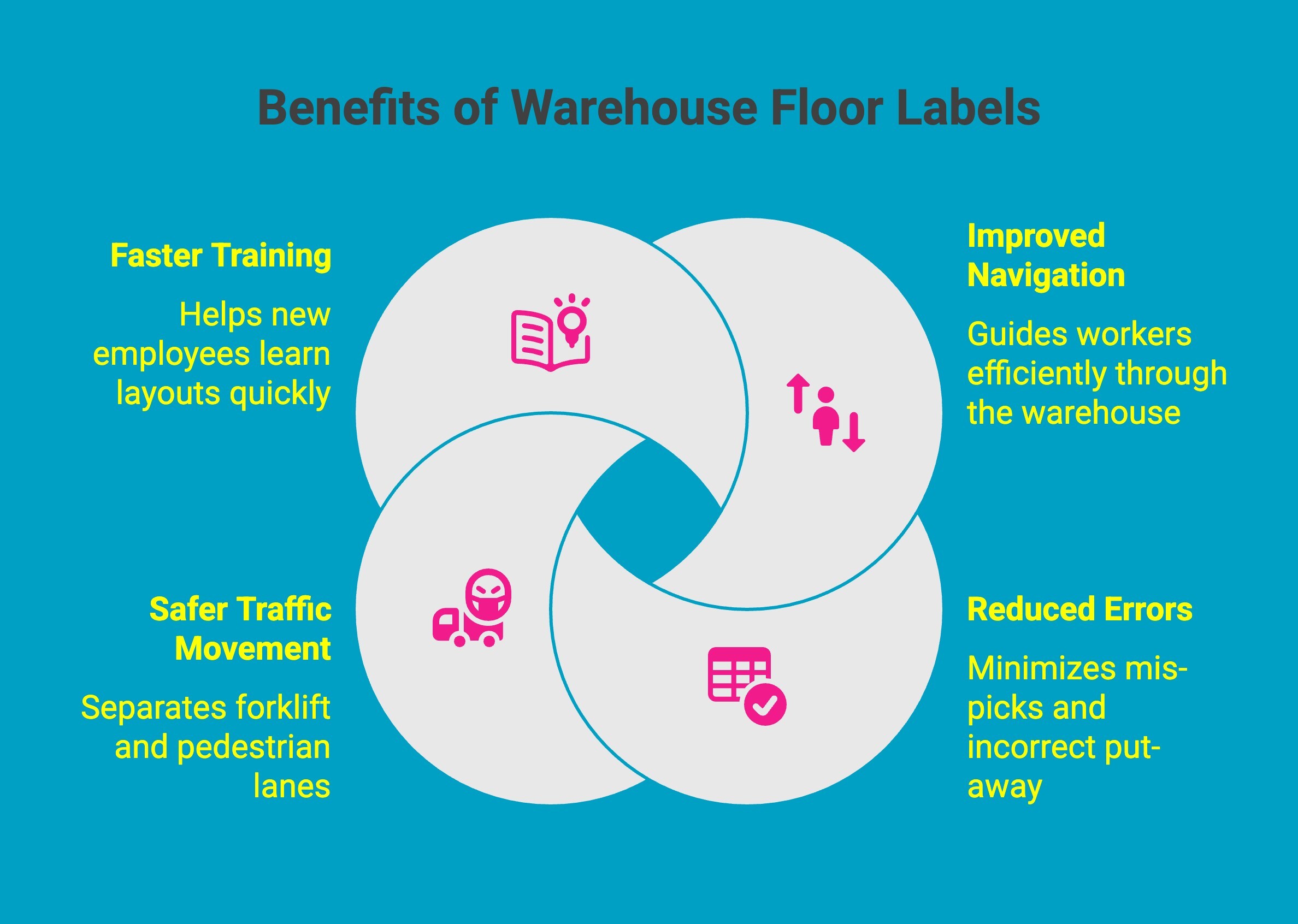
Clear floor labeling helps warehouses run more smoothly by removing guesswork from daily movement and decision-making. When locations, paths, and zones are clearly marked on the floor, workers spend less time searching and more time completing tasks accurately.
1. Improved Navigation and Workflow
Floor labels guide workers directly to aisles, bays, and pick locations. This reduces hesitation, shortens travel paths, and keeps work moving at a consistent pace, even during busy shifts.
2. Reduced Errors and Rework
Clearly marked locations and barcode-enabled floor labels help prevent mis-picks and incorrect put-away. When information is easy to see and scan, accuracy improves across picking, staging, and shipping.
3. Safer Traffic Movement
Warehouse floor labels help define forklift lanes, pedestrian walkways, and restricted areas. Visual separation of traffic reduces confusion and supports safer movement throughout the facility.
4. Faster Training and Onboarding
New employees can learn warehouse layouts more quickly when locations and zones are clearly labeled on the floor. This shortens training time and helps new staff work confidently sooner.
By improving visibility at the point of action, warehouse floor labels support safer operations, faster workflows, and more consistent performance across the warehouse.
How Do You Choose the Right Warehouse Floor Labels?
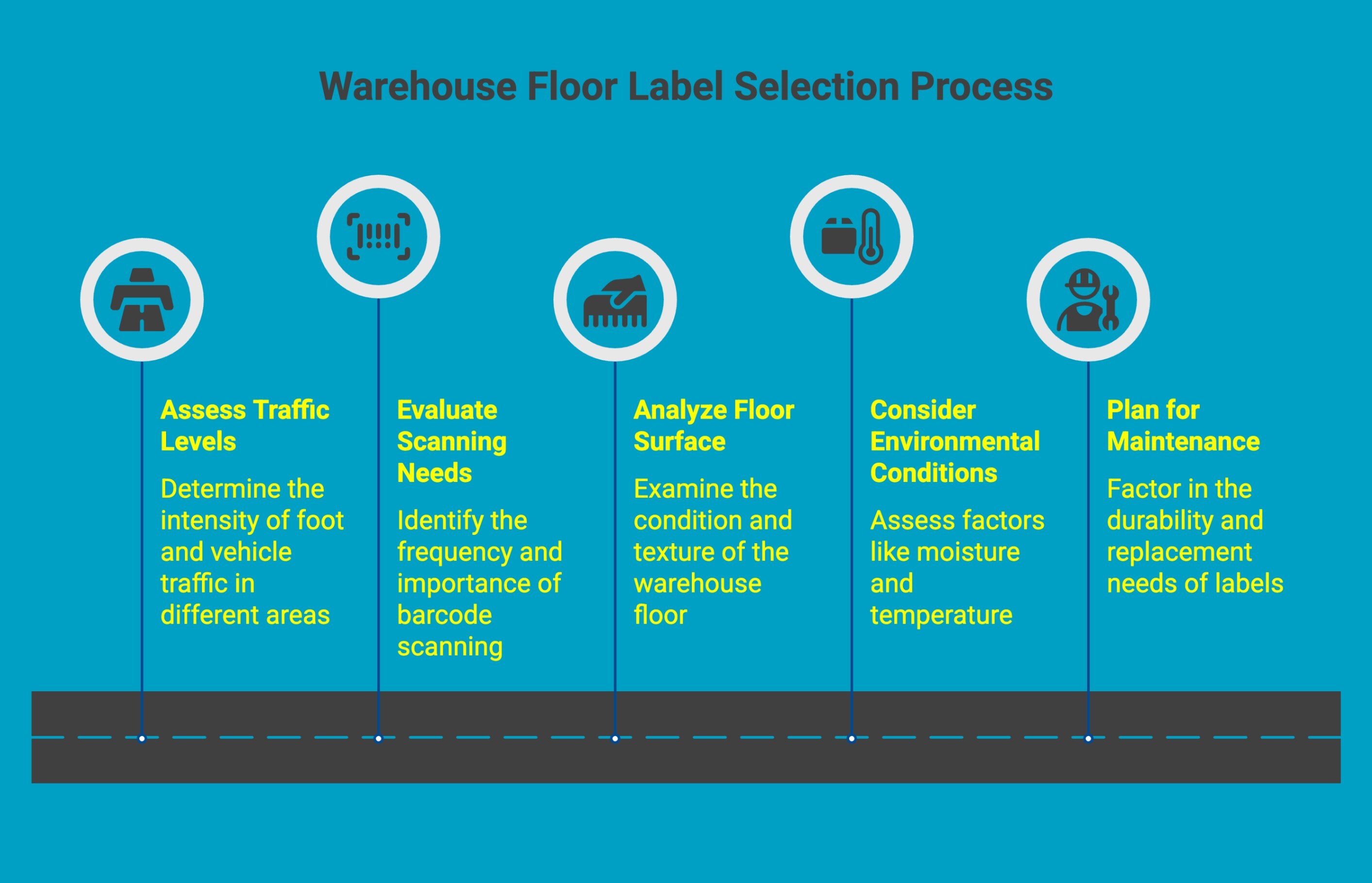
Selecting the right warehouse floor labels depends on how and where they will be used. Traffic levels, scanning needs, and floor conditions all influence which labels perform best over time.
1. Traffic and Usage Level
High-traffic aisles, pick paths, and staging zones require more durable materials and added protection. Low-traffic areas may perform well with standard-duty labels.
2. Barcode and Scanning Requirements
If locations are scanned regularly, warehouse floor barcode labels must remain clear and readable. Print quality and surface protection play a key role in scan reliability.
3. Floor Surface Type
Concrete condition, sealing, and texture affect adhesion. Smooth, well-prepared floors allow labels to bond securely, while rough surfaces may require more robust adhesive solutions.
4. Environmental Conditions
Cleaning routines, moisture exposure, and temperature changes can impact label performance. Choosing materials designed for these conditions helps prevent early failure.
5. Long-Term Maintenance and Replacement
Considering durability upfront helps reduce how often labels need to be replaced. Using protective solutions like Label Armor in demanding areas can lower long-term maintenance efforts.
Choosing warehouse floor labels with these factors in mind ensures consistent performance and supports a more efficient, organized warehouse layout.
Why DuraFast Label Is a Smart Choice for Your Warehouse Floor Labels?
If you are dealing with faded aisle markers, peeling barcodes, or floor labels that need constant replacement, DuraFast Label Company is built for exactly that problem. At DuraFastLabel.ca, we focus on helping you print durable, long-lasting warehouse floor labels in-house, so you stay in control of quality, timing, and costs.
Instead of a one-size-fits-all approach, we offer options that match how your warehouse actually operates. From tough label materials and strong adhesives to protective solutions like Label Armor, everything we provide is designed to hold up in high-traffic aisles, pick zones, and staging areas.
Why this works for you:
-
We help you print warehouse floor labels on demand, without waiting for reorders
-
Our materials are built to withstand forklifts, foot traffic, and routine cleaning
-
We offer Label Armor to extend label life where wear happens fastest
-
Our printers, supplies, and support are designed to work together
If your goal is fewer replacements, clearer locations, and more reliable scanning, we help you build a warehouse floor labeling system that lasts.
Final Words
A well-marked warehouse floor does more than show locations. It sets the pace for how smoothly people move, scan, and work throughout the day.
When floor labels are built to last and protected where traffic is highest, they stay out of the way and do their job without constant fixes or replacements. Everything feels more organized because the guidance is always there when it is needed.
If you want a warehouse floor that supports your team instead of slowing them down, durable warehouse floor labels are a simple improvement with lasting impact.
Frequently Asked Questions
What are the OSHA floor markings for warehousing?
OSHA-aligned floor markings use floor marking tape, floor signs, and internal line marking to define traffic lanes, forklift traffic, safety signs, aisle signs, and specific locations, creating clear visual cues for a safer warehouse environment.
What are the 4 types of product labels?
The four common types of product labels include product information labels, pallet labels, rack labels, and adhesive barcode labels. Together, they support accurate inventory control, inventory management, traceability, and efficient operations across warehouses and distribution centers.
What type of barcode is used in a warehouse?
Warehouses commonly use adhesive barcode labels, including QR codes and linear barcodes, to support real-time inventory tracking. These labels are applied to storage locations, pallet positions, and racks, enabling accurate scanning, faster picking, and better visibility across the warehouse layout.
How to mark a warehouse floor?
A warehouse floor is typically marked using floor marking tape, industrial floor signs, and warehouse floor labels. These tools help define traffic lanes, storage zones, equipment areas, and safety pathways, improving navigation, compliance, and overall operational efficiency.
What do I use to make lasting lines on a warehouse floor?
To create long-lasting lines on a warehouse floor, companies use industrial floor marking tape or heavy-duty warehouse floor labels. These products are designed to withstand forklifts, foot traffic, and cleaning equipment without fading or peeling.
What does the company use to label raw sheets of metal?
Companies label raw sheets of metal using durable warehouse labels with high-tack adhesives and protective laminates. These labels are built to resist abrasion, moisture, oils, and harsh handling conditions common in industrial and manufacturing environments.
Are floor labels the best solution for my warehouse?
In most warehouse environments, floor labels are an effective solution for improving visibility, organization, and workflow. They are easier to update than paint, highly durable, and help streamline operations while supporting safety and compliance requirements.