Product Label Size: How to Measure, Choose, and Order the Right Dimensions
21st Jul 2026
Key Highlights
-
Product label size depends on container shape, design layout, and application method.
-
Label dimensions are always written in width × height format.
-
Portrait and landscape orientations affect printing and machine alignment.
-
Standard sizes range from small (2″×2″) to large wrap formats.
-
Correct measuring prevents wrinkles, peeling, and misalignment issues.
-
Machine application requires precise roll, core, and unwind specifications.
-
Confirming width, height, and orientation before ordering prevents reprints and application errors specific to roll-fed machine setups.
-
Selecting the right size improves appearance, efficiency, and reorder accuracy.
Choosing the wrong product label size is one of the most common and costly ordering mistakes businesses make.
Labels that wrinkle, peel, apply sideways, or cover critical product details often trace back to a sizing or orientation error made before production began.
This guide explains how label dimensions are measured, how orientation affects printing and machine alignment, and what to confirm before placing your order.
What Is the Size for a Product Label?
There is no single standard size for a product label. The correct size depends on your packaging, design, and application method. Choosing the right dimensions ensures your label fits properly and looks professional.
To simplify the process, many suppliers provide guidance to help match label size to container type. This ensures you select the ideal fit for your specific bottles, jars, tins, or other packaging formats.
To determine the correct size, consider the following factors.
-
Shape of container, such as a bottle, jar, or pouch.
-
Whether labels are machine-applied or hand-applied.
-
Amount of text, barcode, and required information.
-
Overall branding layout and design spacing needs.
-
Regulatory labeling requirements for your industry.
Taking a few minutes to measure your container and review your design can save you from costly reprints and frustration later.
Explore Direct Thermal Labels designed for short-term applications like shipping and barcode printing.
How Are Product Label Sizes Measured?
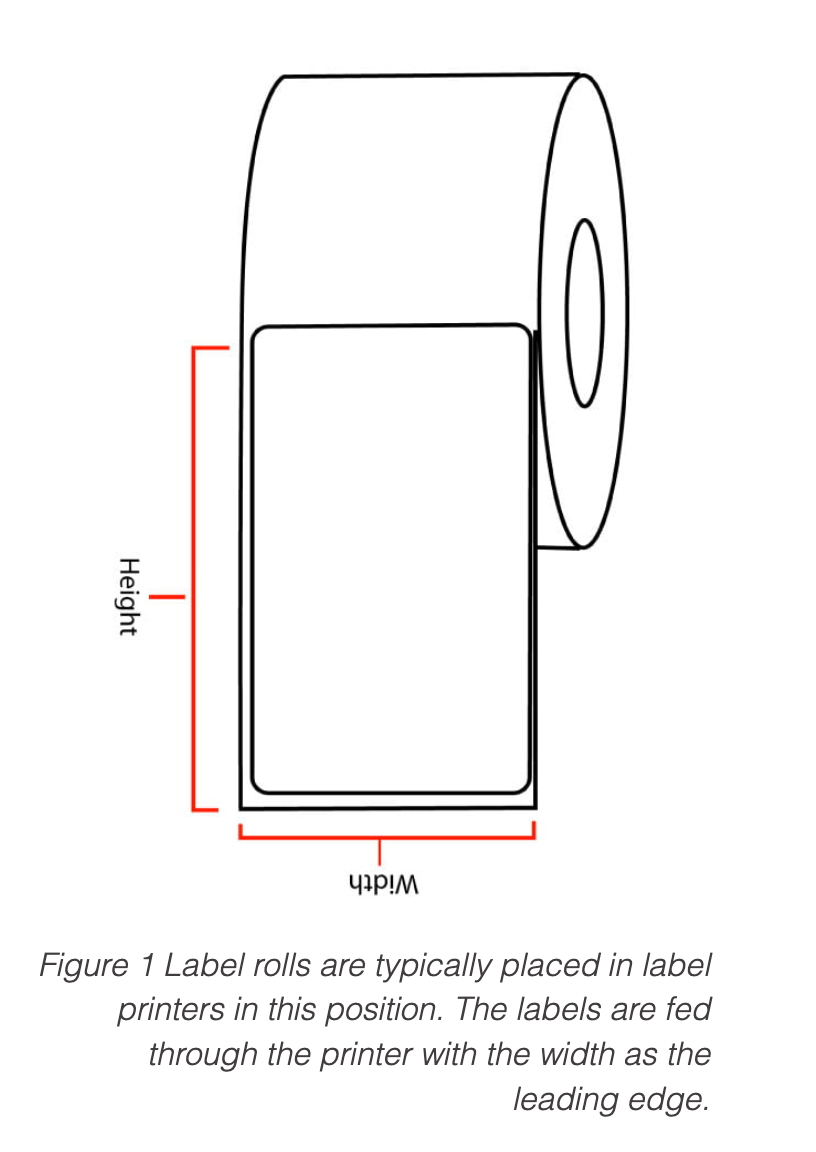
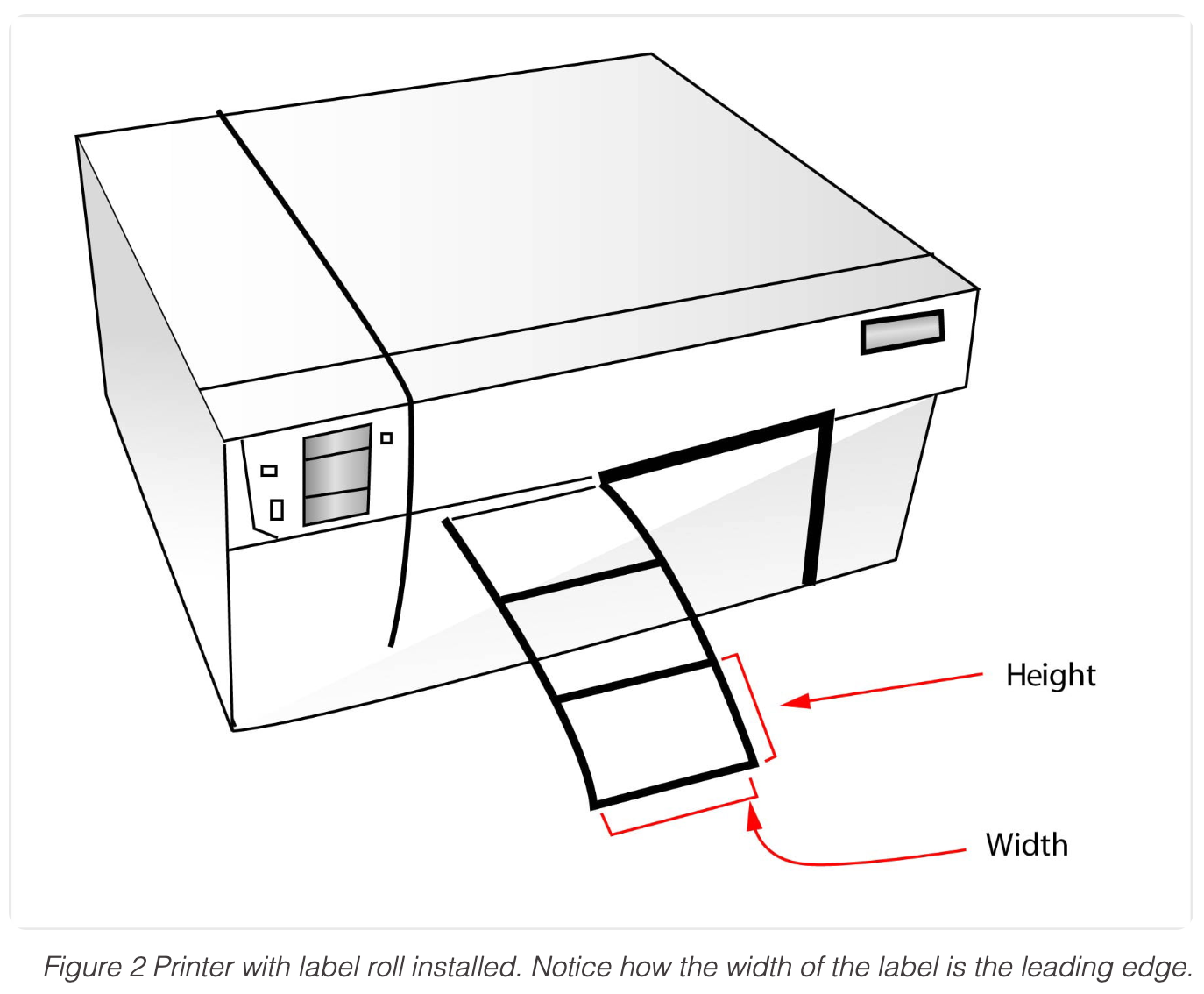
Product label sizes follow a standard format to avoid confusion during printing and production. Understanding how width and height are defined helps ensure your artwork prints correctly and feeds properly through the equipment.
Label sizes are always written as width by height.
Here is what each measurement means.
-
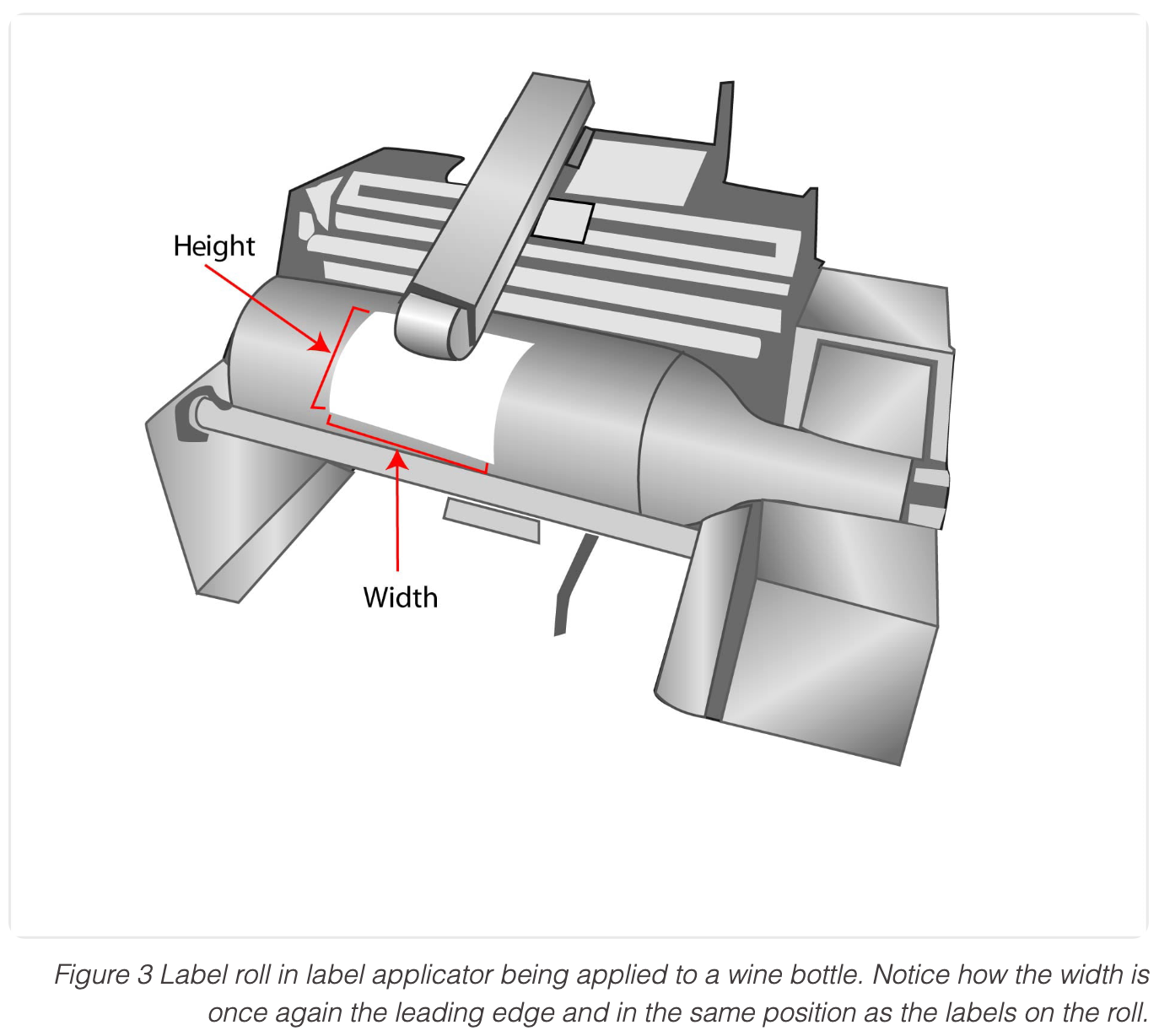
Width is measured across the roll, left to right.
-
Height is measured along the roll feed direction.
This becomes especially important when ordering roll labels. If width and height are reversed, the artwork may rotate incorrectly and create alignment issues during application.
Practical Example: Round Jar Laid on Its Side in a Wrap Applicator
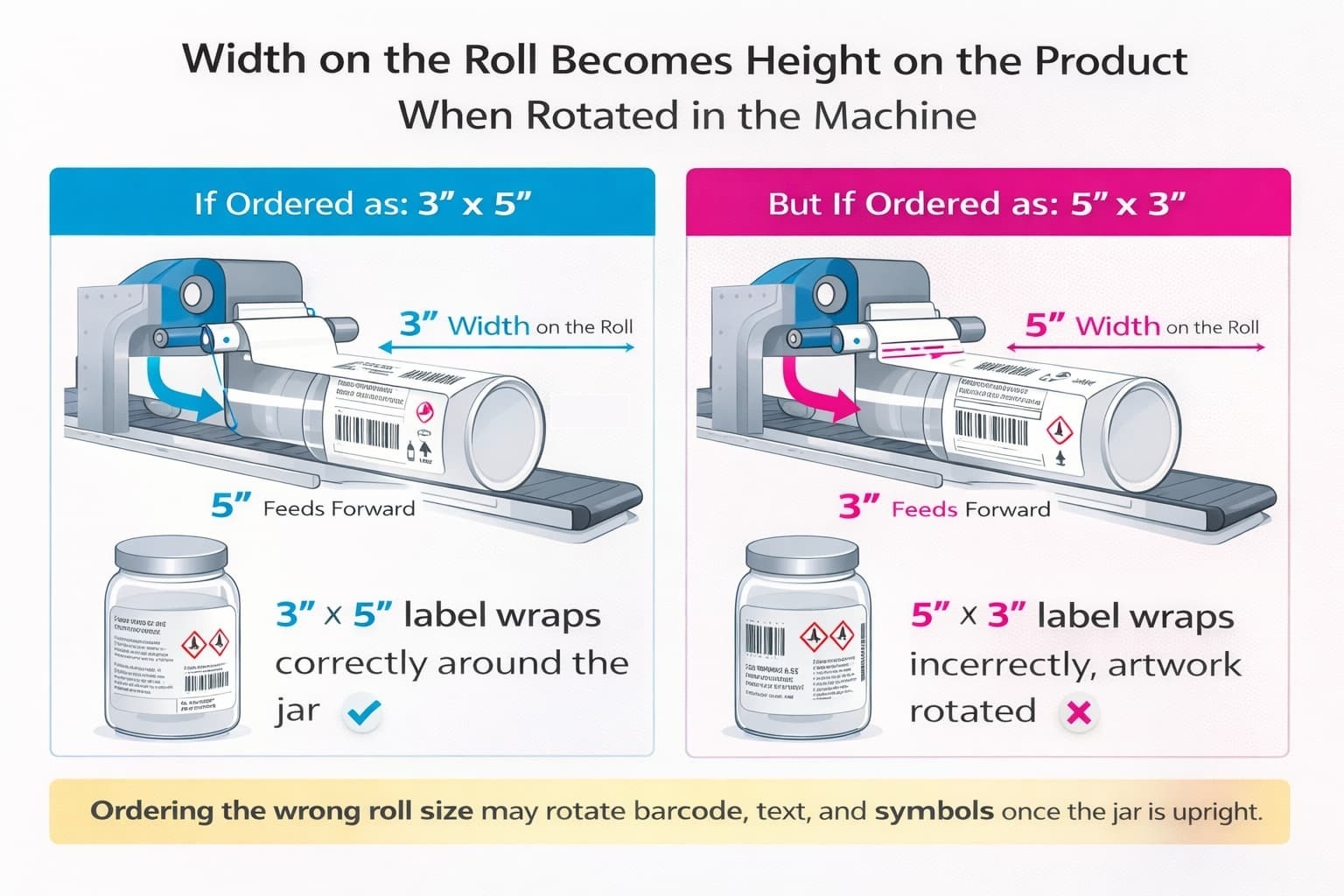
Imagine you are applying a wrap label to a round jar using an automatic wrap applicator.
The jar does not stand upright during labeling. It enters the machine, laid on its side, and the applicator rotates the jar while the label feeds horizontally across its surface.
You order the label as:
3" × 5"
-
3 inches runs across the roll (width).
-
5 inches feeds forward through the machine (height).
On the roll, this makes perfect sense. But inside the applicator, the jar is rotating.
Because the jar is laid on its side:
-
The 5-inch feed direction now wraps around the circumference
-
The 3-inch width becomes the vertical dimension once the jar is standing upright on the shelf
In other words:
What is width on the roll becomes height on the finished product when the item is rotated in the machine.
How Does Label Orientation Affect Product Label Size?
Orientation determines how your artwork sits on the label. Even if the size is correct, the wrong orientation can affect printing, feeding, and final application on your product.
There are two primary label orientations, Portrait and Landscape.
-
Portrait orientation where height is greater than width.
-
Landscape orientation where width is greater than height.
Portrait orientation is common for tall bottles and narrow packaging. Landscape orientation is common for jars and wide containers.
If you are using a labeling machine, orientation must match several setup factors.
-
Feed direction of the labeling machine.
-
Unwind direction required for proper application.
-
Sensor placement used to detect label gaps.
Incorrect orientation can result in sideways or upside-down applications, sensor misreads, and production slowdowns.
For hand application, orientation is more flexible, but it still affects how your label looks and presents on the finished product.
Working in harsh or industrial conditions? See our Industrial Label materials built for chemical exposure, abrasion, and outdoor environments.
What Are Standard Product Label Sizes?
Product label sizes vary depending on the type of container and design needs. However, there are several commonly used sizes that serve as helpful starting points when planning your packaging.
Here are general reference sizes grouped by category.
Small label sizes commonly include:
Small labels such as 2" × 2" and 2" × 3" are commonly used for spice jars, cosmetic tubes, essential oil bottles, and small retail packaging. These are often ordered as inkjet labels or prime roll labels from DuraFast Label Company's custom roll label range.
-
Two-inch by two-inch square labels (2" × 2").
-
Two-inch by three-inch vertical labels (2" × 3").
-
Three-inch by two-inch horizontal labels (3" × 2").
Medium label sizes commonly include:
Medium sizes like 3" × 4" and 4" × 3" are frequently applied to food containers, supplement bottles, craft beverage packaging, and health and beauty products. They are commonly produced as prime labels, thermal transfer labels, or durable product labels through DuraFast Label Company.
-
Three-inch by three-inch square labels (3" × 3").
-
Three-inch by four-inch rectangular labels (3" × 4").
-
Four-inch by three-inch horizontal labels (4" × 3").
Large label sizes commonly include:
Large labels such as 4" × 5" and 5" × 5" are typically used for chemical drums, warehouse cartons, shipping boxes, and compliance labeling. These are often ordered as thermal transfer labels, GHS labels, or industrial roll labels from DuraFast Label Company's industrial labeling solutions.
-
Four-inch by five-inch large format labels (4" × 5").
-
Five-inch by five-inch square labels (5" × 5").
-
Custom wrap sizes for full container coverage.
These are general reference sizes. Your final product label size should always be based on your exact container measurements.
Looking for tracking and inventory visibility solutions? See DuraFast Label Company's RFID Labels options designed for logistics, warehousing, and asset management.
How Do You Measure the Correct Product Label Size?
Measuring your container correctly ensures the label fits neatly and applies without wrinkles or lifting edges. Taking a few extra minutes to measure properly can prevent reprints and application problems later.
Follow these clear steps before finalizing your label size.
Step 1: Measure Container Width
Start by measuring the total width of the area where the label will wrap or sit.
-
For cylindrical containers, measure the full circumference using a flexible tape.
-
Subtract a small gap so label edges do not overlap.
-
For flat surfaces, measure only the smooth printable area.
Step 2: Measure Available Height
Next, determine how much vertical space is safely available for the label.
-
Measure the straight vertical space available for the label.
-
Leave space near the top and bottom curved areas.
-
Avoid seams, ridges, embossing, or uneven surfaces.
Step 3: Confirm Application Method
Finally, confirm how the label will be applied before locking in the size.
-
Machine-applied labels require exact size and alignment.
-
Orientation and roll setup must match your equipment.
-
Hand-applied labels allow more flexibility but still need a proper fit.
Accurate measurements and proper planning help ensure your labels apply smoothly and look professional on every product.
Want retail-ready packaging with premium finish quality? Discover our Prime Label options for high-impact branding and shelf presentation.
What Are Common Mistakes When Selecting Label Sizes?
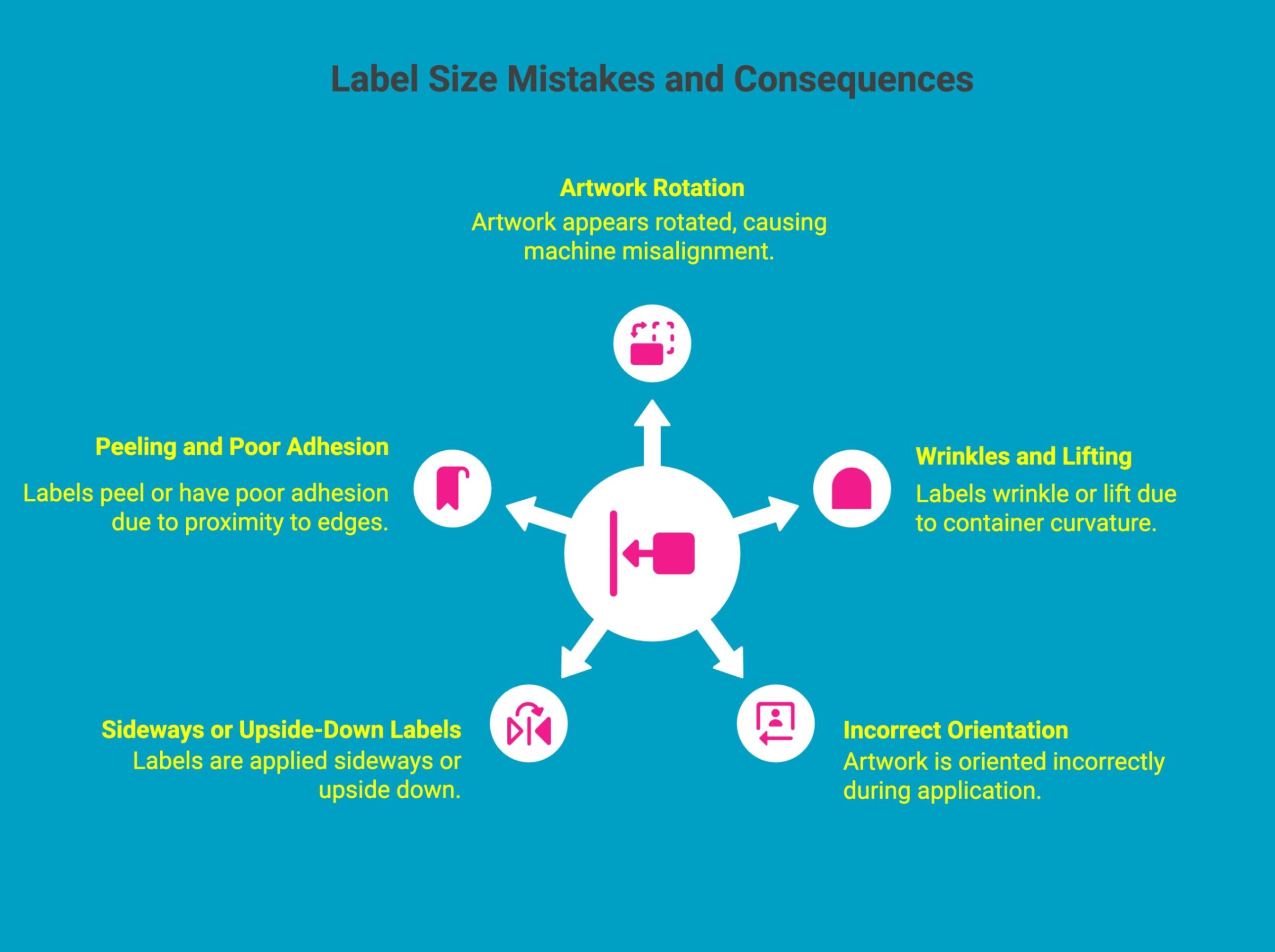
Choosing the wrong label size usually happens during early planning stages. Small measurement or configuration errors can create printing problems, application issues, and wasted inventory.
Here are common mistakes and what they can cause.
-
Reversing width and height causes the artwork to be rotated and machine misalignment.
-
Ignoring container curvature, leading to wrinkles or lifting edges.
-
Designing artwork first, resulting in incorrect orientation during application.
-
Overlooking the machine feed direction, causing sideways or upside-down labels.
-
Choosing a size too close to the edges leading to peeling and poor adhesion.
These issues often lead to reprints, wasted materials, extra adjustments, and costly production delays.
How Does Machine Application Compare to Hand Application?
The way you apply labels directly affects sizing, roll setup, and alignment. Machine application requires precise configuration, while hand application offers more flexibility but still benefits from proper planning.
If You Use a Labeling Machine
When using a machine, both label size and roll configuration must match your equipment requirements.
-
Ensure label size matches your applicator setup exactly.
-
Confirm the correct roll direction for smooth feeding.
-
Verify the core size fits securely on the machine spindle.
-
Check the maximum roll diameter your machine supports.
-
Specify the correct unwind direction for proper alignment.
Even if the label fits the container, incorrect roll setup can cause feeding issues and production delays.
If You Apply Labels by Hand
Hand application allows more flexibility, but proper sizing still ensures better results.
-
Avoid unintended overlap that causes lifting edges.
-
Ensure the design stays upright during placement.
-
Choose a size that is easy to align.
-
Leave small margins near curved edges.
-
Test one label before the full application run.
Taking these steps helps maintain clean, consistent labeling regardless of your application method.
Not sure if inkjet labels are right for your printing setup? See our Inkjet Label options to match print quality and material to your product packaging.
Why Does Product Label Size Matter When Ordering?
Choosing the right product label size is more than just making it fit. It affects how your product looks, how smoothly it runs in production, and how easy it is to reorder later. Getting it right the first time saves time and money.
Understanding product label sizes helps ensure the following.
-
Labels fit your packaging properly every single time.
-
Your design looks neat, centered, and professionally placed.
-
Artwork prints clearly without getting cut off.
-
You avoid wasting material from incorrect sizing.
-
Reordering the same size is simple and stress-free.
When your label size is correct, everything feels smoother from printing to packaging to future reorders.
Printing labels in an office environment? Explore our Laser Labels for small-batch and administrative applications.
What Should You Confirm Before Ordering From DuraFast?
Now that you understand how label size, orientation, unwind direction, and winding type work together, the next step is applying that knowledge when placing your order with DuraFast.
When ordering custom roll labels, barcode labels, shipping labels, prime labels, GHS labels, or industrial roll labels, you will be required to confirm specific configuration details. These fields directly determine how your labels are produced and how they will perform in your printer or applicator.
Here is exactly what to confirm before completing checkout:
1. Enter Size in Width × Height Format
On DuraFast product pages, label size must be entered as Width × Height.
-
Width is measured across the roll
-
Height is measured in the feed direction
Do not reverse these numbers. A 4" × 6" label is not the same as 6" × 4".
If your product rotates inside an applicator, confirm which dimension feeds forward before submitting your size.
2. Select the Correct Unwind Direction
You will need to specify the unwind direction for roll labels used in printers or applicators.
Before selecting Direction 1, 2, 3, or 4:
-
Confirm which edge of the label feeds first
-
Check your printer or applicator manual
-
Verify how the product moves through the machine
If this selection is incorrect, labels may print or apply sideways.
3. Confirm Inside Wound or Outside Wound
During ordering, you may see a field for winding type.
-
Outside wound is the default at DuraFast
-
If your equipment requires an inside wound, you must state this clearly
If you do not specify the inside wound when required, labels will be produced as outside wound.
4. Verify Core Size
You will need to confirm your required core diameter, typically:
-
1-inch core
-
3-inch core
This must match your printer or applicator spindle.
5. Check Maximum Roll Diameter
If you are running automatic labeling equipment, confirm your machine’s maximum roll diameter before ordering. Larger rolls reduce changeovers, but must fit your equipment.
If any of these specifications are unclear, contact DuraFast before placing your order.
Provide:
-
Your printer make and model.
-
Your applicator type.
-
Whether labels are applied by hand or machine.
-
How the product is positioned during labeling.
DuraFast Label Company's team can confirm the correct size format, unwind direction, winding type, and roll configuration so your labels run correctly, the first time.
Applying what you learned in this guide at the ordering stage prevents costly mistakes and ensures your labels arrive ready to perform.
Why Partner with DuraFast Label Company for Your Business?
Measured your container and ready to order? DuraFast Label Company can review your dimensions, confirm orientation, and verify roll specifications before production begins, so your labels fit correctly the first time.
Whether you require durable industrial labels, vibrant prime labels, waterproof materials, or bulk pallet orders, we provide flexible solutions backed by fast nationwide delivery. Our team also offers printer cleaning supplies, spare printheads, and expert guidance to keep your operations running smoothly.
Request free label samples in your size before committing to a full run, or call us with your container measurements, and we will recommend the right format and material for your product.
Final Thoughts
There is no single universal product label size, but understanding how measurements, orientation, and application methods work together removes most of the guesswork. The key next step is to measure your container carefully, confirm how the label will be applied, and review your artwork layout before placing an order.
Whether you are launching a new product, moving to automated labeling, reordering existing labels, or scaling production, choosing the correct label size ensures smoother operations, stronger shelf presence, and fewer costly adjustments later.
Frequently Asked Questions
Are there any regulations for minimum or maximum product label sizes?
Yes, regulations may specify minimum text height and required surface area for mandatory disclosures, but rarely enforce strict maximum dimensions. Requirements differ by product type, country, and safety category, particularly for health, chemical, or hazard-related labeling applications worldwide.
Where can I find templates for different product label sizes?
You can find professionally designed label templates from printer manufacturers, packaging suppliers, and online design platforms. These templates include preset dimensions, bleed guides, and layout structures, helping businesses customize artwork accurately before approving final production files for printing.
How do label size requirements differ for non-food consumer products?
For non-food products, sizing is influenced by durability requirements, warning statements, and regulatory compliance standards instead of nutrition panels. Electronics, cosmetics, and chemical goods often require safety icons, instructions, or certification marks, affecting overall dimensions significantly.
What must be included on a product label regardless of its size?
Regardless of dimensions, a label must clearly display essential information that strengthens brand identity, including product name, manufacturer details, ingredients when applicable, and legally required disclosures to ensure transparency, traceability, and consumer awareness across markets.
What is the size of a traditional label?
There is no single traditional measurement, but many businesses rely on standard label sizes such as 2″×3″ or 3″×5″ for retail packaging. Final dimensions depend on container proportions, placement area, and overall design requirements.
Is A4 for labels?
A4 refers to a sheet paper size rather than an individual label measurement. However, multiple die-cut labels are commonly arranged on A4 sheets for efficient label printing during short-run jobs or office-based production workflows.
What is the most popular label size?
Popularity varies across different industries, but dimensions often align with packaging proportions and consumer visibility. A 2″×4″ rectangular label is frequently used because it balances readability, branding space, and efficient material usage.
What is the size of a 3x5 label in MM?
A 3″×5″ label converts to approximately 76.2 mm by 127 mm. Choosing the right label size ensures artwork fits proportionally while maintaining readability, alignment, and compatibility with container dimensions or packaging layouts.
Is a shipping label the size of a normal page too big?
Yes, a full-page label is generally oversized for shipping needs. Businesses usually select dimensions appropriate for their target market and carrier requirements, with 4″×6″ labels considered more practical and cost-efficient for logistics operations.
What tools can I use to measure label sizes accurately?
To determine the exact size of the product label, use digital calipers, precision rulers, dieline files, or design software measurement tools. Accurate measurements support proper alignment, scaling, and compatibility with packaging specifications and printing equipment.