Why Do Laminated Labels Last Longer Than Standard Labels?
13th Feb 2026
Key Highlights
-
Laminated labels protect printed information from water, heat, chemicals, and abrasion in demanding environments
-
Brother P-touch printers produce laminated labels using durable, ink-free laminated thermal labels
-
Self-laminating labels provide extra protection for cables, wires, and harsh industrial settings
-
Laminated barcode labels improve scan accuracy, compliance, and long-term inventory tracking
-
Laminated name labels and laminated sticker labels are ideal for kitchens, schools, and offices
-
Label gloss laminate improves readability, scratch resistance, and UV protection
-
DuraFast Label Canada supplies genuine Brother laminated labels, including tamper-evident options
Most labels fail long before the job they identify. Heat, moisture, cleaning chemicals, and frequent handling quickly expose the limits of standard labels. When they peel, fade, or smudge, the result is unreadable information, misidentification, compliance risks, and unnecessary relabelling that slows teams down.
Laminated labels are designed to solve this problem at the source. By sealing printed text beneath a clear protective layer, laminated labels stay legible despite abrasion, temperature changes, and harsh cleaning routines. This durability makes them essential in kitchens, laboratories, warehouses, healthcare facilities, industrial sites, and anywhere long-term identification matters.
This guide explores what makes laminated labels different from basic options, how Brother P-touch label makers produce laminated thermal labels, and which laminated label types suit specific applications. It also highlights where Canadian businesses can purchase dependable laminated labels and compatible tapes through DuraFastLabel.ca, helping ensure labels remain clear, secure, and readable long after application.
What Makes Laminated Labels Different from Standard Labels?
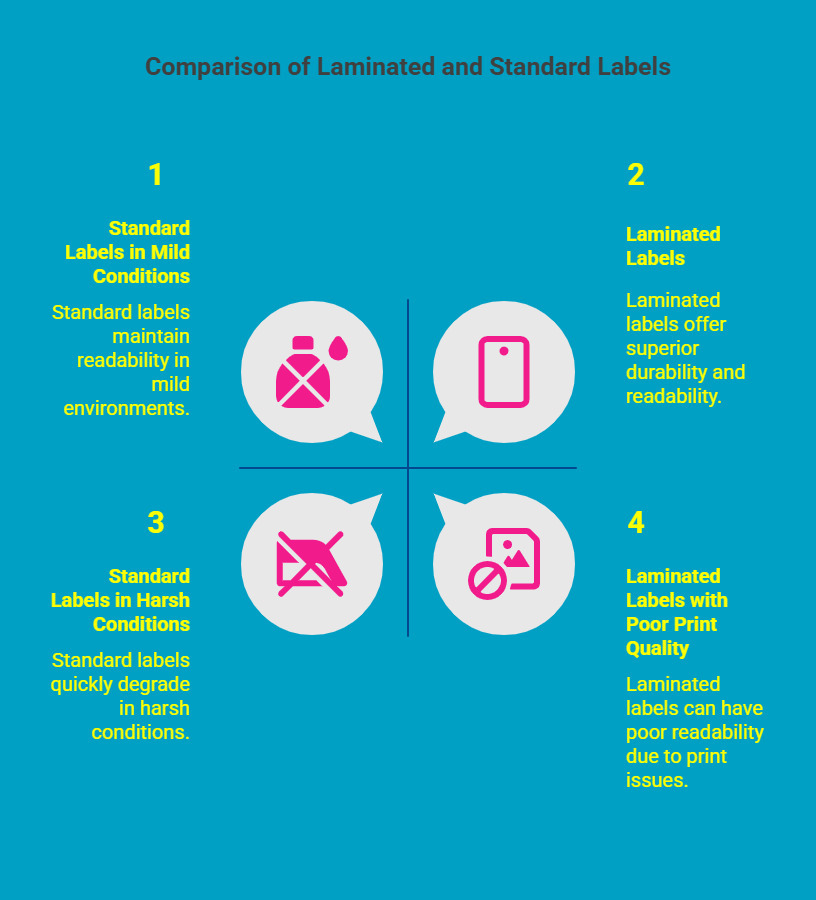
Laminated labels are designed for environments where labels are exposed to moisture, heat, cleaning agents, and frequent handling. Unlike standard labels, the printed information is protected, not left exposed, which significantly improves durability and readability over time.
1. Multi-Layer Protection That Seals the Print
Laminated labels use a layered construction where the print sits between the label material and a clear protective laminate. This laminate acts as a barrier against water, chemicals, friction, and temperature changes, preventing common causes of label failure.
2. Clear, Long-Lasting Readability
Standard labels rely on exposed ink or toner, which can smudge, fade, or wear away with regular use. Laminating labels preserves contrast and sharpness, ensuring text and barcodes remain legible even after repeated cleaning or contact.
3. Built for Real-World Use
Because of their protective structure, laminated labels perform reliably on food containers, cables, machinery, shelving, and inventory systems. They are especially valuable in kitchens, warehouses, laboratories, and industrial settings where label replacement is disruptive.
4. Better Performance Over Time
For applications that require identification to remain intact for months or years, laminated labels consistently outperform non-laminated options. They reduce relabelling frequency, minimize errors, and support long-term operational clarity.
Laminated labels are built to last where standard labels fail. They provide dependable identification in demanding environments without the need for frequent replacement or maintenance.
What Are Self-Laminating Labels and When Should You Use Them?
Self-laminating labels feature an integrated clear laminate flap that seals the printed area immediately after application. This protects the text without requiring separate lamination steps or additional equipment.
They are used where labels face abrasion, moisture, oils, or chemical exposure. The laminate prevents smudging and wear while maintaining legibility on curved, narrow, or uneven surfaces.
Common use cases include:
-
Wire and cable identification
-
Electrical panels and control cabinets
-
Industrial equipment labelling
Compared to standard laminating labels, self-laminating labels reduce application time and deliver consistent protection in demanding environments where label failure is not acceptable.
How Are Laminated Thermal Labels Printed Using Brother P-touch Printers?
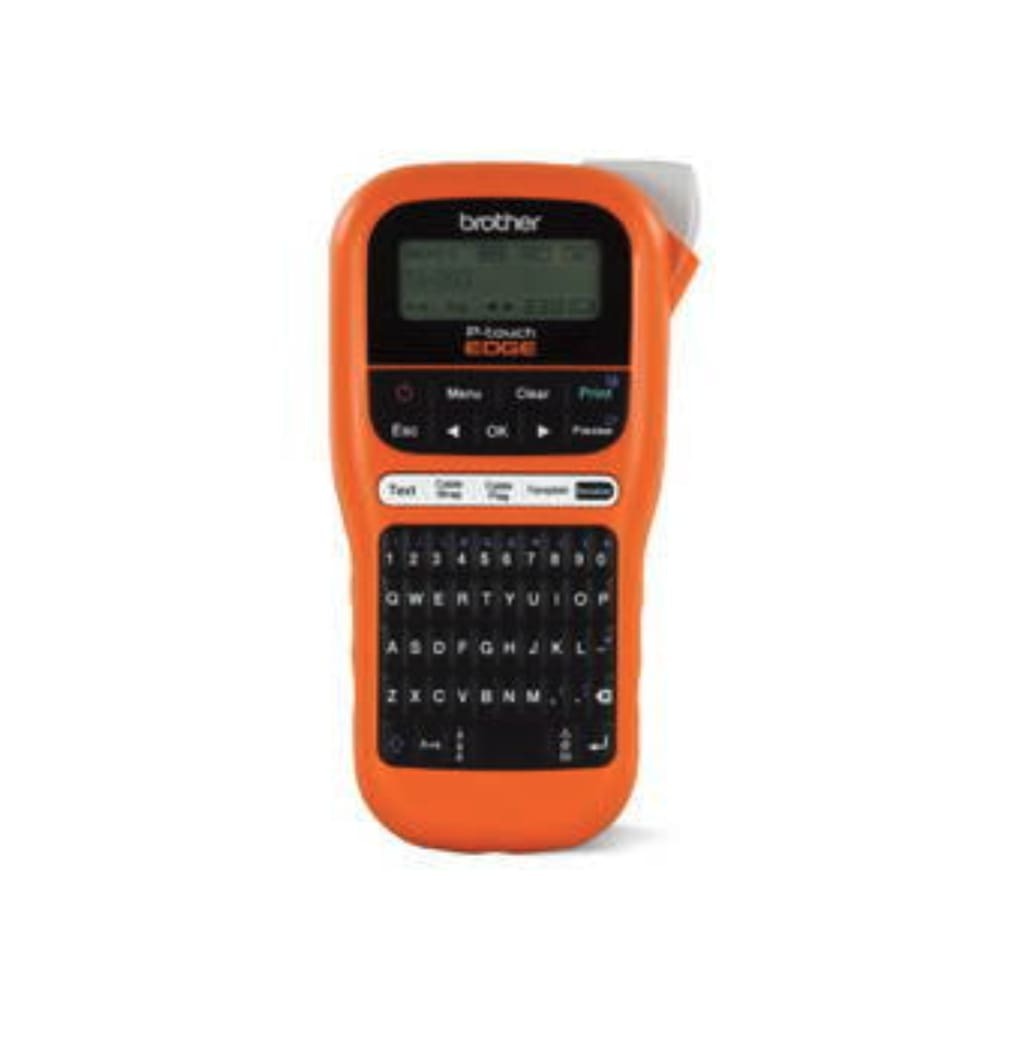
Brother P-touch printers are designed to create laminated thermal labels that remain clear and durable in demanding environments. By combining direct thermal printing with built-in lamination, these printers produce labels that are ready for use immediately, without additional processing or consumables.
1. Direct Thermal Printing with No Ink or Toner
Brother P-touch printers use heat to activate the print layer on laminated thermal labels. Because no ink or toner is involved, the output stays clean and consistent, eliminating issues such as smudging, bleeding, or cartridge replacement.
2. Built-In Lamination for Long-Term Protection
Once printed, the text is sealed beneath a clear laminate layer. This protective layer shields laminated labels from moisture, abrasion, fading, and routine cleaning, helping the information remain readable over time.
3. Precision Features That Improve Label Consistency
P-touch printers support practical features that enhance accuracy and efficiency:
-
Barcode and serial number printing for tracking and compliance
-
Pre-set templates for standardized labelling
-
Automatic cutting for uniform label lengths
Where Laminated Thermal Labels Perform Best?
These laminated thermal labels are widely used in kitchens, laboratories, warehouses, and industrial settings. Their durability and clarity make them suitable for environments where labels are handled frequently or exposed to harsh conditions.
By combining ink-free printing with protective lamination, Brother P-touch printers offer a reliable solution for producing laminated labels that support long-term identification and operational accuracy.
What Types of Laminated Labels Are Available for Different Uses?
Not all laminated labels serve the same purpose. The right option depends on how the label will be used, the conditions it will face, and how long it needs to remain readable. Some laminated labels are designed for daily handling, while others are built to withstand harsh industrial or outdoor environments.
The table below outlines the most common types of laminated labels, along with their primary use cases and practical benefits. This makes it easier to match the right label type to real-world requirements.
|
Laminated Label Type |
Best Use Case |
Key Benefits |
Example Application |
|---|---|---|---|
|
Laminated barcode labels |
Inventory and asset tracking |
Maintains scannability and contrast over time |
Warehouses and distribution centres |
|
Laminated name labels |
Identification and organization |
Resists water exposure and fading |
Food containers and school supplies |
|
Laminated sticker labels |
Signage and organization |
Strong adhesion with the protected print surface |
Offices and storage areas |
|
Laminated vinyl labels |
Outdoor and industrial use |
Withstands weather, chemicals, and abrasion |
Construction sites and machinery |
|
Laminated thermal labels |
Equipment and logistics |
Ink-free printing sealed under laminate |
Manufacturing and asset tracking |
Each of these laminated labels is engineered for specific environments and handling conditions. Selecting the right type helps reduce label failure, improves readability, and ensures identification remains consistent over time.
What Applications Benefit Most From Laminated Sticker Labels?
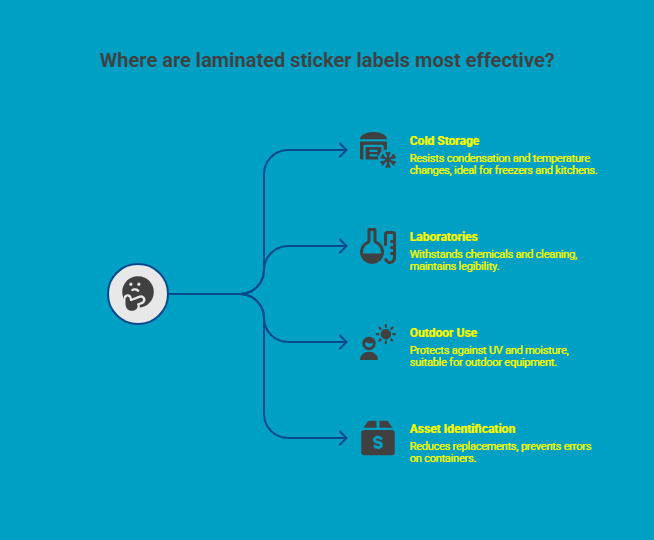
Laminated sticker labels are best suited for environments where standard labels tend to fail due to moisture, temperature fluctuations, or frequent handling. The protective laminate helps preserve print clarity and adhesion over time, even under demanding conditions.
They are especially effective in the following settings:
-
Cold storage and food preparation areas
Freezers, refrigerators, and commercial kitchens benefit from laminated sticker labels because they resist condensation, cleaning solutions, and temperature changes without peeling or fading. -
Laboratories and medical facilities
In controlled environments where surfaces are regularly disinfected, laminated sticker labels withstand exposure to chemicals and repeated cleaning while keeping critical information legible. -
Outdoor and semi-exposed locations
When combined with laminated vinyl labels, these stickers offer added protection against UV exposure, moisture, and weather, making them suitable for outdoor equipment and storage areas. -
Long-term asset and container identification
For tools, bins, and reusable containers, laminated labels reduce the need for frequent replacements and help prevent identification errors caused by worn or unreadable labels.
Overall, laminated sticker labels are a practical choice for any application where durability, clarity, and consistency are required over the long term.
What Is Label Gloss Laminate and How Does It Improve Print Protection?
Label gloss laminate is a clear protective finish applied over laminated labels to improve durability and readability. The glossy surface enhances contrast, making text and barcodes easier to read under bright or uneven lighting.
It also protects labels from scratches, surface wear, and UV exposure caused by regular handling or cleaning. This helps labels stay clear and legible for longer periods.
Label gloss laminate is commonly used for:
-
Laminated barcode labels that require reliable scanning
-
Laminated name labels in kitchens, offices, and storage areas
-
High-touch environments where labels are frequently cleaned
This finish is ideal when visibility and long-term protection matter equally.
How Do Laminated Barcode Labels Improve Tracking and Compliance?
Laminated barcode labels are built to keep scan data reliable over time. The laminate seals the printed code, protecting it from moisture, abrasion, cleaning chemicals, and frequent handling. That protection preserves contrast and edge clarity, so scanners can read consistently, even when labels live on busy bins, tools, and equipment.
Where laminated barcode labels make the biggest difference:
-
Reduce scan failures caused by smudging, wear, or fading
-
Maintain consistent readability in high-traffic environments
-
Support traceability for audits, recalls, and chain of custody workflows
-
Improve accuracy across inventory counts, asset logs, and compliance checks
Next, durability is only part of the decision. Teams also need a system that prints consistently, with minimal effort, across different use cases.
Why Are Brother P-touch Laminated Labels Preferred by Professionals?
Brother P-touch laminated labels are preferred because they solve two problems at once. They hold up under real-world exposure, and they are easy to produce consistently. The laminated construction protects the print so it stays legible when labels face water, chemicals, heat, and day-to-day wear. At the same time, Brother P-touch label makers print laminated labels without ink or toner, which simplifies maintenance and reduces interruptions.
Why professionals choose Brother P-touch laminated labels:
-
Waterproof and smear-resistant output for demanding environments
-
Strong readability for high-use identification points
-
Multiple widths, colours, and specialty tapes for different workflows
-
Reliable results across kitchens, schools, labs, warehouses, and electrical work
The practical takeaway is consistency. When a team standardizes on Brother P-touch laminated labels, they spend less time replacing failed labels and more time running predictable operations.
That said, some environments need more than durability. When security and integrity matter, labels must also show clear evidence of interference.
How Do Tamper-Evident Laminated Labels Improve Security?
Tamper-evident laminated labels are designed to make interference obvious. Instead of peeling off cleanly, they show visible damage or a tamper pattern when removed, which helps prevent reapplication and discourages unauthorized access. This is especially useful when labels are used to indicate sealed status, restricted access, or controlled handling.
Where Tamper Evidence Adds Immediate Value
The Brother TZe-SE4G 3/4 in Black on White Tamper Evident Laminated Tape is compatible with Brother P-touch label makers and is commonly used where verification must be instant.
Common security-driven uses include:
-
Sealing food containers and storage units where integrity matters
-
Marking laboratory samples and controlled materials
-
Securing IT assets, equipment IDs, and calibrated tools
-
Supporting inventory control where access must be accountable
The bottom line is simple. Tamper-evident laminated labels add a visible layer of security without changing your workflow, giving teams faster verification and better control over what has been accessed or altered.
Where Can You Purchase Laminated Labels and Tape Cartridges in Canada?
Choosing the right laminated labels starts with sourcing compatible, reliable supplies. In Canada, DuraFastLabel.ca is a dependable source for Brother laminated label tapes designed to work seamlessly with Brother P-touch label makers.
DuraFastLabel.ca carries a focused range of Brother-compatible laminated labels suited for everyday identification, specialty use cases, and security-driven applications. This includes options built for durability, clarity, and long-term performance across professional environments.
Available laminated label options include:
-
Laminated vinyl labels for outdoor and industrial conditions
-
Laminated thermal labels for clean, ink-free printing
-
Standard Brother TZe laminated tapes in multiple widths and colours
-
Tamper-evident laminated tapes for asset protection and compliance
Not sure which laminated labels are right for your setup?
Contact DuraFast Label Canada for expert guidance on Brother P-touch compatible tapes: https://www.durafastlabel.ca/contact-us/
Final Thoughts
Laminated labels last longer because they are built to protect information, not just display it. By sealing print beneath a durable laminate, they resist moisture, heat, chemicals, abrasion, and frequent handling that cause standard labels to fail.
Combined with Brother P-touch printing systems, laminated labels deliver consistent, ink-free results across kitchens, laboratories, warehouses, and industrial sites. Choosing the right laminated label type and a reliable supplier helps reduce relabelling, improve compliance, and keep identification clear long after application.
FAQs
Are laminated labels waterproof and heat resistant?
Yes. Laminated labels are designed to withstand water, heat, and common cleaning chemicals. The protective laminate seals the print, making these labels reliable for kitchens, laboratories, industrial settings, and other environments with frequent washing or temperature changes.
Can laminated labels be used outdoors?
Yes. Laminated vinyl labels, especially when paired with label gloss laminate, offer resistance to UV exposure, moisture, and weather conditions. This makes them suitable for outdoor equipment, storage areas, and semi-exposed industrial applications.
Do laminated labels work well for barcodes and QR codes?
Yes. Laminated barcode labels maintain sharp contrast and edge definition over time. The laminate prevents smudging, fading, and abrasion, ensuring consistent scanning performance for barcodes and QR codes in high-use or regulated environments.
What surfaces can laminated labels adhere to?
Laminated labels adhere effectively to clean, smooth surfaces such as plastic, metal, glass, and painted finishes. Proper surface preparation improves adhesion and helps ensure long-term durability, especially in environments with moisture or frequent handling.
Do Brother P-touch printers automatically create laminated labels?
Yes. Brother P-touch printers are designed to print laminated labels when used with compatible TZe laminated tapes. The printer produces ink-free text that is automatically sealed beneath a protective laminate layer during printing.
Can self-laminating labels be customized with text or logos?
Yes. Self-laminating labels can be customized with text, symbols, barcodes, and logos using compatible printers. The built-in laminate then seals the printed information, protecting customized content from wear, moisture, and handling.
How do self-laminating labels compare to heavy-duty laminated labels?
Self-laminating labels provide strong protection for cables and curved surfaces, while heavy-duty laminated labels offer greater resistance for harsh industrial or outdoor environments. The best option depends on exposure level, surface type, and required lifespan.
How do I properly apply a self-laminating label to get the best results?
To apply a self-laminating label correctly, clean the surface first, apply the printed section smoothly, then firmly wrap the clear laminate over the text. This ensures full coverage, strong adhesion, and long-lasting protection.
What types of materials are self-laminating labels made from?
Self-laminating labels are typically made from durable synthetic materials such as polyester or vinyl. These materials resist moisture, oils, chemicals, and tearing, while the clear laminate layer protects printed text from abrasion and environmental exposure.
Are there different sizes and colours of self-laminating labels available for various needs?
Yes. Self-laminating labels are available in a wide range of sizes and colour combinations to suit different applications. Custom options include narrow formats for cables, wider labels for assets, and high-contrast colours for improved visibility and organization across environments.