How Does Labelling in the Warehouse Boost Performance?
14th Jul 2026
Key Highlights
-
Smart labelling in the warehouse improves speed, safety, and accuracy
-
Poor durability is the main reason warehouse labelling fails
-
Floor, rack, shelf, and location labels require different best practices
-
Strong labelling system design supports inventory management
-
Protective overlays extend floor label life under heavy traffic
-
A structured warehouse labelling system reduces training time and errors
-
Durable labels lower labour costs and improve customer satisfaction
Walk into any busy facility, and you will see labels everywhere. Floors are marked. Racks are numbered. Shelves carry barcodes. Bins display product information. On the surface, everything looks organized and controlled. But look closer, and the real story appears. Peeling edges, scratched rack labels, faded floor markers, and smudged QR codes quietly signal wear. These small failures are easy to overlook, yet they are often the first signs that visual control inside the warehouse is breaking down.
That is where warehouse operations begin to slow. Teams hesitate, rescans increase, and minor confusion spreads. When labels lose clarity, accurate inventory tracking suffers, picking errors rise, and even the risk of accidents grows in busy zones.
This guide shows how to build an effective warehouse labelling strategy that lasts. You will learn the right label types, placement methods, materials, printing practices, and protection layers like Label Armour for Canadian warehouse conditions.
What Is Labelling In The Warehouse?
Labelling in the warehouse is more than placing stickers on surfaces. It is a structured visual identification system that connects your physical space to digital records inside your warehouse management software. Every rack, shelf, floor zone, and bin becomes part of an organized warehouse layout framework that guides movement, scanning, and decision making on the floor.
When done correctly, effective warehouse labelling functions as operational infrastructure. It supports daily workflows the same way racking, conveyors, and storage systems do. The goal is simple: make critical information visible, readable, and instantly usable.
A strong labelling system ensures:
-
Clear location IDs that align with system data
-
Accurate product codes for faster scanning using barcode scanners
-
Safety markings that support controlled movement
-
Consistent label information across all storage areas
-
Easy recognition for both new and experienced warehouse staff
In short, effective labelling in the warehouse turns physical layout into a navigable, data-connected environment that improves accuracy, speed, and control.
Why Is Warehouse Labelling Critical For Operations?
Speed and accuracy are what separate smooth warehouse operations from constant firefighting. In large warehouses, workers make hundreds of location-based decisions every shift. Labels guide those decisions. When labelling in the warehouse is clear and consistent, movement feels automatic. When it fails, hesitation creeps in and performance drops.
1. Impact On Inventory Accuracy
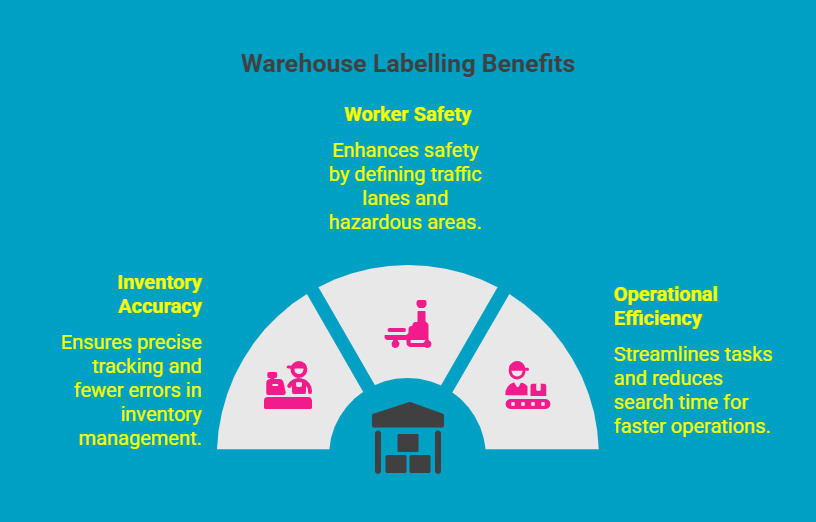
At its core, warehouse labelling protects data integrity on the floor.
Accurate labelling and structured warehouse location labelling ensure the right items are stored and picked from the correct storage areas. Clear barcodes, qr codes, and even rfid tags or radio frequency identification tools reduce rescans and manual checks.
Strong labelling supports:
-
Accurate inventory tracking across locations
-
Fewer mispicks and put-away errors
-
Faster, more reliable cycle counts
-
Better alignment with the warehouse management system
When labels fail, inventory management becomes guesswork.
2. Impact On Worker Safety
Labels are also visual safety controls. Warehouse floor labelling defines forklift lanes, pedestrian routes, and hazardous areas. These markings help separate traffic and guide safe movement.
Poor visibility increases:
-
The risk of accidents in shared traffic zones
-
Confusion in high-activity areas
-
Unsafe shortcuts taken by warehouse workers
Clear floor label placement supports safer navigation without slowing work.
3. Impact On Operational Efficiency
An organized warehouse labelling system removes friction from daily tasks. Staff can identify racks at storage locations at eye level, recognize zones instantly, and follow optimized pick paths.
Effective labelling delivers:
-
Faster location recognition
-
Reduced search time
-
Easier training for new warehouse staff
-
Smoother coordination across shifts
Weak labelling in the warehouse does the opposite. It adds pauses, double checks, and delays that quietly drain productivity.
Choosing the right warehouse label printer can transform your labelling speed, print quality, and durability. Explore top printer options designed to handle industrial environments and support long-lasting, scannable warehouse labels.
What Types Of Warehouse Labelling Systems Do You Need?
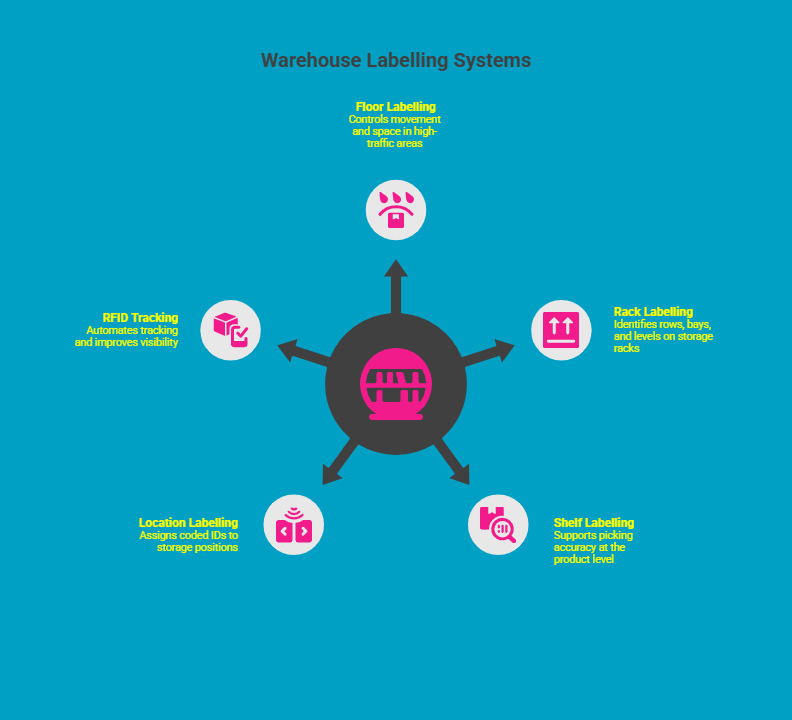
An effective warehouse labelling system is not built with one label type. Different surfaces, traffic levels, and operational tasks demand different solutions. When labelling in the warehouse is planned by function instead of convenience, performance improves across the facility.
1. Warehouse Floor Labelling
Floor labels control movement and space. They define:
-
Aisles and traffic lanes
-
Staging and receiving zones
-
Pallet positions
-
Safety and restricted areas
Because they sit directly in high traffic paths, they face forklifts, pallet dragging, foot traffic, and cleaning chemicals. Floor warehouse labelling requires abrasion-resistant materials and surface protection, especially in busy zones where wear is constant.
2. Warehouse Rack Labelling Systems
Racks form the backbone of storage, so rack labels must be easy to spot and hard to damage. Warehouse rack labelling systems typically:
-
Identify rows, bays, and levels
-
Use large, high contrast characters
-
Sit at eye level for visibility from the equipment
These labels must resist impact from pallets and equipment, while staying readable from a distance during fast movement.
3. Warehouse Shelf Labelling Systems
Shelf and bin labels support picking accuracy at the product level. These labels carry:
-
Location IDs
-
Barcodes or QR codes
-
Product information for specific products
Because pick faces are handled constantly, strong adhesives and durable surfaces are essential to prevent lifting, smudging, or edge damage.
4. Warehouse Location Labelling
This is the structure tying everything together. Warehouse location labelling assigns coded IDs to every storage position, linking physical space to the warehouse management system. It ensures that digital records and physical locations stay aligned, enabling smooth scanning and reliable tracking.
5. RFID And Advanced Tracking Labels
Some operations add RFID tags or radio frequency identification for automated tracking. These technologies work alongside visual labels to improve visibility across the supply chain, especially in large or fast-moving environments.
Together, these layers create a coordinated system where every label supports both people and technology.
Where Do Most Warehouse Labels Fail?
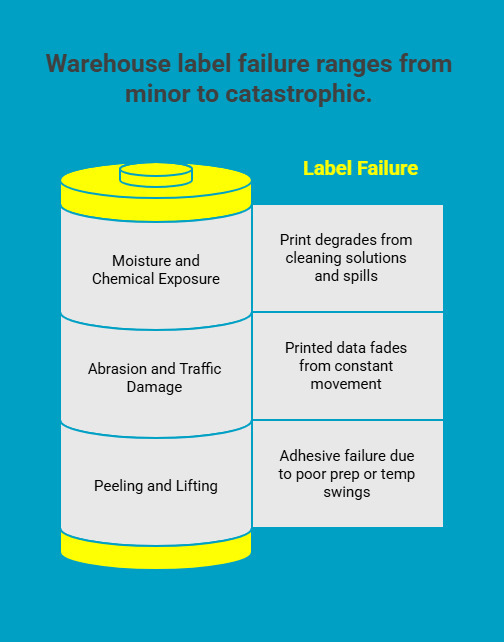
Even the most organized facilities experience label breakdown when environmental stress is underestimated. Labelling in the warehouse operates in a high-impact setting where surfaces face constant movement, friction, moisture, and cleaning. When materials, adhesives, or protection levels do not match these realities, failure is not a matter of if, but when.
1. Peeling And Lifting
Adhesive failure is one of the earliest issues. It often comes from:
-
Poor surface preparation
-
Using the wrong adhesive for the surface
-
Temperature swings are common in Canadian facilities
When edges lift, labels catch on equipment and fail quickly.
2. Abrasion And Traffic Damage
Constant movement is the biggest enemy of labelling in the warehouse. Forklift wheels, pallet edges, and foot traffic grind surfaces daily. Without protective layers, printed data fades, and barcodes become unreadable.
3. Moisture And Chemical Exposure
Cleaning solutions, spills, and humidity weaken adhesives and degrade print. Areas near docks, washdowns, or processing zones see faster wear, especially when labels lack chemical resistance.
Understanding these stress points allows warehouses to design durability into their labelling strategy instead of reacting after failure.
How Does Warehouse Label Printing Affect Performance?
Warehouse label performance is determined long before labels face traffic or handling. Printing quality, material choice, and adhesive matching work together to decide how long labels remain readable, scannable, and attached under real warehouse conditions, making printing a critical operational factor.
-
Barcode And QR Code Readability
Sharp, high-contrast printing ensures scanners read codes instantly from different angles and distances. Poor print clarity leads to rescans, hesitation, and slower workflows, which compound across shifts and reduce overall warehouse operations efficiency. -
Material Selection
Synthetic materials outperform paper in industrial settings. They resist tearing, moisture exposure, and surface abrasion. Strong material selection protects printed information and supports longer-lasting labelling in the warehouse, especially in active storage areas. -
Adhesive Compatibility
Surfaces vary widely across facilities. Plastic bins, painted metal racks, and concrete floors each require different adhesive properties. Correct adhesive matching prevents lifting and peeling, which is a key best practice in effective labelling.
Reliable warehouse label printing ensures label information stays usable, reduces scan failures, and strengthens the foundation of a durable warehouse labelling system.
How Can You Make Warehouse Floor Labels Last Longer?
Floor labels operate in the harshest part of the warehouse environment. Constant forklift movement, pallet dragging, moisture, and cleaning chemicals create continuous surface stress. Without added protection, even durable labels degrade, leading to fading barcodes, edge lifting, and frequent replacements.
-
Importance Of Protective Layers
Protective overlays shield printed data from abrasion, chemicals, and friction. Instead of direct wear on the label surface, the overlay absorbs damage, preserving barcode clarity, label structure, and adhesion strength over longer periods. -
Role Of Label Armour
Label Armour acts as a clear protective barrier placed over floor labels. Forklift wheels and pallet edges contact this layer instead of the print beneath. Facilities using DuraFast floor labels with Label Armour experience longer lifespan, fewer replacements, and more consistent scan performance.
Adding protection transforms floor warehouse labelling from a recurring maintenance task into a stable, long-term component of your warehouse labelling system.
How Do You Build An Effective Warehouse Labelling System?
An effective system is not built label by label. It is built by design. Strong labelling in the warehouse comes from combining structure, visibility, and durability so labels continue to perform under real warehouse pressure.
Here is how that foundation comes together.
1. Location Coding Strategy
Every warehouse labelling system should start with a logical coding structure. Aisles, bays, levels, and zones must follow a pattern that is easy to scale as storage areas expand or layouts change. Good coding allows warehouse staff to understand locations instantly, supports warehouse management software, and strengthens accurate inventory tracking across the facility.
2. Standardized Formatting
Consistency reduces thinking time. When fonts, colours, and layouts follow the same format across racks, shelves, and floors, workers recognize locations faster. This is central to consistent labeling, accurate labeling, and overall system clarity. Standardization ensures that label information is absorbed at a glance, not decoded under pressure.
3. Zoning And Visibility Planning
Not all areas are viewed the same way. Fast-moving zones, forklift travel paths, and high-activity storage areas require larger labels positioned at eye level or visible from equipment height. Smart label placement ensures that essential information can be read quickly, even in motion, supporting faster decisions and smoother warehouse operations.
4. Durability Planning
Structure fails if labels do not last. Protection must match exposure:
-
Floor labels in high-traffic zones need protective overlays
-
Rack labels require impact-resistant materials
-
Shelf and bin labels need strong adhesives for frequent handling
Planning durability by zone ensures proper labelling across all storage areas and prevents constant relabelling cycles.
When these four elements work together, labelling in the warehouse becomes a reliable system rather than an ongoing maintenance issue.
What Are The Benefits Of Durable Warehouse Labelling?
Durability is not just about label life. It stabilizes the entire operation. When labels remain readable and secure, teams move faster, systems stay accurate, and disruptions decrease.
|
Factor |
Standard Labels |
Protected Labels |
|---|---|---|
|
Lifespan |
Short in high traffic |
Significantly extended |
|
Barcode Readability |
Fades with wear |
Maintained longer |
|
Replacement Labour |
Frequent relabelling |
Reduced maintenance effort |
|
Workflow Disruption |
Regular interruptions |
Smoother operations |
|
Long Term Cost |
Higher over time |
Lower due to longevity |
Durable labelling in the warehouse reduces scanning errors, supports reliable inventory management, and maintains stable workflows. Fewer label failures result in fewer delays, fewer corrections, and improved order accuracy, ultimately supporting stronger customer satisfaction throughout the supply chain.
Why Canadian Warehouses Choose DuraFast Label For Reliable Warehouse Labelling
Building a strong system is important. Making it hold up in real warehouse conditions is where the right partner matters. DuraFastLabel.ca specializes in industrial-grade warehouse labelling solutions designed for heavy traffic, pallet impact, moisture, and daily wear in demanding Canadian environments. Instead of generic products, their labels are built for performance and longevity.
DuraFast supports effective labelling in the warehouse with:
-
Durable warehouse floor labels for high-traffic zones
-
Warehouse rack labelling systems that stay visible and readable from a distance
-
Shelf and bin labels with strong adhesives for frequent handling
-
Materials suited for professional warehouse label printing and long-lasting barcodes
-
Label Armour protective overlays that extend floor label life by shielding against abrasion and chemicals
This system-based approach reduces relabelling, lowers maintenance labour, and maintains scan accuracy. Rather than constantly replacing labels, warehouses gain a more stable labelling system that supports inventory accuracy, safer movement, and smoother operations.
If labels in your facility are wearing out too quickly, the issue is often durability. Solutions from DuraFastLabel.ca help close that gap and turn warehouse labelling into a long-term operational asset.
Improve durability, accuracy, and safety. Contact us to get started.
Conclusion
Strong labelling in the warehouse is an operational infrastructure. Most facilities struggle not with layout but with durability gaps that lead to constant relabelling, scan failures, and wasted labour.
By combining structured coding, smart warehouse labelling, quality warehouse label printing, durable materials, and protective layers like Label Armour, you move from reactive fixes to long-term reliability. Instead of replacing labels, teams focus on productivity, safety, and accurate fulfillment across the supply chain.
Frequently Asked Questions
How often should warehouse labels be replaced?
Replacement depends on traffic, label materials, and exposure to temperature fluctuations, moisture, and equipment movement. Facilities using proper labelling practices, durable barcode labels, and protective layers achieve stronger label durability and reduce frequent relabelling caused by wear.
What materials work best for warehouse floor labels?
The best label materials for floors are synthetic, abrasion-resistant options designed for high traffic. Combined with strong adhesives and protective overlays, they improve label durability, maintain print quality, and support effective labelling in demanding warehouse environments.
Why do warehouse labels get damaged quickly?
Heavy traffic, pallet dragging, moisture, chemicals, and temperature fluctuations stress labels daily. Without proper labelling choices, durable label materials, and protection, barcode labels fade, edges lift, and print quality declines, increasing human error and scanning issues.
Are protective overlays worth it for warehouse labels?
Yes. Overlays significantly improve label durability by shielding surfaces from abrasion and chemicals. They protect barcode labels, maintain print quality, and reduce replacement labour, making them a key part of an effective warehouse labelling system.
How do I choose a warehouse labelling system?
Start by assessing traffic, surfaces, product categories, and specific needs. Match different types of labels, adhesives, and sizes to each zone. Include colour coding, proper labelling standards, and durability planning to build an effective warehouse labelling system.
What is warehouse location labelling?
Warehouse location labelling assigns coded identifiers to racks, shelves, bins, and floor positions. It supports seamless integration with the warehouse management system, improves accurate tracking, and reduces human error by making label information clear and easy to use.
How do warehouse signs differ from warehouse labels?
Warehouse signs provide broad guidance like safety notices, emergency exits, or zone identification. Labels focus on precise location and barcode identification. Different types of labels, including magnetic labels, support specific operational needs at rack, shelf, and floor levels.
Are there specific guidelines for e-commerce warehouse labelling?
Yes. E-commerce requires effective warehouse labelling with dense SKU tracking, strong print quality, and durable barcode labels atthe pick level. Proper label creation, colour coding, and alignment with RFID technology support faster picking and fewer errors.