VIPColor vs Epson Label Printers: The 2026 Canadian Business Comparison
8th Aug 2026
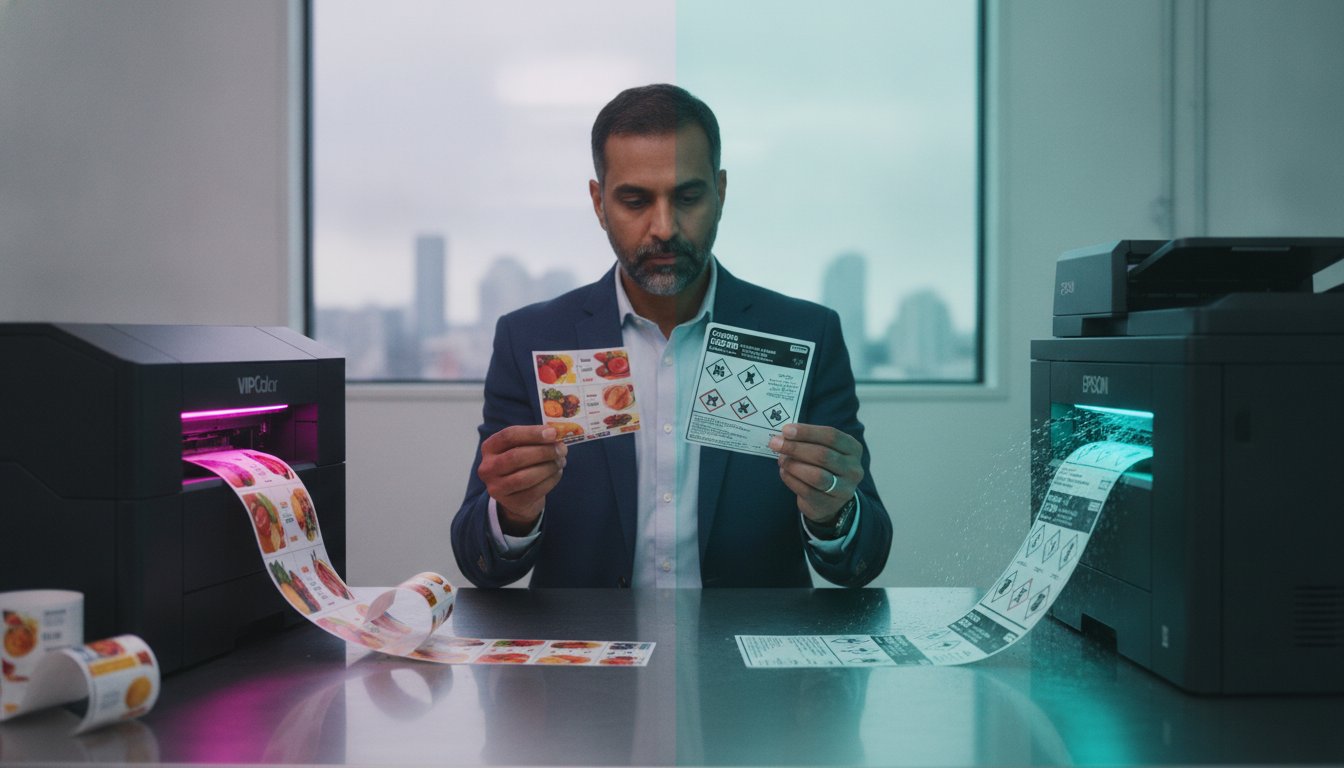
Navigating the In-House Printing Landscape: VIPColor vs Epson
The decision is no longer about buying "just a printer"; it's about investing in a production ecosystem that aligns with your operational goals. Whether you're producing vibrant prime labels for retail shelves or durable chemical labels for industrial drums, one of these brands is engineered to meet your specific needs. This comparison will define the primary use cases for both VIPColor and Epson, helping you determine which platform offers the best return on investment for your facility.
The Rise of In-House Label Production in Canada
Why are so many Canadian businesses taking control of their labelling? The shift is driven by a need for agility and efficiency in a demanding market. By moving production in-house, companies can immediately reduce lead times for seasonal or promotional products, eliminating the costly delays associated with third-party vendors. This localized production also improves supply chain resilience, a critical advantage for Canadian manufacturers facing global disruptions. Ultimately, the financial benefit of controlling your own inventory, printing variable data on demand, and eliminating waste from obsolete labels makes a compelling case for investing in a dedicated in-house system.
Brand Overviews: VIPColor Speed vs Epson Versatility
At a high level, the choice between VIPColor and Epson can be framed by their primary strengths. Each brand has carved out a distinct identity based on the technology they champion:
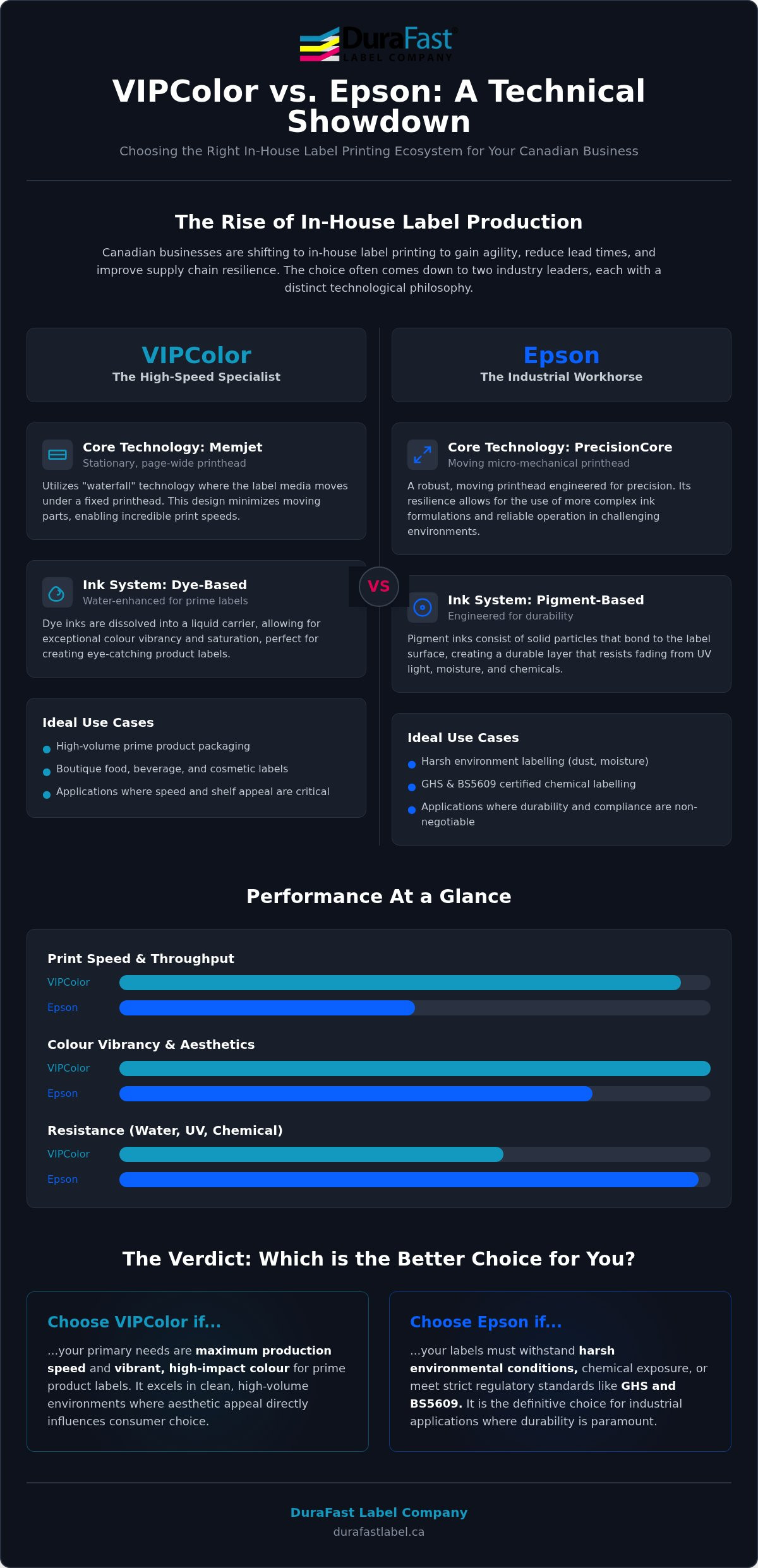
- VIPColor: Known as the high-speed specialist, VIPColor printers are engineered for high-volume prime product packaging. Leveraging Memjet technology, these machines excel at producing stunning, full-colour labels at speeds that keep pace with automated production lines.
- Epson: Positioned as the industrial workhorse, Epson printers are renowned for their durability and media versatility. Their PrecisionCore technology and pigment-based inks deliver labels that withstand chemicals, moisture, and UV exposure, making them the standard for harsh environment labelling.
Identifying which brand aligns with your business requires an honest assessment of your production volume, environmental conditions, and the primary function of your labels. Is speed your bottleneck, or is durability non-negotiable?
Print Technology Showdown: Memjet vs PrecisionCore
The performance gap between VIPColor and Epson originates from their competing printhead technologies: Memjet and PrecisionCore. While both produce sharp, high-resolution images, the way they apply ink to the label media is fundamentally different. This distinction impacts speed, durability, and reliability. In many cases, the only difference between the final print results is how the ink interacts with the media, a factor directly controlled by the printhead.
Exploring Memjet Technology reveals a system built around a stationary, page-wide printhead that deposits millions of ink droplets per second. In contrast, Epson's PrecisionCore technology uses a more traditional moving printhead, prized for its robustness and ability to handle a wider range of ink formulations. Recently, innovations like VIPColor's "water-enhanced dye inks" have started to close the durability gap in prime labelling, but the core technological differences remain the primary factor in your purchasing decision.
VIPColor and Memjet: High-Speed Dye-Enhanced Printing
VIPColor printers harness the power of Memjet's "waterfall" technology. The printhead is as wide as the label media and remains stationary as the label passes underneath it. This design has several key advantages:
- Professional Aesthetics: The use of dye-based colour inks allows for incredible vibrancy and saturation. This makes VIPColor the preferred choice for boutique food and beverage labels, cosmetics, and other consumer-facing products where shelf appeal is paramount.
- Unmatched Throughput: Because the printhead doesn't move back and forth, Memjet printers can achieve speeds that are orders of magnitude faster than their moving-head counterparts. This high throughput directly translates to lower labour costs and increased production capacity.
- Mechanical Simplicity: With fewer moving parts, the stationary printhead design reduces potential points of failure, contributing to the system's overall reliability in clean, high-volume environments.
Epson and PrecisionCore: Industrial Pigment Precision
Epson's PrecisionCore technology is the foundation of its reputation for industrial-grade durability. The micro-mechanical moving printhead is engineered for precision and resilience, enabling the use of pigment-based inks that offer superior resistance to environmental stressors.
- The Science of Pigment Ink: Unlike dye inks that dissolve in a liquid carrier, pigment inks consist of solid particles suspended in the liquid. When printed, these particles sit on top of the label media and bond to it, creating a durable layer that resists UV fading, moisture, and chemical exposure.
- Handling "Environmental Debris": The robust nature of the PrecisionCore printhead allows it to operate reliably in less-than-ideal conditions, such as dusty warehouses or manufacturing floors. This resilience is a key differentiator for industrial applications.
- Compliance and Certification: Thanks to its pigment ink system, Epson is the undisputed standard for GHS and BS5609 compliance. These certifications are legally required for labelling chemicals that will be transported by sea, guaranteeing that the label remains legible even after prolonged saltwater immersion.
Comparing Operational Performance: Speed, Ink, and Capacity
When evaluating a label printer, the spec sheet only tells part of the story. True performance is measured in daily output, operational uptime, and the total cost of ownership (TCO). This requires a closer look at print speeds (measured in inches per second or "ips"), ink capacity (measured in millilitres or "ml"), and the physical hardware configuration, including the role of external versus internal label unwinders.
For Canadian production lines, calculating the TCO means factoring in not just the initial hardware cost but also consumables, maintenance, and labour. A faster printer might reduce labour hours, while a printer with larger ink tanks requires fewer interventions from your staff, maximizing efficiency.
Throughput Realities: IPS and Daily Volume
Print speed is arguably the most significant performance difference between VIPColor and Epson, and the real-world implications are staggering. The user feedback we've received highlights this perfectly: a VIPColor VP700, using its stationary Memjet printhead, can print a full-colour 8-inch wide label at 1600 dpi resolution and maintain a consistent speed of 12 ips.
In contrast, an Epson ColorWorks C6500 printing the same 8-inch wide label at a lower 1200 dpi resolution sees its speed plummet to approximately 0.8 ips. This isn't a minor difference; it's a productivity chasm. For a business printing thousands of labels per day, this speed gap directly impacts labour costs and the ability to meet deadlines. The reason for this disparity is mechanical: the Epson's printhead must travel back and forth across the wide label, while the VIPColor's stationary head prints the entire width simultaneously. If your operation requires high-volume, on-demand printing, the throughput of a Memjet-powered VIPColor printer is the clear winner. It's also critical to match your printer's speed to your finishing equipment; a 12 ips printer requires a label rewinder or finisher that can keep up.
Managing Consumables: Ink Volumes and Maintenance
The cost and management of consumables are central to a printer's long-term value. Both VIPColor and Epson have designed their systems to optimize ink usage, but their approaches differ. A key factor to consider is the size of the ink tanks, as larger volumes (ml) generally lead to a lower cost per millilitre and, more importantly, fewer interruptions to change cartridges. This reduces downtime and allows for longer, unattended print runs.
Maintenance is another critical consideration. All inkjet printers require periodic cleaning cycles to keep their nozzles clear. You must also factor in the eventual cost of printhead replacement. Epson's PrecisionCore heads are known for their long life, while Memjet printheads are typically considered a user-replaceable consumable with a defined lifespan. When budgeting, be sure to compare the costs of both VIPColor ink cartridges and Epson ink cartridges, as well as the projected replacement costs for their respective printheads.
Durability and Environmental Resistance: Which Label Wins?
A common objection to moving printing in-house is the concern over label durability: "Will my labels survive the freezer, the warehouse, or the shipping process?" The answer depends entirely on matching the right ink and label media to the application. There's a significant difference between "wet labels" that encounter condensation and labels that are actively introduced to water, chemicals, or abrasion.
Furthermore, the hardware itself must be suited to the environment. "Environmental debris" like dust and particulates can clog printheads and damage internal components. Here, Epson's enclosed, industrial design often gives it an edge in challenging settings. However, for sheer chemical resistance, nothing beats the combination of pigment ink and certified media, making Epson the dominant force in GHS BS5609 chemical labelling standards.
GHS Compliance and Chemical Resistance
For Canadian chemical manufacturers, agricultural businesses, or any company handling hazardous materials, GHS compliance is not optional. The Workplace Hazardous Materials Information System (WHMIS) mandates specific labelling protocols to ensure safety. For these applications, an Epson printer with pigment ink is the only viable choice. The pigment particles create a bond with the synthetic label material (like polypropylene or polyester) that is incredibly resistant to solvents, oils, and prolonged UV exposure. This ensures that critical safety information remains legible throughout the product's lifecycle. For a complete understanding of Canadian regulations, our WHMIS Labels 2026 Guide provides essential context.
Prime Product Labelling and Aesthetic Appeal
When the primary goal is to capture a customer's attention on a crowded retail shelf, the vibrant colours of VIPColor's dye inks provide the "pop" needed to stand out. Modern water-enhanced dye inks also offer surprising resilience, especially when paired with the right label material. They can easily handle the condensation found on refrigerated beverages and frozen foods. The key is choosing the right labels for inkjet printers; materials with a specialized top-coating are designed to absorb the ink and protect it from moisture and smudging, maximizing adhesion and visual appeal.
The ROI Verdict: Choosing the Right Ecosystem for Your Facility
The final decision comes down to a prescriptive analysis of your business needs. If your production volume is high and speed is your primary bottleneck, the VIPColor ecosystem is your solution. If your operating environment is harsh and label durability is paramount, the Epson ecosystem is the superior choice. Beyond the printer, consider how it will integrate with your workflow. Will you need to connect it to label rewinders and finishers to create finished rolls ready for application? Before signing a purchase order, Canadian buyers should use this final checklist to confirm their choice aligns with their operational reality. As an authorized Canadian dealer for both brands, DuraFast Label is uniquely positioned to be your partner for either ecosystem.
When to Invest in VIPColor Infrastructure
A VIPColor system is the right investment under specific conditions where its core strengths can be fully leveraged:
- High-Volume Prime Labelling: For businesses where print speed (ips) is the primary driver of efficiency, such as in food and beverage, cosmetics, or private label manufacturing.
- Vibrant Graphics are Key: In applications requiring photo-quality, high-resolution graphics to attract consumers, the colour gamut of VIPColor's dye inks is a significant advantage.
- Clean Production Environments: Memjet technology performs best in controlled environments where dust and debris are minimized, typical of food processing or clean manufacturing facilities.
When Epson is the Superior Operational Choice
Epson's platform excels in environments where resilience and reliability are the most important factors:
- Industrial and Chemical Facilities: When durability and resistance to chemicals, abrasion, and UV light are non-negotiable, Epson's pigment inks are the industry standard.
- High-Mix, Lower-Volume Needs: In environments that require printing a wide variety of durable labels but not at the extreme speeds of a Memjet, the versatility and hardware resilience of Epson printers shine.
- Warehouse and Logistics: For standardizing on tough, reliable industrial label printers for shipping, inventory, and asset tracking in potentially dusty or demanding conditions.