VIPColor VP610 vs. VP660: Choosing the Right Colour Printer
9th Jun 2026
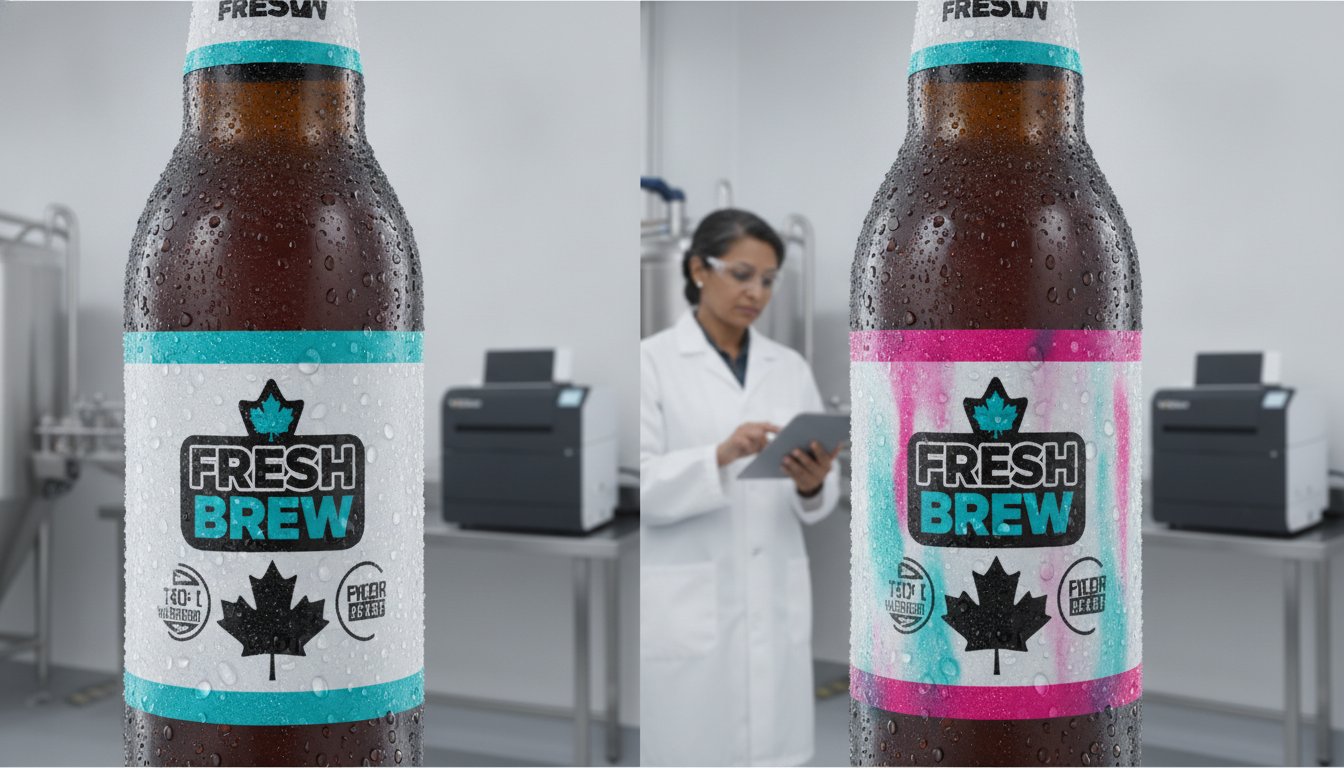
Could a single drop of condensation be the reason your brand loses a loyal customer? Many business owners realize that while vibrant colours grab attention, a label that smudges or peels in a moist environment can quickly undermine a professional image. You've likely felt the frustration of production bottlenecks or the sting of wasting capital on pre-printed labels that eventually end up in the bin. If you are looking to scale your operations, you are probably asking: What is the difference between VIPColor VP610 and VP660 printers!
Choosing the wrong hardware can lead to costly operational disruptions, but selecting the right tool transforms your production line into a high-performance asset. This article provides the clarity you need to choose between these two high-speed colour label printers by highlighting their critical technical and operational differences. We will examine how specific ink formulations and 12 inches per second print speeds impact your bottom line, ensuring your labels survive everything from shipping to refrigeration.
Key Takeaways
- Identify how the VIPColor mid-range series acts as a strategic bridge between desktop models and industrial presses for growing businesses.
- Compare shared performance metrics like the 12 ips print speed and high-resolution 1600 x 1600 dpi output to ensure professional-grade results.
- Discover the answer to "What is the difference between VIPColor VP610 and VP660 printers!" by focusing on the specific ink formulations designed for different environments.
- Evaluate which printer suits your specific application based on whether your labels require standard dye vibrancy or water-enhanced dye for moisture resistance.
- Learn how to eliminate production bottlenecks and reduce waste by bringing high-speed, on-demand colour labelling in-house.
Understanding the VIPColor Mid-Range: VP610 and VP660 Overview
How do you scale production without the massive footprint of an industrial press? The VIPColor mid-range series provides a practical solution. These machines act as a strategic bridge, offering industrial-grade speeds in a desktop-friendly chassis. When you are deciding on a hardware upgrade, you might ask: What is the difference between VIPColor VP610 and VP660 printers! The answer lies primarily in their environmental resilience, though both models share a foundation of field-proven Memjet technology capable of 1600 x 1600 dpi resolution.
The VP610 serves as the high-speed baseline for standard prime labels, perfect for dry goods and retail packaging. Its counterpart, the VP660, is the enhanced variant designed specifically for more demanding applications. While they look nearly identical, their internal chemistry dictates where they belong on your production floor. Both units are engineered to deliver professional results without the complexity of larger systems.
The Role of In-House Labelling in 2026
Why are Canadian businesses moving away from traditional outsourced printing? The answer is fiscal responsibility. Pre-printed label waste remains a major drain on resources, especially as SKU proliferation requires smaller, more frequent batches. By adopting an on-demand label printer, you gain the agility to update designs instantly; this organizes your workflow and ensures you never hold obsolete inventory. This shift allows you to realize better margins and respond to market trends in real time. If you are managing a diverse product line, the ability to print exactly what you need when you need it is a game-changer for operational seamlessness.
Chassis and Design Similarities
Despite their functional differences, both units are built on a shared mechanical platform. This includes a compact footprint that fits easily into a crowded production centre. Both models utilize an easy-access printhead replacement system, allowing your team to handle routine maintenance without specialized technical support. While these units typically utilize an external label unwinder to facilitate quick media swaps, the internal chassis is designed to protect sensitive components from dust and environmental debris. This focus on durability ensures that your investment continues to perform even in busy warehouse environments. If you are looking to explore these colour label printers further, you'll find that their physical design prioritizes both accessibility and longevity.
Shared Performance Metrics: Blazing Speed and Resolution
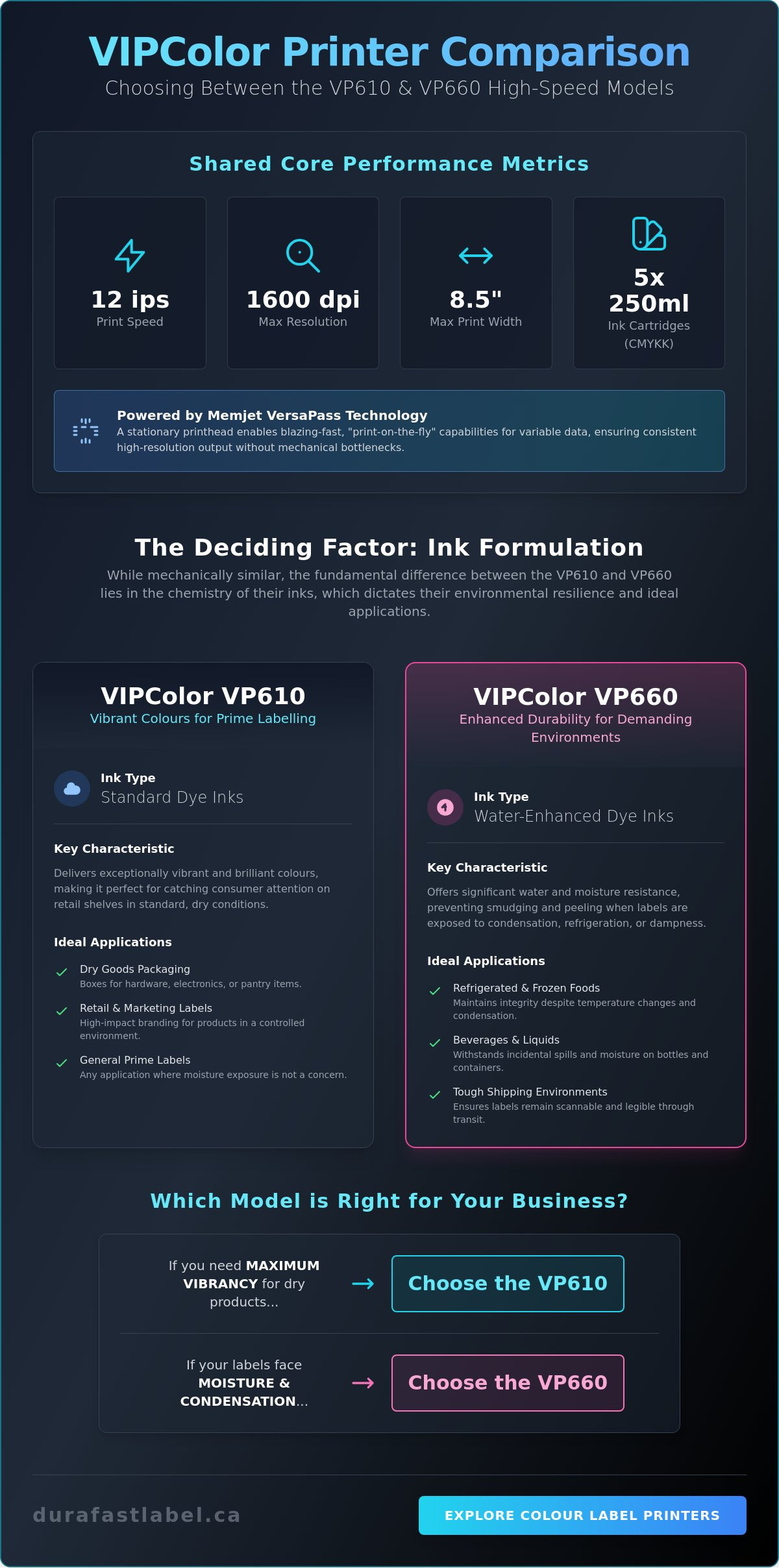
Both the VP610 and VP660 are engineered for rapid-fire production. They share a maximum print speed of 12 inches per second (ips). This speed allows you to print up to 2,400 4x6 inch labels in just ten minutes. While you might still wonder, "What is the difference between VIPColor VP610 and VP660 printers!", their shared ability to maintain 1600 x 1600 dpi resolution at this speed is what makes them leaders in the mid-range category. This resolution ensures that even the smallest text remains crisp and brand imagery stays vibrant. They accommodate a maximum print width of 8.5 inches, making them suitable for large-format prime labels used in chemical or industrial sectors.
To support these industrial speeds, both models use five individual 250ml ink cartridges. This setup includes two black tanks alongside cyan, magenta, and yellow (CMYKK). Large tanks minimize operator intervention, allowing your team to focus on order fulfilment rather than frequent cartridge swaps. These printers work seamlessly with high-quality inkjet labels to produce professional-grade results. If you are unsure which media will perform best on your production line, you can always reach out to our technical team for a consultation.
Memjet VersaPass Technology Explained
The secret to this performance is Memjet VersaPass Technology. Unlike traditional inkjet printers that use a moving carriage, these units feature a stationary printhead. This design enables "print-on-the-fly" capabilities, which is essential for variable data like unique QR codes or expiry dates. In high-volume Canadian manufacturing, this reliability prevents the bottlenecks that often plague slower desktop systems. Understanding the nuances of ink types, such as Pigment vs. dye inks, helps in realizing why these Memjet heads are so effective at delivering consistent colour across long runs.
Handling Large Label Runs
How does this speed translate to your daily operations? Printing 1,000 4x6 labels takes well under ten minutes; this is a fraction of the time required by entry-level desktop units. This throughput is vital for businesses experiencing seasonal spikes or sudden order increases. Because the ink capacity is so high, you can complete these large runs without stopping to replace consumables. This operational seamlessness is a hallmark of the VIPColor brand, providing the reliability needed to scale your business with confidence. The combination of high-capacity tanks and rapid throughput ensures that your labelling process never becomes a logistical hurdle.
The Main Difference: Standard Dye vs. Water-Enhanced Dye Inks
If you're comparing the spec sheets for these two units, they appear to be carbon copies. However, the chemistry inside the cartridges tells a different story. What is the difference between VIPColor VP610 and VP660 printers! The primary differentiator is the ink formulation. While both utilize the same high-performance Memjet engine, the VP610 is built around standard dye-based inks, whereas the VP660 utilizes water-enhanced dye inks. Other than this specific change in ink technology, the physical hardware, including the printhead and the 250ml cartridge volume, remains identical. This means your choice isn't about mechanical capability, but rather the environmental conditions your labels will face after they leave the printer.
Environmental Resilience of the VP660
Does your product live in a fridge or travel through humid shipping containers? If so, the VP660 is the strategic choice for your production line. Water-enhanced dye inks are engineered to resist smudging when they encounter condensation or accidental spills. This is particularly vital for the Canadian food and beverage sector, where frozen goods and refrigerated items often face temperature fluctuations that cause labels to "sweat." When you pair this printer with weatherproof labels, you ensure that your branding remains professional and legible from the warehouse to the consumer's kitchen. It prevents the logistical hurdle of returned goods due to unreadable barcodes or damaged branding. This resilience ensures that your labels survive shipping and handling without losing their visual impact.
The Cost-Efficiency of the VP610
Why would you opt for the VP610 if the VP660 offers more durability? The answer comes down to vibrancy and fiscal responsibility. Standard dye inks are widely recognized for their ability to produce "popping" colours and deep blacks on a variety of media. For businesses producing dry goods, vitamins, or retail packaging that stays in a climate-controlled environment, the VP610 is the superior option. It typically offers a lower total cost per label because standard dye inks are often more cost-effective for high-volume runs where moisture isn't a factor. You don't need to pay for environmental resilience that your application doesn't require. By choosing the baseline model for dry applications, you maximize your resources while still achieving the 1600 dpi resolution that makes your brand stand out on the shelf. It's a pragmatic decision that balances high-quality output with long-term operational savings.
Choosing Your Model: Application-Driven Decision Making
How do you determine which unit fits your specific production line? The decision hinges on the logistical journey your product takes after it's labelled. While we've established that ink chemistry is the core technical "delta," you must realize how this affects real-world Canadian business sectors. For instance, a label travelling from a temperate facility in British Columbia to a cold storage centre in Ontario will face significant environmental stress. If you've been asking, "What is the difference between VIPColor VP610 and VP660 printers!", it's helpful to view the choice through the lens of your specific application and the durability required to survive national shipping.
Before committing to a model, you should always test your designs on various blank labels with the corresponding ink type. This ensures the adhesion and print quality meet your brand standards. A common question we encounter at DuraFast Label Company Canada is whether a business can simply purchase the VP610 and use VP660 water-enhanced dye inks later. The answer is no. The firmware and internal ink delivery systems are calibrated specifically for their respective formulations. Attempting to swap them will lead to printhead damage and operational disruption. It's vital to select the correct model from the start to maintain fiscal responsibility and equipment longevity.
Best Applications for the VP610
The VP610 is the ideal partner for brands that prioritize maximum colour vibrancy in controlled environments. It excels in the following sectors:
- Gourmet Dry Foods: Coffee bags, spice jars, and artisanal pasta packaging where moisture isn't a concern.
- Vitamins and Nutraceuticals: Supplement bottles that remain in dry medicine cabinets or retail shelves.
- High-End Cosmetics: Secondary cardboard packaging and luxury gift boxes where "popping" colours define the brand aesthetic.
- Internal Logistics: Barcode labelling for warehouse racking and inventory management in climate-controlled facilities.
Best Applications for the VP660
If your products face wet or cold conditions, the VP660 offers the necessary resilience to prevent smudging and label failure. This model is preferred for:
- Craft Beverages: Wine bottles, craft beer cans, and chilled juices that encounter heavy condensation.
- Frozen and Fresh Foods: Packaging for frozen meats or fresh produce that undergoes temperature shifts during distribution.
- Personal Care: Shampoos, soaps, and lotions used in showers where labels are constantly exposed to water.
Still not sure which model will maximize your resources? Speak with a DuraFast Label Company Canada expert today to find the perfect fit for your production environment.
Final Verdict: Scaling with DuraFast Label Company Canada Support
Choosing between these two powerhouses comes down to your specific environmental requirements. What is the difference between VIPColor VP610 and VP660 printers! It's a strategic decision between the standard dye vibrancy of the VP610 and the water-enhanced resilience of the VP660. Both machines provide the 12 ips speed and 1600 dpi resolution necessary to eliminate production bottlenecks. By moving your labelling in-house, you realize immediate gains in flexibility and fiscal responsibility. DuraFast Label Company Canada supports your growth by ensuring you have consistent access to high-capacity 250ml VIPColor ink cartridges for both models, which prevents costly downtime during peak production cycles.
Future-proofing your production line means selecting hardware that grows with your business. For most Canadian SMEs, the VP660 offers the most versatile path forward because it handles both dry and refrigerated applications without compromise. However, if your products remain in climate-controlled retail environments, the VP610 provides a cost-effective baseline that maximizes your resources. Regardless of the model you select, the transition to on-demand colour labelling is a curative measure for the headaches of pre-printed inventory management and shipping delays.
Beyond the Printer: The Total Solution
A printer alone is only one part of an efficient production centre. To truly organize your workflow, you need professional design software like Bartender to manage variable data and SKU changes seamlessly. You should also consider integrating Label Rewinders and Finishers to automate the output of your VP610 or VP660. These tools transform a standalone printer into a comprehensive labelling station, allowing your team to handle high-volume runs without manual winding. If your current volume is better suited for entry-level production, you can refer to our guide on the VIPColor VP550 for smaller batch needs. This allows you to scale at a pace that matches your current operational demands.
Expert Consultation and Samples
How do you ensure your chosen ink and media combination will survive your unique shipping conditions? Requesting printed samples is the most pragmatic way to verify durability before making a final investment. We encourage you to test our labels against moisture, abrasion, and cold storage to see the results first-hand. DuraFast Label Company Canada acts as a strategic partner, providing the technical expertise needed to navigate these choices with confidence. As an authorized dealer with Canadian-based support and local inventory, we understand the intricate logistical challenges of distribution across the provinces. We are here to help you achieve professional-grade results while maintaining fiscal responsibility. Contact DuraFast Label Company Canada to find your perfect VIPColor match today!
Future-Proof Your Production with the Right VIPColor Choice
Choosing between these two high-speed colour label printers involves balancing your immediate production needs with the long-term journey of your products. While both models share a robust chassis and industry-leading throughput, your final decision depends on the environmental resilience your application demands. If you've been asking, "What is the difference between VIPColor VP610 and VP660 printers!", the answer lies in aligning standard dye vibrancy or water-enhanced durability with your specific business goals.
As an authorized VIPColor dealer, DuraFast Label Company Canada provides the strategic support and local inventory required to keep your production line running smoothly. We offer an extensive selection of compatible blank labels and genuine ink to ensure your brand maintains its professional image from the warehouse to the consumer. Our team is dedicated to helping you realize the full potential of in-house printing while maintaining strict fiscal responsibility and operational seamlessness.
Contact DuraFast Label Company Canada to find your perfect VIPColor match today! Taking control of your labelling process is a pragmatic step toward achieving better results and securing the longevity of your production workflow.
Frequently Asked Questions
What is the main difference between the VIPColor VP610 and VP660?
The primary differentiator is the ink chemistry. While you may ask: What is the difference between VIPColor VP610 and VP660 printers!, the answer is that the VP610 uses standard dye inks for maximum vibrancy, while the VP660 uses water-enhanced dye for moisture resistance. Both models share the same 12 ips speed and 1600 dpi resolution. This ensures that you don't sacrifice performance when choosing the model that fits your specific environmental needs.
Can I use the same ink cartridges for both the VP610 and VP660?
No, you cannot swap ink cartridges between these two models. Although they both use 250ml tanks, the internal delivery systems and firmware are calibrated specifically for either standard dye or water-enhanced dye. Attempting to use the wrong ink will likely lead to printhead damage and operational disruptions. It's essential to stock the correct VIPColor ink cartridges to maintain your equipment's longevity and ensure consistent print quality on your production line.
Are the VP610 and VP660 printers compatible with Mac and Windows?
Yes, both the VP610 and VP660 are fully compatible with Windows and Mac operating systems. They utilize standard drivers that allow for seamless integration with design software like Bartender or Adobe Illustrator. This flexibility ensures that your design team can organize their workflow without being limited by hardware constraints. Most Canadian businesses find the setup process straightforward, allowing them to realize their in-house labelling potential quickly after installation.
Do these printers require a specific type of label material?
These printers require inkjet-receptive media to achieve professional-grade results. Standard thermal or laser labels won't absorb the ink correctly, leading to smudging and poor image quality. You should choose from a variety of matte, glossy, or synthetic blank labels specifically designed for Memjet technology. Matching the correct media to your ink type is a curative step that prevents label failure during shipping or refrigeration, especially when using the VP660.
How fast can the VP660 print a standard 4x6 inch label?
The VP660 prints a standard 4x6 inch label in approximately half a second. Because it operates at a blazing speed of 12 inches per second (ips), it can produce 2,400 labels in just ten minutes. This high throughput eliminates the bottlenecks often caused by slower desktop units. It's a pragmatic solution for businesses that need to fulfil large orders rapidly while maintaining the high resolution required for crisp text and barcodes.
Is the VP660 ink truly waterproof or just water-resistant?
The VP660 uses water-enhanced dye inks, which are highly water-resistant rather than 100% waterproof. This formulation is designed to resist smudging and bleeding when exposed to condensation, moisture, or environmental debris. It's the ideal choice for refrigerated beverages or chilled foods that "sweat" during distribution. For applications requiring complete immersion or harsh chemical resistance, you might consider different technology, but the VP660 remains the standard for most moisture-heavy retail environments.
Does the VP610 include an internal unwinder?
No, the VP610 does not feature an internal label unwinder; it typically includes an external unwinder as part of the standard purchase. This design allows for easier access when changing large media rolls but does take up slightly more space on your workbench. If your facility has significant environmental debris or dust, you might consider the VP700 series, which offers an internal unwinder to protect the media from contamination before it reaches the printhead.
Which printer is better for a business starting with frozen food products?
The VP660 is the superior choice for any business dealing with frozen food products. When you consider: What is the difference between VIPColor VP610 and VP660 printers!, the ability to handle temperature fluctuations is key. The water-enhanced dye in the VP660 prevents the ink from running when labels encounter frost or condensation during the thawing process. This ensures your branding remains professional and your barcodes stay scannable throughout the entire cold chain journey.