Thermal Card Grading Tags: Professional Supplies Guide
21st Sep 2026
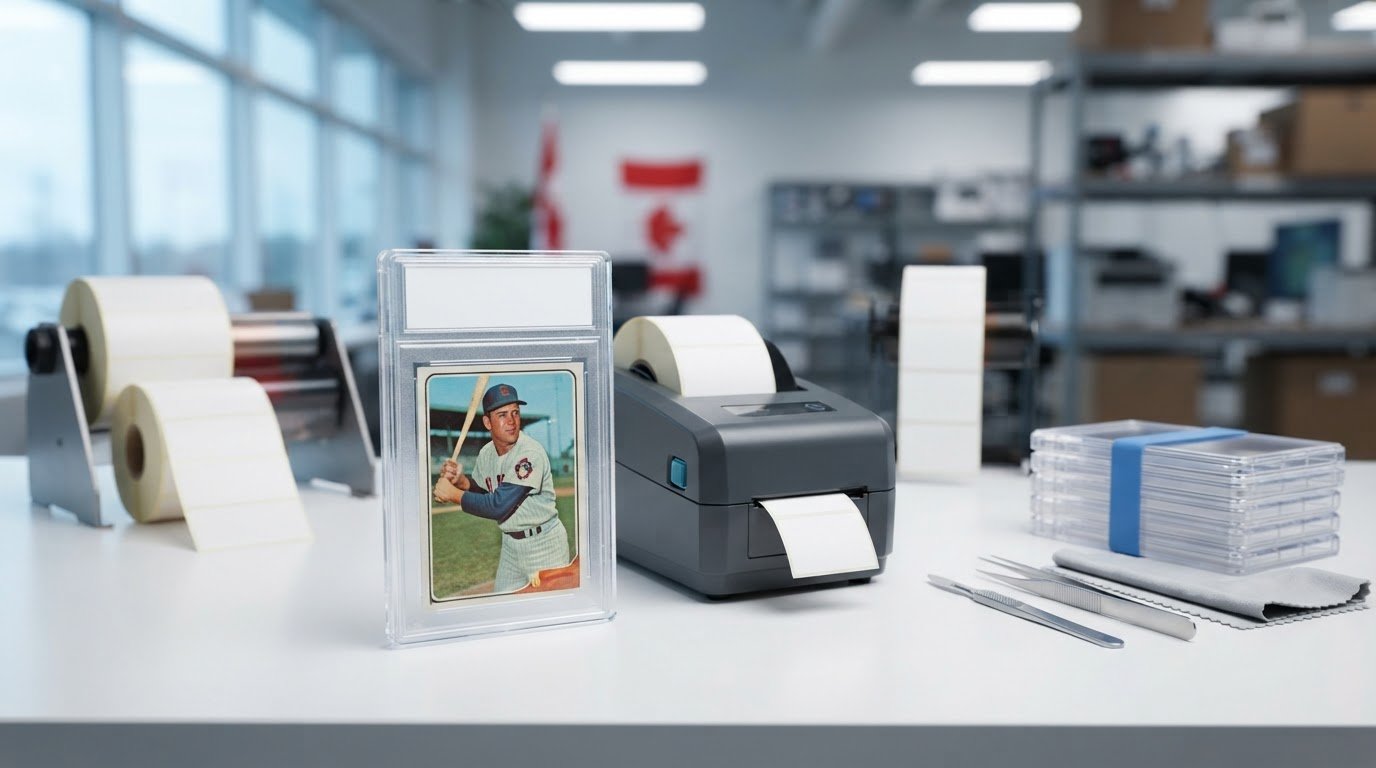
Did you realize that over 26 million cards were professionally graded worldwide in 2025, yet a single faded barcode or a yellowed insert can strip away a collectible's hard-earned market value in an instant? It's a sobering thought for any business owner who prides themselves on precision. You likely agree that a grading slab is only as reliable as the information it displays. When Thermal Card Grading Tags become unreadable or start to curl inside the acrylic, it doesn't just look unprofessional; it creates a logistical nightmare for collectors and sellers alike.
This guide will show you how to produce high-resolution, archival-quality tags in-house to enhance your business and protect your assets. You'll learn how to select the right materials that resist UV rays and environmental debris while maintaining crisp, high-contrast text. We will examine the essential hardware for 300 DPI printing, compare standard and water-enhanced ink systems for maximum longevity, and outline an efficient workflow for high-volume card processing. By partnering with DuraFast Label Company Canada, you can realize better results and operational seamlessness throughout your entire production cycle.
Key Takeaways
- Learn why synthetic materials like Valeron and Polylith are essential for maintaining archival stability and preventing card damage inside sealed slabs.
- Discover how 300 DPI resolution ensures that small-font grading data and barcodes remain perfectly crisp for digital database verification.
- Produce high-resolution Thermal Card Grading Tags in-house by choosing hardware that balances precision with operational speed.
- Streamline your workflow by using professional design software to automate variable data and protect your brand identity.
- Realize the logistical advantages of sourcing supplies within Canada to eliminate cross-border delays and currency exchange volatility.
What are Thermal Card Grading Tags and Why Do They Matter?
Professional card grading is a high-stakes industry where the physical presentation of data is as critical as the grade itself. Thermal Card Grading Tags are the semi-rigid, precision-cut inserts that sit inside a protective slab, displaying the card’s name, year, grade, and authentication details. These aren't simple paper stickers. They are engineered components designed to live inside an airtight environment for decades without degrading. As the volume of cards entering the market continues to rise, the need for standardized, high-quality tagging has never been more apparent to collectors and businesses aiming for long-term value.
Why does the print quality matter so much? It's about scannability and trust. A barcode that fails to scan because of poor contrast or bleeding ink effectively severs the link between the physical card and its digital certificate. This creates immediate friction for buyers and sellers who rely on instant verification. When you use professional thermal card grading labels, you ensure that every QR code and serial number remains crisp and accessible. This professional aesthetic directly influences the perceived value of the collectible. A smudge-free, high-contrast tag signals that the grading process was handled with industrial-grade care and precision.
The Anatomy of a Professional Grading Tag
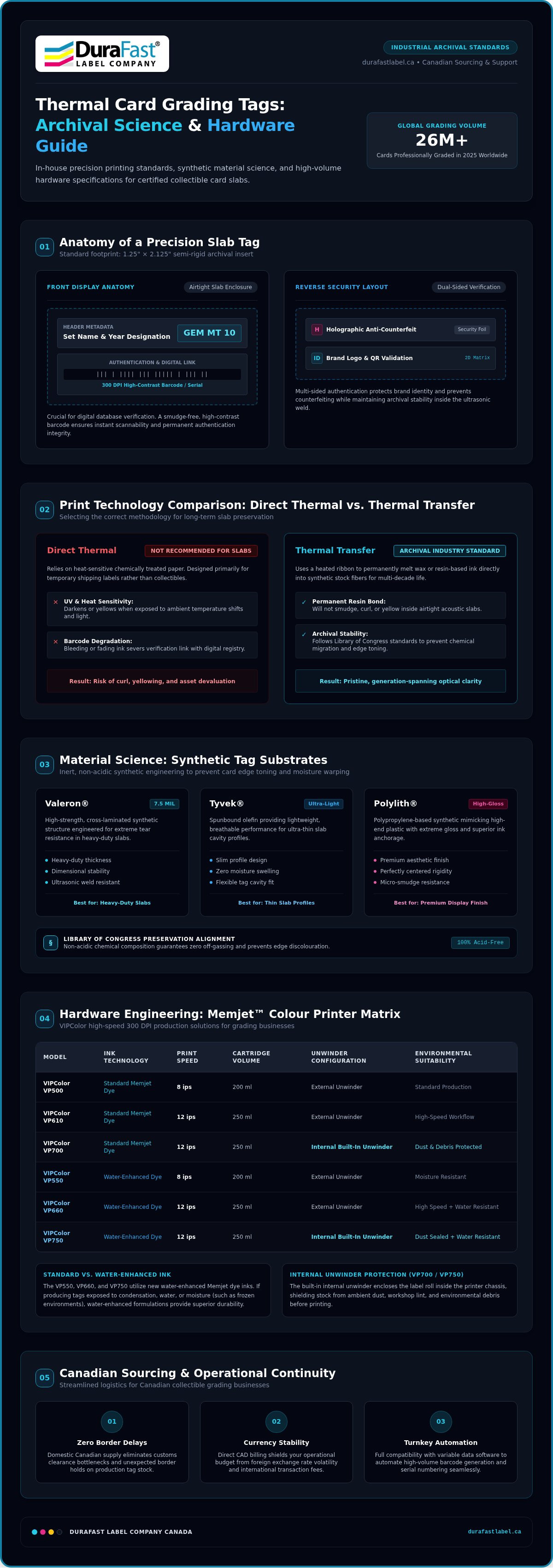
A well-designed tag maximizes every millimetre of its standard 1.25" × 2.125" footprint. The front header typically houses the most vital data, such as the numerical grade and the card's specific set information. Below this, the integration of a high-resolution barcode allows for instant verification against a grading database. Many high-volume operations also utilize the back of the tag to print security features, holographic elements, or brand logos. This multi-sided approach helps prevent counterfeiting and reinforces your brand’s authority in a crowded marketplace.
Direct Thermal vs. Thermal Transfer for Collectibles
Choosing the right printing method is a decision that affects the long-term archival stability of the collectible. Direct thermal printing is often used for temporary shipping labels, but it's risky for card slabs. Because direct thermal paper is chemically treated to react to heat, the tags can darken or fade when exposed to UV light or ambient temperature shifts over time. This is why the thermal-transfer printing process is the industry standard for archival tagging. It uses a heated ribbon to melt a wax or resin-based ink onto the tag material, creating a permanent bond that won't smudge or yellow. By matching a resin ribbon to a synthetic tag material, you produce a tag that remains pristine for generations, ensuring the card's history is never lost to environmental wear.
Material Science: Selecting Durable Tag Stock for Slabs
Beyond the printing process discussed previously, the physical substrate plays a massive role in preservation. Thermal Card Grading Tags constructed from synthetic stocks offer a level of protection that standard paper simply cannot match. While paper is susceptible to yellowing and moisture absorption, synthetics remain inert, ensuring the environment inside the slab doesn't compromise the card's surface over time. Selecting the right material is a strategic decision that affects the long-term integrity of the collectible and your reputation for quality.
A primary concern for long-term storage is chemical migration. By following the Library of Congress preservation guidelines, businesses can avoid acidic materials that might cause "toning" or discolouration on the card edges. Synthetic coatings also enhance ink anchorage, which is vital for preventing micro-smudges that can occur during handling or the high-pressure ultrasonic welding process. This stability ensures that the grade and authentication data remain as pristine as the card itself.
Synthetic Tag Materials: Valeron, Tyvek, and Polylith
Different slab designs require specific material thicknesses and textures. Valeron is a high-strength choice, often favoured for its 7.5MIL thickness and extreme tear resistance, making it ideal for robust, heavy-duty slabs. Tyvek offers a lightweight, breathable alternative for thinner profiles, while Polylith provides a premium, high-gloss finish that mimics the look of high-end plastic. These materials are dimensionally stable, meaning they won't swell or warp in humid conditions. This ensures the tag stays perfectly centred within the slab's recess, maintaining the professional look your customers expect.
Ribbon Compatibility and Print Longevity
Achieving a permanent bond requires matching your stock with the correct thermal ribbons. Resin-enhanced ribbons are the gold standard for synthetic Thermal Card Grading Tags, as they prevent "ghosting"—a phenomenon where ink transfers from the tag to the inner acrylic wall. This heat-welded bond is particularly important for moisture-resistant applications where standard inks might bleed. If you need a tailored material recommendation for your specific slab type, you can consult with our technical team to find the ideal combination for your production line.
Hardware Solutions: Comparing Seiko and VIPColor Printers
Choosing between a compact desktop unit and a high-speed industrial system is a pivotal decision for any growing grading business. While small-batch operations might prioritize a small footprint, enterprise-level labs require hardware that can keep pace with thousands of submissions per week. The core requirement for all Thermal Card Grading Tags is legibility. If your resolution is too low, the fine print on a grade header becomes a blurry mess that collectors won't accept. High-contrast, 300 DPI printing ensures that even the smallest text remains sharp and professional.
Seiko SLP850: The Precision Desktop Choice
For businesses focusing on standard 2-inch tags, the Seiko SLP850 offers a specialized solution. This 300 DPI printer delivers the crisp resolution needed for small fonts and complex barcodes, ensuring every tag meets professional standards. It officially replaces the discontinued SLP650 series, offering a more compact desktop footprint and enhanced connectivity. With USB, Serial, and Bluetooth options, you can easily integrate these units into flexible shop layouts without being tethered to a single workstation. At a print speed of 4.7 ips, it's a reliable workhorse for boutique grading services that value precision over raw volume.
VIPColor Series: High-Volume Inkjet Tag Production
When your workflow scales to hundreds of cards per hour, the VIPColor series provides the necessary throughput. The VP700 and VP750 models both feature a max print speed of 12 ips and utilize 250ml ink cartridges to minimize downtime. A major advantage of these models is the built-in internal unwinder. This feature is crucial in grading labs because it protects the tag roll from environmental debris and airborne dust, preventing particles from being trapped inside a sealed slab. It's a pragmatic solution for maintaining a cleanroom-style environment during the encapsulation process.
Choosing between these models often comes down to ink durability. The VP700 uses standard Memjet dye inks for vivid colour, while the VP750 uses water-enhanced dye inks for superior resistance to moisture and condensation. If you are producing tags for high-end collectibles that may be subject to varying storage conditions, the VP750 is the better choice for long-term protection. By contrast, the VP500 and VP610 offer similar print quality but utilize external unwinders and different ink capacities. Selecting the right hardware ensures your production remains efficient while maintaining the archival standards your customers demand. This strategic investment allows you to realize better results as you scale your operations.
Designing Your Tags for Compliance and Brand Identity
How do you turn a blank synthetic insert into a trusted certificate of authenticity? Design is the bridge between raw material and market confidence. Using professional software like BarTender or NiceLabel allows you to move beyond basic templates and create a unique brand identity. These tools are essential for integrating variable data, which automates the printing of unique serial numbers for every submission. This automation reduces manual entry errors and ensures that your internal database remains perfectly synchronized with your physical inventory.
Aligning print heads for small-format Thermal Card Grading Tags requires precision. Even a one-millimetre shift can ruin a batch of inserts. You should always use the software's calibration tools to ensure your design sits perfectly within the tag's boundaries. Strategic use of colour is another way to add value. You might use gold headers for premium tiers or specific colours to denote different grading years. This helps collectors quickly identify high-value items in their inventory while reinforcing your brand’s visual authority.
Optimizing Layout for Scannability
Scannability is non-negotiable. If a mobile device can't read your barcode, the tag fails its primary purpose. You must ensure your barcodes meet minimum size requirements for reliable scanning under various lighting conditions. Font selection is equally vital. At 6pt or 8pt sizes, sans-serif fonts typically offer the best legibility. Managing white space is a balancing act; you need to include authentication data without making the tag look cluttered. A clean, balanced layout signals industrial reliability and attention to detail.
Security Features and Authentication
Preventing tag counterfeiting is a top priority for any grading house. You can print micro-text or hidden patterns that are nearly impossible to replicate with standard home printers. Incorporating holographic overlays on your Thermal Card Grading Tags adds another layer of visual security that is immediately recognizable to collectors. Finally, using unique QR codes to link directly to digital authentication certificates provides a seamless way for buyers to verify the card's history. This level of sophistication reassures your clients that their investment is protected. If you need assistance setting up your design software or choosing the right tag templates, you can contact our team for expert guidance.
Canadian Sourcing and Support for Grading Businesses
Why should a Canadian grading business look beyond cross-border vendors for their essential supplies? Sourcing thermal card grading labels within Canada is a strategic move that protects your bottom line from currency exchange volatility and unexpected customs delays. When you deal with domestic fulfillment, you eliminate the logistical hurdles that often plague international shipments, ensuring your production schedule remains uninterrupted. DuraFast Label Company Canada acts as a strategic partner, providing a comprehensive resource for high-performance materials and equipment that allow you to take control of your own production processes.
Accessing national technical support is another critical advantage for growing enterprises. If a printer goes down during a high-volume grading cycle, waiting for support from a US-based seller or an international marketplace isn't a viable option. As an authorized dealer for Seiko and VIPColor, DuraFast Label Company Canada provides the industrial reliability you need to scale from a hobbyist setup to a professional grading house. This supportive approach ensures that your operational challenges have accessible, high-quality solutions, allowing you to focus on growing your collectibles business rather than troubleshooting hardware.
Inventory Management and Just-In-Time Supply
Maintaining a local stock of ribbons and tags is the best way to prevent production downtime. We understand the intricate logistical challenges of production and marking, which is why we maintain a specialized inventory of synthetic stocks ready for national shipping. We can also provide custom tag sizes tailored to your unique slab designs, ensuring a perfect fit every time. By leveraging our expertise in industrial label printers, you can transition to enterprise-level throughput without the growing pains typically associated with scaling. This methodical approach to supply ensures you always have the materials needed to meet collector demand.
Conclusion: The Future of Card Grading in Canada
The Canadian card grading market is shifting toward more transparent, high-tech standards where material quality and print precision are paramount. By investing in professional Thermal Card Grading Tags and high-resolution hardware, you position your business as a leader in this evolving landscape. Protecting card values starts with the tag inside the slab, and choosing archival-grade supplies is a commitment to longevity and fiscal responsibility. High-contrast barcodes, acid-free synthetics, and reliable hardware are the pillars of a successful grading operation. Ready to enhance your operations and produce professional-grade results? Explore our full range of card grading solutions today.
Elevate Your Collectibles Business with Archival Precision
Professional card grading depends on the perfect synergy between high-resolution hardware and archival-grade materials. By selecting acid-free, synthetic Thermal Card Grading Tags, you protect the long-term integrity of every collectible while ensuring that barcodes remain scannable for decades. Transitioning to in-house production allows you to realize better operational efficiency and maintain a consistent brand identity across all grading tiers. Whether you are scaling a boutique service or managing an enterprise lab, the right tools prevent disruption and maximize your resources.
As an authorized Canadian partner for Seiko and VIPColor, DuraFast Label Company Canada provides the specialized materials and technical support you need to succeed in a competitive market. From high-strength synthetic stocks to moisture-resistant ink systems, our solutions are designed for longevity and fiscal responsibility. Take the next step in professionalizing your workflow and protecting card values with our national shipping and expert guidance. Shop Thermal Card Grading Tags and Printers at DuraFast Label Company Canada and start producing professional-grade results today.
Frequently Asked Questions
What is the best printer for printing small card grading tags?
The Seiko SLP850 is widely considered the best choice for small, high-resolution monochrome inserts due to its 300 DPI precision. This desktop unit delivers the crisp text required for numerical grades and certification data, effectively replacing the discontinued SLP650 series. For businesses needing full-colour branding at scale, the VIPColor VP750 provides industrial throughput while maintaining the high resolution necessary for professional grading standards and cleanroom-style dust protection.
Do thermal tags fade over time inside a plastic grading slab?
Direct thermal tags are susceptible to fading when exposed to UV light or ambient heat, but thermal transfer tags are designed for long-term archival stability. Because direct thermal paper is chemically treated to react to heat, it remains reactive even after printing. By contrast, thermal transfer technology uses a ribbon to create a permanent, heat-welded bond. This ensures your certification data remains dark and legible for decades without the risk of yellowing or disappearing.
What is the difference between direct thermal and thermal transfer tags?
Direct thermal printing requires no ribbon and uses heat-sensitive paper, making it suitable for short-term identification like shipping labels. Thermal transfer printing uses a heated ribbon to transfer ink onto the substrate, creating a much more durable and smudge-resistant finish. For card grading, thermal transfer is the industry standard because it allows for the use of synthetic, acid-free materials that are essential for long-term preservation inside a sealed acrylic environment.
Can I print QR codes on my card grading tags with a Seiko SLP850?
Yes, the Seiko SLP850 features a 300 DPI printhead that is perfectly suited for generating high-contrast QR codes and barcodes. This level of resolution ensures that even small-format codes remain sharp and scannable by mobile devices and industrial scanners. By integrating professional design software, you can automate the printing of unique QR codes for every slab, providing a seamless digital link to your authentication database for buyers and sellers.
What material should I use for archival-quality card tags?
For archival-quality inserts, you should select chemically inert synthetic stocks such as Valeron or Polylith. Unlike standard paper, these materials are acid-free and won't off-gas or yellow inside a sealed slab over several decades. Using high-performance Thermal Card Grading Tags ensures the environment inside the acrylic remains stable, protecting the card's surface and edges from the long-term degradation often seen with low-quality paper alternatives that absorb moisture.
How do I prevent ink from smudging on my synthetic grading tags?
Preventing smudges requires matching your synthetic tag stock with a high-quality resin or wax-resin thermal ribbon. This combination creates a heat-bonded finish that resists micro-abrasions and handling during the encapsulation process. If you are using an inkjet system, selecting a model like the VIPColor VP750 with water-enhanced inks will provide similar resistance. Ensuring your printhead temperature is correctly calibrated in your software will further enhance ink anchorage and prevent ghosting.
Are there water-resistant ink options for card grading tags?
Yes, the VIPColor VP550, VP660, and VP750 models utilize water-enhanced dye inks from Memjet for superior durability. These inks are specifically formulated to resist moisture, condensation, and wet handling, making them a pragmatic choice for high-end collectibles. The VP750 is particularly effective for high-volume operations, offering a print speed of 12 ips and an internal unwinder that protects your media roll from environmental debris and airborne dust prior to printing.
Where can I buy card grading tag supplies in Canada?
Professional grading businesses can source specialized hardware and media directly from DuraFast Label Company Canada. Dealing with a domestic partner ensures you avoid the currency exchange volatility and customs delays associated with cross-border shipping. We provide national technical support and maintain a specialized inventory of synthetic stocks and thermal ribbons, allowing you to realize better results and maintain operational seamlessness across your entire production and distribution cycle.