RFID Printers: The 2026 Guide to Automating Canadian Supply Chains
2nd Jul 2026
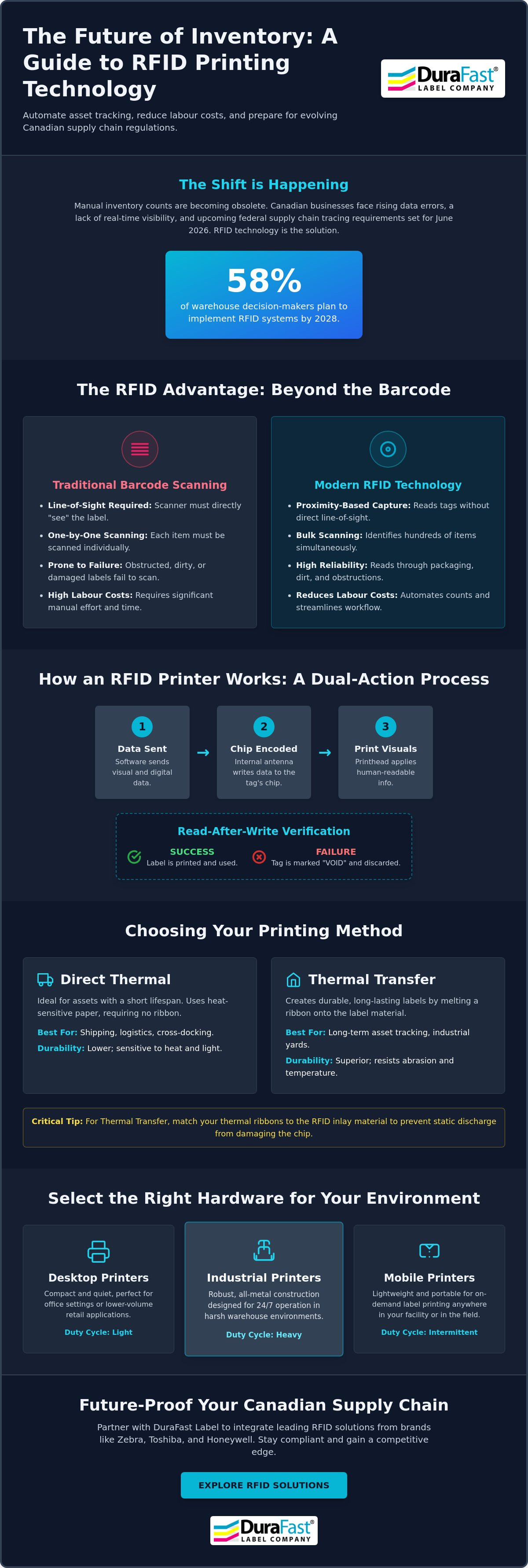
Did you know that 58% of warehouse decision-makers plan to implement RFID systems by 2028 to address inventory visibility challenges? In the Canadian market, manual barcode scanning results in data errors and a lack of real-time inventory updates. These logistical hurdles are now subject to June 2026 federal supply chain tracing requirements, which makes traditional methods technically insufficient for high-risk goods. Encoding tags correctly while maintaining operational speed is a specific requirement for modern distribution centres.
This guide demonstrates how RFID printers and encoding technology automate asset tracking and reduce labour costs for inventory counts. We will evaluate the technical specifications of industrial and desktop models to show how hardware features bridge the gap between physical inventory and digital twins. By analyzing antenna placement, duty cycles, and software integration, you can select the equipment necessary to remain compliant with evolving regulatory standards.
Key Takeaways
- Learn how proximity-based data capture replaces traditional line-of-sight scanning to eliminate manual errors and improve real-time inventory visibility.
- Understand the technical process of simultaneous visual printing and digital encoding, including the importance of antenna placement for specialized small-pitch tags.
- Explore the 2026 shift toward Cloud-to-Printer workflows and specialized "On-Metal" tagging solutions designed for Canadian industrial environments.
- Discover how to select the ideal hardware for your facility by comparing the duty cycles and physical design features of desktop, industrial, and mobile RFID printers.
- Realize the benefits of future-proofing your supply chain through strategic partnerships and seamless integration with hardware from leading brands like Zebra, Toshiba, and Honeywell.
Understanding RFID Printers: The Evolution of Modern Asset Tracking
Modern RFID printers function as hybrid devices that bridge the gap between physical inventory and digital data systems. Unlike a standard barcode printer that only applies a visual image to a surface, these machines perform two tasks at once. They apply a high-resolution visual label while simultaneously encoding digital information into an embedded microchip. This dual-action capability is essential for businesses that require both human-readable information and automated data capture within a single workflow. These machines aren't just peripherals; they're the primary engines for creating "smart" assets.
The primary shift in technology involves how data is collected. Standard barcodes require a direct line-of-sight between the scanner and the label. If the tag is obscured, dirty, or facing the wrong way, the scan fails. In contrast, Radio-frequency identification (RFID) utilizes proximity-based capture. This allows readers to identify hundreds of items at once without needing to see each individual tag. Many Canadian businesses are migrating to this technology to combat rising labour costs, as it eliminates the need for staff to manually scan every pallet or box. High-quality RFID labels are the foundation of this ecosystem, housing the delicate inlays that store your critical asset data.
The Core Components: Printhead vs. Encoder
When you evaluate these machines, the baseline component is the thermal printhead, which handles the visual elements like text and barcodes. The main difference between a standard unit and an RFID-enabled model is the integrated encoder. This internal antenna is the technical delta that transmits data to the tag chip as it passes through the printer. To ensure the highest level of accuracy, these RFID printers use a read-after-write verification process that checks the encoded data for errors and automatically marks any defective tags as void before they leave the machine.
Direct Thermal vs. Thermal Transfer RFID Printing
Choosing the right printing method depends on the required lifespan of your tracked assets. For long-term tracking in warehouses or industrial yards, thermal transfer labels offer superior durability against abrasion and temperature fluctuations. Conversely, direct thermal RFID is often sufficient for short-term logistics such as cross-docking or shipping, where the label only needs to remain legible for a few days. If you choose the thermal transfer route, it is vital to match your thermal transfer ribbons specifically to the RFID inlay material to prevent static discharge from damaging the sensitive electronic components during the encoding process.
How RFID Printing and Encoding Work: A Technical Breakdown
The mechanical workflow of RFID printers involves a precise sequence that differs significantly from standard thermal printing. First, your software sends a data packet containing both the visual layout and the digital encoding instructions. As the label media advances, the printer positions the integrated chip directly over the internal encoding antenna. The encoder writes the specific data to the chip before the label reaches the thermal printhead. Only after a successful write operation does the printhead apply the visual text or barcode. For applications using "small-pitch" tags, where inlays are spaced closely together, precise antenna calibration is required to avoid "over-burning" or encoding adjacent tags by mistake.
Accuracy is the primary goal of this process. If the encoder detects a chip failure or a data mismatch during the write phase, the printer automatically "voids" the tag. It does this by printing a distinct grid or "VOID" pattern over the face of the label. This prevents defective tags from entering your production line, ensuring that every asset in your facility is accurately represented in your digital twin. To manage these complex data structures, you must utilize specialized barcode software that can communicate directly with the printer's RFID chipset.
The Role of Label Design Software
Managing the Electronic Product Code (EPC) memory banks requires sophisticated platforms like Loftware or NiceLabel. The main difference between standard labelling and RFID workflows is the necessity of serialization. While a standard barcode might represent a broad SKU, an RFID tag identifies a specific individual item. Software handles this by automatically incrementing hexadecimals or pulling unique serials from your ERP. Standard label design focuses on pixels and DPI; RFID-enabled workflows focus on bit-level memory mapping and TID (Tag Identifier) validation. This level of precision is a core requirement for any comprehensive ROI analysis for RFID implementation. If you are unsure which software version supports your hardware, you can consult with our technical team to verify compatibility.
Encoding Standards: RAIN RFID and EPC Gen 2
To maintain global interoperability, most Canadian industrial sectors utilize the RAIN RFID standard. This protocol operates in the Ultra High Frequency (UHF) band and follows the EPC Gen 2 air interface. These standards act as the baseline for how data is organized within the tag memory banks. For businesses shipping across the border, using EPC Gen 2 ensures that your tags are readable by logistics providers in both Canada and the United States without hardware reconfiguration. These protocols organize data into specific banks to allow for seamless cross-border shipping and automated customs documentation.
Key Trends Shaping the RFID Printing Landscape in 2026
The adoption of RFID printers in 2026 is moving toward a decentralized, cloud-native model. One significant trend is the rise of "Cloud-to-Printer" encoding, which allows instructions to be sent directly from an ERP to the hardware. This removes the baseline requirement for local print servers and specialized middleware. By centralizing management in the cloud, Canadian distribution centres can maintain uniform data standards across multiple provinces without the IT overhead of decentralized systems. This workflow ensures that every encoded tag adheres to the specific bit-level memory mapping required for global interoperability.
Another technical delta in 2026 is the integration of high-speed colour inkjet technology into the RFID workflow. The main difference between standard thermal units and colour-integrated RFID printers is the use of Memjet Technology to produce high-resolution visual cues and digital encoding in a single pass. For applications involving frozen foods or wet environments, the use of water enhanced dye inks is the only difference required to ensure visual legibility remains intact despite condensation. This shift allows businesses to produce prime product labels that are both visually striking and digitally traceable, eliminating the need for pre-printed media.
Sustainability and Liner-Free RFID
How can high-volume facilities reduce waste while maintaining throughput? The trend toward linerless RFID labels addresses 2026 ESG mandates by removing the silicone-coated backing paper. Other than this change in media structure, the encoding process remains identical to standard thermal transfer methods. However, the hardware requires a specific delta in design: specialized non-stick rollers and heavy-duty cutters are necessary to manage the exposed adhesive. By removing the liner, you increase the number of labels per roll and reduce waste disposal costs in high-volume distribution environments.
On-Metal Tagging and AI Diagnostics
For the Canadian mining and energy sectors, "On-Metal" RFID printing is now a standard requirement. These RFID printers utilize a specific antenna calibration to encode thicker, foam-backed tags that isolate the signal from metallic substrates. This is a practical application of IEEE RFID applications in industrial settings where standard tags would fail due to signal interference. Additionally, AI-driven diagnostics now monitor the electrical resistance of the printhead. This technology predicts failure before it occurs, allowing you to schedule maintenance during planned downtime to maximize your equipment's longevity and resource efficiency.
Selecting the Right RFID Hardware for Your Operational Environment
Selecting RFID printers requires an evaluation of daily duty cycles and environmental constraints. While desktop units are sufficient for low-demand environments, high-volume production lines require the performance metrics of industrial-grade hardware. The choice of hardware directly impacts your ability to maintain real-time inventory updates without mechanical downtime.
Desktop vs. Industrial RFID Printers
Desktop printers serve as the baseline for office-based tagging or retail environments where space is limited. The main difference between these and industrial label printers is the physical chassis and internal media capacity. Industrial models utilize all-metal frames to protect internal components from vibration and impact. Other than this, industrial units feature faster print speeds, often exceeding 12 ips, compared to the 4 or 6 ips typical of desktop models.
For dusty warehouse environments, an industrial model is necessary because it includes an internal label unwinder to isolate media and ribbons from environmental debris. The only difference between certain high-performance series is the ink technology; for instance, some models use larger ml ink cartridges to reduce the frequency of operator intervention. These technical specifications ensure that the hardware can handle continuous operation in demanding Canadian distribution centres.
Mobile RFID Printers for Field Operations
Mobile units are designed for on-demand tagging in Canadian field services and yard management. These ruggedized devices handle the delta of moisture and temperature fluctuations found in outdoor operations. They prioritize wireless connectivity, such as Wi-Fi 6 and Bluetooth 5.3, to ensure constant communication with your ERP. If you require a specific hardware recommendation for your facility, request a hardware consultation from DuraFast Label Company Canada to ensure your selection matches your production volume.
Future-Proofing Your Supply Chain with DuraFast Label RFID Solutions
How can your organization ensure that its transition to digital automation remains scalable and reliable? Transitioning to an RFID-based workflow is a significant strategic move that requires more than just high-performance hardware; it requires a partner that understands the intricate logistical challenges of the Canadian market. DuraFast Label Company Canada positions itself as a comprehensive resource for businesses looking to modernize their operations, offering a balanced selection of RFID printers from industry leaders such as Zebra, Toshiba, and Honeywell. By providing a single point of contact for hardware, software, and blank labels, we help you eliminate the compatibility issues that often plague multi-vendor implementations.
One of the primary benefits of partnering with a Canadian-based supplier is the availability of localized support for national logistics networks. When your production line is running at high speed, you can't afford to wait for cross-border shipping or international time zones for technical assistance. We prioritize operational seamlessness, ensuring that your equipment is correctly configured to meet both internal efficiency goals and external regulatory requirements. This supportive approach allows you to focus on growth while we manage the technical complexities of your marking and distribution systems.
Custom RFID Media and Ribbons
The technical integrity of your tracking system depends on the synergy between your hardware and your media. It's essential to perform rigorous testing when using labels for inkjet or thermal printers that contain embedded RFID inlays. The main difference between a standard label and an RFID-enabled one is the presence of the sensitive antenna; if the media isn't properly matched to the printer's energy settings, you risk damaging the chip. DuraFast Label Company Canada provides specialized media solutions tailored to unique sectors, such as durable tags for the horticulture industry or specialized textile labels for garment tracking. Every roll of media is verified to ensure compliance with Canadian shipping standards, providing you with the confidence that your assets will remain visible throughout their entire lifecycle.
Expert Consultation and Software Integration
Selecting the right software is just as critical as choosing the physical hardware. Our advisory team assists you in evaluating the delta between platforms like Loftware and Bartender Professional to determine which best fits your specific RFID workflow. We don't just sell equipment; we act as a knowledgeable consultant to help you realize a tangible ROI through efficient encoding and serialization. Whether you need to manage complex EPC memory banks or integrate with a cloud-based ERP, we provide the expertise to make the transition smooth. If you're ready to move beyond manual scanning and embrace full automation, contact DuraFast Label Company Canada for a customized RFID hardware assessment to find the ideal solution for your facility.
Advancing Your Canadian Supply Chain with RFID Automation
Are you ready to transition from manual scanning to a fully automated inventory system? Implementing RFID printers is the most effective way to eliminate human error and meet the enhanced supply chain tracing requirements introduced in June 2026. By moving to proximity-based data capture, you gain real-time visibility that traditional barcodes simply can't provide. Success depends on selecting hardware that matches your specific duty cycle and environmental conditions, whether you're in a temperature-controlled retail centre or a rugged industrial yard.
DuraFast Label is your strategic partner in this evolution. As an authorized dealer for Zebra, Honeywell, and Toshiba, we provide the industrial reliability your business demands. We maintain a comprehensive inventory of RFID-certified labels and ribbons to ensure your media never compromises your encoding integrity. Our team offers expert Canadian support for complex software integrations to help you realize the highest ROI. Explore our full range of RFID Printers and Encoders to start your customized hardware assessment today. We're here to help you take control of your production processes and achieve better results.
Frequently Asked Questions
What is the main difference between an RFID printer and a standard barcode printer?
The main difference is the integrated encoder. While a standard printer only applies ink or heat to create a visual image, an RFID printer simultaneously writes digital data to a microchip embedded in the label. This dual functionality ensures that an asset is identifiable both visually by staff and digitally by automated sensors without a direct line of sight.
Can I use my existing barcode software to print RFID labels?
Only if your current software version supports RFID encoding and the specific printer driver. Standard versions of basic labelling software often lack the tools to manage EPC memory banks or serialization. You likely need an upgrade to a professional edition, such as BarTender Professional or Loftware NiceLabel, to communicate correctly with the hardware's internal antenna.
Do I need special ribbons for thermal transfer RFID printing?
You don't necessarily need "RFID-specific" ribbons, but you must match the ribbon type to the label material to avoid damaging the tag. Static discharge during the printing process can "fry" the sensitive RFID chip. Using high-quality resin or wax-resin ribbons designed for synthetic media helps maintain tag integrity while ensuring the visual print remains durable in industrial environments.
How does the printer handle a defective or "dead" RFID tag during the encoding process?
Modern RFID printers utilize an automated "voiding" process to prevent defective tags from entering your supply chain. If the encoder fails to write data to the chip after several attempts, the printer stops and prints a distinct pattern over the face of the label. This visual indicator tells your operators that the tag is unusable and should be discarded.
Is an industrial RFID printer necessary for my warehouse, or will a desktop model suffice?
The choice depends on your daily production volume and environmental conditions. Desktop models are suitable for low-volume office or retail tagging. However, if you're operating in a dusty warehouse or need to print more than a few hundred labels per day, the metal frame and internal unwinder of an industrial model are necessary to ensure longevity and prevent mechanical failure.
What are RAIN RFID printers, and are they the standard in Canada for 2026?
RAIN RFID refers to Ultra High Frequency (UHF) technology that follows the GS1 EPC Gen 2 protocol, which is the baseline standard for Canadian logistics in 2026. These RFID printers are designed for global interoperability; they ensure that the tags you encode in Canada are readable by partners and customs officials worldwide. This standard is essential for seamless cross-border shipping and inventory tracking.
Can RFID printers also print standard 1D and 2D barcodes?
Yes, these machines retain all the capabilities of a standard thermal printer. You can print 1D barcodes like UPCs or 2D barcodes like QR codes while simultaneously encoding the RFID chip. This hybrid approach is ideal for businesses that are transitioning to RFID but still need to support legacy scanning systems or human-readable text on their labels.
What is the "read-after-write" feature in modern RFID encoders?
Read-after-write is a verification feature that ensures data integrity by reading the chip immediately after the encoding process. If the data read from the tag doesn't match what was sent from the software, the printer recognizes the error and voids the label. This feature is the only way to guarantee that every "smart" label leaving your printer is functional and accurate.