NeuraLabel Callisto vs Epson C6500: Best Industrial Printer
6th Sep 2026
What if the very equipment meant to streamline your production is actually the primary source of your daily bottlenecks? It's a common frustration for Canadian manufacturers who find that as orders scale, their reliable desktop printers simply can't keep up with the pace of a busy warehouse. You likely appreciate the rugged nature of the Epson C6500, yet you've realized that frequent downtime for roll changes and slower print speeds are eating into your margins.
This guide illustrates why the NeuraLabel Callisto is better then Epson ColorWorks C6500 printer for businesses ready to transition to high-volume industrial output. We'll examine how the Callisto's 18 ips speed and high-capacity ink cartridges significantly lower your cost-per-label while improving overall efficiency. By comparing stationary printhead technology against traditional serial moving heads, we'll help you determine which machine will best support your long-term growth and operational resilience. You'll learn how to organize your labelling centre for maximum throughput, ensuring your hardware is a strategic partner in your success rather than a hurdle to overcome.
Key Takeaways
- Understand the fundamental technology gap between stationary Memjet "waterfall" printheads and serial moving-head systems to optimize your production flow.
- Discover why the NeuraLabel Callisto is better then Epson ColorWorks C6500 printer for high-volume operations, delivering up to 18 ips to eliminate labelling bottlenecks.
- Compare ink capacity metrics to see how larger 241 ml cartridges minimize downtime for maintenance and significantly reduce your total cost-per-label.
- Learn how to organize your labelling centre using hardware that integrates seamlessly with finishing equipment for a professional, end-to-end workflow.
Navigating the Industrial Colour Labelling Landscape in Canada
Canadian small and medium enterprises (SMEs) are rapidly pivoting away from the logistical delays of outsourced printing. Bringing production in-house allows you to organize your workflow according to your own timelines rather than a third-party schedule. This shift is particularly vital as e-commerce is projected to account for 14.5% of all Canadian retail sales by 2026, demanding faster turnaround times for shipping labels and product branding. When you control the print queue, you eliminate the risk of waiting weeks for a vendor to deliver a critical batch of labels.
Selecting the right hardware is a pivot point for your long-term ROI. The debate usually centres on two industry leaders: the NeuraLabel Callisto and the Epson ColorWorks C6500. While both are capable industrial label printers, the fundamental difference lies in their architecture. One utilizes a stationary head while the other relies on a moving serial printhead. This choice is perhaps the most critical decision your operations team will make this year, as it dictates your maximum daily output and your total cost-per-label.
The Problem: Production Bottlenecks and High Costs
When your print speed can't keep up with your packing line, you face a logistical hurdle that impacts your bottom line. Slow print speeds directly delay shipping and distribution, causing orders to pile up in your warehouse. Frequent downtime is another profit-killer. If your team has to stop every hour for ink cartridge replacements or roll changes, your throughput suffers. Standard printers often fail in high-output or "dusty" environments because they aren't built for the rigours of industrial label printing. Environmental debris can easily compromise sensitive components, leading to streaks or hardware failure. These hidden costs of maintenance and constant operator intervention quickly overshadow any initial savings on smaller, entry-level hardware.
The Solution: High-Performance Inkjet Technology
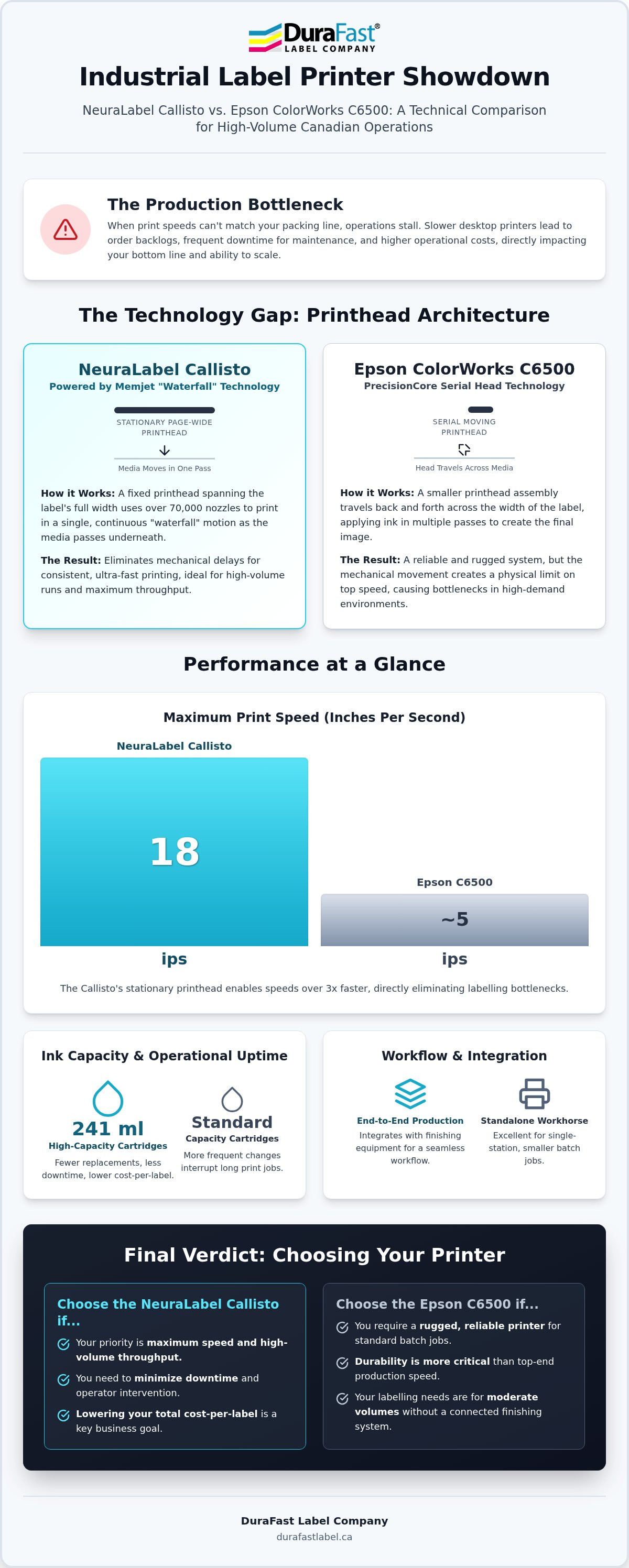
Choosing between these models requires a deep look at the printhead. The main difference between the NeuraLabel Callisto and the Epson C6500 lies in the mechanics of ink application. While the Epson C6500 utilizes a serial PrecisionCore TFP head that travels back and forth across the media, the NeuraLabel Callisto employs a stationary, page-wide Memjet head. This architectural distinction is exactly why the NeuraLabel Callisto is better then Epson ColorWorks C6500 printer for facilities that cannot afford the mechanical delays inherent in moving-head systems.
Understanding Memjet Waterfall Technology
The Callisto is powered by Memjet Technology, which features a fixed printhead spanning the entire width of the label. This "waterfall" design uses over 70,000 nozzles to fire millions of ink droplets per second. Because the printhead remains still while the media moves underneath it, you achieve a consistent ips (inches per second) regardless of the label's complexity. This system is particularly effective when using water enhanced dye inks, which produce the vibrant colour depth required for high-resolution prime product labelling. If your goal is to organize a production line that produces professional, shelf-ready aesthetics at incredible speeds, the stationary head design provides a clear path to success. You don't have to worry about the vibrations or mechanical wear associated with a heavy carriage assembly moving thousands of times per hour.
The PrecisionCore Approach
Epson’s PrecisionCore technology is celebrated for its reliability and heat-free operation. It's an excellent choice for standard batches where durability is the primary concern. However, the serial nature of this technology presents limitations when you attempt to scale to true industrial volumes. A moving head must accelerate, decelerate, and change direction for every pass. This mechanical motion naturally limits the maximum ips and introduces more opportunities for environmental debris to interfere with the carriage path. In a dusty warehouse or high-traffic production centre, the stationary architecture of the Callisto is more resilient because it has fewer moving parts to maintain. If you find your current equipment is struggling to keep up with order volume, consulting with a labelling expert can help you determine if a shift to stationary head technology is the right move for your ROI. While the Epson is a rugged workhorse for many, the Callisto is built to handle the heavy lifting of high-throughput environments without the maintenance cycles required by serial inkjet printers.
By investing in colour label printers that utilize stationary heads, you reduce the logistical hurdles that typically slow down a Canadian distribution centre. The Callisto’s ability to maintain high speeds without sacrificing image quality makes it a superior choice for those who have outgrown the capabilities of traditional desktop hardware.
Comparing Throughput: Speed (ips) and Production Efficiency
How much does an extra ten seconds per roll cost your business over a fiscal year? In a high-volume Canadian warehouse, throughput is the heartbeat of your operation. While many entry-level machines focus on print quality alone, industrial leaders prioritize the relationship between raw speed and consistent uptime. The Epson C6500 offers a respectable 5 ips, which is suitable for many standard applications. However, the NeuraLabel Callisto reaches up to 18 ips, providing a massive advantage for facilities that need to move products out the door without delay.
This discrepancy in speed is a primary reason why the NeuraLabel Callisto is better then Epson ColorWorks C6500 printer for scaling enterprises. When you calculate the daily output, the Callisto’s stationary head architecture allows it to maintain these high speeds even when processing complex graphics. A moving-head printer like the Epson must physically travel back and forth, which can lead to variable speeds depending on the colour density and resolution settings of your job. In contrast, the Callisto’s page-wide technology ensures every inch of the media is covered in a single, rapid pass.
Real-World Speed Metrics
To realize the impact on your ROI, let's look at a standard 4x6 shipping label. At 18 ips, the Callisto can produce approximately 10,800 labels per hour. At 5 ips, the Epson C6500 produces roughly 3,000 labels in the same timeframe. This means the Callisto is nearly four times more productive during active print cycles. The 'first label out' time is also significantly reduced with stationary head technology. You won't spend valuable minutes waiting for a carriage to prime and find its home position. This efficiency allows you to handle short-run custom batches just as effectively as long production rolls, keeping your distribution centre agile.
Managing Environmental Resilience
Throughput isn't just about how fast the paper moves; it's about how often the machine stops. In dusty or non-climate-controlled spaces, environmental debris can become a significant logistical hurdle. Serial printers with moving parts are more susceptible to dust settling on the carriage rails, which can cause mechanical errors or require frequent cleaning. The Callisto’s design minimizes these risks by reducing the number of moving internal components. To maximize this resilience, it's vital to pair your hardware with high-quality inkjet labels that are designed to handle high-speed ink absorption without smudging. By choosing media that matches your printer's performance, you ensure that your labels remain professional and readable even in the harshest Canadian industrial environments.
Operational Efficiency: Ink Capacity and Maintenance
How many times a day does your production line stop for a cartridge swap? For high-volume Canadian businesses, these interruptions are more than a nuisance; they're a drain on your fiscal efficiency. The main difference between the NeuraLabel Callisto and the Epson C6500 is the sheer scale of their ink systems. While the Epson C6500 utilizes 80 ml cartridges, the Callisto features high-capacity tanks holding up to 241 ml of black ink and 233 ml per colour. This volume gap is a significant reason why the NeuraLabel Callisto is better then Epson ColorWorks C6500 printer for operations that prioritize consistent uptime.
Cost-Per-Label Analysis
Larger ink tanks naturally lead to lower long-term overhead. When you realize that the Callisto holds roughly three times the ink of the Epson, the reduction in operator intervention becomes clear. You won't just save on the price per ml; you'll save on the labour costs associated with frequent maintenance cycles. If your products are destined for refrigerated environments, using water enhanced dye inks or high-grade pigments ensures your branding remains intact. These inks are specifically formulated to resist the smudging often seen on wet labels or packaging affected by condensation for frozen foods. By monitoring your ml consumption per job, you can organize your budget with greater precision and improve your overall ROI.
Unwinder Configurations and Workflow
Hardware footprint is another area where these two machines diverge. The Epson C6500 typically utilizes an internal label unwinder, which keeps the unit compact but limits the diameter of the label rolls you can use. This means more frequent roll changeovers during a busy shift. In contrast, the Callisto is designed with a heavy-duty external label unwinder. This configuration allows you to use much larger rolls, which is essential for maintaining the 18 ips speeds required in industrial settings. To create a truly professional production line, we recommend integrating label rewinders and finishers that can keep pace with these high-output machines.
Using an external unwinder also helps you organize your workspace more effectively by separating the media supply from the printer's internal mechanics. This setup reduces the risk of environmental debris entering the print path during a changeover. If you're unsure which configuration fits your facility, contact our team for a detailed consultation on how to optimize your labelling centre for better performance and reduced downtime.
Final Verdict: Why Callisto Wins for Canadian Operations
Choosing between these two industrial powerhouses depends entirely on your daily production goals. The Epson C6500 remains a reliable, versatile workhorse for businesses with low-to-medium volume needs that require a rugged, compact unit. However, if your facility is struggling with bottlenecks, the technical advantages of the Callisto are undeniable. By utilizing stationary Memjet Technology and high-capacity 241 ml ink tanks, the Callisto is designed to support the heavy lifting of a scaling enterprise without the constant maintenance breaks required by serial printers.
This comparison illustrates why the NeuraLabel Callisto is better then Epson ColorWorks C6500 printer for high-output environments. While the Epson offers a respectable 5 ips, it simply cannot compete with the Callisto’s 18 ips maximum speed. When you realize that the Callisto provides nearly four times the throughput during active print cycles, the ROI for a high-volume Canadian warehouse becomes very clear. You aren't just buying a printer; you're investing in the ability to move products through your distribution centre with unprecedented efficiency.
Prescriptive Recommendations Based on Use Case
The "better choice" for your specific operation depends on your environment and label requirements. If you're producing labels for condensation for frozen foods or wet labels, the Callisto’s water enhanced dye inks provide the professional aesthetics and durability you need. For those focused on GHS compliance and chemical labelling in standard batches, the Epson C6500 is a solid, heat-free option. However, for any business aiming to scale their in-house production, the Callisto is the superior investment because it eliminates the mechanical wear and speed limitations of moving-head technology. It allows you to organize a more resilient production line that handles dusty warehouse conditions with ease.
Next Steps with DuraFast Label
Ready to see the difference for yourself? You can start by accessing our extensive selection of blank labels for sale in Canada, specifically designed to handle the high-speed ink absorption of these industrial machines. We also encourage you to request print samples to see the vibrant colour and clarity of the Memjet "waterfall" technology firsthand. Understanding your total cost-per-label is the first step toward optimizing your facility's ROI. Contact our specialists to organize your in-house production today and receive a customized labelling analysis tailored to your specific logistical challenges.
Empowering Your Production Future
Is your current equipment keeping pace with your growth? Achieving a higher ROI in the Canadian market requires hardware that doesn't just print labels but actively accelerates your distribution cycle. This comparison highlights Why the NeuraLabel Callisto is better then Epson ColorWorks C6500 printer for high-volume environments, primarily due to its 18 ips stationary head technology and significantly larger 241 ml ink tanks. While the Epson is a reliable choice for standard batches, the Callisto removes the mechanical bottlenecks that often slow down a busy warehouse.
As an authorized Canadian dealer specialized in high-volume inkjet solutions, DuraFast Label provides the expert technical support for Memjet systems you need to succeed. We're here to help you organize your facility for maximum throughput and seamless operational flow. Don't let slow print speeds or frequent maintenance cycles limit your potential. Browse our NeuraLabel Callisto solutions and high-capacity ink cartridges to take the next step in your production journey. We look forward to helping you realize a more efficient, cost-effective labelling process.
Frequently Asked Questions
What is the main difference in print speed between the Callisto and the C6500?
The main difference is the maximum velocity; the NeuraLabel Callisto reaches up to 18 ips while the Epson C6500 tops out at approximately 5 ips. This gap exists because the Callisto uses a stationary page-wide head, whereas the Epson relies on a serial moving head. This is a primary reason Why the NeuraLabel Callisto is better then Epson ColorWorks C6500 printer for high-volume Canadian warehouses that need to eliminate production bottlenecks.
Does the NeuraLabel Callisto use dye or pigment inks for industrial labels?
The NeuraLabel Callisto utilizes water-resistant aqueous pigment inks. These specialized inks are designed to provide the durability required for industrial environments while maintaining the vibrant colour depth of high-end marketing labels. While DuraFast Label also specializes in water enhanced dye inks for other models, the Callisto’s pigment-based system is specifically engineered for labels that must withstand harsh conditions without smudging or fading over time during shipping and distribution.
Can I use the NeuraLabel Callisto for GHS-compliant chemical labelling?
Yes, you can use the NeuraLabel Callisto for GHS-compliant chemical labelling. Because the printer uses pigment-based inks, it's capable of producing labels that meet the BS5609 standard for durability in marine environments. When paired with the correct synthetic media, the Callisto ensures that your chemical containers remain compliant and readable even when exposed to chemicals, moisture, or extreme temperature fluctuations common in industrial settings across the country.
How do ink tank sizes (ml) compare between these two models?
The ink capacity difference is substantial; the Callisto features 241 ml black and 233 ml colour tanks, whereas the Epson C6500 uses 80 ml cartridges. This means the Callisto holds nearly three times the volume of the Epson per tank. Larger tanks reduce the frequency of operator intervention and lower your total cost-per-label, making the Callisto a more fiscally responsible choice for businesses that produce thousands of labels per shift.
Is the printhead on the Callisto user-replaceable?
The printhead on the NeuraLabel Callisto is indeed user-replaceable. Unlike some industrial presses that require a service technician for head changes, the Callisto is designed for operational seamlessness. You can swap the stationary Memjet head in just a few minutes without specialized tools. This feature minimizes downtime and ensures that your production line stays active even during routine maintenance or when a head reaches the end of its expected lifecycle.
Which printer is better for labels that will be introduced to water or condensation?
Both printers perform well, but the Callisto is often the better choice for labels introduced to water or condensation for frozen foods. Its high-capacity pigment ink system is formulated for superior adhesion on synthetic media. While both use pigment technology, the Callisto’s ability to apply ink consistently at high speeds ensures that the protective barrier on the label remains intact, preventing the ink from running when exposed to moisture or humidity.
Do I need an external unwinder for high-volume production runs?
You definitely need an external unwinder for high-volume production runs to accommodate larger media rolls. The NeuraLabel Callisto comes equipped with a heavy-duty external unwinder, allowing you to use rolls with a larger outer diameter than the Epson C6500’s internal system. This setup reduces the number of roll changeovers per shift, which is essential for maintaining the 18 ips throughput required in professional Canadian distribution centres and manufacturing facilities.
How does Memjet technology handle environmental debris compared to PrecisionCore?
Memjet technology handles environmental debris more effectively because the printhead is stationary. In a dusty warehouse, the moving carriage of a PrecisionCore system can attract particles that settle on the rails or the head itself, leading to streaks. The Callisto’s fixed architecture has fewer moving internal components, which reduces the risk of dust interfering with the print path. This design ensures your hardware remains resilient and reliable even in non-climate-controlled spaces.