NeuraLabel Calisto: GHS BS5609 Chemical Drum Label Guide
25th Jun 2026
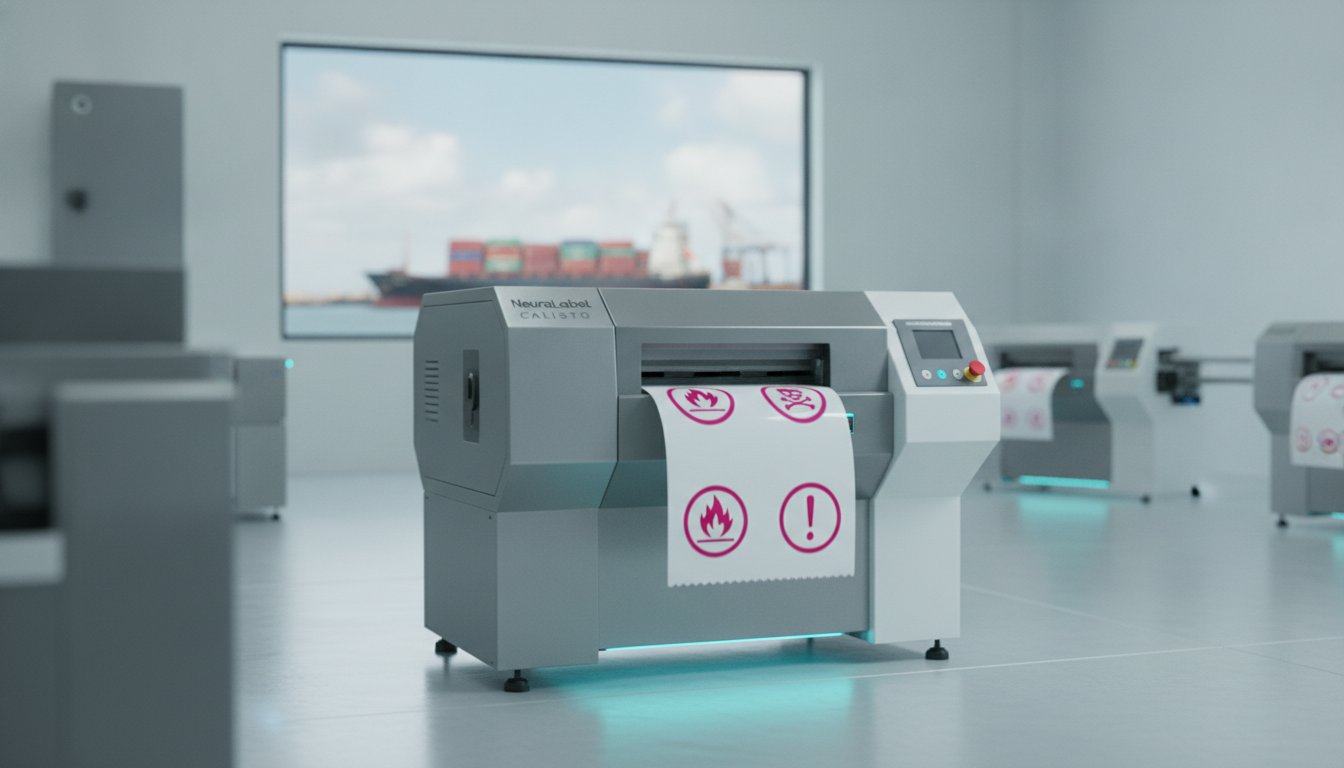
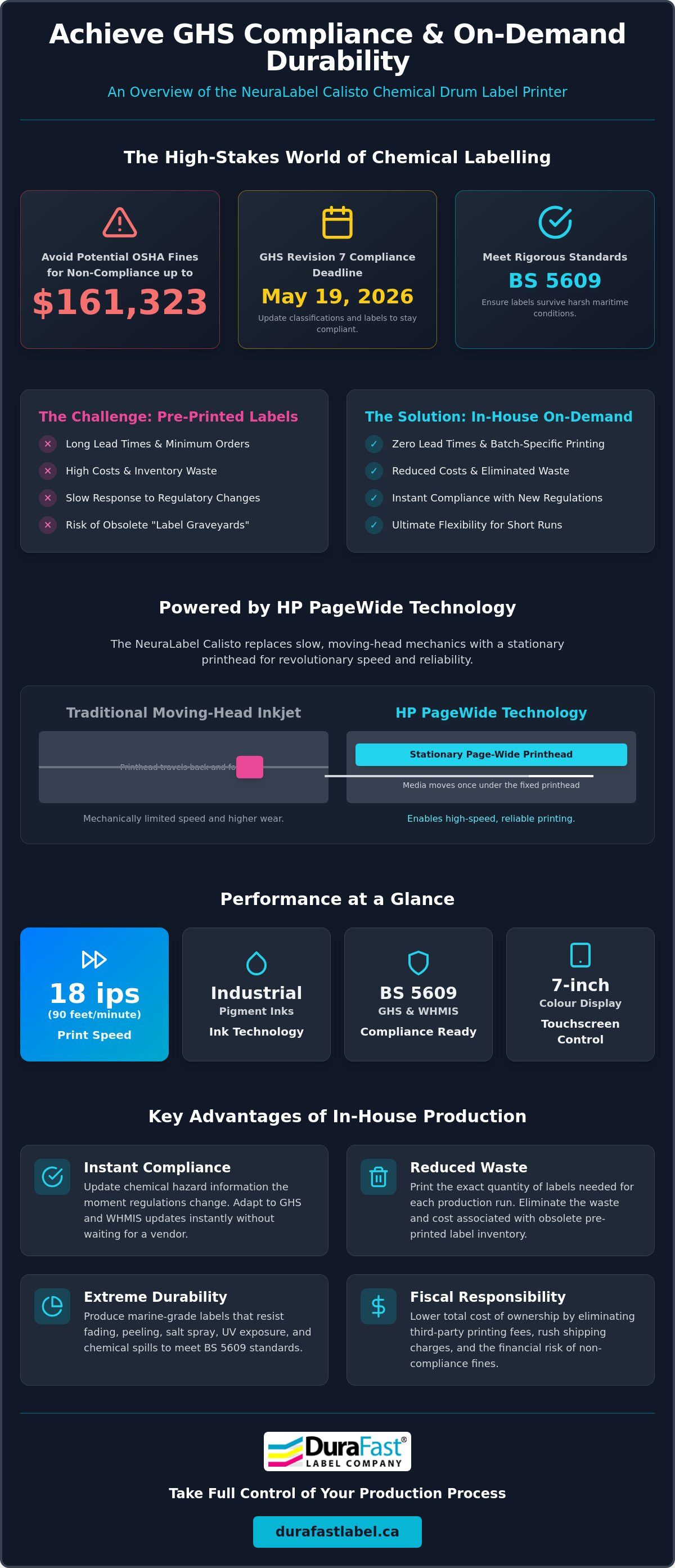
What if you could eliminate the risk of a $161,323 OSHA fine while simultaneously cutting your label lead times to zero? For many Canadian manufacturers, the pressure to maintain strict GHS compliance while managing the high costs of pre-printed labels often feels like a losing battle. You likely recognize the frustration of seeing expensive labels peel or fade during a harsh winter or failing to survive the abrasion of sea transport. Integrating a NeuraLabel Calisto GHS BS5609 Chemical Drum Label Printer into your facility is a strategic way to achieve compliance for your chemical drum labelling in-house while protecting your bottom line.
This guide will show you how the NeuraLabel Calisto streamlines your workflow by transforming logistical hurdles into a high-speed, in-house advantage. We will explore how HP PageWide technology and durable pigment inks allow you to produce labels that meet the rigorous BS 5609:2024 standards at speeds of up to 18 inches per second. By the end of this article, you will understand how to take full control of your production process, reduce lead times for short-run labels, and ensure every drum leaves your facility with a label built to survive the harshest industrial environments.
Key Takeaways
- Learn why it's vital to meet the latest BS 5609:2024 standards to ensure hazardous material labels survive punishing maritime conditions and avoid costly non-compliance penalties.
- Discover the performance benefits of HP PageWide technology, which enables the NeuraLabel Calisto GHS BS5609 Chemical Drum Label Printer to achieve high-volume output at speeds of up to 18 ips.
- Find out how to streamline your in-house production by integrating high-speed colour printing with industry-standard software like Bartender and Loftware NiceLabel.
- Identify the specific material and ink combinations required to produce marine-grade labels that resist fading, peeling, and abrasion in harsh environments.
- Analyze the long-term fiscal benefits of transitioning from pre-printed labels to an in-house inkjet solution to improve your drum labelling flexibility and reduce lead times.
Why Chemical Drum Labelling Requires the NeuraLabel Calisto
How do you ensure your hazardous material labels remain legible after months of international sea transit? It's a critical question for Canadian chemical manufacturers who must handle both global shipping lanes and domestic safety standards. Standard office inkjet technology typically uses dye-based inks that dissolve or smudge when they encounter salt water, chemicals, or the abrasive friction of drum handling. The NeuraLabel Calisto GHS BS5609 Chemical Drum Label Printer addresses this logistical hurdle by using industrial pigment inks. These inks penetrate the surface of the label material to create a permanent bond. The result is a label that remains vibrant and readable even after prolonged exposure to environmental debris or extreme temperature shifts common in northern climates.
The Reality of GHS and WHMIS Compliance
Meeting the requirements of the Globally Harmonized System (GHS) is a foundational part of workplace safety and legal compliance in Canada. With recent updates aligning OSHA standards with GHS Revision 7, manufacturers have until May 19, 2026, to re-classify substances and update their labels. The NeuraLabel Calisto GHS BS5609 Chemical Drum Label Printer empowers you to make these changes instantly. If a signal word or pictogram needs to change, you don't have to wait for an external vendor. You simply update the digital artwork and resume production. This level of control is essential for preventing bottlenecks and avoiding the steep fines associated with non-compliant hazard communication, which can reach up to $161,323 for repeated violations.
Transitioning from Pre-Printed to In-House Labelling
The "baseline" challenge for many facilities is the hidden cost and logistical burden of managing a massive inventory of pre-printed labels. Storing thousands of versions for different products often leads to "label graveyards" where obsolete stock is eventually discarded due to minor regulatory shifts. The "delta" provided by the Calisto is the transition to a lean, on-demand workflow. By bringing production in-house, you can print exactly what you need for a specific batch. This eliminates the need for large minimum orders and reduces the capital tied up on warehouse shelves. When paired with high-quality weatherproof labels, this system ensures that short-run labels are just as durable as those produced by large-scale commercial presses. You gain the flexibility to respond to market demands without sacrificing the longevity required for industrial drum applications.
Switching to an industrial pigment-based system like the Calisto provides several immediate benefits:
- Reduced Waste: Print only the quantity needed for each production run.
- Instant Compliance: Update chemical hazard information the moment regulations change.
- Durability: Ensure labels survive salt spray, UV exposure, and chemical spills.
- Fiscal Responsibility: Lower the total cost of ownership by eliminating third-party printing fees and rush shipping.
Technical Specifications: Speed, Precision, and HP PageWide Technology
What makes the Calisto faster than almost any other printer in its class? The answer lies in the transition from traditional moving-head inkjet technology to a stationary architecture. Most desktop colour printers rely on a printhead that travels back and forth across the media. This creates a mechanical speed limit and increases the risk of hardware fatigue over time. The NeuraLabel Calisto GHS BS5609 Chemical Drum Label Printer utilizes a fixed HP PageWide printhead that spans the entire width of the label. This allows the printer to achieve a remarkable speed of 18 inches per second (ips), which translates to 90 feet per minute. For a high-volume chemical facility, this means producing hundreds of full-colour drum labels in the time it takes a standard printer to finish a dozen.
A 7-inch touchscreen interface sits at the centre of the unit to simplify complex industrial workflows. This allows operators to manage print jobs and monitor ink levels directly at the station. The physical build is equally impressive; it features a heavy-duty aluminum construction that provides the stability needed for high-speed precision. Despite its industrial power, the printer maintains a space-efficient footprint, allowing it to integrate into production lines where floor space is at a premium. If you have questions about how this unit fits into your specific floor plan, you can reach out to our specialists for a technical consultation.
The Power of HP PageWide Technology
The main difference between the Calisto and its competitors is the stationary printhead. Because the head remains fixed while the media moves beneath it, there is significantly less mechanical wear. This increases uptime and ensures consistent output during long production cycles. The technology delivers a resolution of 2400 dpi, which is essential for maintaining the legibility of small-text safety instructions. Crisp text is a requirement when following GHS compliance guidance, as blurry pictograms or unreadable signal words can lead to serious safety risks and regulatory penalties.
Ink and Media Capacity for High-Volume Runs
To support its high speed, the Calisto uses large pigment ink cartridges with a capacity of up to 250ml per colour. This high volume reduces the frequency of ink replacements, which is a major delta compared to smaller units that use 30ml or 60ml tanks. The printer is also highly versatile regarding media handling. It supports label widths from 1 inch up to 8.5 inches, making it suitable for everything from small secondary containers to large industrial drums. You can configure the system with an internal label unwinder to protect media from environmental debris or use an external setup for larger rolls. This flexibility ensures the NeuraLabel Calisto GHS BS5609 Chemical Drum Label Printer adapts to your specific facility requirements rather than forcing you to change your workflow.
Achieving BS5609 Compliance for Hazardous Material Shipments
Is your labelling system certified for the most punishing maritime conditions? For Canadian businesses exporting chemicals globally, the answer is often a matter of legal necessity rather than preference. BS5609 is the international standard for marine-grade pressure-sensitive labels, specifically designed to ensure that if a drum is lost at sea, the safety information remains legible after months of immersion and abrasion. While previous sections of this guide highlighted the speed of the NeuraLabel Calisto GHS BS5609 Chemical Drum Label Printer, its true value lies in its ability to produce labels that withstand these extreme conditions. Achieving this level of durability requires a perfect synergy between the hardware, specialized pigment inks, and certified media.
The technical requirements for this certification are outlined in OSHA's Hazard Communication Standard, which emphasizes the need for permanent pictograms and hazard statements. When shipping hazardous materials, your labels must survive salt spray, UV degradation, and the physical friction of handling. If a label fails during transport, the resulting fines and shipment rejections can be devastating to your operational budget. By utilizing the NeuraLabel Calisto GHS BS5609 Chemical Drum Label Printer, you ensure that every drum leaving your dock is equipped with a label that meets the most recent BS 5609:2024 standards, which include mandatory testing on HDPE surfaces.
Section 2 vs. Section 3: What You Need to Know
The main difference between the two parts of the BS5609 standard is what is being tested. Section 2 focuses on the blank label material and the adhesive, requiring the facestock to survive three months of seawater immersion without peeling or shrinking. Section 3, however, is a test of the specific combination of the printer, the ink, and the label material. You cannot claim full compliance simply by using a "certified" blank label; the print itself must be tested for abrasion resistance and colour fastness. Standard dye-based inks will fail Section 3 testing almost immediately because they lack the chemical bond required to resist moisture. BS 5609 Section 3 is the mandatory standard for printed label durability.
Weatherproofing for the Canadian Climate
In Canada, your labels don't just face the ocean; they must also survive extreme temperature swings and heavy condensation. The pigment-based inks used in the Calisto are designed to resist fading under intense UV exposure and remain stable during the freeze-thaw cycles of northern winters. This moisture resistance is vital for keeping safety data legible in "wet" industrial environments where chemical spills or cleaning agents are common. When you pair this printer with high-quality weatherproof labels, you create a robust labelling solution that maintains its integrity from the production line to the final destination, regardless of the environmental hurdles encountered along the way.
Optimizing Your In-House Production Workflow
How do you integrate a high-speed printer into an existing chemical production line without creating a bottleneck? It requires a balance of hardware reliability and software flexibility. The NeuraLabel Calisto GHS BS5609 Chemical Drum Label Printer acts as a curative solution for facilities moving away from slow, manual labelling processes. By utilizing its compact aluminum frame, you can position the unit at the end of your filling line to ensure labels are printed and applied as containers are palletized. This real-time production flow eliminates the need to pre-print and store thousands of labels for different batch requirements, freeing up valuable warehouse space.
Maintaining uptime is the priority for any business-focused operation. The Calisto includes built-in help options through its 7-inch touchscreen, which guides operators through routine tasks and troubleshooting. This user-friendly interface reduces the learning curve and ensures production doesn't stall due to minor configuration issues. By taking control of your own production process, you gain the agility to respond to market changes or regulatory updates without waiting for external vendors.
Software and Connectivity Solutions
Many facilities struggle with manual data entry, which significantly increases the risk of non-compliance fines. Using Bartender label software allows you to connect the Calisto directly to your existing ERP or chemical databases. This integration ensures that pictograms, signal words, and hazard statements are pulled accurately for every specific run. Ethernet and USB connectivity provide network-wide access, allowing your compliance team to push updates to the production floor instantly. Automating serialisation and batch coding through the software improves your traceability, ensuring every drum can be tracked throughout its lifecycle.
Matching Media to the Application
The main difference between a standard label and an industrial drum label is the substrate's ability to handle high-speed pigment ink deposition. Selecting the right labels for inkjet printers is essential to maximize ink absorption and prevent smudging when printing at 18 ips. In industrial chemical environments, weatherproof labels are the only viable choice for drum storage. These materials are engineered to resist chemical spills and the heavy condensation common in Canadian warehouses. The Calisto’s internal unwinder further protects your media from environmental debris and dust, which is a major delta compared to external setups that leave rolls exposed to the factory floor.
If you are ready to see how this hardware can modernize your facility and improve your operational efficiency, contact our experts today to discuss your specific production requirements.
Investing in Durability: Why Choose the Calisto for Your Business
Is the NeuraLabel Calisto GHS BS5609 Chemical Drum Label Printer the right fiscal choice for your 2026 labelling strategy? For many Canadian manufacturers, the decision comes down to balancing immediate capital expenditure with long-term operational resilience. While entry-level printers might seem attractive, they often lack the hardware longevity required for continuous industrial use. The Calisto is engineered with heavy-duty aluminum components designed to survive the dust and debris of a busy chemical facility. Investing in this technology doesn't just solve a logistical hurdle; it positions your brand as a leader in safety and compliance, ensuring that your hazard communication is always professional and permanent.
Analyzing the total cost of ownership reveals that the Calisto is a curative solution for budget-conscious innovators. Its stationary printhead technology reduces mechanical wear, which maximizes your resources by decreasing the need for frequent repairs. By taking control of your own production process, you eliminate the high markups and rush fees associated with third-party print shops. This empowerment allows you to focus your capital on growth rather than logistics.
Calculating Your ROI
The "baseline" problem with outsourcing is the lack of control over lead times and minimum order quantities. When you transition to the Calisto, the "delta" is an immediate reduction in label waste and a significant boost to supply chain velocity. You no longer have to stockpile thousands of labels that might become obsolete during regulatory shifts. The value of "water-enhanced" pigment inks ensures that labels remain legible during long-term storage, preventing the need for costly relabelling. By printing exactly what you need for each batch, you improve your fiscal responsibility and eliminate the hidden costs of managing a massive, outdated label inventory.
The DuraFast Label Company Canada Advantage in Canada
Success in in-house labelling depends on a reliable supply of consumables and expert guidance. Partnering with a local provider ensures you have access to a comprehensive inventory of colour label printers and the specific pigment inks required for BS 5609 compliance. If you run a hybrid shop using multiple technologies, our team provides tailored advice on matching thermal transfer ribbons for your secondary barcode and shipping needs. Maintaining a consistent supply of ink and media is the only way to prevent production downtime and ensure your labelling process remains seamless. By choosing the NeuraLabel Calisto GHS BS5609 Chemical Drum Label Printer and leveraging the support of DuraFast Label Company Canada, you gain a strategic partner dedicated to your operational growth and long-term success.
Secure Your Chemical Labelling Future
Adopting the NeuraLabel Calisto GHS BS5609 Chemical Drum Label Printer is a strategic move that transforms your facility's labelling from a logistical bottleneck into a streamlined production asset. You've seen how HP PageWide technology delivers the 18 ips speed necessary for high-volume runs without sacrificing the durability required for international maritime transport. By bringing production in-house, you gain the agility to meet upcoming GHS deadlines while eliminating the fiscal waste of obsolete pre-printed stock. It's about taking full control of your compliance workflow and protecting your bottom line.
As an authorized NeuraLabel dealer, DuraFast Label Company Canada provides the comprehensive support you need to succeed. We offer specialized GHS BS5609 certified media and expert technical support tailored specifically for the unique challenges of chemical labelling. It's time to stop reacting to regulatory shifts and start leading with a robust, in-house solution that ensures your safety data remains legible in any environment. Contact our specialists today to discuss your drum labelling requirements and discover how we can help you achieve operational excellence. We look forward to partnering in your growth.
Frequently Asked Questions
Does the NeuraLabel Calisto require special ink for GHS compliance?
Yes, the system utilizes specialized pigment-based inks to meet strict GHS and BS 5609 standards. Unlike standard dye inks that smudge or dissolve when exposed to moisture, these pigment inks create a permanent bond with the label surface. This ensures that hazard pictograms and safety data remain legible even after exposure to harsh chemicals or prolonged seawater immersion during international transit.
What is the difference between the Calisto and a standard desktop inkjet printer?
The main difference is the print architecture and speed. Standard desktop printers use a moving printhead that travels back and forth, which limits speed and increases mechanical wear. The NeuraLabel Calisto GHS BS5609 Chemical Drum Label Printer features a stationary HP PageWide head that prints across the entire width of the media at once, achieving industrial speeds of 18 ips.
Can I print different sized drum labels on the same Calisto printer?
Yes, the printer is highly versatile and handles media widths ranging from 1 inch up to 8.5 inches. This allows you to produce small labels for secondary containers and large-format labels for 55-gallon drums on the same machine. You don't need separate printers for different container sizes, which helps organize your workflow and reduces your total equipment costs.
Is the NeuraLabel Calisto compatible with Bartender software?
Yes, the Calisto integrates seamlessly with Bartender and other industry-standard software like Loftware NiceLabel. This connectivity allows you to automate GHS label production by pulling pictograms and hazard statements directly from your existing chemical database. It eliminates manual entry errors and ensures that every batch meets the specific regulatory requirements for your hazardous materials.
How does HP PageWide technology improve printer reliability?
HP PageWide technology uses a stationary printhead, which means there are significantly fewer moving parts to fail during high-volume production. This architecture reduces mechanical fatigue and increases uptime compared to traditional moving-head inkjet systems. It also maintains a consistent 2400 dpi resolution across the entire label, ensuring that small safety text and barcodes remain crisp and readable.
What is BS5609 Section 3, and why does the Calisto need it?
BS5609 Section 3 is the mandatory test for the durability of the printed image itself. While Section 2 tests the blank label material and adhesive, Section 3 ensures that the specific combination of the printer, the pigment ink, and the label substrate can survive seawater and abrasion. The Calisto is designed to meet these requirements so your shipments aren't rejected at international ports.
Is the Calisto suitable for dusty or harsh industrial environments?
Yes, the unit is built for industrial use and features a rugged aluminum frame for extra stability. The internal label unwinder is a key component that protects your media from environmental debris and dust before it reaches the printhead. This design prevents contamination that could affect print quality or damage the stationary head, making it a reliable choice for the factory floor.
Where can I buy NeuraLabel Calisto ink and labels in Canada?
You can purchase all consumables for the NeuraLabel Calisto GHS BS5609 Chemical Drum Label Printer, including 250ml ink cartridges and certified media, directly from DuraFast Label Company Canada. As an authorized dealer, we maintain a local inventory to ensure quick delivery and prevent production bottlenecks. We provide specialized support to help you select the right materials to maintain your compliance standards.