Make Your Own CFIO Compliant Labels: A Complete Guide
27th Aug 2026
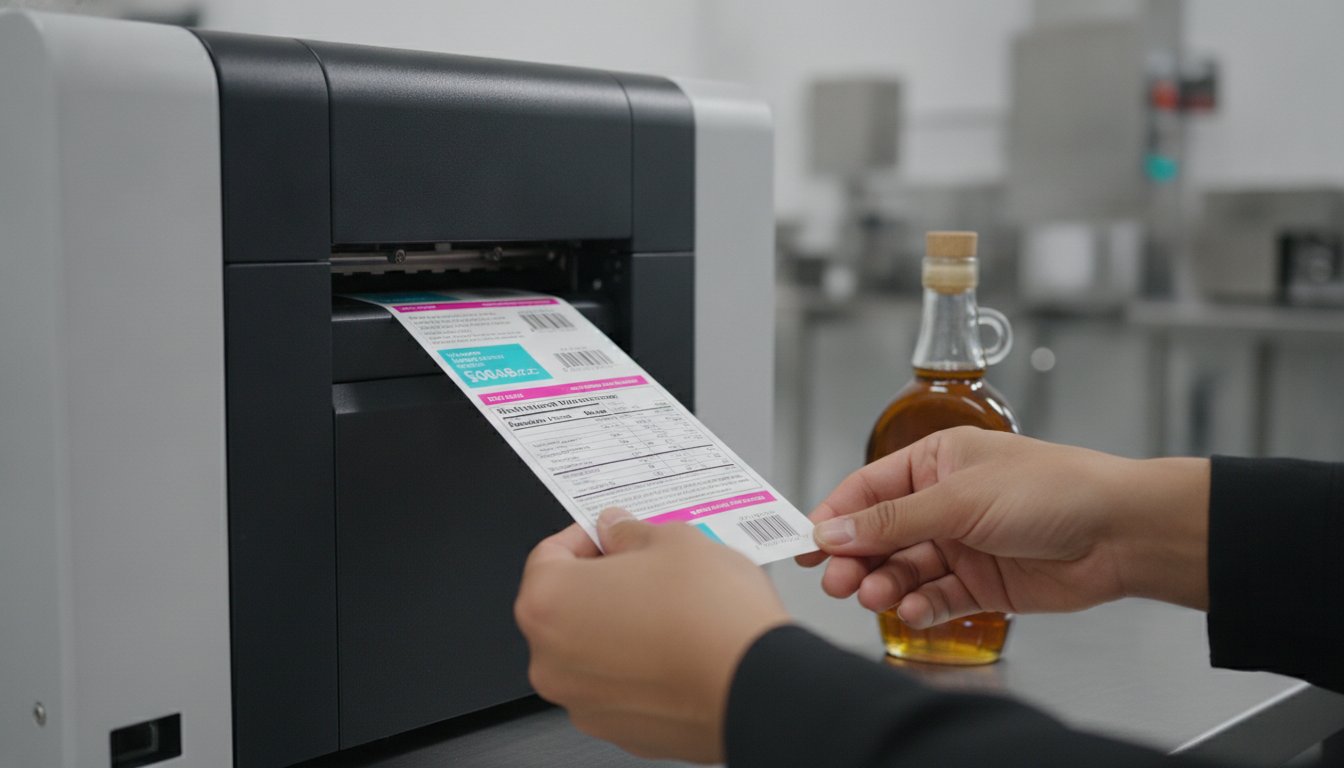
With the Canadian Food Inspection Agency conducting approximately 2,837 food safety investigations every year, the margin for error on your product packaging is virtually non-existent. You likely realize that staying ahead of the January 1, 2026, deadline for mandatory front-of-package nutrition labelling is a massive logistical hurdle. It’s frustrating to deal with the high costs of third-party printers and the constant fear that a simple bilingual formatting error could trigger a costly product recall. If you want to take control of your production, the most effective strategy is to learn how to make your own CFIO compliant labels in-house.
How do you maintain operational efficiency while meeting strict bilingual requirements? We’ll show you how to implement a professional printing system that ensures total compliance while significantly reducing your cost-per-label. This guide provides a clear roadmap for Canadian regulations and compares high-performance hardware like the VIPColor VP550 and VP700 series. You’ll learn how to select the right ink capacities and print speeds to keep your operations running seamlessly. From understanding water-enhanced dye inks to mastering Memjet technology, we’ll help you build a reliable system that turns a regulatory burden into a competitive advantage.
Key Takeaways
- Master mandatory CFIA requirements, including bilingual formatting and the new 2026 front-of-package regulations, to protect your brand from costly product recalls.
- Learn how to make your own CFIO compliant labels using professional in-house systems that reduce your cost-per-label and improve operational flexibility.
- Compare hardware features like internal label unwinders and high-capacity ink cartridges to find the most efficient solution for your production centre.
- Select the right ink technology, such as water-enhanced dye inks, to ensure your labels withstand moisture and condensation in refrigerated environments.
- Streamline your labelling workflow by integrating professional software that automates the creation of accurate nutrition facts tables and allergen declarations.
Understanding CFIA and CFIO Compliance for Canadian Food Labels
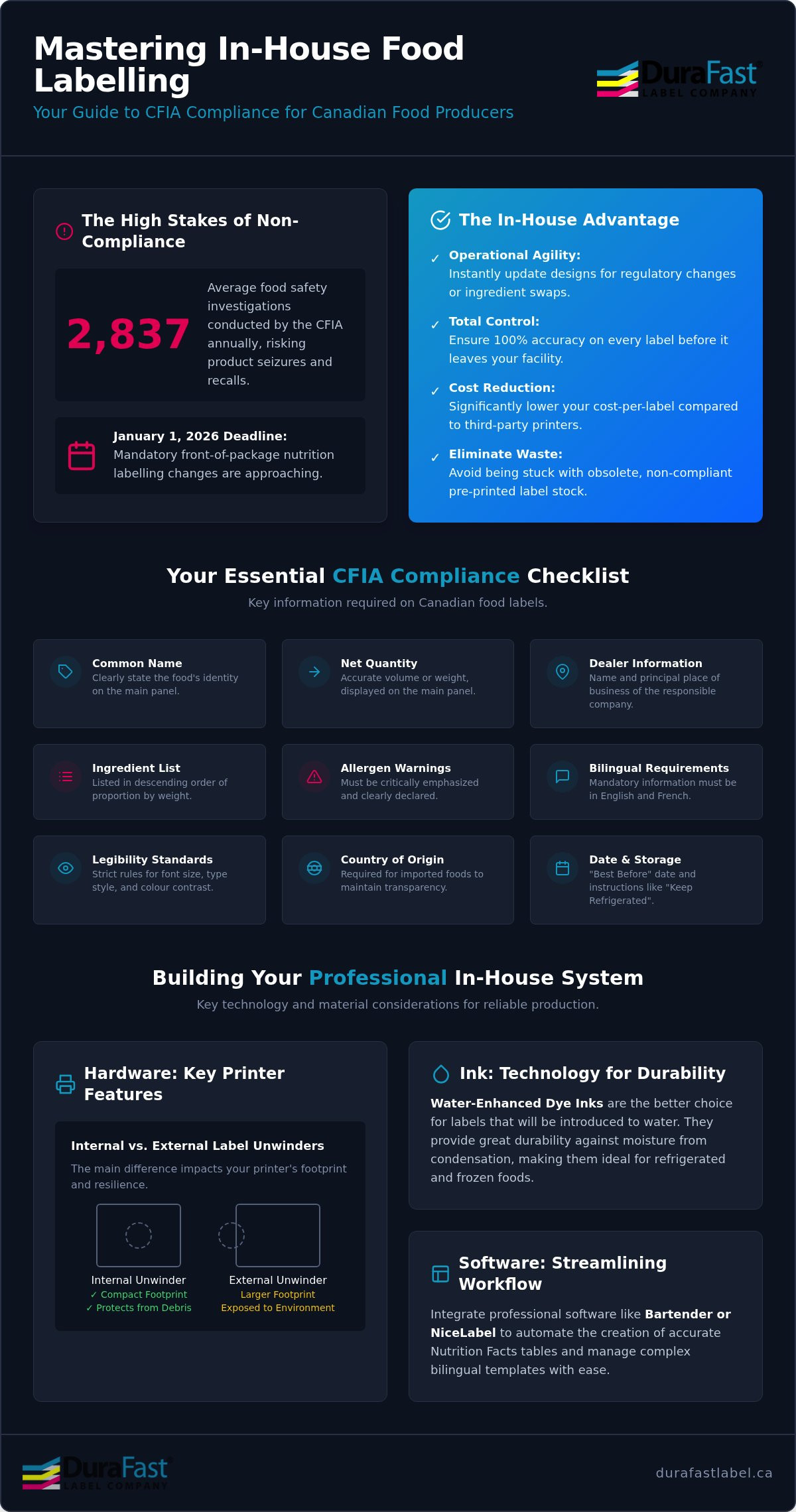
Compliance with the Canadian Food Inspection Agency (CFIA) is more than a bureaucratic checkbox; it's a fundamental pillar of food safety and consumer transparency. According to this Canadian Food Labelling Overview, federal bodies like Health Canada and the CFIA mandate specific disclosures to protect the public. Failure to meet these standards leads to severe operational disruptions, including product seizures and mandatory recalls. With the CFIA conducting roughly 2,837 food safety investigations annually, ensuring your packaging is airtight from a regulatory perspective is essential for business longevity. If your labels fall short, the agency has the authority to pull products from retail shelves instantly, costing your brand thousands in lost revenue and reputational damage.
Why should you choose to make your own CFIO compliant labels rather than relying on third-party print houses? The primary reason is operational agility. Regulations are not static; for example, the new front-of-package nutrition symbol requirements become mandatory on January 1, 2026. When you utilize industrial label printers in-house, you can update your designs the moment a regulation changes or an ingredient is swapped. This eliminates the risk of being stuck with obsolete, non-compliant pre-printed stock that cannot be used.
Mandatory Information for CFIO Compliant Labels
To achieve total compliance, your labels must serve as a comprehensive information hub. Every package requires the common name of the food and the net quantity clearly displayed on the principal display panel. You must also include the name and principal place of business for the manufacturer or distributor. Transparency extends to the ingredient list, where every component must be listed in descending order of proportion. Allergen warnings are particularly critical; they must be emphasized to prevent life-threatening errors. By taking control of the process to make your own CFIO compliant labels, you ensure these details are accurate for every batch you produce.
Bilingual Requirements and Legibility Standards
Canada’s bilingual nature means your labels must speak to both English and French consumers with equal clarity. This isn't just about translation; it involves strict rules for font size, type style, and colour contrast to ensure legibility. For example, Nutrition Facts tables have specific bilingual formatting requirements that dictate exactly how the two languages are presented. Managing these complex layouts is significantly easier when you use professional label design software like Bartender or NiceLabel. These tools allow you to create templates that automatically adjust for bilingual text lengths. This ensures your colour label printers produce professional, readable results every time, even in high-pressure production environments.
Core Requirements for Making Your Own Compliant Labels
How do you ensure every data point on your package is legally sound? It starts with a rigorous adherence to the CFIA Industry Labelling Tool. This resource acts as the definitive checklist for everything from font height to allergen placement. When you make your own CFIO compliant labels, you aren't just printing stickers; you're creating a legal document that represents your brand's commitment to consumer safety. Accuracy is paramount, as even a minor discrepancy in formatting can lead to costly delays at the retail level.
The "true nature" of your food must be immediately apparent to the shopper. This means you must avoid misleading vignettes or images that suggest ingredients not actually present in the product. If your food is imported or processed in a way that changes its origin, you must clearly state the country of origin to maintain transparency. Proper placement of the "Best Before" date and specific storage instructions, such as "keep refrigerated," ensure the product remains safe throughout its entire shelf life. By managing these details in-house, you can verify that every batch meets these high standards before it leaves your facility.
Nutrition Facts Tables: Formatting and Rounding Rules
The 2022 Health Canada Daily Values introduced significant updates to the Nutrition Facts table. These changes require specific disclosures for nutrients like potassium and refined rounding rules for sugar and fat content to help consumers make informed choices. Depending on your package size, you might need to choose between standard, simplified, or dual-format tables. Simplified formats are useful for products with limited nutritional diversity, while dual-format tables are necessary for foods that require additional preparation. Accurate serving sizes are equally vital; they must be standardized based on the specific food category to allow for direct comparisons.
Allergen Labelling and Ingredient Lists
Allergen management is perhaps the most sensitive aspect of compliance. You must use a "Contains" statement to highlight priority allergens such as gluten, milk, eggs, or sulphites. If your facility processes multiple items, cross-contamination warnings are essential to mitigate risk and protect vulnerable consumers. Managing this complex data is much simpler with Bartender label software. This tool allows you to automate the organization of ingredient lists and allergen bolding, ensuring consistency across every SKU in your lineup. If you're unsure which software configuration best suits your production line, you can speak with a labelling expert for personalized guidance.
Choosing the Right Hardware for In-House Label Production
How do you translate complex regulatory data into a physical product that stands out on a retail shelf? While the CFIA Food Labelling for Industry handbook defines what must be on your package, your hardware determines the quality and reliability of that output. Choosing the right printer is the most critical step when you decide to make your own CFIO compliant labels. The main difference between desktop and industrial label printers is the duty cycle they can handle. Desktop models are compact and suitable for smaller batches, while industrial printers are built with rugged internal components designed for continuous, high-volume production environments.
Evaluating print speeds, measured in inches per second (ips), is essential to match your production output. If your facility produces thousands of units daily, a printer that operates at 12 ips, like the VIPColor VP700 series, prevents logistical bottlenecks. Conversely, slower models at 8 ips might suffice for boutique brands. You should also compare ink capacities measured in ml. High-capacity 250 ml cartridges offer a significant cost-per-label advantage over smaller 200 ml tanks, directly impacting your long-term fiscal responsibility. Memjet Technology plays a vital role here; it utilizes a stationary, page-wide printhead to achieve 1600 dpi resolution, ensuring your nutrition panels and bilingual text are sharp and professional.
Internal vs. External Label Unwinders
Where will your printer sit within your production line? Internal label unwinders are integrated into the machine's chassis, which helps maintain a smaller footprint in tight production centres. This is an ideal choice for entrepreneurs with limited workspace. However, external label unwinders are often a better choice for high-volume environments. They allow you to use larger label rolls and provide better environmental resilience against dust or debris. Your facility layout and specific workflow will dictate which configuration allows for the most operational seamlessness.
Inkjet vs. Thermal Transfer for Food Labelling
Which technology fits your specific food category? Professional colour label printers are superior for branding and complex nutrition panels because they handle high-resolution graphics and bilingual text with ease. In contrast, you should use thermal label printers for shipping and barcode-only tasks where colour isn't required. You also need to analyze the durability of your ink. Dye inks provide vibrant colours for dry goods, but water-enhanced dye inks or pigment inks are better choices for labels introduced to moisture or condensation. By matching the right hardware to your specific use case, you ensure that your decision to make your own CFIO compliant labels leads to high-performance results.
Selecting Materials for Durability and Environmental Resilience
Does your label remain legible from the production line to the consumer’s kitchen? While previous sections focused on regulatory data and hardware, the physical substrate you choose is what protects that information in the real world. If you decide to make your own CFIO compliant labels, you must account for environmental debris like dust and grease that can compromise print quality in industrial settings. Standard paper might suffice for dry ambient goods, but refrigerated or frozen products require specialized synthetic materials that won't degrade. In cases where you are handling chemical food additives or industrial-grade ingredients, GHS BS5609 certified materials become a mandatory requirement to ensure the label survives harsh exposure and remains compliant throughout its lifecycle.
Moisture resistance is a critical factor for "wet labels" or any product prone to condensation. If a label becomes soggy and peels off, your product is no longer compliant, regardless of how accurate the printed data was. This is why matching the material to the storage environment is just as important as the design itself. To ensure your packaging stands up to these challenges, you can contact our team for a material consultation to find the perfect match for your specific application.
Adhesives for Frozen and Refrigerated Foods
How do you prevent your branding from peeling away in a cold storage centre? The main difference between standard and cold-temp adhesives lies in their initial tack and long-term bond strength at low temperatures. Frozen food containers are often prone to condensation, which prevents standard adhesives from forming a secure grip. You must select the right blank labels for sale based on your container material, whether it's plastic, glass, or cardboard. Permanent adhesives are the better choice for most food packaging because they resist tampering. Removable options are typically reserved for reusable containers where leaving no residue is a priority.
Dye Inks vs. Pigment Inks for Food Packaging
Which ink technology ensures your product stands out while remaining durable? Dye inks offer the most vibrant colour and are the industry standard for "prime" retail labels where shelf appeal is the priority. However, the only difference that truly matters in high-moisture environments is resistance to smudging. Pigment inks provide superior water and light resistance, making them a better choice for products introduced to water or heavy handling. If you are using a printer like the VIPColor VP550, you can leverage water enhanced dye inks. These offer a middle ground by providing excellent vibrancy with significantly better resistance to condensation for frozen foods compared to standard dye inks.
Implementing a Compliant Labelling Workflow with DuraFast Label Company Canada
How do you move from understanding regulations to executing a high-volume production strategy? Implementing a system to make your own CFIO compliant labels requires a structured roadmap that prioritizes accuracy and scalability. Step one involves a thorough audit of your current label data to identify compliance gaps, specifically regarding the mandatory 2026 nutrition symbols discussed earlier. Once your data is verified, step two is selecting hardware that matches your volume, such as the VIPColor VP750. Step three focuses on integrating design software to automate data management, and step four involves sourcing high-quality consumables from a reliable partner. DuraFast Label Company Canada provides the specialized hardware and local support necessary to ensure this transition is both seamless and fiscally responsible.
By following this methodical approach, you can transform your labelling process from a logistical hurdle into a streamlined asset. Taking control of your production centre allows you to respond to regulatory shifts instantly, ensuring that your brand remains both compliant and competitive in the Canadian market. This strategy doesn't just save money on third-party printing; it builds a foundation for long-term growth and reliability. Working with DuraFast Label Company Canada ensures you have access to the technical expertise required to navigate these complex industrial requirements.
Scaling with VIPColor Label Printers
The VIPColor VP700 series allows you to scale from small boutique batches to mass production without sacrificing quality. These industrial label printers utilize Memjet Technology to achieve a professional 1600 dpi resolution, which is essential for keeping small bilingual text legible and compliant. The main difference between this series and desktop models is the print speed of 12 ips, providing the throughput needed for growing brands. By utilizing high-capacity 250 ml ink tanks, you can minimize downtime and realize a lower cost-per-label compared to systems with smaller ml volumes.
Software Integration for Compliance Automation
Compliance automation relies on professional design software that acts as a bridge between your data and your colour label printers. Integrating Loftware or Bartender allows you to connect your ingredient database directly to your templates, ensuring that any recipe changes are reflected instantly on the production line. You can also automate the generation of UPC barcodes and QR codes to meet retail traceability standards. The software uses conditional logic to manage "Best Before" dates based on production time, which eliminates the risk of human error and ensures your decision to make your own CFIO compliant labels is backed by precise, automated data.
Future-Proof Your Brand with In-House Compliance
Taking control of your production line is the most effective way to ensure your brand remains resilient in the face of shifting Canadian regulations. By integrating professional hardware and automation software, you eliminate the risk of recalls while drastically reducing your overhead. You've seen how matching the right ink and substrate to your specific storage environment prevents non-compliance and ensures label longevity. When you choose to make your own CFIO compliant labels, you gain the agility needed to update packaging instantly as market demands and federal requirements evolve.
DuraFast Label Company Canada acts as your strategic partner throughout this transition. As an authorized VIPColor and Afinia dealer, we provide Canadian-based shipping and support tailored to national businesses. We specialize in GHS and compliant labelling solutions that help you maintain operational seamlessness without the high costs of third-party vendors. Don't let complex bilingual laws or moisture-heavy environments disrupt your growth. Browse our selection of VIPColor Label Printers for your in-house production needs and start building a more efficient, compliant future for your brand. Your operational challenges have accessible, high-quality solutions, and we're here to help you implement them.
Frequently Asked Questions
Is it legal to print my own food labels for retail in Canada?
Yes, it's entirely legal to print your own food labels for retail in Canada, provided they meet all CFIA and Health Canada regulatory standards. Many businesses choose to make your own CFIO compliant labels to maintain total control over their packaging data and avoid the lead times of external print houses. You must ensure that every requirement, from bilingual text to the new front-of-package nutrition symbols, is accurately represented before your products reach the retail shelf.
What is the minimum font size for bilingual text on a Canadian label?
The minimum font size for most mandatory information on Canadian food labels is 1.6 mm, based on the lowercase letter "o". However, this requirement can vary depending on the available surface area of the package. For example, very small containers may qualify for exemptions or reduced font sizes. It’s essential to realize that legibility isn't just about size; high-contrast colours and clear typefaces are also required to ensure consumers can read ingredient lists easily.
How much does it cost to set up an in-house label printing system?
The cost of setting up an in-house system depends on your specific production volume and durability needs. Entry-level desktop models are a practical choice for boutique brands, while high-speed industrial printers like the VIPColor VP700 series require a larger initial investment. You should evaluate the long-term fiscal responsibility of the system by calculating the cost-per-label, which is often significantly lower than third-party printing due to high-capacity ink cartridges and the elimination of minimum order quantities.
Can I use a standard office inkjet printer for food labels?
No, standard office inkjet printers are generally unsuitable for professional food labelling. These machines lack the specialized ink technology required to resist moisture, oils, and environmental debris found in production centres. Office inks often smudge when introduced to water or condensation, which can lead to non-compliance if the mandatory data becomes unreadable. Professional systems use specialized dye or pigment inks designed for high-resolution graphics and long-term durability on various synthetic substrates.
What is the difference between CFIA and CFIO labelling requirements?
The main difference lies in the terminology rather than the intent. The CFIA is the federal agency responsible for enforcing the laws, while CFIO often refers to the specific compliance standards set out under the Safe Food for Canadians Regulations and the Food and Drugs Act. Both frameworks aim to ensure food safety and consumer transparency. When you make your own CFIO compliant labels, you're adhering to the unified set of rules managed by the CFIA to protect the Canadian public.
Do I need special ink for labels that will be used in freezers?
Yes, labels destined for refrigerated or frozen environments require specialized ink to prevent smudging and degradation. Standard dye inks may bleed when exposed to heavy condensation for frozen foods. A better choice is water-enhanced dye ink, found in the VP550 series, or pigment ink, which offers superior resistance to moisture and light. You must also pair these inks with cold-temp adhesives to ensure the label doesn't peel away when temperatures drop below freezing.
How do I ensure my barcodes are scannable by Canadian retailers?
To ensure scannability, your printer must achieve high-resolution output, typically 300 dpi or higher. Canadian retailers generally require GS1-standard barcodes with high contrast, usually black on a white background. Professional label printers utilizing Memjet Technology can produce sharp, 1600 dpi barcodes that prevent scanning errors at the checkout. You should also use professional software to automate the generation of UPC and QR codes, which ensures the data structure meets national retail traceability standards.
Which label software is best for managing bilingual nutrition facts?
Professional design software like Bartender or Loftware NiceLabel is the best choice for managing complex bilingual layouts. These programs allow you to connect directly to your ingredient database and use templates that automatically adjust for English and French text lengths. They also include built-in tools for applying Health Canada’s rounding rules and formatting Nutrition Facts tables. This automation reduces the risk of human error and ensures your bilingual panels remain compliant as your product lineup scales.