Liner-Free Printers: The 2026 Guide to Sustainable Labelling in Canada
18th Sep 2026
Did you know that a standard roll of labels can contain up to 40% waste by weight, simply from the backing paper you eventually throw away? For many Canadian businesses, that waste isn't just an environmental burden; it's a constant source of downtime and a significant safety hazard on the warehouse floor. You've likely experienced the frustration of frequent roll changes slowing down your production line or the risk of a team member slipping on discarded liners. It's a logistical challenge that demands a smarter, more sustainable approach to marking and distribution.
This 2026 guide shows you how liner-free printers can solve these issues by eliminating backing paper entirely and increasing your labels per roll by 40% to 60%. We'll explore how this technology helps you meet current Canadian environmental reporting requirements while lowering your operational costs. We will also provide a technical comparison of industry-leading hardware, including the latest Seiko SLP850 and the VIPColor water-enhanced series for durable applications. You'll learn how to select the right equipment to streamline your operations and improve your sustainability metrics for the years ahead.
Key Takeaways
- Eliminate silicone-coated backing paper to reduce landfill waste and align your operations with expanding Canadian Extended Producer Responsibility (EPR) regulations.
- Increase your labels per roll by 40% to 60% using liner-free printers, which directly lowers freight expenses and minimizes the frequency of roll changes on the production line.
- Distinguish between standard and water-enhanced ink models, such as the VP750, to ensure your labels maintain "great durability" when exposed to condensation or frozen food environments.
- Choose the right hardware configuration for your facility, including internal unwinders to protect label stock from environmental debris in dusty Canadian warehouses.
- Enhance workplace safety and efficiency by removing slippery liner waste from floors while accelerating throughput in high-speed logistics and food service applications.
What Are Liner-Free Printers and Why Is Your Business Switching?
What if you could eliminate the single largest source of waste in your packaging process? Liner-free printers allow Canadian businesses to do exactly that by utilizing label rolls that lack the traditional silicone-coated backing paper. This backing, or liner, typically accounts for nearly 40% of a roll's total weight. By removing it, you aren't just being environmentally conscious; you're fundamentally changing your operational efficiency. In a climate where the Federal Plastics Registry requires strict reporting on plastic packaging for 2026, switching to linerless technology is a proactive step toward compliance and fiscal responsibility.
The benefits extend far beyond the waste bin. Because there's no liner, each roll can hold between 40% and 60% more labels compared to standard rolls of the same diameter. This means your team spends significantly less time on roll changes, keeping your production line moving. Safety also improves. Discarded liners are notoriously slippery and often end up cluttering the centre of a busy warehouse or kitchen floor. Eliminating the liner removes this hazard entirely, creating a cleaner and safer workspace for your staff.
The Anatomy of a Linerless Label
The construction of a linerless label is a marvel of material science. Instead of a separate backing sheet, each label is treated with a specialized release coating on its face. This coating acts as a barrier, allowing the pressure-sensitive adhesive on the underside to peel away from the roll with ease. It functions much like a roll of high-quality tape. Depending on your needs, these labels come with different adhesive strengths. Permanent adhesives are ideal for logistics, while repositionable options are perfect for the quick-service restaurant industry where labels must be moved from a prep station to a delivery bag.
Direct Thermal vs. Liner-Free: Understanding the Connection
Most liner-free printers utilize direct thermal technology, which eliminates the need for ribbons or ink. However, it's a mistake to assume a standard thermal printer can handle these rolls. Linerless systems require specialized thermal printheads with non-stick coatings and modified platen rollers to prevent adhesive buildup. This hardware allows for variable length labelling. Instead of being forced into a fixed die-cut size, the printer cuts the label exactly where the data ends. This precision minimizes material use and ensures you aren't paying for empty white space on your packaging. For those needing compact solutions, the Seiko SLP720RT offers a reliable entry point into this efficient technology.
The Mechanics of Linerless Technology: Specialized Hardware
Why can't you simply load a linerless roll into your existing thermal printer? The answer lies in the specialized architecture required to manage exposed adhesive. Standard thermal printers rely on the silicone-coated backing paper to act as a buffer between the label and the internal components. Without this liner, the adhesive would immediately bond to the platen roller, leading to catastrophic jams and production downtime. Liner-free printers are engineered with non-stick platen rollers, usually coated in specialized silicone or proprietary polymers, which allow the labels to pass through without sticking. This hardware distinction is why a simple software update or a change of media is never enough to convert traditional equipment.
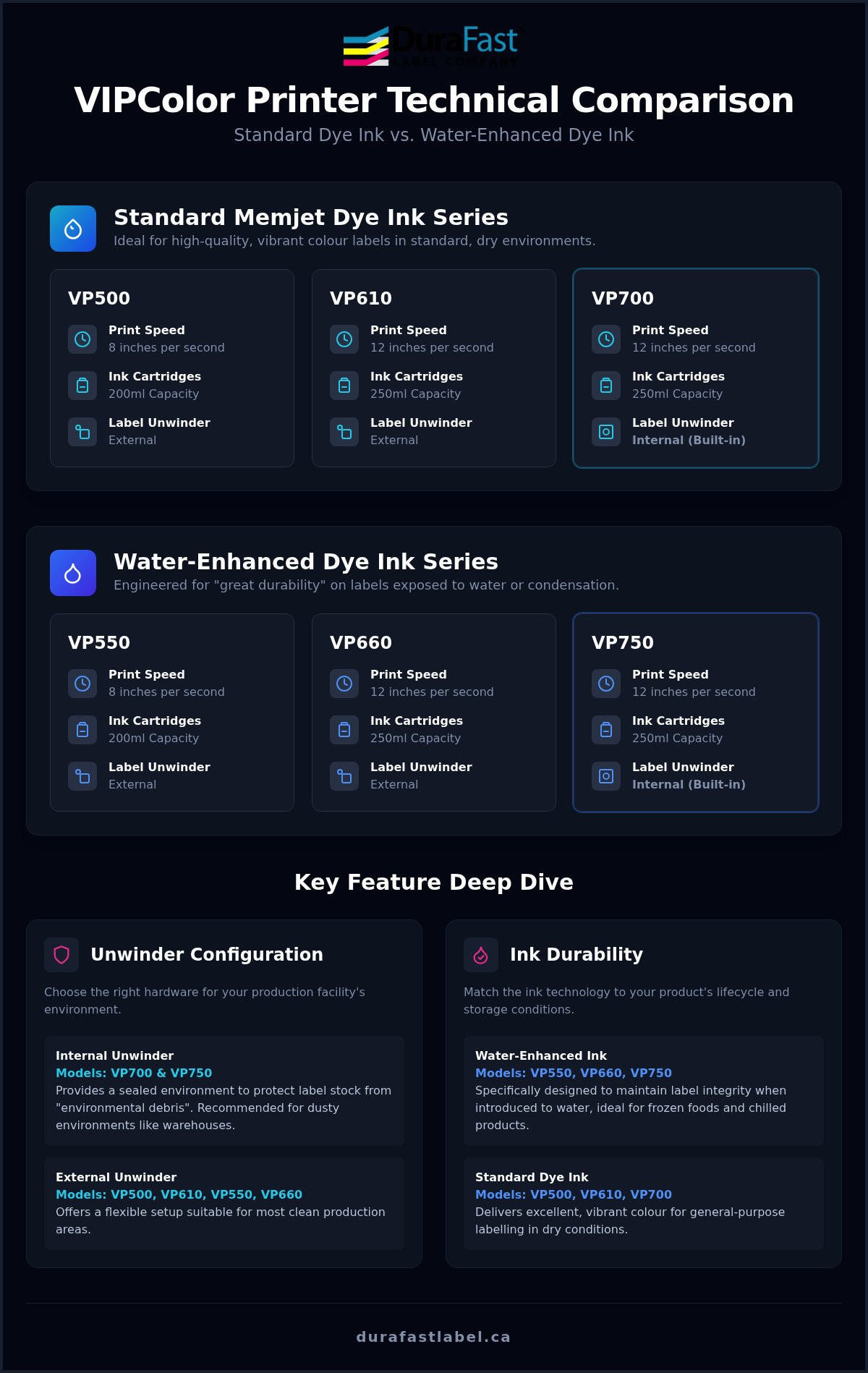
Another critical hardware consideration is the unwinder configuration. In many Canadian industrial environments, airborne dust and "environmental debris" can compromise the adhesive quality of a label roll. Models featuring an internal label unwinder, such as the VIPColor VP700 or the water-enhanced VP750, provide a sealed environment that protects the media until the moment of printing. If you're unsure which hardware configuration fits your facility, our team can help you evaluate your specific production environment to ensure maximum uptime.
Printhead Innovation and Maintenance
Modern liner-free printheads utilize advanced anti-adhesive coatings to ensure the label face doesn't drag or catch during high-speed operations. While these coatings are durable, they require a disciplined maintenance schedule to remain effective. We recommend cleaning the platen rollers and printhead with isopropyl alcohol after every one to two rolls of media, or at the start of every shift in high-volume settings. This prevents minute adhesive deposits from accumulating into a "seamless" layer of grime that can degrade print quality. For businesses scaling their operations, knowing when to source replacement thermal printheads is essential for maintaining industrial reliability.
Cutter Durability and Precision
The integrated cutter is perhaps the hardest working component in a liner-free system. Unlike die-cut labels that are pre-separated on a liner, linerless labels exist as a continuous strip. The printer must cut through the adhesive layer for every single label. To prevent "gumming up," these cutters are designed with specialized geometries and non-stick surfaces. This capability enables the "variable length" feature, where the printer only uses the exact amount of material required for the data provided. While traditional die-cut labels often result in wasted white space, liner-free technology allows you to produce a two-inch label for a small order and a six-inch label for a bulk shipment from the same roll, significantly reducing material costs.
Comparing the Costs: Traditional Labelling vs. Liner-Free Efficiency
What is the true cost of a single label? Most business owners look at the purchase price per thousand, but this figure ignores the "hidden" expenses of freight, storage, and disposal. When you use traditional thermal labels, you're paying to ship, store, and eventually discard thousands of tonnes of silicone-coated backing paper every year. Liner-free printers reframe this entire financial equation. By removing the liner, you eliminate nearly 40% of the roll's weight, which translates directly into lower shipping costs from your suppliers. Over a three-year business cycle, the Total Cost of Ownership (TCO) for linerless systems often proves superior because you're no longer paying for a component that ends up in a landfill.
Labor efficiency is another significant factor in the cost-benefit analysis. Every time a production line stops for a roll change, you lose valuable uptime. Because linerless rolls contain more material in the same physical footprint, your staff performs fewer changeovers. In a high-volume Canadian fulfillment centre, reducing roll changes by half can reclaim hours of productivity every week. Additionally, large-scale facilities face rising waste disposal fees and stricter reporting requirements under provincial Extended Producer Responsibility (EPR) programs. Transitioning to linerless technology significantly reduces the volume of waste your facility generates, potentially lowering your environmental levies and disposal costs.
Calculating the ROI of Linerless Systems
To determine your return on investment, you must look beyond the initial hardware purchase. A comprehensive ROI framework should include the cost of liner disposal and the value of reclaimed production time. Consider these specific advantages:
- Increased Density: You gain a 40% to 60% increase in labels per roll compared to standard thermal rolls of the same diameter.
- Material Reduction: You reduce your total material volume by up to 50%, which lowers the carbon footprint of your inbound logistics.
- Variable Length Savings: Printing only the exact length needed prevents the "white space waste" common with fixed-size die-cut labels.
This fiscal responsibility aligns with the growing demand for sustainable business practices across Canada. By cutting material waste at the source, you're protecting your margins while meeting modern environmental standards.
Storage and Logistics Advantages
Space is a premium resource in any warehouse. Traditional labels require twice the storage footprint because half of every pallet is comprised of useless backing paper. Switching to linerless direct thermal labels allows you to store twice as many labels in the same square footage. This frees up space in your warehouse centre for revenue-generating inventory rather than packaging supplies. For Canadian businesses aiming to minimize their environmental impact, this reduction in storage and transport volume is a tangible metric for sustainability reports. It's a pragmatic solution that pairs industrial reliability with measurable fiscal gains.
Industry Applications: From Food Service to Canadian Logistics
How does a high-volume Canadian kitchen manage hundreds of custom orders without drowning in backing paper? In the quick-service restaurant (QSR) sector, liner-free printers are becoming the essential tool for order accuracy and operational speed. These devices allow staff to apply labels directly to containers and delivery bags without the need to peel away a liner, saving precious seconds during peak hours. Beyond food service, retail pharmacies are adopting this technology for patient-specific prescription labelling. The ability to print variable-length instructions on a single roll ensures that critical dosage information is clear and appropriately sized for different bottle dimensions, all while maintaining a tidy workstation.
The transition to linerless systems is not merely about convenience; it's about matching hardware to the specific rigours of the industry. Whether you're managing a pharmacy or a fulfillment centre, the goal is the same: reduce friction and maximize resource utilization. If your business handles a wide variety of packaging types, you can consult with our specialists to determine which liner-free solution aligns with your specific workflow and volume requirements.
Linerless in the Cold Chain and Food Industry
Canadian food producers face distinct challenges when labels are introduced to water or condensation. Standard labels often peel or smudge in these conditions, but "water enhanced" models like the VIPColor VP750 are specifically intended for durability in these environments. The VP750 is a high-performance solution that prints at 12 ips and utilizes 250ml ink cartridges. Because it features an internal label unwinder, the roll remains protected from "environmental debris" common in food processing plants. This water-enhanced dye ink series provides "great durability" for frozen foods and refrigerated goods, ensuring your products remain compliant with Canadian food safety marking standards throughout the entire cold chain.
Logistics and Warehouse Optimization
In the e-commerce sector, box sizes vary significantly from one order to the next. Using a standard 4x6 label on a small mailer is often wasteful and cumbersome. Liner-free printers solve this by enabling variable length printing, where the integrated cutter trims the label to the exact size of the shipping data. For businesses requiring compact and reliable hardware for these tasks, the Seiko SLP720RT printers are a premier choice for both desktop and mobile logistics applications. These units provide the industrial reliability needed for high-speed parcel delivery, allowing logistics teams to maintain high throughput without the constant maintenance associated with traditional liner waste.
Selecting Your Solution: Seiko and VIPColor Precision
Choosing the right hardware configuration is the final step in optimizing your labelling workflow. To make an informed decision, you must evaluate your production volume alongside the environmental conditions of your facility. Whether you require a compact desktop unit or an industrial-grade colour system, the selection among liner-free printers depends on the specific technical requirements of your application. Canadian businesses often find that matching the printer's unwinder type and ink durability to their workspace is the key to achieving long-term reliability.
The Seiko SLP850: High-Precision Desktop Labelling
The Seiko SLP720RT has long been a staple for logistics, but the Seiko SLP850 series offers enhanced precision for retail and pharmaceutical needs. Specifically, the SLP850-BK0C11-03 is a versatile choice as it supports both traditional die-cut and linerless media. With a 300 DPI resolution, it ensures that small barcodes and text remain crisp. The SLP850 also provides Bluetooth and USB connectivity, making it ideal for modern Canadian workspaces where mobility and a clean setup are priorities. It's a pragmatic solution for businesses that don't want to sacrifice quality for a smaller footprint.
For high-volume colour needs, the VIPColor standard series offers a scalable path. The VP500 provides a print speed of 8 ips and uses 200ml ink cartridges, serving as an excellent entry point for growing brands. If your throughput demands more speed, the VP610 increases performance to 12 ips and uses larger 250ml ink cartridges. Both the VP500 and VP610 feature external label unwinders for straightforward media loading. If your warehouse is a dusty environment, the VP700 is the superior solution. It maintains the 12 ips speed and 250ml capacity but includes an internal label unwinder to protect rolls from environmental debris.
VIPColor Water Enhanced Series for Industrial Durability
Labels exposed to water, condensation, or frozen foods require the water enhanced dye ink series, which is specifically intended for "great durability" in wet applications. The VP550 (8 ips, 200ml) and VP660 (12 ips, 250ml) both utilize external label unwinders and provide high-speed colour output for moisture-heavy environments. For the most demanding industrial settings, the VP750 stands as the premier choice. It features an internal label unwinder to shield media from debris while delivering the moisture resistance necessary for the Canadian food industry. This technical distinction ensures your marking remains legible from the production line to the customer's freezer.
Future-Proofing Your Canadian Labelling Strategy
Transitioning to linerless technology is no longer just a sustainability goal; it's a strategic move for operational resilience. Throughout this guide, you've seen how liner-free printers eliminate silicone-coated backing paper to reduce landfill waste while increasing your label capacity per roll by up to 60%. Whether you're optimizing a pharmacy workstation with a Seiko desktop unit or deploying the VIPColor water-enhanced series for frozen food durability, the right hardware ensures your production remains seamless and safe. These choices directly impact your ability to meet 2026 environmental reporting standards while protecting your bottom line.
As an authorized Canadian partner for Seiko and VIPColor, we maintain a specialized inventory of linerless thermal labels to keep your facility running without interruption. Our team provides the expert technical support needed to navigate the functional differences between internal and external unwinder models. We don't just sell equipment; we act as your strategic partner in growth. Ready to eliminate waste and lower your freight costs? Contact our labelling specialists to find the right liner-free solution for your business. We look forward to helping you scale your in-house production with confidence.
Frequently Asked Questions
What is the main advantage of a liner-free printer for a Canadian warehouse?
The primary advantage is the total elimination of silicone-coated backing waste, which significantly reduces disposal costs and improves workplace safety. By removing slippery liners from the warehouse floor, you mitigate common slip and fall hazards. Additionally, liner-free printers allow for 40% to 60% more labels per roll. This means your team performs fewer roll changes, which directly increases productivity and reclaimable uptime in high-volume logistics environments.
Do liner-free printers require special labels?
Yes, these systems require specialized linerless media designed with a release coating on the face and a specific adhesive on the back. This construction allows the label to peel off the roll without a backing sheet, much like a roll of tape. Using standard labels in a linerless system won't work and can cause hardware damage. We maintain a specialized inventory of linerless direct thermal labels to support these Canadian business operations.
How do I prevent adhesive buildup on a linerless printhead?
Consistent maintenance is the most effective way to prevent adhesive accumulation. You should clean the platen rollers and printhead with isopropyl alcohol after every one to two rolls of media, or at the start of every shift. This routine ensures that the non-stick surfaces remain effective and prevents debris from compromising print quality. Following a disciplined schedule helps maintain industrial reliability and ensures that your liner-free printers continue to operate at peak performance.
Can I use a standard thermal printer for liner-free labels?
No, standard thermal printers lack the specialized hardware required to manage exposed adhesive. Liner-free systems are engineered with proprietary non-stick platen rollers and integrated cutters designed to slice through adhesive without gumming up. Attempting to use linerless media in a traditional printer will cause immediate jams as the adhesive bonds to the internal components. It's essential to invest in dedicated hardware like the Seiko SLP720RT or the VIPColor VP series for these applications.
Are liner-free labels more expensive than traditional labels?
While the initial purchase price per roll may appear higher, the total cost of ownership is often lower for Canadian businesses. You save significantly on freight and storage because you aren't paying to transport useless backing paper. Since each roll contains up to 60% more labels, you also reclaim labor costs by reducing the frequency of roll changes. When you factor in reduced waste disposal fees, the fiscal responsibility of linerless technology becomes clear.
What industries benefit most from linerless technology in 2026?
Quick-service restaurants (QSR) and high-volume logistics hubs see the most immediate benefits due to the speed of application and variable-length labelling. E-commerce businesses use the technology to minimize material waste on diverse box sizes. In 2026, Canadian food producers are also adopting water-enhanced models for frozen goods. These industries prioritize efficiency and sustainability, making the switch to linerless a strategic move to meet modern regulatory and operational demands across the country.
What is the difference between the VIPColor VP700 and VP750?
The primary difference lies in ink durability and application. The VP700 uses the standard Memjet dye ink series and is ideal for high-speed, high-volume labelling in dry environments. The VP750 belongs to the water-enhanced dye ink series, providing "great durability" for labels exposed to water, condensation, or frozen foods. Both models feature an internal label unwinder, which protects the media from environmental debris in dusty settings while maintaining a 12 ips print speed.
Is the Seiko SLP850 compatible with liner-free labels?
Yes, the Seiko SLP850 is fully compatible with both die-cut and liner-less labels. Specifically, the SLP850-BK0C11-03 model is designed to handle these versatile media types at a 300 DPI resolution. This makes it a premier choice for businesses needing high-precision barcodes and text in a compact desktop format. Its integrated cutter and non-stick components ensure that switching between traditional and liner-free media is a seamless process for your production team.