How to Produce CFIO Compliant Labels in Canada
27th Aug 2026
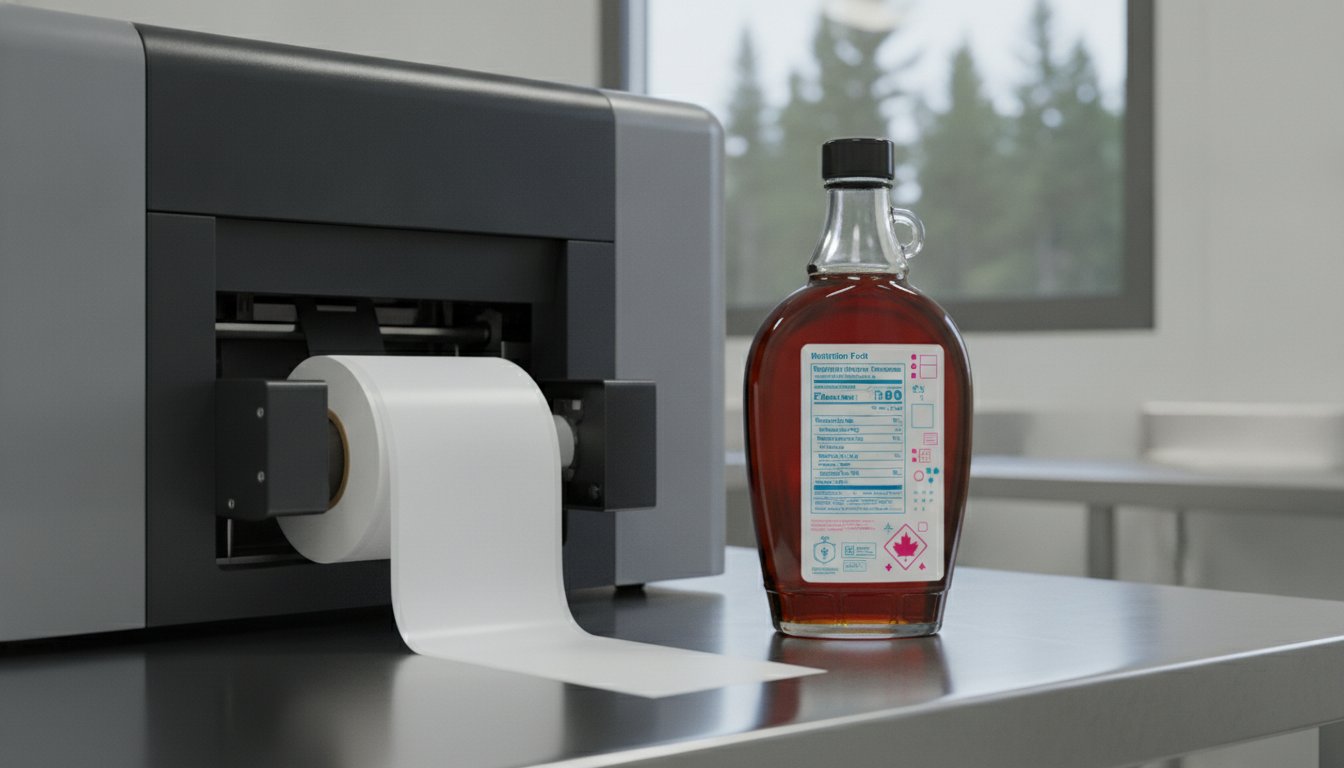
Is your production line ready for the January 1, 2026, deadline when mandatory front-of-package nutrition symbols become a reality for most prepackaged foods in Canada? You likely understand the pressure of keeping up with evolving Health Canada standards while trying to keep your operational costs under control. Producing CFIO compliant labels shouldn't be a source of constant anxiety or a logistical bottleneck that leads to expensive product recalls. It's a technical hurdle that's best cleared with the right tools and a clear strategy.
We agree that the complexity of bilingual requirements and nutrition table formatting can feel overwhelming, especially when the high costs of outsourcing small batches eat into your margins. This article will help you master the complexities of Canadian food labelling regulations and show you how to produce fully compliant labels in-house with professional precision. We'll provide a clear framework for choosing the right colour label printer and software to reduce your lead times and improve flexibility. You'll gain a thorough understanding of core requirements and the technical metrics needed to ensure your packaging remains durable in cold storage or high-moisture environments.
Key Takeaways
- Understand the legal standards of the Canadian Food Inspection Agency (CFIA) and how the Industry Labelling Tool (ILT) ensures federal compliance for your food products.
- Master essential technical requirements for CFIO compliant labels, including the mandatory 1.6 mm font size rule and correct Principal Display Panel (PDP) placement.
- Learn how in-house printing reduces lead times and costs by analyzing technical metrics such as ink volumes in ml and print speeds measured in ips.
- Discover how to select high-resolution printers and professional design software like Bartender or Loftware to manage complex bilingual and nutrition updates.
- Identify the best hardware for your specific environment, such as choosing pigment inks for labels exposed to condensation or cold storage.
What Are CFIO Compliant Labels and Why Do They Matter in 2026?
In the Canadian marketplace, the term "CFIO" is often used interchangeably with the Canadian Food Inspection Agency (CFIA) standards. Essentially, CFIO compliant labels represent the legal baseline for any food product sold within our borders. These labels aren't just decorative; they're a technical requirement governed by the Food and Drugs Act and the Safe Food for Canadians Act. To stay aligned with these federal standards, manufacturers rely on the Industry Labelling Tool (ILT). This digital resource acts as a comprehensive guide for everything from ingredient lists to net quantity declarations. Failing to produce CFIO compliant labels isn't a minor clerical error. Retailers will flatly reject your shipments to avoid their own liability, and federal regulatory action can lead to costly seizures or public recalls that damage your brand's reputation for years. The main difference between a generic sticker and a professional compliant label lies in the precision of the data and the durability of the material used.
The Core Objectives of Canadian Food Labelling
Why does the government care so much about your packaging? The primary goal is facilitating informed purchasing choices for Canadian consumers. By providing a standardized format, shoppers can compare products easily. Beyond that, it's about ensuring health and safety through accurate allergen declarations. Missing a "contains milk" warning can have life-threatening consequences. Finally, these regulations prevent fraud by requiring a "true nature" description of the food. You can't label a product as "maple syrup" if it's mostly corn syrup; the law ensures consumers get exactly what they pay for. For a broader look at how these laws evolved, you can explore the history of Food Labelling in Canada.
Navigating the Safe Food for Canadians Regulations (SFCR)
The Safe Food for Canadians Regulations (SFCR) represent a massive shift in how the food supply chain is monitored. In 2026, the emphasis on traceability and precise date markings has never been higher. These rules impact every level of production, from the farmer to the final retailer. Many businesses are moving toward in-house production using colour label printers to manage frequent regulatory updates without waiting for an external print shop. This shift allows you to adjust to new mandates, like the front-of-package nutrition symbols, in real-time. By taking control of your printing process, you ensure that every batch meets the current SFCR requirements while maintaining the operational seamlessness your business needs to grow.
Core Technical Requirements for CFIA/CFIO Compliance
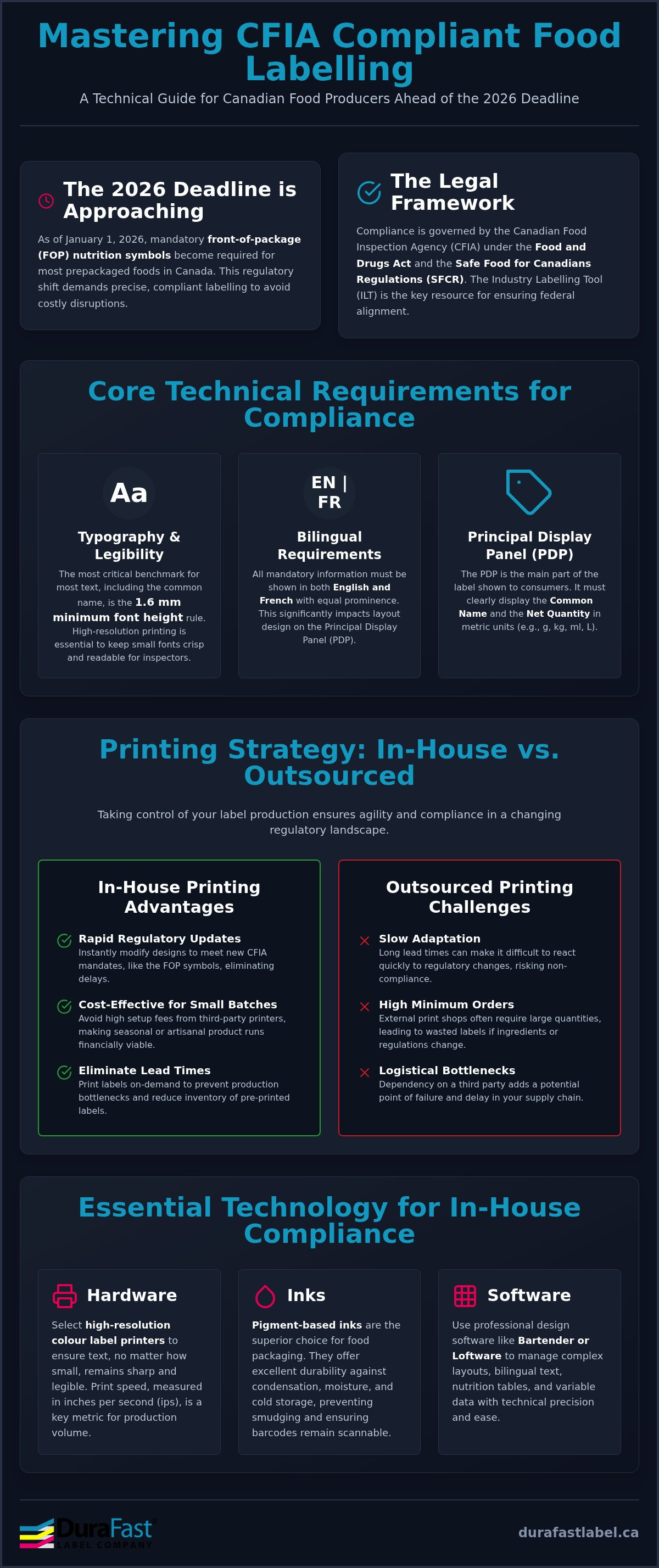
How do you translate complex federal mandates into a physical label design? Achieving CFIO compliant labels requires strict adherence to typography and placement rules. The most critical benchmark for most manufacturers is the 1.6 mm rule for common names. This minimum font height ensures that consumers can identify the product quickly. You should consult the CFIA Industry Labelling Tool for specific exceptions; however, if your text is smaller than this standard, your product is at risk of being non-compliant. High-resolution printing is essential here because even small fonts must remain crisp and legible to pass inspection.
Bilingual requirements add another layer of complexity. In the Canadian market, both English and French text must be presented with equal prominence. This requirement often creates a spatial challenge on the Principal Display Panel (PDP), which is the part of the label most likely to be seen by a consumer during a normal sale. Balancing these two languages while leaving room for a legible Nutrition Facts Table (NFT) requires precise software control and professional-grade hardware. If your layout is cluttered or the font is compressed to fit both languages, you may inadvertently violate legibility standards.
Common Name and Net Quantity Declarations
Standardizing the common name prevents consumer confusion and remains a core requirement for CFIO compliant labels. This name must appear on the PDP in both official languages. Similarly, the net quantity must be expressed in metric units, typically grams or millilitres. The minimum type height for these declarations scales based on the total surface area of your package. For instance, a larger container requires larger text to maintain readability. If you are struggling to fit these mandatory elements onto a small package, you can speak with a labelling specialist to verify your layout and font choices.
Ingredient Lists and Allergen Labelling
Accuracy in your ingredient list is a matter of public safety. The main difference between standard ingredients and priority allergens is the specific formatting requirement. Allergens must be clearly identified, often using bold text or a separate "Contains" statement to draw the eye. In production environments that are dusty or introduced to water, you must ensure your labels are durable. Using pigment-based inks prevents the text from smearing or fading. This ensures that critical safety information remains clear and legible throughout the product's entire shelf life, regardless of condensation or cold storage conditions.
In-House vs. Outsourced Printing for Compliance
Are you tired of waiting weeks for a third-party print shop to deliver a small batch of labels that might be outdated by the next regulatory shift? Transitioning to in-house production for CFIO compliant labels offers a level of fiscal responsibility and operational seamlessness that outsourcing simply cannot match. When you analyze the cost-per-label, the most significant factor is often the ink volume measured in ml. High-capacity systems allow for a much lower cost per unit compared to small, consumer-grade cartridges. Maintaining high print speeds, measured in ips (inches per second), is essential for scaling your production without creating a bottleneck in your packaging line. By taking control of your printing, you also reduce environmental debris and waste, as you only print exactly what you need for each production run.
Evaluating Print Technology for Food Labels
Choosing between Memjet Technology and traditional inkjet systems is a strategic decision for any Canadian food manufacturer. While both can produce professional results, the only difference that truly impacts your workflow is the balance between speed (ips) and image resolution. High-speed Memjet systems are often the better choice for large-scale operations requiring rapid output. These colour label printers are universally superior for producing the complex nutrition tables required by the CFIA Food Labelling Requirements. These tables must be perfectly legible to remain compliant, and professional-grade hardware ensures that every line and percentage is sharp.
Managing Ink Costs and Efficiency
For industrial use, comparing large ink tanks of 250ml or more to small cartridges is vital for long-term value. Large tanks minimize downtime and lower your overhead significantly. If your brand prioritizes visual appeal, water enhanced dye inks provide exceptional colour vibrancy on blank labels for sale. You must consider your specific environment carefully. If your products will be introduced to water or heavy condensation, such as frozen foods or chilled beverages, pigment-based inks are the superior choice. This prescriptive approach ensures your CFIO compliant labels remain intact and readable from the warehouse to the consumer's table, preventing the logistical hurdles of smudged or detached branding.
Choosing the Right Hardware and Software for CFIO Standards
How do you move from understanding regulations to actual execution on the production floor? Producing CFIO compliant labels requires a methodical four-step approach to ensure your hardware and software work in harmony. First, you must select a printer that supports high-resolution printing to maintain the crispness of the mandatory 1.6 mm small-font text. Second, implement professional design software like Bartender or Loftware to manage the complex data fields. Third, choose your label materials based on the product’s storage environment. Finally, verify your results. Using a professional analyzer to check barcode and NFT legibility ensures your packaging survives the scrutiny of retail inspectors. Ensuring your facility produces CFIO compliant labels consistently is a strategic advantage that prevents costly re-labelling projects.
The Role of Label Design Software
Bartender has become the industry standard for generating accurate nutrition facts tables and barcodes. It allows you to link your product database directly to the label template, which reduces manual entry errors. If you manage multiple production lines or facilities, Loftware offers cloud-based compliance tools that ensure every location prints the exact same approved design. These platforms also simplify the process of automating bilingual text placement. By setting up dynamic fields for French and English descriptions, you ensure that both languages receive equal prominence without redesigning the layout for every SKU.
Material Selection: From Wet Labels to Frozen Foods
Your choice of substrate is just as vital as the ink. Selecting durable industrial labels is essential for products stored in harsh environments. For instance, frozen food manufacturers often face the hurdle of labels peeling due to high condensation. To prevent this, you need aggressive adhesives designed for sub-zero temperatures. The only difference between a standard paper label and a synthetic one is the resistance to moisture and tearing. If your food labelling also requires GHS or chemical resistance, pigment-based inks are the superior choice. These inks create a permanent bond with the material, ensuring your safety warnings and ingredient lists don't smudge when introduced to water. If you're unsure which hardware configuration fits your specific production volume, you can request a professional consultation to find the right solution for your facility.
DuraFast Solutions for Canadian Food Labelling Compliance
Selecting the specific machinery that bridges the gap between regulatory theory and production reality is a critical business decision. At DuraFast Label Company Canada, we act as a strategic partner to ensure your facility is equipped with the exact hardware needed to produce CFIO compliant labels without disruption. Whether you're a high-volume manufacturer or a boutique producer, the choice of printer determines your long-term efficiency and fiscal responsibility. We provide national support for industrial label printers across Canada, ensuring that your equipment remains operational and your supplies are always in stock. By matching technical specifications to your specific environmental challenges, we help you take full control of your production process.
Comparing the VIPColor VP Series
The VIPColor lineup offers some of the most versatile Memjet solutions for large batches. When choosing between models, the main difference between the VP700 and the VP750 is the latter's use of water enhanced dye inks. This feature makes the VP750 a superior choice for products introduced to water or heavy condensation. You should also consider your facility footprint. While internal label unwinders offer a more compact design, machines with external label unwinders often provide better environmental resilience in demanding settings. If you operate in a particularly challenging area, the VP550 is a better choice for businesses with dusty production floors because its ruggedized design protects the sensitive printhead from environmental debris.
Comprehensive Support and Supplies
DuraFast Label Company Canada is more than an equipment vendor; we're a comprehensive resource for the lifespan of your labelling operation. We provide a specialized inventory of labels for inkjet printers that are specifically tailored to meet CFIA standards for adhesion and legibility. If your workflow requires thermal technology, we offer high-quality thermal transfer ribbons that ensure your barcodes and date markings remain crisp. For manufacturers dealing with frozen foods or wet labels, our pigment ink solutions, such as the Afinia L502, provide the durability needed to prevent smudging and peeling. For smaller SMEs, the Epson ColorWorks series remains a reliable desktop standard that balances professional output with ease of use. To ensure your current setup meets every federal requirement, we encourage you to contact a DuraFast specialist to audit your compliance workflow and optimize your production results.
Take Control of Your Canadian Food Labelling Strategy
Success in the Canadian food industry requires more than just a great product; it demands technical precision on every package. By mastering mandatory font sizes and bilingual layouts, you protect your brand from the risks of retail rejection. Moving production in-house isn't just about saving on ink costs; it's about gaining the flexibility to respond to regulatory shifts in real-time. Whether you need high-speed Memjet output or the moisture resistance of pigment inks, the right hardware ensures your CFIO compliant labels remain legible throughout the cold chain.
DuraFast Label Company Canada acts as your expert guide through these logistical hurdles. As an authorized VIPColor and Afinia Canadian partner, we offer a specialized inventory of durable labels and expert technical support for Loftware and Bartender software. We're committed to helping you achieve operational seamlessness and fiscal responsibility. Ready to optimize your facility's capabilities? Shop CFIA-Ready Label Printers and Supplies at DuraFast Label Company Canada today. We're here to help you navigate these changes and grow with confidence.
Frequently Asked Questions
What is the minimum font size for CFIA compliant food labels in Canada?
The minimum font height for the common name on most food labels is 1.6 mm. This measurement is based on the lowercase "o" and is a non-negotiable standard for the Canadian Food Inspection Agency. To maintain this level of precision on small packaging, you need a high-resolution printer capable of producing sharp edges. Professional design software like Bartender helps you lock these dimensions to ensure your facility consistently produces CFIO compliant labels.
Do all food labels in Canada have to be bilingual in English and French?
Yes, most prepackaged food sold in Canada must feature all mandatory information in both English and French. Both official languages must be presented with equal prominence on the label to ensure accessibility for all consumers. Balancing this text on the Principal Display Panel requires careful layout planning. Using professional software like Loftware allows you to automate these translations and placements, which reduces the manual design time needed for each new product batch.
What are the mandatory elements of a Canadian Nutrition Facts Table?
A Canadian Nutrition Facts Table must include specific core nutrients such as calories, fat, sodium, carbohydrates, and protein. As of January 1, 2026, many products also require a front-of-package nutrition symbol if they exceed thresholds for saturated fat, sugars, or sodium. This symbol features a black-and-white magnifying glass. High-speed colour printers are essential for adding these symbols without slowing down your production line or increasing your cost-per-label significantly.
Can I print my own CFIO compliant labels at home or in my office?
You can print your own CFIO compliant labels in-house provided you use industrial-grade hardware and software. Standard home or office inkjet printers often fail to meet the durability standards required for food packaging. Professional models from VIPColor or Afinia allow you to use pigment inks that resist smudging. This ensures your safety declarations and barcodes remain legible from the moment they leave your facility until they reach the consumer's pantry.
What is the Principal Display Panel (PDP) on a food label?
The Principal Display Panel is the part of the package that is most likely to be seen by the consumer under normal conditions of sale. This is typically the front face of the product. Federal regulations require mandatory information, such as the common name and net quantity, to be placed directly on this panel. Correct placement is vital because retailers will reject shipments if these core identifiers aren't visible at a glance on the store shelf.
How do I label allergens like gluten or milk for the Canadian market?
Allergens such as gluten, milk, or peanuts must be clearly declared in the ingredient list or in a separate "Contains" statement. You should use bold text to ensure these safety warnings are immediately visible to consumers with sensitivities. In production environments that are dusty or wet, using high-quality pigment inks prevents these critical declarations from fading. This prescriptive approach protects your customers and shields your business from the logistical nightmare of a health-related recall.
Are there specific requirements for the 'Product of Canada' claim?
A "Product of Canada" claim requires that all or virtually all major ingredients and at least 98% of the total direct costs of production are Canadian. This is a higher standard than the "Made in Canada" claim, which has different thresholds. Accuracy here is essential to prevent fraud and maintain consumer trust. If you're updating your origin claims, in-house printing allows you to make these changes instantly without waiting for an external vendor's lead times.
What kind of ink is best for labels that will be introduced to water?
Pigment-based inks are the best choice for labels that will be introduced to water, condensation, or cold storage. Unlike dye inks, pigment particles create a durable bond with the label material that resists smearing and fading. The Afinia L502 is a better choice for frozen foods or chilled beverages because it utilizes these resilient inks. This hardware configuration ensures your branding and safety data remain intact even in high-moisture environments.