Honeywell Desktop Thermal Transfer Printer Canada: 2026 Buyer's Guide
24th Sep 2026
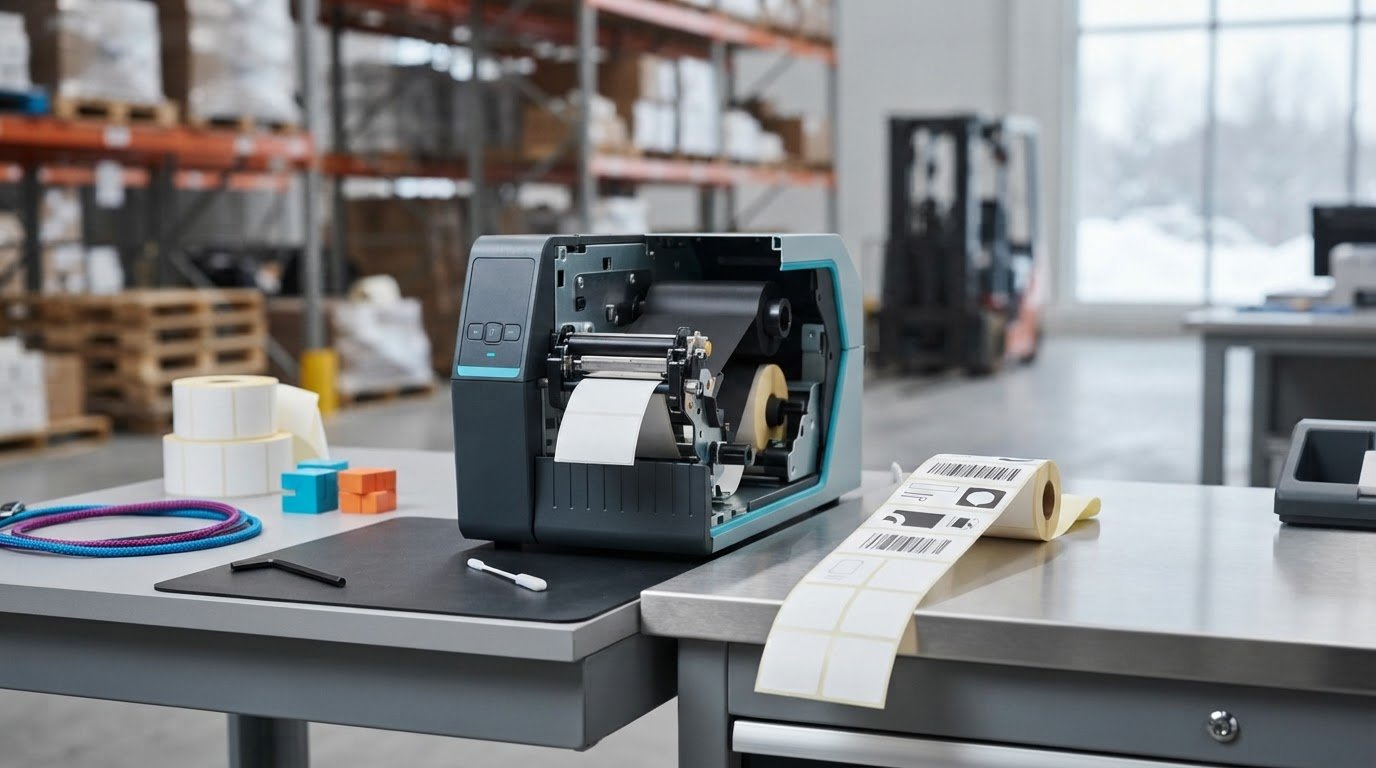
Industrial barcode durability no longer requires a bulky, floor-standing cabinet that takes up valuable floor space. For fast-paced operations, finding the right honeywell desktop thermal transfer printer Canada businesses rely on is about packing heavy-duty print endurance into a practical desktop footprint. If you have ever dealt with faded barcodes in cold storage, equipment jams during peak fulfilment cycles, or frustrating delays waiting for replacement consumables, you know how quickly a minor printing bottleneck can disrupt your entire dispatch schedule.
You shouldn't have to guess which ribbon formulation bonds cleanly with your synthetic tags or worry whether your equipment can withstand rigorous daily output. In this 2026 guide, you will discover how to select, configure, and source the ideal Honeywell desktop thermal transfer setup to maintain crisp, scannable tracking across demanding environments. We examine leading options like the PC45t and PC42 series, outline ribbon and substrate pairings engineered to resist abrasion and moisture, and show you how a dependable national supply chain keeps your facility running smoothly.
Key Takeaways
- Match your expected daily label volumes with proper duty cycles to avoid hardware strain when choosing a honeywell desktop thermal transfer printer Canada facilities depend on.
- Select between 203 DPI and 300 DPI printheads based on your need for standard shipping tags or high-density 2D barcodes and regulatory symbols.
- Pair wax, wax-resin, or pure resin ribbons with the correct label facestock to safeguard barcode readability against moisture, cold storage, and handling abrasion.
- Calibrate media sensors and optimize darkness settings during initial setup to protect thermal printheads from premature wear and reduce label waste.
- Source your printers, ribbons, and blank media through a dedicated Canadian supplier to prevent unexpected cross-border customs delays and import fees.
Understanding Honeywell Desktop Thermal Transfer Printers for Canadian Facilities
How do Canadian distribution centres and manufacturing plants keep critical barcode tracking intact across long transit routes and unheated storage areas? They rely on mechanical hardware built to fuse legible graphics onto tough materials without failing under load. Selecting a reliable honeywell desktop thermal transfer printer Canada facilities trust ensures your operations produce durable identification tags that survive scuffing, sub-zero temperatures, and rough handling.
Honeywell desktop thermal transfer systems produce durable barcodes engineered for harsh handling. By placing these compact, high-precision units directly on packing stations or assembly lines, companies eliminate the need for oversized industrial machinery while maintaining clean tracking through every dispatch cycle.
Thermal Transfer vs. Direct Thermal Technology
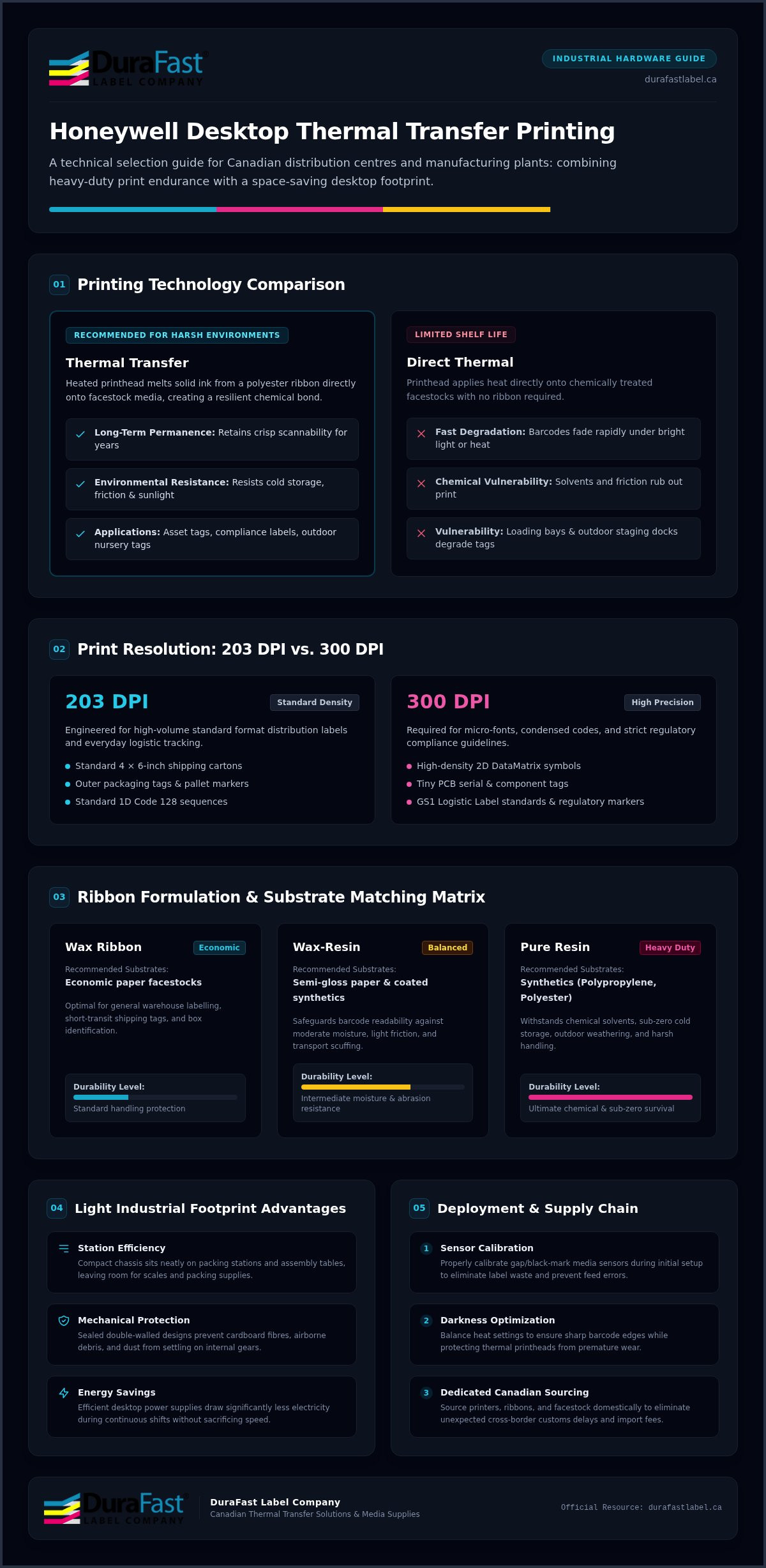
Thermal-transfer printing uses a heated printhead to melt solid ink from a polyester ribbon directly onto your media. This chemical bonding process differs fundamentally from direct thermal printing. While direct thermal hardware applies heat directly onto chemically treated facestocks, those markings quickly degrade when exposed to sunlight, friction, or industrial solvents. Operations relying solely on standard labels direct thermal materials often discover unreadable barcodes on freight that sits near bright loading bays or outdoor staging docks.
In contrast, pairing the appropriate ink formulation with rugged labels thermal transfer stocks ensures data remains crisp for years. This permanence is mandatory for asset tracking, outdoor nursery tags, and compliance labels that must satisfy rigorous regulatory inspections across the country.
Why Desktop Footprints Excel in Light Industrial Workflows
Floor space on Canadian sorting tables and shipping stations is always at a premium. Bulky steel-cased printers consume valuable surface area that packing staff need for scanning, weighing, and boxing goods. Honeywell desktop printers solve this challenge by housing industrial-grade components inside a space-saving chassis:
- Station efficiency: Small-footprint enclosures sit neatly on workbenches, freeing up room for scales and packing materials.
- Mechanical protection: Sealed double-walled designs prevent dust, cardboard fibres, and airborne debris from settling onto sensitive internal gears.
- Energy savings: Efficient desktop power supplies draw significantly less electricity during continuous shifts without sacrificing print throughput.
For a deeper look into selecting the right hardware class for your facility, review our comprehensive guide to thermal label printers for Canadian businesses to evaluate foundational printhead and feed mechanisms.
Core Selection Criteria: Evaluating Honeywell Desktop Label Printers
Selecting the right hardware requires balancing physical footprint with operational workload. If you push an entry-level unit beyond its intended duty cycle, you risk premature printhead failure and unwanted line stoppages. Reviewing our curated lineup of thermal label printers allows you to match specific engineering strengths to your facility's daily throughput demands.
When investing in a honeywell desktop thermal transfer printer Canada operations can rely on, three technical variables dictate real-world success: resolution, media capacity, and connectivity integration.
Print Resolution: Choosing 203 DPI vs. 300 DPI
Resolution directly impacts readability and barcode scan rates across supply networks. A 203 dots per inch (DPI) printhead handles standard 4x6-inch carton identifiers, outer packaging tags, and basic Code 128 sequences smoothly. However, if your facility prints high-density 2D DataMatrix symbols, tiny PCB serial tags, or compact regulatory markers, 300 DPI is indispensable. Adhering strictly to GS1 Logistic Label standards often necessitates crisp edges on micro-fonts and compressed barcodes, preventing costly chargebacks caused by scanning failures at third-party distribution hubs.
Throughput Capacity and Media Core Flexibility
Daily productivity depends heavily on print speeds and roll swap intervals:
- Print speeds: Desktop units operating between 4 and 8 inches per second (ips) quickly clear batch-printing queues without sacrificing edge sharpness.
- Core versatility: Printers supporting dual-core architectures accept both 0.5-inch and 1-inch ribbon cores, giving you maximum consumable sourcing flexibility.
- Roll length capacity: Units housing 300-metre ribbons dramatically cut down roll changeovers during high-volume shipping windows, keeping operators focused on packing.
Connectivity and System Emulation Capabilities
Can your new hardware communicate effortlessly with legacy software? Modern Honeywell desktop architectures support multiple command emulations right out of the box, including ZPL-II, DPL, and Direct Protocol. This feature enables simple drop-in replacements for ageing devices without rewriting existing template scripts or modifying enterprise resource planning (ERP) systems. Standard USB and Ethernet ports ensure dependable local or networked communication, while optional wireless configurations reduce desk cable clutter. If you need help identifying which model fits your specific software stack, reach out to our technical team for dedicated configuration support.
Matching Ribbons and Substrates for Extreme Durability
Why do scannable barcodes sometimes smear across corrugate packaging or peel off outdoor totes after just a few weeks? The answer almost always comes down to a chemical mismatch between your ribbon ink and label facestock. Equipping your facility with a high-performance honeywell desktop thermal transfer printer Canada operations trust is only half the formula; genuine longevity requires bonding the correct thermal ink directly into the right material. Sourcing authentic Honeywell ribbons also shields your thermal printhead against abrasive friction, dramatically extending component lifespan while maintaining flawless optical contrast.
Ribbon Chemistry Formulations Explained
Selecting the proper ribbon formula balances printhead heat requirements with required physical resistance:
- Wax ribbons: Economical formulations that melt at lower printhead temperatures, making them ideal for standard uncoated paper shipping tags and indoor carton labels.
- Wax-resin hybrids: Blended formulations that introduce synthetic polymers, delivering superior scratch and smudge resistance for warehouse shelf bins and high-touch freight boxes.
- Pure resin ribbons: Premium formulations engineered to chemically lock into polypropylene, polyester, and vinyl facestocks, resisting aggressive industrial cleaners, automotive fluids, and outdoor weathering.
Read our detailed guide on thermal transfer ribbons in Canada for deeper consumable selection insights.
Selecting Substrates for Demanding Canadian Climates
Canadian industrial environments subject packaging to severe climate swings, from sweltering summer cross-docks to unheated winter staging areas. Standard paper labels exposed to frost or condensation absorb ambient moisture, causing barcodes to bleed and facestocks to tear during handling. Cold-storage operations require specialized chill and freezer-grade adhesives that maintain tack well below freezing temperatures without curling.
When you pair synthetic film substrates with a honeywell desktop thermal transfer printer Canada supply managers count on, you produce asset tags and container labels that withstand extreme abrasion and heavy moisture. Browse our dedicated inventory of labels for thermal transfer designed for resilient enterprise tagging.
Deployment, Calibration, and Barcode Software Integration
Even the most durable hardware underperforms if media feeding and print parameters aren't dialed in correctly. Uncalibrated sensors cause skipped tags, while excessive heat settings burn out ceramic heating elements prematurely. Setting up a honeywell desktop thermal transfer printer Canada operations deploy requires methodical calibration, verified software integration, and a consistent cleaning schedule to guarantee scan compliance on every single dispatch.
Step-by-Step Media Loading and Sensor Alignment
Smooth media feeding starts with proper mechanical alignment inside the print mechanism:
- Centring guides: Adjust the roll holders snugly against the media core to keep labels travelling straight without walking sideways.
- Sensor positioning: Slide the transmissive gap or reflective black mark sensor directly over the cutouts or tracking lines of your facestock.
- Hardware calibration: Initiate the onboard calibration routine so the printer accurately calculates label pitch, backing thickness, and stop positions.
Taking sixty seconds to run a media calibration whenever you swap stock sizes prevents costly tracking errors and stops piles of wasted labels from gathering around workstations.
Integrating Barcode Software: BarTender and Loftware
How does your warehouse software communicate product details to the physical printhead? Enterprise operations depend on robust label design platforms like BarTender and Loftware NiceLabel to build dynamic, automated printing workflows. BarTender handles complex serialization, lot numbering, and GS1 compliance templates seamlessly. Loftware centralizes label formatting across your business database, preventing operators from entering incorrect SKU data manually.
Standardized Windows print drivers allow these platforms to manage print darkness and throughput speeds directly from your software templates, protecting printheads from unnecessary thermal stress.
Preventative Maintenance for Extended Printhead Lifespans
A well-maintained printhead reliably produces millions of linear inches of clean barcodes. Establish a routine maintenance schedule to protect your investment:
- Routine cleaning: Clean the heating array using isopropyl alcohol wipes every time you replace the ribbon roll to dissolve burnt wax, resin, and paper dust.
- Platen roller maintenance: Wipe the rubber platen roller down to clear adhesive residue that causes media slippage and uneven feed tension.
- Tool safety: Keep metal blades and screwdrivers away from the printhead; even minor scratches on the ceramic coating create dead lines across your barcodes.
Ready to deploy new desktop barcode systems across your facility? Contact DuraFast Label today to configure your software licenses, order compatible media, and streamline your hardware setup.
Sourcing Honeywell Desktop Printers and Supplies Across Canada
Why do so many Canadian businesses struggle with sudden stockouts and stalled packing lines? Sourcing hardware and printing supplies through international distributors often leads to unexpected customs brokerage fees, border clearance delays, and volatile currency exchange rates. When your dispatch team needs replacement rolls immediately, a shipment stuck at a cross-border customs inspection puts your entire order fulfilment cycle at risk.
Securing your honeywell desktop thermal transfer printer Canada deployment through an authorized domestic partner eliminates these cross-border friction points entirely. DuraFast Label acts as a complete single-source specialist, providing expert guidance on hardware, certified ribbons, and custom media while keeping billing straightforward in Canadian funds.
Benefits of a Dedicated Canadian Labelling Specialist
Generic technology vendors frequently ship hardware in a sealed box without confirming whether the internal sensors, ribbon formulation, and label stocks will actually work together on your production line. Partnering with a dedicated Canadian labelling specialist delivers measurable operational benefits:
- System validation: Receive tailored recommendations that balance upfront capital equipment investments against ongoing consumable costs.
- Domestic stability: Eliminate surprise tariff surcharges and import brokerage paperwork by managing all procurement within Canada.
- Dedicated support: Access responsive technical support specialists who understand the demands of cold-storage operations and light manufacturing workflows.
Securing Reliable Consumable Replenishment Across Canada
A desktop barcode printer is only as effective as the supply chain supporting it. When picking stations run out of thermal transfer ribbons, entire shipping schedules screech to a halt. Establishing routine replenishment schedules for high-turnover thermal ribbons ensures your packing staff never face avoidable downtime during peak quarterly volume surges.
Equally critical is pairing your hardware with precision-cut media tailored to Honeywell loading dimensions. Selecting high-grade blank labels for sale from an extensive domestic warehouse network guarantees that clean, uniform rolls arrive at your facility before your inventory runs low. Empower your team with a dependable honeywell desktop thermal transfer printer Canada platform backed by reliable national delivery and experienced technical advice.
Equip Your Packaging Line for Reliable Barcode Performance
Selecting the right honeywell desktop thermal transfer printer Canada operations rely on transforms daily order fulfilment from a potential bottleneck into a predictable, high-speed asset. Pairing compact hardware with chemically matched thermal ribbons guarantees crisp, scannable barcodes that survive moisture, sub-zero cold-storage facilities, and rigorous freight transit across the country. Establishing a domestic procurement pipeline also shields your business from cross-border clearance hold-ups and unpredictable import fees.
DuraFast Label supports Canadian enterprises with an extensive inventory of Honeywell label printers, verified thermal transfer ribbons, and industrial substrates engineered for demanding workflows. Whether you require specialized technical consultation for software integration or dependable national logistics for regular consumable replenishment, our team is ready to help your facility thrive. Connect with our technical labelling specialists today to configure the perfect desktop printing system for your team.
Frequently Asked Questions
What is the primary difference between direct thermal and thermal transfer printing?
Direct thermal uses chemically treated heat-sensitive media without a ribbon, while thermal transfer uses a heated ribbon to melt ink onto the label facestock. Because direct thermal paper reacts to ambient heat and sunlight, it fades over time. Thermal transfer produces long-lasting images resistant to abrasion, moisture, and temperature fluctuations, making it ideal for permanent asset tags and compliance marking.
Can a Honeywell desktop thermal transfer printer also print direct thermal labels?
Yes, virtually all Honeywell desktop thermal transfer models can operate in direct thermal mode. To switch methods, you simply remove the thermal transfer ribbon, load direct thermal roll media, and adjust your software driver settings to direct thermal printing. This dual capability provides operational versatility if you produce short-life parcel shipping labels alongside long-term durable container tags.
Which ribbon formulation should I use for outdoor and chemical-resistant labels?
Pure resin ribbons paired with synthetic facestocks like polyester or polypropylene provide the highest resistance against outdoor weathering, moisture, and harsh industrial chemicals. While wax and wax-resin ribbons offer excellent everyday durability on paper packaging, they can smear or scratch off when exposed to solvents, fuels, or prolonged rain. Resin ink chemically fuses into synthetic substrates, ensuring permanent legibility under extreme conditions.
How do I choose between a 203 DPI and a 300 DPI Honeywell desktop printer?
Choose 203 DPI for conventional shipping tags and standard linear barcodes, and select 300 DPI for high-density 2D DataMatrix codes, micro-text, or compact product markings. Standard logistics labels scan reliably at 203 DPI, offering faster throughput speeds. However, when printing regulatory symbols or serialization on small pharmaceutical and electronics labels, the 300 DPI printhead prevents scanner misreads by delivering sharper edge definition.
Are Honeywell desktop printers compatible with third-party label design software?
Yes, Honeywell printers integrate smoothly with leading third-party barcoding platforms including BarTender, Loftware NiceLabel, and Teklynx. Thanks to comprehensive Windows drivers and multi-language firmware emulation, these desktop units accept standard ZPL, DPL, and Direct Protocol print commands seamlessly. This interoperability ensures you can deploy new hardware across your packing stations without rewriting existing label templates or overhauling database integrations.
What routine maintenance is required to prolong the printer's thermal printhead life?
Clean the printhead heating line and platen roller with an isopropyl alcohol wipe every time you load a fresh ribbon roll. This quick cleaning step removes abrasive paper dust, melted wax, and adhesive residues before they bake onto the ceramic surface. Additionally, avoid touching the heating line with metal tools, and maintain balanced darkness settings to avoid overheating the delicate print elements.
Why is sourcing thermal transfer printers and supplies within Canada advantageous?
Purchasing your honeywell desktop thermal transfer printer Canada hardware and ongoing supplies domestically prevents border delays, unexpected customs brokerage fees, and foreign exchange volatility. A dedicated Canadian supplier like DuraFast Label provides reliable nationwide delivery, brand-verified consumables, and local technical assistance. This dependable supply line ensures your packing stations maintain continuous operation without risking extended shipment stalls at international border crossings.