High temperature polyimide barcode labels for soldering and cleaning
17th Nov 2026
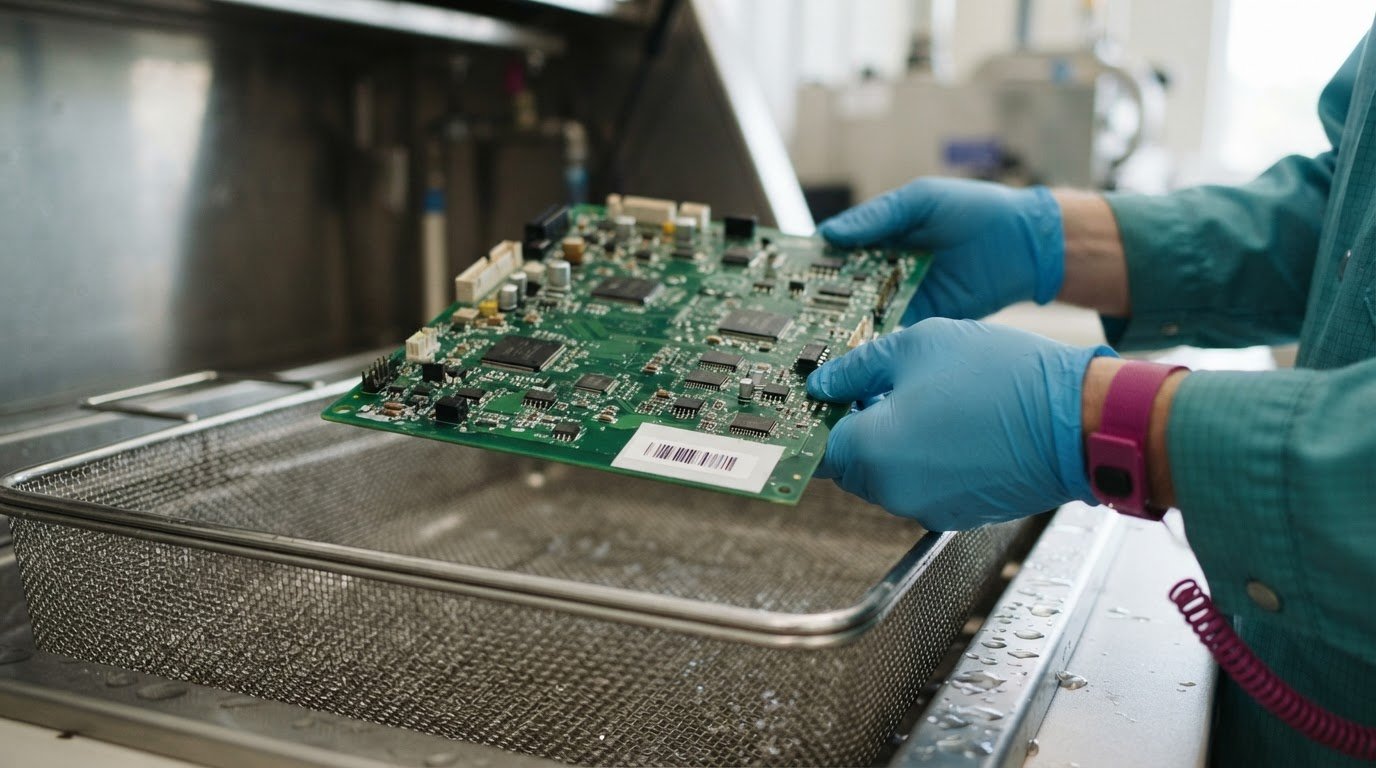
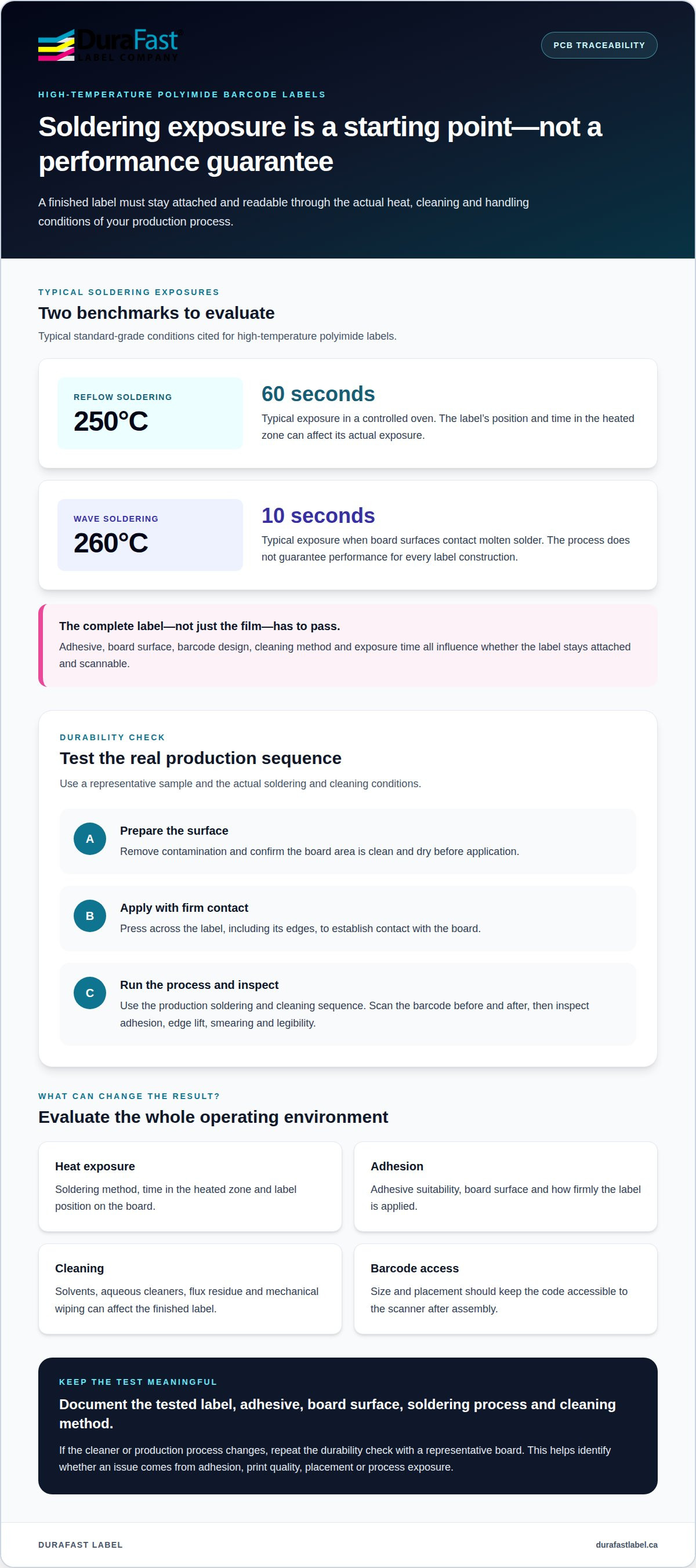
What if a barcode stayed readable through the heat of soldering and the cleaning that follows? High temperature polyimide barcode labels are designed for demanding electronics workflows: standard grades typically withstand reflow soldering at 250°C for 60 seconds or wave soldering at 260°C for 10 seconds. That makes them a practical option for tracking printed circuit boards through production, provided the finished label suits the specific process.
Look beyond a film’s heat rating when assessing label performance. Adhesive, cleaning chemicals, exposure time and the labelled surface can all affect whether a label stays attached and scannable. Polyimide’s heat resistance is useful, but the material name alone cannot predict how a complete label will perform in every environment.
This article explains what polyimide labels are and how they’re used during soldering and cleaning. It also outlines what to consider when choosing a label for heat, chemical exposure and demanding industrial applications, helping you make a more informed decision for your operation.
Key Takeaways
- Match the complete label’s heat tolerance to the soldering process: typical exposures include reflow at 250°C for 60 seconds and wave soldering at 260°C for 10 seconds.
- Consider the film, adhesive, barcode readability and application surface together; the material name alone doesn’t determine how a finished label will perform.
- Choose a label based on its actual exposure to heat and chemicals, including the cleaning method and how long the label encounters each condition.
- Compare polyimide with PET and vinyl based on the demands of the application; polyester labels typically max out around 150°C.
- Explore how labelling requirements differ across aerospace, automotive and medical applications before choosing a material and printing approach.
Barcode durability through soldering and cleaning
Polyimide barcode labels identify printed circuit boards during soldering and subsequent production steps. Reflow and wave-solder conditions offer useful starting points for evaluation, but they don’t guarantee performance in every process. Heat duration, adhesive, board surface, barcode size and cleaning method all affect the result. The complete label must stay attached and readable, not just withstand heat as a film.
Reflow soldering heats assembled boards in a controlled oven; wave soldering brings board surfaces into contact with molten solder. The processes expose labels differently. A label’s position, nearby components and time in the heated zone all influence exposure. For example, a traceability label near a board edge may experience different conditions from one near a heat-sensitive component.
Cleaning presents another challenge. Depending on the production line, a barcode may encounter solvents, aqueous cleaners, flux residue or mechanical wiping. The film, adhesive and printed image must suit the actual cleaning sequence. A label that tolerates soldering may still lift at the edges or lose contrast after chemical contact. Consider every production stage part of the label’s operating environment.
Are there Canadian standards or compliance requirements for industrial barcode labels? Requirements depend on the product, sector and customer specification; there is no single label specification for every industrial use. For PCB tracking, define the barcode information and production conditions required by the applicable product or process specifications.
How should polyimide barcode labels be applied and tested for durability? Apply each label to a clean, dry surface and press it firmly. Then test a sample using the actual soldering and cleaning sequence. Scan the barcode before and after testing, and inspect adhesion, edge lift, smearing and legibility.
- Before application: Remove surface contamination and confirm the board area is dry.
- After application: Press across the label, including its edges, to establish contact.
- During testing: Use the production process and cleaner, then compare scan results and label condition.
High temperature polyimide barcode labels can support traceability through demanding manufacturing stages. Barcode design matters too: choose a size and placement that remain accessible to the scanner after assembly. Avoid locations where components, board fixtures or residue could obstruct scanning. A readable barcode links the physical board to its production record.
Document the tested combination of label, adhesive, board surface, soldering process and cleaning method. If the cleaner or process changes, repeat the durability check with a representative board. This gives production teams a practical reference and helps pinpoint whether failures stem from adhesion, print quality, placement or process exposure. Test the conditions the label will actually encounter.
What Are Polyimide Labels?
Polyimide labels use a thin film made from imide monomers as their printable face stock. This material can suit identification labels used in demanding manufacturing environments.
Polyimide and Kapton Naming
Polyimide is a family of materials, while Kapton is a trade name associated with polyimide film. The terms are related, but not every polyimide label uses Kapton-branded film. For buyers, the distinction separates a material category from a specific brand name. Check the finished label’s documented construction and use conditions rather than treating either name as a complete performance specification.
Polyimide label film is usually 1-2 mil thick. Its thin profile can suit compact identification areas, such as a circuit-board location beside components. Label construction also includes adhesive and printable surface layers, so the film alone doesn’t define the complete product. The adhesive must suit the board material, while the printable face must hold a clear barcode through the intended production stages.
In practice, polyimide is chosen as a label substrate and paired with an adhesive and printing method. A small board label, for example, needs room for the barcode and any required human-readable text. Position it so scanning equipment can access the code. These design choices affect identification just as much as the material.
Comparing Label Materials
Polyimide, ceramic and metal labels have different constructions and suit different identification needs. Polyimide is a flexible film; ceramic and metal labels are rigid alternatives. The differences matter for surface shape, mounting method and fit. A film label may conform more readily to a flat board, while rigid options need a suitable mounting area.
How do polyimide barcode labels compare with ceramic and metal labels? Polyimide is a thin, flexible film, while ceramic and metal labels are rigid. Choose based on the product surface, attachment method, available space and identification process.
Printing method affects barcode readability. Thermal-transfer printing uses a heated printhead to transfer ink from a ribbon onto the label surface. Polyimide labels for this method need a compatible ribbon and printer configuration. The ribbon, face stock and print settings work together to produce clear bars and spaces.
Which printing methods and ribbons work with polyimide barcode labels? Thermal-transfer printing is a common option, using a ribbon matched to the label’s printable surface. Choose the combination for the barcode’s required clarity and the label’s later exposure, rather than relying on the ribbon name alone.
A compact code, for example, needs clean edges and enough contrast to scan reliably. Print a sample on the intended label stock, scan it and review the result. This can reveal issues with bar width, density or placement before regular use. With thermal-transfer equipment, ribbon compatibility is also essential to the print setup.
If you’re considering a thermal-transfer setup for industrial identification, discuss your label and printing needs.
Label selection for heat and chemical exposure
Choose a polyimide label by matching its complete construction to the process. The film, adhesive and printable surface each face different demands. A grade’s temperature range is only one consideration.
Standard polyimide label grades are rated from -100°C to +250°C. High-performance grades can withstand short exposures up to +400°C. Those figures describe different grades and exposure conditions, not one universal rating. For example, a brief high-heat step differs from sustained heat during equipment operation. Compare the label’s documented conditions with the actual process, including exposure time and repeated heating.
What adhesive types work on metal, circuit boards and other high-temperature surfaces? Silicone adhesive for polyimide labels performs from -73°C to +260°C. For engine-compartment exposure from -40°C to +200°C continuously, high-temperature adhesive is recommended. Match the adhesive to the surface and duration, rather than choosing by film type alone.
Chemical and solvent resistance also depend on the complete label construction. A cleaner may affect the face stock, printed image and adhesive differently. Consider the chemical, contact method and exposure duration. Wiping a label with solvent, for example, differs from immersing it. Polyimide labels can offer chemical resistance for harsh environments, but a general material description cannot replace the finished label’s documented conditions.
Compare candidate labels for your application using these factors:
- Peak temperature: Compare the process maximum with the label grade’s stated range, such as +250°C for standard grades.
- Exposure time: Separate short heat events from continuous conditions, such as engine-compartment exposure at -40°C to +200°C.
- Adhesive: Match the adhesive’s range to the surface and heat cycle. Silicone adhesive performs from -73°C to +260°C.
- Chemical contact: Identify the cleaner or solvent used, and whether it is wiped, sprayed or left on the label.
- Static control: CL-782 antistatic polyimide material has a listed temperature range of -40 to 300 ℃.
Burn-in testing is another distinct condition. A typical exposure for standard polyimide labels is 150°C for an extended period. That example should not be treated as equivalent to a short high-temperature peak. For a label used during burn-in, compare its grade and adhesive with that sustained exposure. Also account for any chemical cleaning performed before or after testing.
Evaluate the finished label under the conditions it will encounter. Check adhesion and barcode readability after the relevant heat and cleaning steps. A label that stays attached but becomes difficult to scan can still disrupt identification. Matching film, adhesive and print performance to the documented process makes selection more reliable.
Polyimide compared with PET and vinyl
Polyimide, PET polyester and vinyl suit different labelling conditions. Compare more than just the material name: heat exposure, surface shape, sterilization and readability all matter. For a circuit board passing through a high-temperature process, polyimide may suit conditions beyond polyester’s typical limit. Other materials may work for routine identification without that heat demand.
PET polyester labels typically max out around 150°C. That makes PET a consideration for applications whose temperatures stay within its stated limit, but a poor match for processes that exceed it. Polyimide is used in higher-temperature environments, though performance depends on the complete label construction. Vinyl offers another material option, often selected for the needs of a specific surface and labelling task rather than for high-heat processing.
For example, a piece of equipment needing general-purpose identification has different demands from a board exposed to soldering. A vinyl label tape can suit a compatible marking task, while a high-heat process calls for a label designed for that exposure. Selecting by task helps avoid using a material outside its intended role.
Autoclave compatibility adds another comparison point. Polyimide labels with silicone adhesive can withstand autoclave sterilization cycles typically ranging from 121°C to 134°C. This can make them relevant for identification that remains with an item during sterilization. However, the temperature range alone doesn’t describe every part of the cycle. The label’s adhesive, surface and printed information all matter.
For an item processed in an autoclave, consider what happens before and after sterilization. The label may need to stay attached to a container or instrument while its barcode remains readable. The surface must support firm adhesion, and the printed code must retain enough contrast to scan. A curved container, for example, presents a different surface from a flat panel.
- Choose polyimide when the application calls for a thin film label and exposure suited to that material.
- Consider PET where the process remains within polyester’s typical 150°C maximum.
- Consider vinyl for compatible identification tasks that don’t require high-temperature performance.
- For autoclaving, assess the full label construction against the stated 121°C to 134°C cycle range.
These comparisons help narrow the material choice, but the materials are not interchangeable. A label for an autoclave cycle may have different requirements from one used on equipment or electronics. Match the material and adhesive to the actual surface and process, then assess barcode readability after exposure. This keeps the identification method suited to the label’s task.
Aerospace, automotive, and medical uses
Aerospace, automotive and medical products may need identification that stays with a component through manufacturing or service. Polyimide labels are one option when labels must suit heat or chemical exposure. The application determines the details: a circuit-board identifier, an engine-compartment part number and a medical container label face different conditions. Choose for the actual surface, process and scanning task, not the industry name alone.
In aerospace production, a label may identify an electronic assembly or component during manufacturing and maintenance. A compact barcode can link the physical part to its production or service record. Placement matters: a code hidden beneath a connector or obstructed by a panel is difficult to scan. For a small assembly, plan the label dimensions, text and barcode position around the available flat surface.
Automotive components may face heat in or near the engine compartment. The stated use case for high-temperature adhesive is continuous exposure from -40°C to +200°C. That range is relevant to matching adhesive performance, but it doesn’t describe every automotive part or process. For example, a label on a circuit board has different surface and exposure conditions from one attached to a metal component.
Medical applications can involve sterilization, identification and repeated scanning. Polyimide labels with silicone adhesive can withstand autoclave sterilization cycles typically ranging from 121°C to 134°C. That makes the complete label construction important for items requiring identification through an autoclave cycle. The label’s position, substrate and barcode readability all affect whether it remains useful after processing.
Across these sectors, map the label’s journey. Note where it is applied, which processes it encounters and when staff need to scan it. A component identifier, for example, might be scanned during assembly and again during later service. A medical container may need a readable code after sterilization. In each case, consider both attachment and readable data.
- Aerospace: Consider component identification, restricted label space and scan access during assembly or maintenance.
- Automotive: Match adhesive and label construction to the component surface and documented temperature exposure.
- Medical: Consider sterilization conditions alongside the substrate, adhesion and barcode readability.
High temperature polyimide barcode labels can support tracking when a component’s identity must remain accessible through a demanding process. The material alone does not establish suitability for every aerospace, automotive or medical application. Specify the exposure, surface and scanning requirements, then assess a representative finished label under those conditions. This ties the material choice to an operational task rather than a broad industry category.
For help aligning label-printing requirements with a demanding application, contact the team about your labelling needs.
DuraFast Label Company Canada
DuraFast Label Company Canada offers VIPColor, Afinia, Toshiba and Honeywell label printers for businesses planning an in-house printing setup. When comparing equipment for production, consider how the printer fits your label formats and workflow. Polyimide label performance still depends on matching the material, adhesive and printing method to the application, so printer selection is one part of the decision.
For teams producing labels in-house, understanding the process helps clarify equipment requirements. Consider the intended label stock, barcode design and production environment as you assess the setup.
Contact DuraFast Label Company Canada to discuss your label-printing requirements.
Put Your Label Requirements Into Practice
Turn your process conditions into a clear label specification. Map where the label will be applied, what it will encounter and when staff need to scan it. This connects material, adhesive and printing decisions to the actual workflow instead of treating them as separate purchasing choices.
For high temperature polyimide barcode labels, a useful specification describes the intended surface, exposure sequence, cleaning method and barcode requirements. Share these details with the people responsible for selecting and printing labels. They can use them to align the production setup with the identification task and avoid relying on material names alone.
DuraFast Label Company Canada can help you consider label-printing equipment for your workflow. Bring your application details and operational priorities to the conversation to shape a practical next step for your team.
Contact DuraFast Label Company Canada to discuss your requirements and move forward with confidence.
Frequently Asked Questions
What are high-temperature polyimide barcode labels?
High temperature polyimide barcode labels use polyimide film as the face stock for printed identification in demanding production environments. A barcode can link a component to manufacturing or tracking records. For example, a circuit-board label can identify an assembly during production. The film is only one part of the label, so the adhesive and printing method also matter to the intended application.
What temperature range can polyimide barcode labels withstand?
Standard polyimide label grades are rated from -100°C to +250°C; high-performance grades can withstand short exposures up to +400°C. These ratings describe different grades and exposure conditions. For high temperature polyimide barcode labels, consider whether exposure is brief or sustained, and account for the adhesive as well as the film. Repeated heating can also affect how the complete label performs.
How resistant are polyimide barcode labels to chemicals, abrasion, and solvents?
Polyimide labels can offer chemical resistance in harsh environments, but performance varies with the complete label construction and exposure. Consider the specific cleaner or solvent, contact method and exposure time. Abrasion resistance also depends on placement and handling. A code exposed to repeated rubbing, for example, needs different evaluation from one protected inside an equipment housing. Assess print readability as well as adhesion.
Which barcode types and label sizes are available for high-temperature applications?
Barcode format depends on the information system and scanners, rather than on polyimide film itself. Linear and two-dimensional codes can serve different data and scanning needs. Standard label widths range from 0.25″ to 4″. The usable barcode area depends on label dimensions, text and placement. Make sure the layout can be printed clearly and scanned where the labelled item is used.
What industries and applications use high-temperature polyimide barcode labels?
Electronics manufacturers use polyimide labels to track printed circuit boards through production, including soldering. Aerospace and automotive applications may use them to identify components or assemblies. Medical settings may need identification that stays legible through processing, including autoclave cycles. The label’s role varies, from linking a component to production records to helping staff identify an item later.
Which Canadian suppliers sell high-temperature polyimide barcode labels?
DuraFast Label Company Canada is a Canadian online retailer offering label-printing equipment and supplies, including durable industrial labels and thermal transfer ribbons. Its printer offerings include VIPColor and Afinia. For a polyimide labelling workflow, consider printer and ribbon compatibility alongside the label material. Aligning these choices with the barcode format and production process supports practical in-house label printing.