GHS Compliant Labels Canada: Essential Compliance Guide
9th Aug 2026
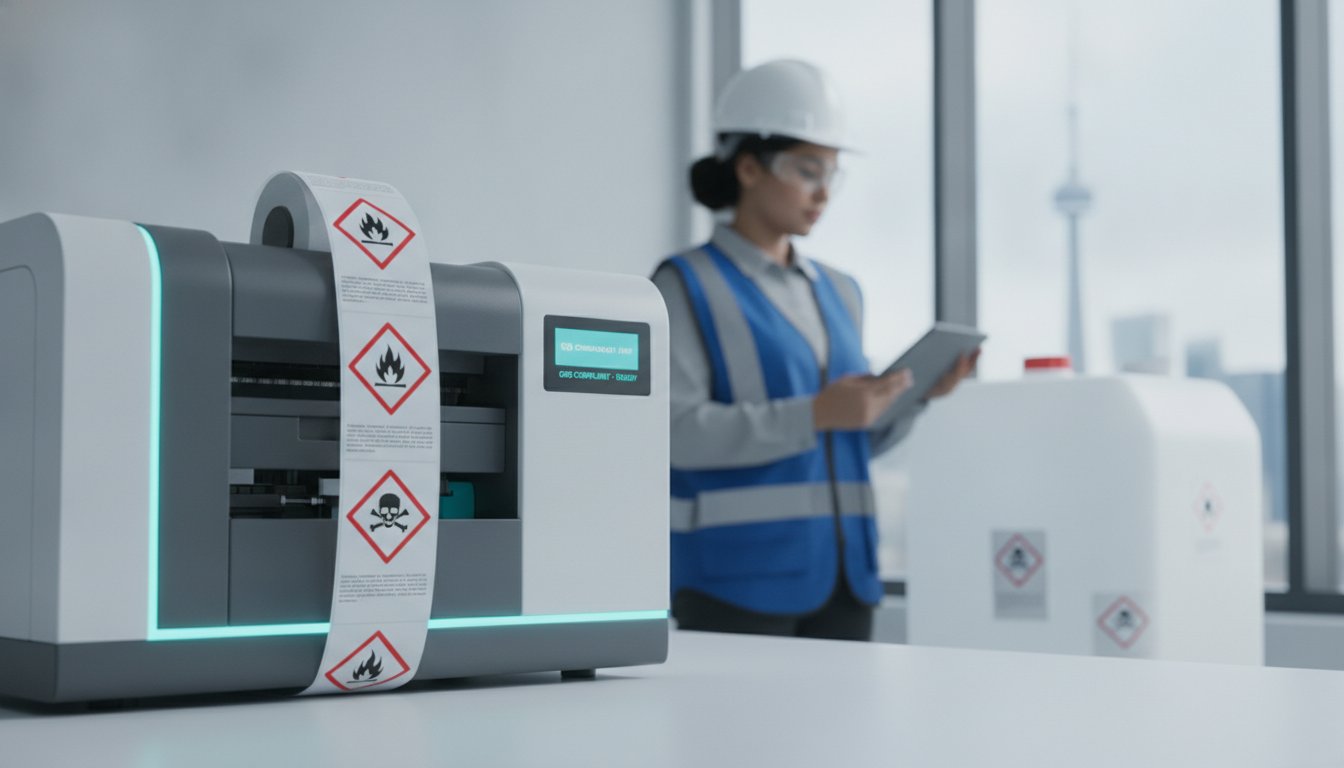
What if the labels on your chemical containers are technically non-compliant even though the contents haven't changed? It's a common concern for industrial operators across the country as the December 15, 2025, transition deadline for the amended Hazardous Products Regulations approaches. You likely agree that maintaining a safe workplace is your most important job, but the complexity of WHMIS and the transition to the latest GHS standards can be overwhelming. Between managing strict bilingual requirements and worrying about labels that fade or peel in damp environments, the fear of a Health Canada audit is real. Securing GHS compliant labels Canada doesn't have to be a source of frustration.
This guide provides the clarity you need to ensure your operations remain both safe and legal. We'll walk you through the six essential label elements, the critical importance of BS5609 durability for chemical exposure, and how to implement a streamlined in-house printing system. By the end of this article, you'll have a practical roadmap to replace confusion with a reliable, cost-effective workflow that keeps your facility running smoothly and your team protected.
Key Takeaways
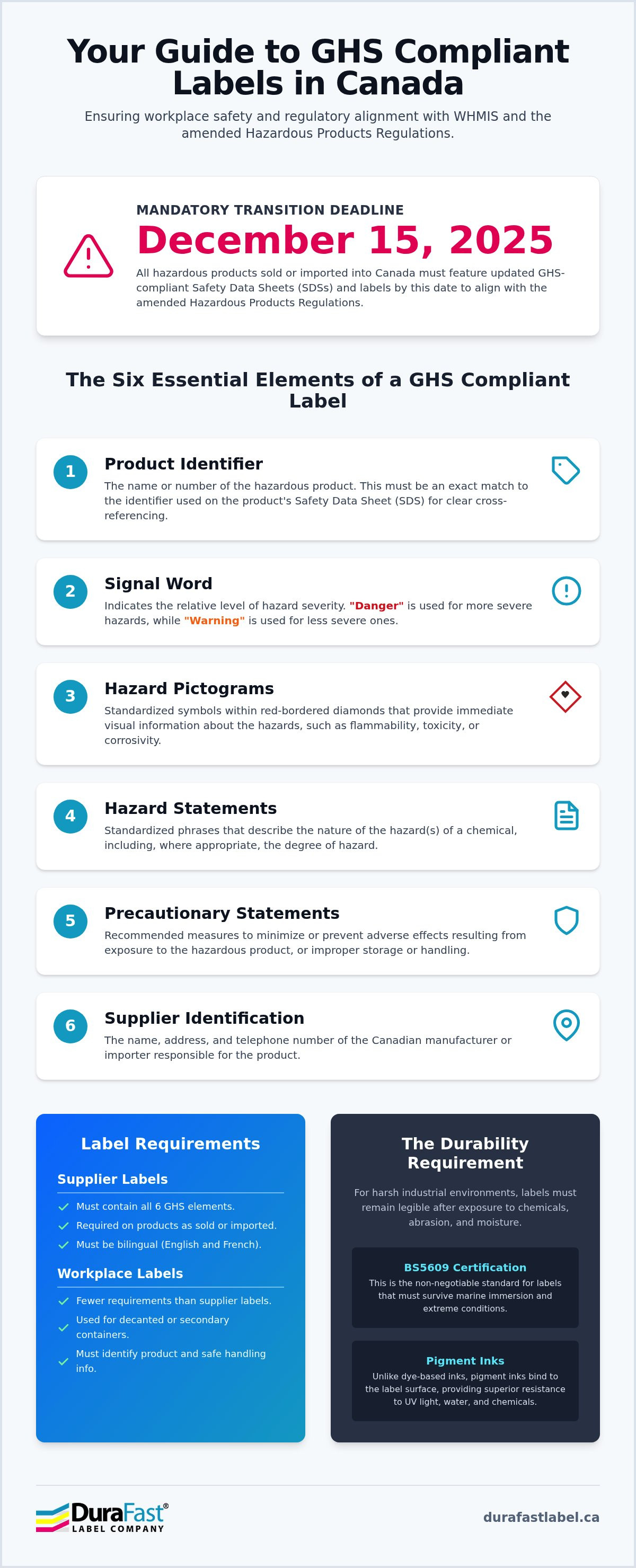
- Understand the mandatory transition to the amended Hazardous Products Regulations by December 15, 2025, to ensure your facility remains fully aligned with WHMIS standards.
- Identify the six required elements for GHS compliant labels Canada, including precise signal words and pictograms that must match your Safety Data Sheets exactly.
- Learn why BS5609-certified media and pigment inks are non-negotiable for labels that must survive saltwater, abrasion, and chemical exposure without fading or peeling.
- Discover how to automate your labelling workflow using professional software like Bartender or Loftware to eliminate manual errors and streamline in-house production.
- Compare the technical advantages of industrial printers like the Afinia L502 and VIPColor VP550 to find the ideal balance of print speed and environmental resilience for your facility.
Understanding GHS and WHMIS 2015/2026 in Canada
How do you ensure your facility is prepared for the latest regulatory shifts? In Canada, hazard communication is governed by the Workplace Hazardous Materials Information System (WHMIS). This national standard has been updated to align with the Globally Harmonized System of Classification and Labelling of Chemicals (GHS), an international framework created by the United Nations. By standardizing pictograms and hazard statements, GHS ensures that a worker in Calgary understands the risks of a chemical just as clearly as one in Berlin. For business owners, implementing GHS compliant labels Canada is not just a matter of following the law; it's a critical strategy for reducing industrial liability and ensuring every team member returns home safely.
Health Canada oversees these requirements through the Hazardous Products Regulations (HPR). These rules dictate exactly how hazardous products are classified and what information must appear on their packaging. Failing to meet these standards can result in significant fines and operational disruptions. However, viewing compliance as a technical hurdle allows you to implement more efficient systems, such as on-demand colour label printers, which eliminate the need for costly pre-printed inventories and long lead times.
The Evolution of Canadian Labelling Standards
The transition from the original WHMIS 1988 to the current GHS-aligned system represents a major shift in how we handle industrial safety. While the old system relied on hatched borders and unique symbols, the modern standard uses standardized red-bordered diamonds. The transition period for the latest HPR amendments ends on December 15, 2025. This means that by early 2026, all hazardous products sold or imported into Canada must feature updated GHS-compliant Safety Data Sheets (SDSs) and labels. Federal law requires these labels for any product classified as a hazardous product intended for use, handling, or storage in a workplace. Staying ahead of these dates is essential for any importer or supplier operating in the Canadian market.
Supplier vs. Workplace Labels: Key Distinctions
Understanding who is responsible for labelling depends on where the product is in your workflow. The requirements differ based on whether a product is arriving from a vendor or being used internally:
- Supplier Labels: These are required on hazardous products as they are sold or imported. They must contain all six GHS elements and must be provided in both English and French.
- Workplace Labels: These are used when a product is decanted into a secondary container or when a supplier label becomes damaged. While they have fewer requirements than supplier labels, they must still clearly identify the product and provide safe handling instructions.
It's the employer's responsibility to ensure that every container remains clearly marked and legible. If a label is lost or becomes unreadable due to chemical exposure, it must be replaced immediately to maintain safety and compliance. Utilizing GHS compliant labels Canada ensures that your facility meets these rigorous standards at every stage of production.
The Six Essential Elements of a GHS Compliant Label
How do you fit a mountain of regulatory data onto a single container without sacrificing clarity? A standard label for GHS compliant labels Canada is far more than a simple identification tag. It's a technical document that must integrate six specific elements to meet federal law. According to the Canadian Centre for Occupational Health and Safety (CCOHS), these components provide a standardized way to communicate chemical risks across different industries and provinces. When these elements are missing or incorrect, you risk more than just a fine; you compromise the safety of everyone in your facility.
Every compliant supplier label must include these core features:
- Product Identifier: This name or number must be an exact match to the identifier used on the Safety Data Sheet (SDS).
- Signal Words: These indicate the severity of the hazard. "Danger" is reserved for more severe hazard categories, while "Warning" is used for less severe ones.
- Hazard Pictograms: There are nine standard red-bordered diamond symbols used in Canada. These visual cues transcend language barriers to immediately communicate risks like flammability, toxicity, or corrosive properties.
- Hazard Statements: These are standardized phrases that describe the nature of the hazard, such as "Extremely flammable gas."
- Precautionary Statements: These provide essential instructions for safe handling, storage, and first aid measures.
- Initial Supplier Identifier: This must include the name, address, and telephone number of the Canadian manufacturer or importer.
Canadian Bilingual Requirements
In Canada, compliance means communicating in both official languages. All required text on a supplier label must be provided in English and French. This requirement often creates a design challenge. How do you maintain legibility with double the text? Many businesses utilize a side-by-side layout for larger labels or a back-to-back approach where space is limited. The goal is to ensure that the font size remains readable and that the French and English sections are clearly distinguished from one another. If you're struggling to organize this data on your packaging, our technical team can help you design a layout that balances these bilingual requirements with professional aesthetics.
Initial Supplier Identifier
The supplier identifier is a critical safety link for emergency responders. It must feature the contact information of the party responsible for the product within Canada. If you are importing chemicals from the United States or overseas, you cannot simply leave the foreign manufacturer's address on the label. The Canadian importer's details must be present to provide a local point of contact. This ensures that in the event of an accidental exposure, medical professionals or hazardous materials teams can quickly reach a representative who understands Canadian regulations and can provide immediate assistance.
The Durability Requirement: BS5609 and Pigment Inks
What happens when a hazardous container is stored outdoors or exposed to heavy condensation? If you're using standard office-grade printers, the answer is usually an illegible mess. For industrial environments, the durability of your label is just as important as the information printed on it. To produce GHS compliant labels Canada that actually survive real-world conditions, you must look beyond the visual layout and focus on the technical bond between the ink and the substrate—much like how you might visit Epoxy Solutions™ for flooring systems designed to withstand heavy chemical exposure. This is where the BS5609 standard becomes the benchmark for reliability.
BS5609 is a British Standard for pressure-sensitive adhesive labels used in marine environments. While it originated for sea freight, it's now the go-to metric for any chemical label that might face moisture, abrasion, or temperature extremes. According to the Canadian WHMIS Label Requirements, labels must remain legible under normal conditions of use. In an industrial setting, "normal" often includes exposure to solvents, acids, and rough handling during transport. If your labels fail these tests, your facility is technically non-compliant, regardless of how accurate the text was at the time of printing.
Why Pigment Inks are Non-Negotiable
Why do some labels run while others remain crisp? The main difference lies in the chemistry of the ink. Dye-based inks work by absorbing into the fibres of the media. While they offer vibrant colours, they are highly susceptible to water and UV light. In contrast, pigment inks contain solid particles that sit on the surface of the media, creating a durable layer that resists fading and smudging. This UV resistance is essential for chemical drums stored in outdoor yards. If you want to maintain compliance over the long term, choosing pigment inkjet printers is the most effective way to ensure your hazard pictograms don't disappear when they get wet.
Selecting BS5609-Certified Media
Is the label material itself strong enough to stay attached? BS5609 certification isn't just about the ink; it covers the entire "sandwich" of the base material, the adhesive, and the printed image. For chemical drums and industrial containers, you need synthetic materials like BOPP (Biaxially Oriented Polypropylene), polyester, or vinyl. These substrates are engineered to resist tearing and chemical degradation. When paired with the right pigment ink, these Weatherproof and UL certified labels ensure that your safety information remains affixed even after months of exposure to harsh Canadian winters or industrial wash-downs. By matching the right media to your specific printer technology, you avoid the risk of labels peeling off and creating a significant compliance gap.
Setting Up an In-House GHS Labelling Workflow
How do you transition from regulatory theory to a functional production line? Building a reliable system for GHS compliant labels Canada begins with a thorough assessment of your chemical inventory. You must identify every container size in your facility, from small laboratory vials to 205-litre industrial drums. This audit ensures you select a printer and media combination that fits your specific footprint. Once you've mapped your inventory, the next step is implementing a verification process. Every label must be cross-referenced with the corresponding Safety Data Sheet (SDS) to ensure that pictograms and hazard statements are current and accurate. Accuracy is non-negotiable; even a minor discrepancy between the label and the SDS can lead to non-compliance during a Health Canada inspection.
Automating with Labelling Software
Manual data entry is the enemy of compliance. Professional software solutions like Bartender and Loftware NiceLabel offer dedicated GHS pictogram libraries that simplify the design process. By using database integration, these programs can automatically pull hazard statements and precautionary text directly from your SDS records. The main difference between manual entry and database-driven software is the total elimination of human transcription errors. This automation ensures that your formatting remains consistent across different container sizes, even when dealing with complex bilingual layouts. It also allows you to update hundreds of label templates instantly if a chemical classification changes. Using conditional logic within your software can even help you switch between "Danger" and "Warning" signal words automatically based on the hazard level of the product being printed.
Cost-Benefit of In-House Production
Is on-demand printing more fiscally responsible than buying pre-printed stock? For many Canadian businesses, the answer is a resounding yes. When you rely on pre-printed labels, you're often forced into high minimum order quantities. If Health Canada updates a regulation or your chemical supplier changes an SDS, that expensive inventory becomes obsolete waste. In-house production allows for "just-in-time" labelling, which is especially valuable for custom chemical blends or small-batch production. You print only what you need, when you need it, which maximizes your resources and eliminates the lead times associated with external vendors. By investing in high-quality colour label printers, you gain total control over your compliance timeline and reduce your overall operational costs.
If you're ready to modernize your facility's safety marking, contact our workflow specialists to discuss a tailored hardware and software bundle that fits your specific industrial needs.
Prescriptive Solutions: Afinia and VIPColor for Canada
How do you choose the right hardware to anchor your safety program? Selecting a printer is a technical decision that directly impacts your long term compliance and operational costs. Working with a Canadian supplier is vital for your success. It ensures your consumables arrive quickly and your technical support operates in your local time zone. When you invest in the right equipment, you transform GHS compliant labels Canada from a regulatory burden into a seamless part of your production line.
Afinia L502: The GHS Specialist
The Afinia L502 stands out as the premier "dual-ink" solution for small to mid-sized batches. Its specific "GHS Mode" is engineered to work with pigment inks and BS5609-certified media. This rugged industrial design allows you to use the printer in environments that might be dusty or damp without risking hardware failure. The main difference between this and entry-level models is its versatile printhead system. You can swap between dye and pigment inks, allowing one machine to handle both vibrant prime labels and high-durability chemical marking. This flexibility makes it a fiscally responsible choice for businesses with diverse labelling needs.
VIPColor VP550: Speed and Durability
If your facility requires higher volume and faster turnaround, the VIPColor VP550 is a better choice. This printer utilizes Memjet technology to achieve professional results at speeds up to 8 inches per second. While many high-speed printers struggle with moisture, the VP550 uses water-enhanced dye inks that offer significantly improved resistance to condensation and wet handling. You can find a detailed technical breakdown in our VIPColor VP550 Memjet Color Label Printer guide. This model allows you to maintain a high-speed production pace while ensuring your safety information remains crisp and legible.
Final Steps to Compliance
As the 2026 enforcement dates approach, your facility must be prepared for rigorous Health Canada standards. Use this final checklist to verify your readiness:
- Review all Safety Data Sheets for the latest HPR amendments.
- Confirm your colour label printers are utilizing pigment-based inks for maximum durability.
- Implement a training program to ensure workers recognize the nine standard GHS pictograms.
- Audit your existing templates to ensure all text is fully bilingual (English and French).
Taking control of your labelling process today prevents costly disruptions tomorrow. If you're unsure which hardware configuration fits your volume, contact DuraFast Label Company Canada's experts for a GHS compliance audit to secure your facility's future.
Securing Your Facility for the 2026 Compliance Deadline
Transitioning to the latest WHMIS standards is a strategic move that protects both your workers and your business reputation. By focusing on the technical synergy between pigment inks and BS5609-certified media, you ensure that your GHS compliant labels Canada remain legible under the most demanding industrial conditions. Similarly, protecting your facility’s infrastructure with professional coatings from Drip Epoxy Flooring ensures that your floors are just as resilient as your safety markings when facing chemical spills. We've explored how the Afinia L502 specialized GHS pigment ink system and automated software can eliminate manual errors while significantly reducing your long term operational costs. You don't have to navigate these complex regulatory shifts alone. Our team provides expert Canadian technical support to help you manage WHMIS transitions with confidence and clarity. With a full inventory of BS5609-certified labelling media and high performance printers in stock, we're ready to help you modernize your production line. Take the first step toward a safer, fully compliant workplace and gain total control over your labelling workflow. Our specialists are here to ensure your facility is ready for 2026 and beyond.
Request a GHS Compliance Consultation and Quote
Frequently Asked Questions
Are GHS labels legally required for all chemicals in Canada?
Yes, GHS labels are mandatory for all hazardous products intended for use, handling, or storage in a Canadian workplace. These requirements are governed by the federal Hazardous Products Act and the Hazardous Products Regulations (HPR). If a chemical is classified as hazardous, it must feature a compliant label to ensure worker safety and avoid potential fines from Health Canada during an inspection.
What is the difference between a GHS label and a WHMIS label?
The main difference is that GHS is an international framework, while WHMIS is Canada's specific implementation of that framework. Since 2015, WHMIS has been aligned with GHS to create a standardized system for classification and hazard communication. Today, a compliant WHMIS label effectively serves as a GHS label, utilizing the same red-bordered pictograms and signal words recognized by industrial operators globally.
Do I need to print GHS labels in both English and French?
Yes, all supplier labels for GHS compliant labels Canada must be fully bilingual. This means every required element, including hazard and precautionary statements, must appear in both English and French. You can achieve this using a side-by-side layout or a single label that integrates both languages. Ensuring your labelling software supports bilingual database fields is the most efficient way to manage this federal requirement.
What happens if a GHS label becomes damaged or unreadable?
You're legally required to replace any label that becomes unreadable or detached immediately. If the original supplier label is damaged, the employer must apply a workplace label that identifies the product and provides safe handling instructions. This is why using durable pigment inks and synthetic media is so critical; it prevents the need for constant re-labelling and ensures your facility stays within regulatory bounds at all times.
Can I use a standard office inkjet printer for GHS labels?
No, standard office printers aren't suitable for industrial GHS labelling. Most office printers use dye-based inks that smear or fade when they encounter moisture, UV light, or chemical spills. To meet the technical durability requirements of the HPR, you need a printer like the Afinia L502 that uses pigment inks. These specialized inks bond with synthetic media to survive harsh industrial environments and chemical exposure.
What are the nine GHS pictograms and what do they mean?
The nine pictograms represent specific hazards: Exploding Bomb (instability), Flame (flammability), Flame Over Circle (oxidizers), Gas Cylinder (pressure), Corrosion (damage), Skull and Crossbones (toxicity), Health Hazard (chronic risk), Exclamation Mark (irritation), and Environment (aquatic risk). These red-bordered diamonds communicate risks instantly. Using standardized symbols ensures that safety information is understood across language barriers, which is essential for maintaining a safe and compliant Canadian workplace.
Is BS5609 certification mandatory for Canadian chemical labels?
BS5609 certification is mandatory for hazardous chemicals being shipped by sea. While it's not strictly required for all domestic land-based transport, it's considered the industry benchmark for GHS compliant labels Canada. Using BS5609-certified materials ensures your labels remain legible after exposure to saltwater, abrasion, and extreme temperatures. This level of durability is the best way to prove you've taken every reasonable precaution for workplace safety.
How do I choose between the Afinia L502 and VIPColor VP550 for GHS?
The best choice depends on your specific production volume and environment. The Afinia L502 is the better choice for small to mid-sized batches where maximum chemical resistance is needed, as it's specifically engineered for pigment inks. If you require high-speed production for larger volumes, the VIPColor VP550 offers faster print speeds up to 8 ips. Its water-enhanced dye inks provide excellent resilience for many industrial applications.