Food Product Label Requirements Canada: The 2026 Industry Guide
1st Sep 2026

Is your packaging ready for the January 1, 2026, deadline, or is a costly CFIA recall already looming over your next production run? Mastering the latest food product label requirements Canada has established is a significant challenge for any growing business. You likely feel the pressure of balancing bilingual text with new mandatory symbols while trying to keep your packaging looking professional. It's a complex puzzle where a single mistake can lead to market disruptions and lost revenue.
We're here to help you turn these regulatory demands into a streamlined part of your workflow. This guide provides a clear checklist of mandatory elements, including the new front-of-package nutrition symbols required for foods high in sodium, sugars, or saturated fat. You'll learn how to implement cost-effective, in-house labelling solutions that eliminate the need for expensive third-party vendors for short-run labels. We'll explore how high-performance hardware can give you the flexibility to update labels instantly, ensuring your brand stays compliant and competitive in a changing market.
Key Takeaways
- Identify the core mandatory elements for Canadian food labels, including bilingual requirements and specific net quantity formatting, to ensure full CFIA compliance.
- Prepare for the January 1, 2026, deadline by understanding which products require the new Front-of-Package (FOP) nutrition symbols for saturated fat, sugars, and sodium.
- Master the current food product label requirements Canada enforces to avoid costly market disruptions and maintain consumer trust through transparent packaging.
- Evaluate the cost-saving benefits of in-house printing using high-speed industrial printers, allowing for immediate label updates and better management of short-run products.
- Select the right hardware and ink combinations to ensure label durability in challenging food environments, such as high-moisture or refrigerated storage conditions.
Understanding Food Product Label Requirements in Canada
How do you move from a local kitchen to national retail shelves without risking a total business shutdown? The answer lies in your ability to master food product label requirements Canada has established to protect consumers and standardize the marketplace. Accurate labelling isn't just a legal hoop to jump through; it's the foundation of consumer trust. When a shopper picks up your product, they expect absolute transparency regarding ingredients and nutritional value. Failing to meet these standards doesn't just result in a minor warning. It leads to costly CFIA recalls, the loss of hard-earned retail shelf space, and a damaged brand reputation that is incredibly difficult to repair.
While voluntary marketing claims like "natural" or "high protein" can help differentiate your brand, they must never come at the expense of mandatory core elements. The upcoming January 1, 2026, deadline for front-of-package symbols is a prime example of how quickly the landscape shifts. Staying ahead of these changes requires a proactive strategy. If you're printing in-house, you can pivot quickly. If you're relying on external vendors for large batches, you risk being stuck with thousands of dollars in obsolete, non-compliant inventory.
Who Regulates Food Labelling in Canada?
The regulatory framework is primarily governed by two major pieces of legislation: the Food and Drugs Act and the Safe Food for Canadians Act. Health Canada takes the lead in establishing nutritional standards and safety rules, ensuring that the information provided is scientifically sound. Meanwhile, the Canadian Food Inspection Agency (CFIA) acts as the enforcement arm, conducting inspections and managing labelling tools. For a detailed overview of the legal history and specific acts, you can refer to the entry on Food Labelling in Canada. Understanding these distinct roles helps you identify where to turn for specific guidance on your product's unique requirements.
The Importance of Compliance for Canadian SMEs
For small and medium sized enterprises (SMEs), professional labelling is the great equalizer. It allows a small batch producer to stand side by side with multinational brands on a grocery store shelf. However, the path from a farmers market to a national chain requires a shift in how you handle production. This is where colour label printers become a strategic asset. By moving production in-house, you gain the agility to update your designs immediately as new rules emerge. This flexibility ensures you can scale your business without the constant fear that a regulatory update will halt your distribution or drain your bank account through forced re-labelling projects.
Mandatory Core Labelling Elements for Food Products
Every prepackaged food sold in Canada must adhere to a strict set of standards to ensure consumer safety and informed choice. Meeting the food product label requirements Canada mandates is not just about listing what's inside; it's about how that information is presented. Core elements like the common name, net quantity, and manufacturer contact details must be clearly visible. Failing to include a "Best Before" date on products with a shelf life of 90 days or less, or omitting priority allergens, can lead to immediate enforcement action. These rules exist to create a level playing field where clarity is the priority.
Bilingual Labelling and Legibility Standards
Canada’s official languages must be represented with equal prominence on all mandatory label information. This means both English and French are required for the common name, ingredient list, and nutrition facts. While some local or specialty exemptions exist for very small producers, most commercial products must comply to reach a national audience. Font sizes are strictly regulated to ensure legibility. You must ensure that all text is clear and easy to read, typically requiring a minimum height for lowercase letters to prevent important data from being obscured in fine print.
The Nutrition Facts Table (NFt) and Ingredient List
The NFt is perhaps the most scrutinized part of any label. It must follow standardized formatting so consumers can quickly compare products across different brands. For the ingredient list, all sugar-based ingredients must be grouped together after the name "Sugars" to provide a clearer picture of total sweetness. Regarding visual clarity, the nutrition facts table must be displayed on a white or neutral background with maximum contrast between the text and the surface to guarantee readability. Priority allergens and gluten sources must also be clearly identified, often using "Contains" or "May Contain" statements to protect sensitive consumers.
Common Name and Net Quantity Requirements
The common name must accurately describe the product to avoid misleading the public. It belongs on the principal display panel (PDP), which is the part of the package most likely to be seen by the consumer. Net quantity must be expressed in metric units and placed in the lower portion of the PDP. The Canadian Food Inspection Agency labelling requirements specify that font height for net quantity is determined by the size of the principal display surface; for example, a larger surface requires a larger font to maintain visibility. If you are unsure how these specific measurements apply to your unique packaging dimensions, you can reach out to our support team for guidance on compliant layout design.
Navigating New 2026 Front-of-Package (FOP) Nutrition Symbols
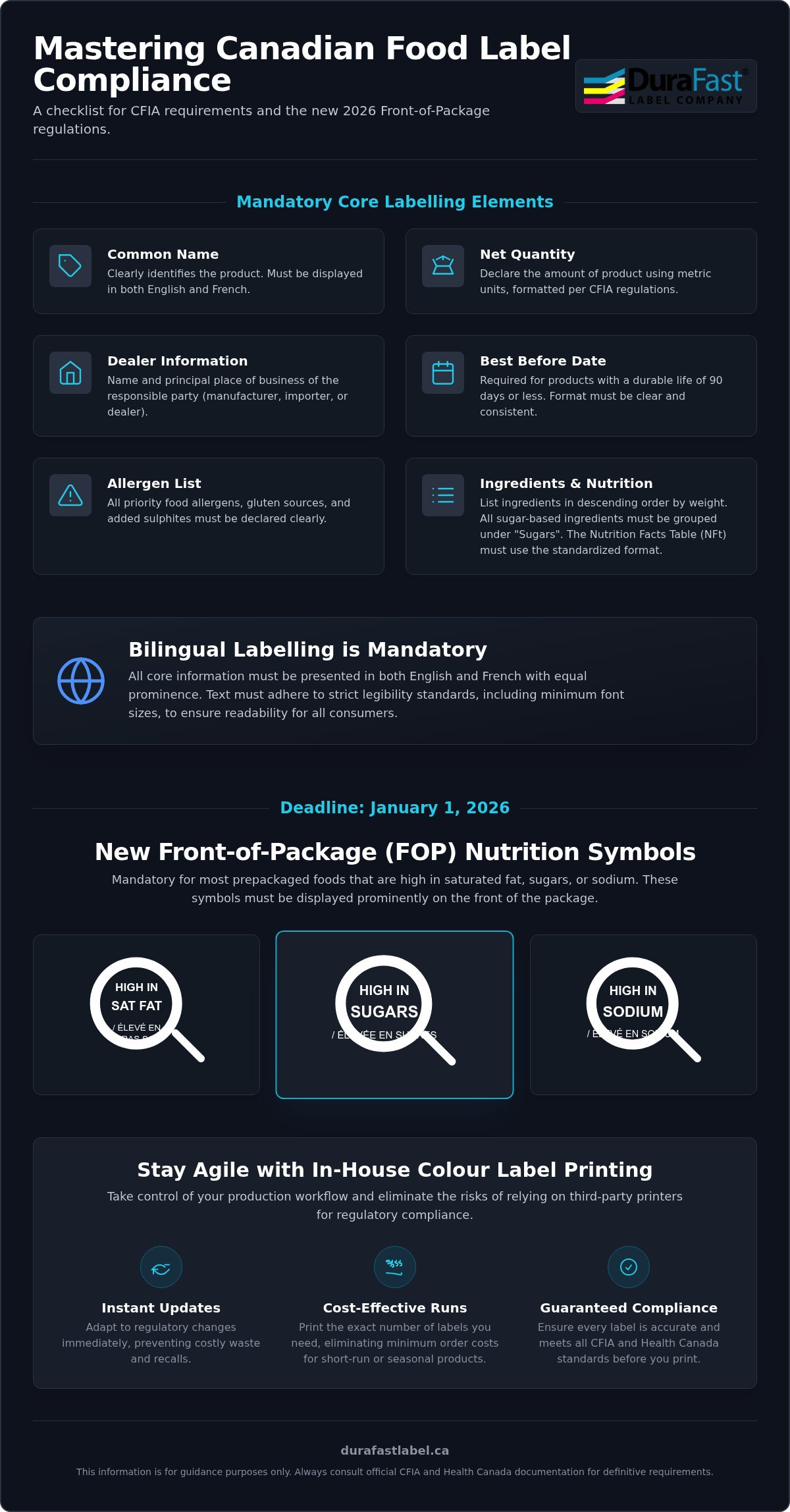
How do you ensure your product remains on retail shelves when the calendar flips to 2026? The introduction of the mandatory front-of-package (FOP) nutrition symbol represents the most significant shift in food product label requirements Canada has seen in decades. This black and white symbol is designed to help consumers identify foods high in saturated fat, sugars, and sodium at a single glance. While the regulation was announced in July 2022, the transition period ends on December 31, 2025. Starting January 1, 2026, the Canadian Food Inspection Agency (CFIA) will begin enforcement. For manufacturers, this isn't just a graphic update; it's a critical compliance milestone that impacts every facet of your packaging design. These symbols will likely influence consumer perception, potentially pushing shoppers toward products without the "High In" warning.
The "High-In" Nutrition Symbol Requirements
When does your product require this new warning symbol? Most prepackaged foods must display the symbol if the amount of saturated fat, sugars, or sodium reaches 15% or more of the daily value (%DV) per serving. For products with a small reference amount, typically 30 grams or 30 millilitres or less, the threshold is even stricter, triggering at 10% of the DV. Each nutrient of concern has its own specific icon within the symbol, providing clear data to the shopper. However, not every product is subject to these rules. Certain single-ingredient foods, like raw meats and vegetables, and products in very small packages are often exempt. Understanding these nuances is essential to avoid cluttering your label with unnecessary warnings while remaining fully compliant with national standards.
Symbol Placement and Graphic Specifications
Where exactly must this symbol sit on your package? The regulations are remarkably specific, requiring the symbol to be placed in the upper right-hand corner of the principal display panel. If the package shape makes this impossible, there are alternative secondary locations, but the right-hand side remains the priority. The graphic itself must adhere to strict rules regarding colour, size, and border thickness to ensure it's never obscured by other design elements. Managing these intricate layout changes across a diverse product line can be overwhelming for any production team. Utilizing professional barcode software allows you to integrate these symbols into your templates with precision. This ensures that every label you print meets the exact technical specifications required by Health Canada, protecting your business from the risks of non-compliance and the financial burden of a product recall.
Best Practices for In-House Label Production and Design
How do you bridge the gap between understanding the law and physically applying it to your packaging? Moving your production from an outsourced model to an in-house setup is a strategic move that offers both fiscal responsibility and operational seamlessness. When you print your own labels, you eliminate the lead times and minimum order quantities associated with third-party vendors. This flexibility is vital when food product label requirements Canada mandates sudden changes, such as the 2026 front-of-package symbols. Instead of discarding thousands of obsolete labels, you simply update your digital template and resume production. This level of control ensures that your brand remains compliant without the financial sting of wasted inventory.
Utilizing Professional Label Design Software
Can your current design process handle the complexity of mandatory bilingual text and standardized nutrition tables? Manual data entry is often where compliance fails. Utilizing professional software like Loftware NiceLabel Designer Pro allows you to manage templates with industrial precision. These programs can automate the creation of Nutrition Facts Tables, pulling data directly from a centralized database to reduce human error. By maintaining your ingredient lists and French translations in one secure location, you ensure that every SKU in your lineup meets Health Canada's legibility standards every time you hit print.
Selecting Durable Materials for Food Environments
What happens to your label when it encounters the moisture of a refrigerator or the sub-zero temperatures of a commercial freezer? A label that peels or smears is no longer compliant. For products introduced to water or heavy condensation, selecting weatherproof labels is a non-negotiable requirement. These materials are designed to withstand moisture and environmental debris without losing their adhesive bond. If you are working with frozen goods, you must choose an adhesive specifically formulated for cold-chain environments. Pairing these durable substrates with high-performance Memjet Technology results in vibrant, high-resolution labels that remain legible from the production floor to the consumer's home.
Traceability is another critical factor in modern food production. Integrating barcodes and QR codes into your design doesn't just help with inventory management; it allows you to engage directly with consumers who want more transparency about your sourcing. If you are ready to take control of your production process and ensure your packaging is 2026-ready, consult with our labelling experts to find the right hardware and software combination for your facility.
Scaling Your Food Labelling with Professional In-House Printers
How do you maintain absolute compliance when your production volume jumps from hundreds to thousands of units? Scaling up from artisanal batches to national distribution requires more than just a compliant design; it requires hardware that can keep pace with your growth. Industrial-grade printers are essential for high-volume food production because they offer the reliability needed to prevent costly downtime during critical shipping windows. When evaluating your options, the main difference between entry-level and industrial models often comes down to print speed and ink capacity. High-speed units can reach up to 12 ips (inches per second), while larger ink tanks, often 250 ml per colour, significantly lower your total cost per label. If you are managing long production runs, using external label unwinders is a strategic way to increase efficiency, as they allow for much larger label rolls than standard internal configurations.
VIPColor and Afinia: Solutions for Complex Food Labels
Choosing the right technology depends heavily on your specific product environment. The VIPColor VP700 is a powerhouse for high-speed, high-volume labelling, utilizing Memjet Technology to deliver professional 1600 dpi resolution. This high resolution is critical for meeting food product label requirements Canada enforces, as it ensures that tiny bilingual text and mandatory symbols remain crisp and legible. If your needs are more varied, the Afinia L502 provides excellent versatility for different product lines. The only difference you need to consider is your choice of ink. Dye inks are perfect for vibrant, shelf-ready prime labels, while pigment inks are the better choice for labels that will face heavy condensation or refrigerated storage.
Maintaining Quality and Compliance at High Speeds
Operational seamlessness is the goal of any production manager. You can reduce downtime by selecting printers with large ink tanks and user-replaceable printheads, allowing your team to handle maintenance immediately without waiting for a service technician. In food production areas, environmental debris like flour dust or sugar particles can interfere with sensitive equipment. Industrial printers with protected housings are designed to withstand these conditions, ensuring consistent print quality despite the surrounding environment. If you are a small-batch producer just starting to scale, you might find our VIPColor VP550 guide useful for finding a balance between physical footprint and performance. Taking control of your production floor with the right hardware ensures your brand remains both compliant and profitable through 2026 and beyond.
Future-Proof Your Food Labelling Strategy
Transitioning to the 2026 regulatory landscape requires a proactive approach to compliance. Between mandatory bilingual formatting and the new "High In" nutrition symbols, the complexity of food product label requirements Canada enforces is only increasing. By moving production in-house, you gain the agility to respond to these shifts without the burden of outsourced lead times or wasted inventory. It's about taking control of your brand's future while ensuring every package meets the highest national standards for transparency and safety.
As an authorized Canadian distributor for VIPColor and Afinia, we provide the industrial reliability your business requires to scale. Our team consists of high-speed Memjet technology experts who offer specialized technical support for your label design software. We help you bridge the gap between technical specifications and practical, real-world applications on the production floor. Contact our labelling experts today to find a hardware and software solution that fits your specific production goals. You've built a great brand; let's work together to make sure your packaging reflects that quality while staying fully compliant.
Frequently Asked Questions
Do I need a different label for food sold only in one province?
Most food product label requirements Canada enforces apply regardless of whether you sell across borders or within a single province. While the Safe Food for Canadians Act focuses on interprovincial trade, the Food and Drugs Act sets national standards for safety and nutrition. This means bilingual labelling and accurate ingredient lists are mandatory for almost all retail food products. Selling locally doesn't exempt you from federal standards designed to protect consumer health and prevent misleading claims.
What are the font size requirements for Canadian nutrition labels?
Font sizes are strictly regulated to ensure legibility for all consumers. For the Nutrition Facts table, most text must be at least 6 points, with headings like Nutrition Facts requiring larger, bolder type. The font height for net quantity is determined by the size of your package's principal display surface. Using professional software helps you maintain these specific ratios automatically, ensuring your text remains clear and compliant on every production run without manual measurement errors.
How do I determine if my food product needs the new FOP symbol?
You must display the new front-of-package symbol if your product reaches specific thresholds for sodium, sugars, or saturated fat. For most prepackaged foods, the threshold is 15% of the daily value per serving. If your product has a small reference amount of 30 grams or less, the symbol is triggered at 10%. You should review your latest nutritional analysis against these 2026 standards to determine if the High In icons are required for your specific formulation.
Can I use a sticker to correct an existing food label?
You can use a sticker to correct non-compliant information, provided the adhesive is permanent and the new label doesn't obscure other mandatory elements. This process, often called over-labelling, is a common solution for businesses transitioning to the new 2026 symbols; for example, using durable vinyl options from Sticker-A-Peel ensures these corrections remain legible and professional. However, the sticker must meet all legibility and bilingual requirements. Printing these corrective labels in-house allows you to fix errors quickly and maintain distribution without waiting for external print shops.
To label a product as organic in Canada, it must be certified by a CFIA-accredited body. Products with at least 95% organic content can display the Canada Organic logo and use the term organic in their marketing. If your product contains between 70% and 95% organic ingredients, you can list the percentage on the label but cannot use the logo. These claims are subject to the same bilingual and legibility standards as core mandatory information.
How much space must the Nutrition Facts Table take up on my package?
The Nutrition Facts table must be placed on a continuous surface of the package where it can be easily read by the shopper. While there isn't a single percentage of space required, the table must follow specific dimensions based on the available display surface. If your packaging is very small, you may be eligible for simplified or linear formats. It's vital to choose a format that provides maximum visibility while fitting within your unique container's physical constraints.
What allergens must be declared on Canadian food labels?
You must declare eleven priority allergens on your label: peanuts, tree nuts, sesame seeds, milk, eggs, fish, crustaceans and molluscs, soy, wheat or triticale, mustard, and sulphites. These must be listed in the ingredient list or a separate Contains statement. Accuracy here is the foundation of consumer safety. Missing a single allergen is one of the most common reasons for a CFIA recall, making precise database management in your design software absolutely essential.
Do I need a UPC barcode for my food product to be sold in retail?
While a UPC barcode is not a legal requirement under federal food product label requirements Canada guidelines, almost all major retailers require one for inventory management. If you plan to sell your products in grocery stores or national chains, you'll need a unique barcode assigned through GS1 Canada. Integrating these codes into your label design is simple with professional software, allowing you to pair mandatory nutritional data with the scannable codes retailers demand.