Epson C6500 vs. VIPColor VP550: Colour Label Printer Guide
10th Jun 2026
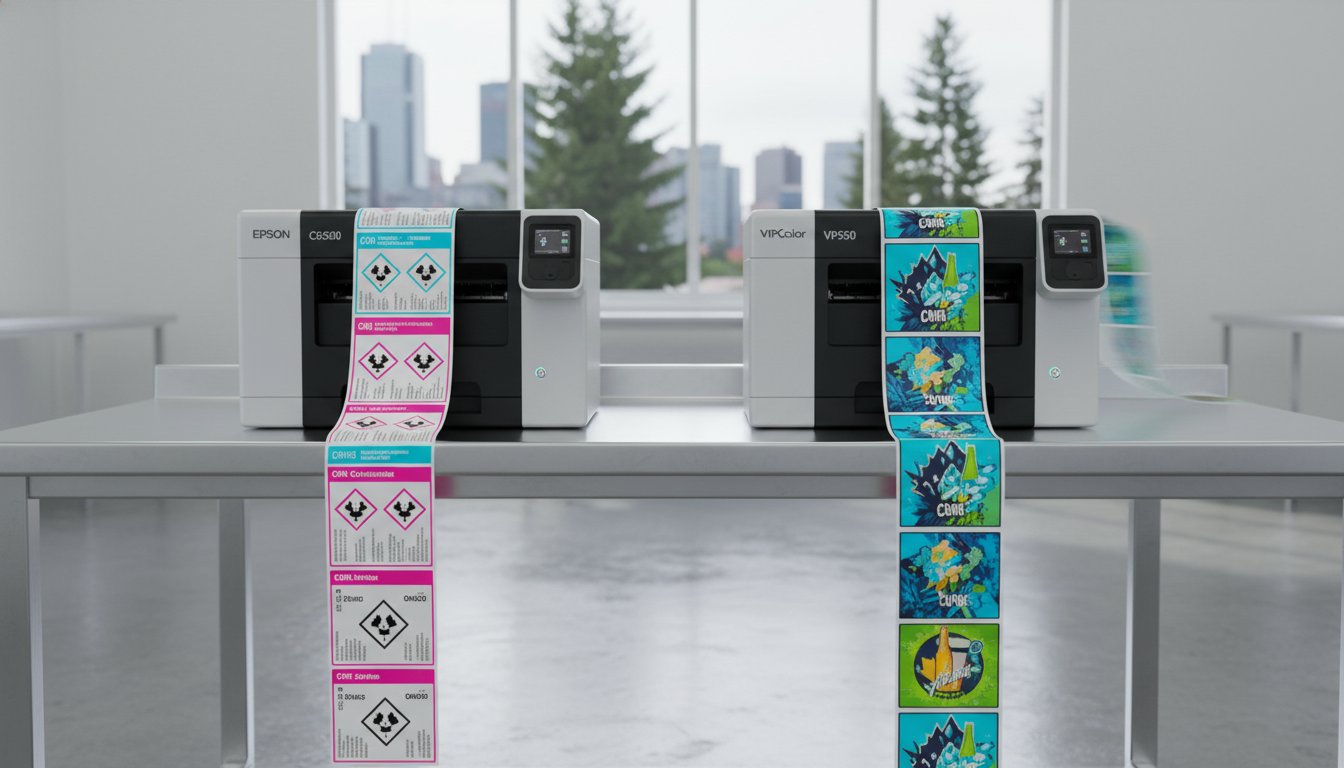
Is the fastest print speed always the smartest investment for your Canadian production facility? You likely realize that bringing label production in-house is the most effective way to slash outsourcing costs and regain control over your inventory. However, the decision becomes complex when you have to choose between two industry leaders with vastly different strengths. When you compare Epson C6500 and VIPColor VP550 color label printers, the "right" choice depends entirely on whether your workflow prioritizes chemical-grade durability or high-volume throughput.
This technical guide provides a side-by-side analysis to help you resolve the confusion surrounding pigment versus dye inks and environmental resistance. We'll examine how these 8-inch inkjet printers handle real-world conditions, from the condensation on a craft beer bottle to the harsh chemicals in an industrial warehouse. By the end of this comparison, you'll understand the total cost of ownership for each model and which machine will truly empower your business to scale without technical disruptions.
Key Takeaways
- Understand how Memjet and PrecisionCore technologies impact your daily throughput and overall print quality.
- Compare ink volumes and print speeds to accurately calculate the total cost of ownership for your Canadian production facility.
- Use our technical breakdown to compare Epson C6500 and VIPColor VP550 color label printers for durability in moisture-heavy or dusty industrial environments.
- Match your specific industry needs, from GHS chemical compliance to craft beverage labelling, with the ideal hardware and ink combination.
Navigating the 8-Inch Colour Label Printer Market
For many Canadian SMEs, the transition to in-house production isn't just a trend; it's a strategic move to secure supply chain independence. By eliminating the wait times and high minimum order quantities associated with third-party print shops, businesses can respond to market demands in real time. As an authorized dealer for both Epson and VIPColor, DuraFast Label Company Canada helps organizations evaluate these industrial tools through a pragmatic lens. When you compare Epson C6500 and VIPColor VP550 color label printers, you're looking at the peak of the 8-inch category. This specific width is the sweet spot for wide-format product labels that require high visibility and professional branding on the shelf or in the warehouse.
The primary differences between these two contenders lie in their core inkjet printing technology and ink chemistry. While one focuses on the rugged durability of pigment inks, the other prioritizes the high-speed throughput of Memjet dye-based systems. Choosing between them requires a clear understanding of your operational environment and the specific stresses your labels will face after they leave the printer. This ensures that your investment supports long-term growth rather than creating a logistical bottleneck.
Identifying the Primary Use Case
Why are 8-inch labels so essential? For industries like chemical manufacturing, beverage production, and large-format logistics, a standard 4-inch label simply doesn't provide enough real estate for regulatory data and branding. Small businesses often find that blank labels for sale in wider formats allow for GHS-compliant chemical drums or eye-catching craft beer wraps. This guide uses a baseline and delta approach to show how the Epson C6500 serves as a durable industrial baseline, while the VIPColor VP550 offers a significant delta in speed and volume. The shift from outsourced printing to on-demand solutions allows you to print exactly what you need, reducing waste and inventory costs simultaneously.
Why Businesses Compare the C6500 and VP550
How do you choose when both machines sit in a similar price bracket? Both the Epson and the VIPColor target small to medium production lines that demand professional-grade output of 1200 dpi or higher. The Canadian market specifically values machines that can handle industrial reliability for long shifts without constant maintenance. You might find yourself weighing the need for batch flexibility against the requirement for a printer that can withstand moisture or chemicals. While the Epson C6500 is often praised for its pigment-based longevity, the VP550 is frequently selected for its ability to churn out thousands of vibrant labels in a single afternoon. Understanding these operational tradeoffs is the first step in maximizing your return on investment.
Print Technology: Epson PrecisionCore vs. VIPColor Memjet
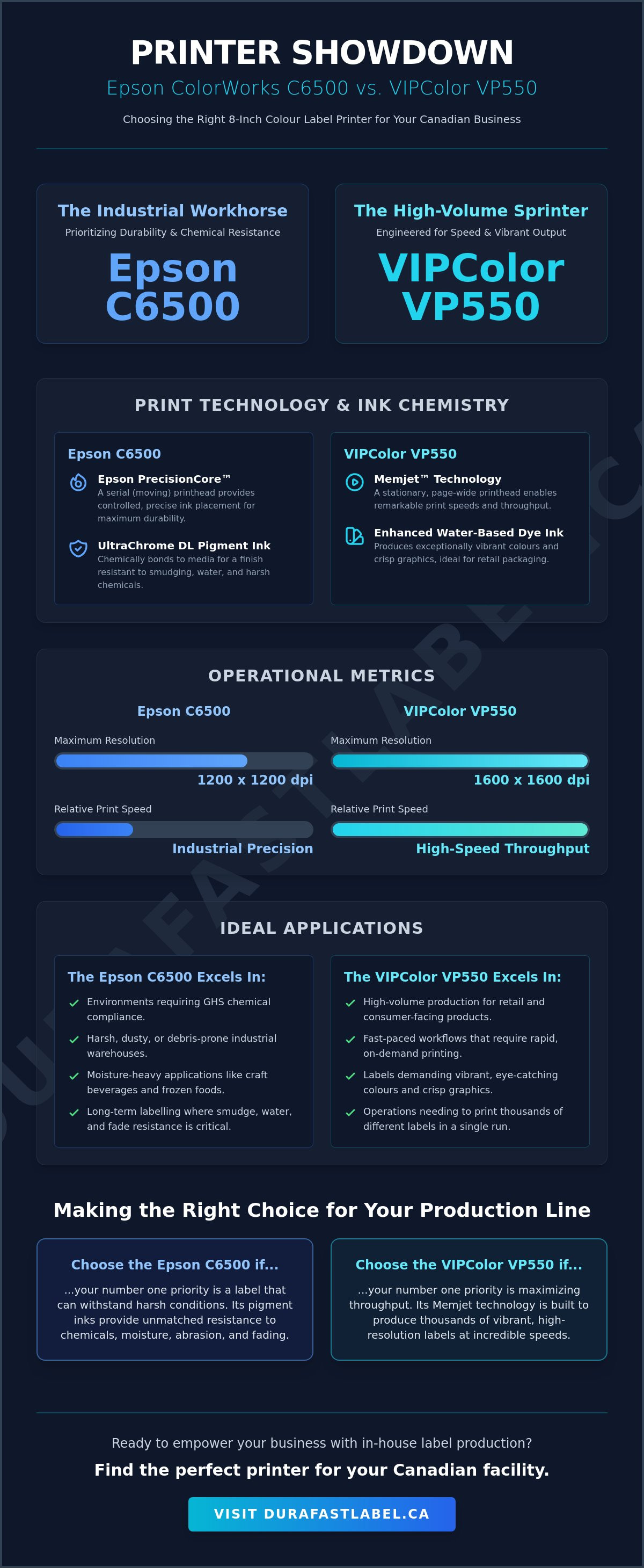
The fundamental difference between these two machines starts with the printhead architecture. When you compare Epson C6500 and VIPColor VP550 color label printers, the Epson serves as the baseline for industrial durability, while the VP550 represents a significant delta in speed and resolution. The VP550 utilizes Memjet technology, which features a stationary, page-wide printhead. Because the printhead remains fixed while the media moves beneath it, the printer can achieve remarkable throughput. Conversely, the Epson C6500 uses a serial PrecisionCore printhead that travels back and forth across the web. While this mechanical movement is slower, it provides the controlled precision required for high-density pigment ink placement.
Beyond the physical movement of the heads, resolution metrics create another point of distinction. The Epson C6500 delivers a maximum of 1200 x 1200 dpi, which is more than sufficient for industrial barcodes and sharp text. The VIPColor VP550 pushes this further to 1600 x 1600 dpi. This higher resolution is a direct result of the Memjet head's nozzle density, creating incredibly crisp graphics for retail packaging. Maintenance cycles also vary. Memjet heads are generally user-replaceable consumables that you can swap out in minutes. Epson's PrecisionCore heads are designed to last for the life of the printer under normal operating conditions. If you're unsure which maintenance profile fits your production team, you can speak with our technical advisors for a breakdown of long-term upkeep.
Epson C6500: Precision and Pigment Durability
The Epson C6500 is engineered for environments where a label's life doesn't end on the shelf. Its UltraChrome DL pigment ink is designed to bond deeply with specific inkjet labels, creating a finish that is resistant to smudging, water, and even harsh chemicals. It's often considered the gold standard for meeting GHS and chemical labeling requirements. For Canadian manufacturers shipping goods through variable climates, the lightfastness of pigment ink ensures that safety data remains legible even after months of UV exposure or moisture. This makes the C6500 the logical choice for industrial marking and outdoor applications.
VIPColor VP550: Speed and High-Resolution Dye-Enhanced Ink
In contrast, the VIPColor VP550 uses water-enhanced dye inks. These are not standard desktop dyes; they've been formulated to offer better moisture resistance than traditional dye inks while maintaining the extreme vibrancy that retail brands demand. Dye ink particles are physically smaller than pigment particles. This allows the ink to soak into the media for a smoother, glossier finish. This makes the VP550 ideal for prime product branding where shelf appeal is the primary objective. It offers a massive speed advantage for high-volume batches without sacrificing the intricate detail of 1600 dpi graphics.
Operational Metrics: Speed, Ink Capacity, and Throughput
When you compare Epson C6500 and VIPColor VP550 color label printers, the most immediate differentiator is the pace of production. While the Epson C6500 is a robust baseline for quality, the VP550 offers a significant delta in raw speed. The physical footprint also varies; the Epson features a built-in peeler or cutter, making it a compact all-in-one unit. In contrast, the VP550 often utilizes an external unwinder to handle larger media rolls. For Canadian businesses integrating these into existing workflows, both support standard middleware, though the Epson’s native ZPL II support makes it particularly easy to drop into environments currently using thermal industrial label printers.
Print Speed and Throughput Realities
In the labelling industry, "ips" refers to inches per second. How does this translate to your daily operations? If you're running a batch of 1,000 four-inch labels, the Epson C6500’s speed of up to 5 ips means the job takes roughly 13 minutes. The VIPColor VP550, capable of 8 ips, finishes the same task in just over 8 minutes. This difference becomes a deciding factor for high-volume facilities where every minute of uptime counts. However, you must realize there's a trade-off; running at maximum speed often requires a slight reduction in print resolution. For many, the ability to churn through thousands of labels during a single shift outweighs the need for microscopic detail.
Managing Ink Consumption and Cartridge Volume
Operational efficiency is also determined by how often your team has to stop production to change supplies. The VIPColor VP550 features massive 200ml individual ink tanks, which is a substantial increase over the 70ml to 80ml cartridges found in the Epson C6500. These larger tanks allow for longer uninterrupted print runs and generally lower the cost-per-label, especially for designs with high ink coverage. Following FDA food labeling guidelines often requires detailed ingredient lists and nutrition facts panels that consume significant ink. By using individual colour cartridges, both printers ensure you only replace the specific colour that has run out, minimizing waste and supporting fiscal responsibility.
Durability and Media Handling: Which Environment Wins?
How does your facility's physical environment dictate your hardware choice? When you compare Epson C6500 and VIPColor VP550 color label printers, you must look beyond the spec sheet to the actual floor conditions. The Epson C6500 serves as the industrial baseline for ruggedness; its internal label unwinder keeps the media roll fully enclosed. This design is a significant advantage in dusty warehouses or manufacturing plants where environmental debris can settle on the media and damage sensitive printheads. The VP550 typically utilizes an external unwinder, which allows for larger rolls but leaves the media more exposed to the surrounding atmosphere.
Media compatibility also plays a role in your long-term operational strategy. While these are inkjet machines, businesses often evaluate them alongside other technologies. For instance, you might use direct thermal labels for short-term shipping, but those won't work in these high-resolution colour units. Similarly, if your current process relies on thermal transfer ribbons, you'll realize that switching to the C6500 or VP550 eliminates the need for ribbons entirely while adding full-colour flexibility. The challenge lies in matching the ink chemistry to the substrate to ensure the label survives its intended lifecycle.
Chemical Resistance and GHS Compliance
The Epson C6500 is the definitive choice for applications requiring weatherproof UL certified labels. Because pigment ink is made of solid particles that sit on top of the media, it offers superior resistance to harsh solvents and UV light. This is a non-negotiable requirement for meeting Canadian GHS labelling standards for industrial chemicals. Dye-enhanced inks, like those in the VP550, produce stunning visuals but can smudge or bleed when exposed to certain chemicals. If your labels must remain legible after exposure to oil, alcohol, or heavy moisture, the Epson's pigment system is the safer investment.
Material Compatibility and Environmental Factors
Does your product face extreme temperature shifts? Many Canadian food producers deal with condensation during the transition from cold storage to room temperature. The VP550 is specifically recommended for frozen foods and cosmetics where vibrant branding is the priority. Its water-enhanced dye inks offer better moisture resistance than standard dyes, making them suitable for "wet-label" environments. To achieve the best results, you must pair the printer with the correct blank labels designed for that specific ink type. If you need to verify how a specific material performs in your unique climate, contact our experts for a technical consultation.
Making the Choice: ROI for Canadian Production Lines
How do you determine which machine offers the best return for your specific production line? When you compare Epson C6500 and VIPColor VP550 color label printers, you're evaluating more than just upfront costs; you're looking at long-term operational efficiency and workspace optimization. The Epson C6500 serves as a compact, all-in-one baseline that simplifies the workspace with its internal unwinder and integrated peeler. Conversely, the VP550 represents a modular delta that requires more bench space for its external media handling but rewards the user with significantly higher throughput for large batches. Your choice should reflect whether your facility values the "set it and forget it" reliability of an integrated unit or the high-speed scalability of a modular system.
For Canadian businesses, the availability of local support is a critical component of fiscal responsibility. Choosing a partner like DuraFast Label Company Canada ensures you have access to specialized knowledge and domestic stock, preventing the disruption of international shipping delays. If you've decided that speed and vibrancy are your top priorities, our VIPColor VP550 Memjet Color Label Printer guide provides a deeper look into maximizing that specific hardware for your 2026 production goals. Organizing your workspace to accommodate either the internal roll of the Epson or the external setup of the VIPColor is the final logistical step in your transition to in-house printing.
The Case for the Epson ColorWorks C6500
The Epson C6500 is the logical choice for industrial environments where chemical contact or long-term outdoor exposure is expected. It's built for longevity and remains a top performer among industrial label printers due to its pigment ink chemistry. You should prioritize this model if your workflow requires integrated peeling and cutting or if you must meet strict GHS compliance standards. It's a pragmatic solution for rugged marking where durability is more important than raw print speed, providing a stable ROI through its lower maintenance requirements and industrial-grade build quality.
The Case for the VIPColor VP550
Specialty producers often find the VP550 offers a better ROI for high-resolution retail branding. It's best for small businesses that need to produce vibrant, professional-grade labels in large batches without the wait times of a serial printhead. While some competitors suggest this technology is niche, it provides unique value for those who need 1600 dpi precision for intricate graphics. The larger 200ml ink tanks mean fewer stops for cartridge swaps, which translates to lower labour costs and higher throughput during peak production seasons. It's the ideal tool for brands that want their products to stand out on the shelf with photographic quality while maintaining a low cost-per-label.
Optimizing Your Production for Long-Term Growth
Selecting the right 8-inch printer is a foundational step in scaling your in-house operations. The Epson C6500 remains the standard for industrial durability, while the VP550 provides the high-speed throughput required for vibrant retail packaging. When you compare Epson C6500 and VIPColor VP550 color label printers, the choice ultimately hinges on whether your labels face harsh warehouse conditions or need to capture attention on a store shelf. You don't have to navigate these technical differences alone.
As an authorized dealer for both brands, DuraFast Label Company Canada provides specialized expertise in GHS and prime label applications. We maintain Canadian-based stock and support to ensure your production line doesn't stall due to supply delays. Our team is ready to help you evaluate these operational metrics against your unique business goals. Compare our full range of Colour Label Printers and find your perfect match today. We're excited to help you achieve a more efficient and cost-effective labelling process.
Frequently Asked Questions
What is the main difference between pigment and dye-enhanced inks?
The primary difference lies in the molecular structure and environmental resistance of the ink. Pigment inks, used in the Epson C6500, consist of solid particles that bond to the surface of the media to provide superior UV and chemical resistance. Water-enhanced dye inks, found in the VP550, use liquid-based colourants that penetrate the media for more vibrant colours and higher resolution. While pigment is the standard for industrial longevity, dye-enhanced inks are preferred for retail shelf appeal.
Can the Epson C6500 print GHS compliant labels for the Canadian market?
Yes, the Epson C6500 is specifically engineered to produce GHS-compliant labels for the Canadian market. When you pair Epson's pigment inks with BS5609-certified media, the resulting labels meet the rigorous durability standards required for chemical drums and hazardous materials. This ensures your safety data remains legible even after exposure to salt water, harsh sunlight, or abrasive industrial chemicals, helping you maintain regulatory compliance across your entire product line.
Is the VIPColor VP550 suitable for frozen food labels?
The VIPColor VP550 is well-suited for frozen food applications because it utilizes water-enhanced dye ink technology. Unlike standard dye inks, this specific formulation resists smudging when labels face condensation or rapid temperature shifts. When you compare Epson C6500 and VIPColor VP550 color label printers for this use case, the VP550 often wins on visual vibrancy, provided you use media designed for refrigerated environments to ensure the adhesive and ink bond correctly.
How often do I need to replace the printhead on a Memjet printer?
The printhead on a Memjet-powered printer like the VP550 is a user-replaceable consumable that you swap out after processing several litres of ink. You typically replace it once print quality begins to degrade, which usually occurs after approximately 7 to 10 litres of ink usage. This modular design allows you to maintain factory-new print quality without needing a service technician, ensuring your production line experiences minimal downtime during high-volume runs.
Which printer has a lower cost-per-label for high-coverage graphics?
The VIPColor VP550 generally offers a lower cost-per-label for designs with high ink coverage and full-bleed graphics. Its massive 200ml individual ink tanks provide a better economy of scale compared to the smaller 70ml to 80ml cartridges found in the Epson C6500. For small businesses running vibrant, ink-heavy branding, the larger ink volume reduces the frequency of user intervention and lowers the amortized cost of consumables over long production cycles.
Does the Epson C6500 require an external unwinder?
No, the Epson C6500 does not require an external unwinder because it features a built-in internal label unwinder. This internal component protects your media from environmental debris and keeps the printer's footprint compact for smaller workspaces. However, the internal unwinder is limited to 6-inch outside diameter rolls. If your production requires larger 8-inch or 10-inch rolls to reduce changeover frequency, you can add an external unwinder to increase your media capacity.
Are there specific labels I must use for these inkjet printers?
You must use specific inkjet-receptive media to achieve professional results with both of these 8-inch printers. Standard thermal or laser labels lack the specialized coating required to absorb and lock in the ink, which leads to smudging and poor colour accuracy. We offer a wide range of compatible matte and gloss labels specifically tested to perform with PrecisionCore and Memjet technologies, ensuring your barcodes remain scannable and your branding stays crisp.
Can I use these printers with Bartender or NiceLabel software?
You can absolutely use both printers with industry-standard software like Bartender and NiceLabel. Both manufacturers provide robust Windows drivers that allow for seamless integration with professional label design suites and automated print systems. This compatibility is essential for Canadian businesses that need to compare Epson C6500 and VIPColor VP550 color label printers while maintaining their existing database connections, variable data requirements, and warehouse management system workflows.