Epson C6500 vs. Primera LX910: Best Color Label Printer?
9th Aug 2026
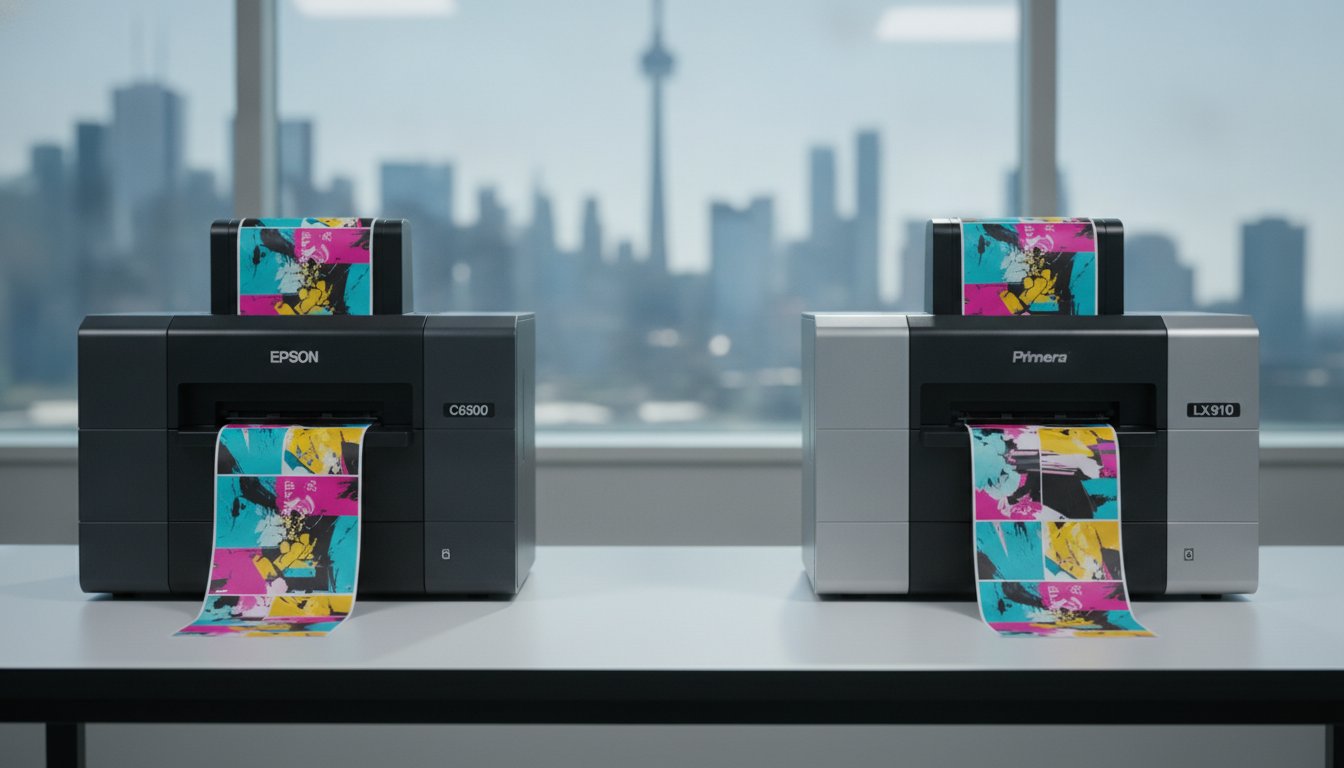
Is the printer with the lower sticker price actually the one that will drain your budget over the long term? When you compare Epson C6500 and Primera LX910 colour label printer options, the initial C$1,390 price gap is only the beginning of the financial story. You likely want to escape the high costs of outsourced labelling while ensuring your brand looks professional on every shelf. It's frustrating to worry if your ink will smudge on a frozen product or if a dusty warehouse will lead to constant maintenance delays.
We understand that choosing the right equipment is a strategic investment in your company's growth. This guide explores the technical and financial differences between these two 8-inch powerhouses to determine which printer delivers the best ROI for your production line. You'll discover how the Epson's individual pigment ink cartridges stack up against the Primera's versatile dye and pigment swap system. By the end, you'll know exactly which machine provides the operational seamlessness and lower cost-per-label your business requires to scale efficiently in the Canadian market.
Key Takeaways
- Evaluate the total cost of ownership by weighing initial hardware investments against long-term ink utilization and waste management efficiency.
- Identify the main difference between pigment and dye ink systems to ensure your labels remain legible in challenging environments like frozen storage or wet production floors.
- Compare Epson C6500 and Primera LX910 colour label printer performance metrics, including print speeds measured in ips and the footprint impact of internal label unwinders.
- Discover how transitioning to in-house 8-inch wide-format labelling can reduce lead times and inventory costs for chemical drums and pallet marking.
The 8-Inch Decision: Why Compare the Epson C6500 and Primera LX910?
Scaling In-House Production for Wide-Format Labels
The 8-inch format serves as the sweet spot for industrial and prime packaging. It provides enough surface area for GHS-compliant warnings on chemical containers while offering the visual impact needed for retail branding on large boxes. For businesses across Canada, this agility is a massive competitive advantage. By using on-demand colour label printers, you don't have to worry about obsolete label stock sitting in a warehouse when regulations or branding requirements change. You simply update the digital file and print what you need for today's production run. This reduces waste and ensures your capital isn't tied up in thousands of unused labels.
Industrial Reliability vs. Boutique Versatility
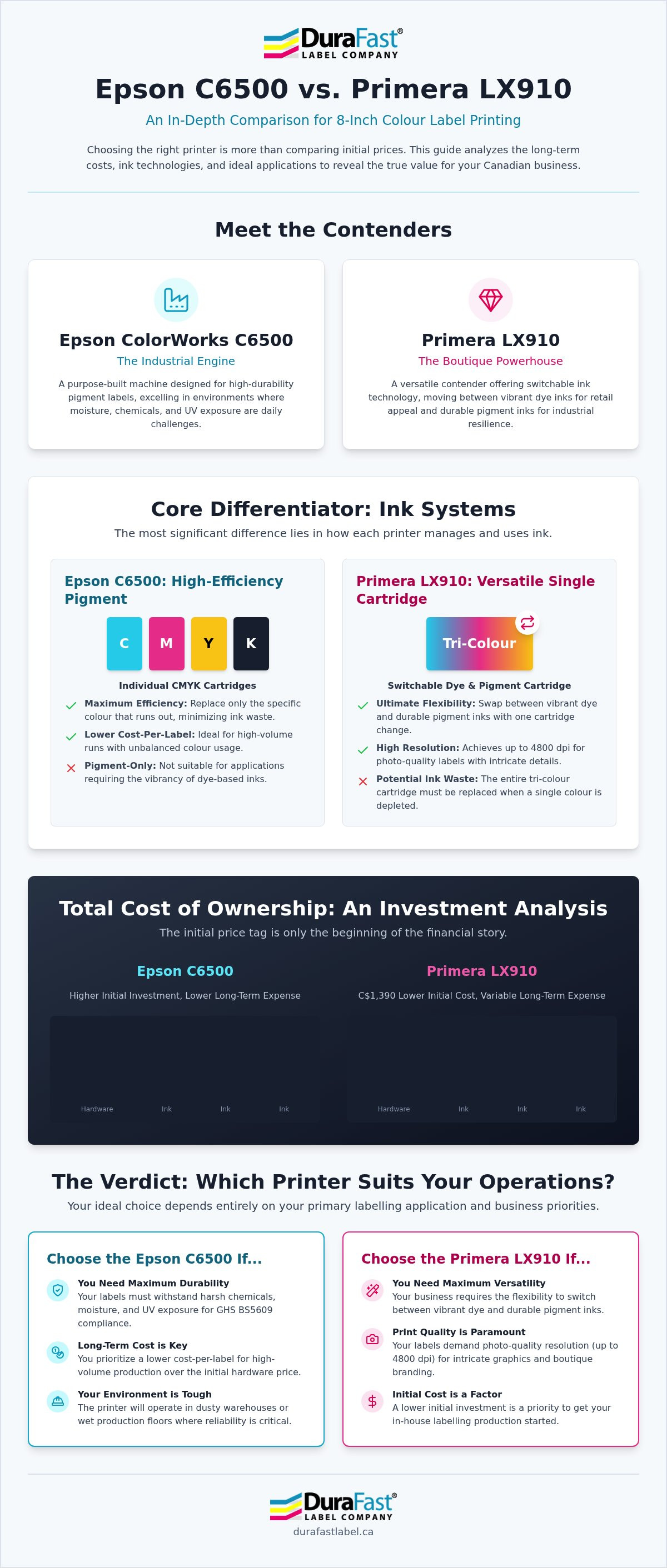
The core of this comparison rests on a fundamental choice: do you need a dedicated industrial engine or a versatile boutique powerhouse? The Epson C6500 is a purpose-built industrial machine designed specifically for high-durability pigment labels. It excels in environments where moisture, chemicals, and UV exposure are daily challenges. In contrast, the Primera LX910 is a versatile contender that offers switchable ink technology. This unique feature allows you to move between vibrant dye inks for high-end retail shelf appeal and pigment inks for industrial resilience. Your primary label application, whether it's a luxury gourmet food item or a heavy-duty pallet of industrial solvent, will ultimately dictate which of these machines is the better choice for your specific operations.
Ink Technology and Print Quality: Pigment vs. Dye Systems
The main difference between pigment and dye inks boils down to how they interact with the label surface. When you compare Epson C6500 and Primera LX910 color label printer technology, you're looking at two very different philosophies regarding image longevity. Pigment inks use solid particles suspended in liquid, which sit on top of the media. This makes them highly resistant to UV fading and moisture. Dye inks, however, dissolve completely, soaking into the material to produce vibrant, photographic results that follow printing industry standards for high-end retail packaging. Choosing the right finish is vital for your brand identity; a smudge on a luxury bottle can be just as damaging as an unreadable warning on a chemical drum.
Epson’s PrecisionCore Pigment Performance
The Epson C6500 utilizes a four-colour (CMYK) individual pigment system. This setup is highly efficient because you only replace the specific colour that runs out, unlike tri-colour cartridges. These inkjet colour labels are essential for industrial use, particularly for GHS BS5609 compliance where labels must withstand harsh chemicals and seawater. PrecisionCore technology ensures that every droplet is placed with extreme accuracy. This maintains consistent colour output even in dusty warehouse environments where environmental debris might compromise lesser printheads. It's a system built for reliability and fiscal responsibility over high-volume runs.
Primera’s Single-Cartridge Dye and Pigment Flexibility
The Primera LX910 offers a unique advantage: the ability to switch between dye and pigment inks with a simple cartridge swap. It achieves a staggering resolution of up to 4800 dpi. This is ideal for boutique products with intricate graphics or tiny text. However, there's a trade-off. The LX910 uses a single tri-colour cartridge. If you print a lot of one colour, you'll eventually discard the remaining ink of the other two colours when the cartridge is empty. For boutique brands, "water enhanced dye inks" can bridge the gap, offering better moisture resistance than standard dye while keeping the vibrancy high. This flexibility makes it a powerful tool for innovators who don't want to be locked into a single ink type.
Deciding between these systems depends on your specific operational hurdles. If your production line is in a damp or dusty facility, the Epson's industrial build is a safer bet. For those needing maximum aesthetic flexibility for short runs, the Primera's 4800 dpi output is hard to beat. If you aren't sure which ink chemistry fits your specific product, our team can help you request a printed sample to test durability in your own facility.
Performance Metrics: Print Speed, Durability, and Media Handling
When you compare Epson C6500 and Primera LX910 color label printer specifications, the "inches per second" (ips) rating is often the first metric buyers examine. However, real-world throughput is dictated by the resolution settings required for your specific branding. Speed is meaningless if the resulting label doesn't meet your quality standards; conversely, the highest resolution is a bottleneck if it halts your production line. Understanding these trade-offs is essential for maintaining operational seamlessness in a busy Canadian warehouse.
Real-World Throughput and "ips" Ratings
The Epson C6500 offers a maximum speed of 5 ips when printing at 300 x 600 dpi. If you increase the quality to 600 x 600 dpi, the speed drops to approximately 2.3 ips. At the maximum 1200 x 1200 dpi setting, it produces stunning detail but at a slower pace. In contrast, the Primera LX910 reaches a top speed of 4.5 ips. While the Primera can achieve a staggering 4800 dpi, printing at this boutique level significantly reduces throughput. To calculate your daily capacity, consider an 8-hour shift: at a steady 3 ips, you can theoretically produce 1,440 linear feet of labels, though you must account for media changes and maintenance cycles.
Media Unwinders and Environmental Resilience
Hardware construction plays a vital role in longevity. The Epson C6500 is a rugged industrial label printer featuring a compact footprint thanks to its internal label unwinder. This design protects your blank labels from environmental debris and dust before they reach the printhead. The Primera LX910, while robustly built, often utilizes an external label unwinder to accommodate larger 8-inch outer diameter rolls. While this increases the physical footprint on your workbench, it allows for longer unattended print runs. For facilities dealing with high humidity or airborne particles, the Epson’s enclosed media path offers superior resilience against the elements that typically cause premature printhead failure.
Choosing between these two depends on your physical environment and volume needs. The Epson is designed to thrive in the "dusty" or "wet" conditions mentioned earlier, whereas the Primera is better suited for a clean, climate-controlled office or boutique studio. Both machines represent a significant step up from standard desktop units, providing the heavy-duty components needed to realize a high-volume, in-house labelling strategy.
Total Cost of Ownership: Analyzing Long-Term Operational Expenses
Is the printer with the lower sticker price always the most fiscally responsible choice? When you compare Epson C6500 and Primera LX910 color label printer options, the initial acquisition cost tells only a fraction of the story. While the Primera LX910 enters the market at a more accessible price point of C$2,575, the Epson C6500 requires a higher upfront investment of C$3,965. For a Canadian business owner, the real decision rests on your monthly label volume and the ink coverage of your designs. Long-term profitability depends on managing recurring expenses such as ink utilization and the cost of blank labels.
Ink Efficiency and the Cost-Per-Label Reality
The main difference in operational cost stems from the ink delivery systems. The Epson C6500 utilizes four individual CMYK ink cartridges, each priced at C$59. This design ensures maximum efficiency because you only replace the specific colour that runs out. In contrast, the Primera LX910 uses a single tri-colour cartridge priced at C$120. If your brand uses a logo with heavy cyan tones, you'll find yourself replacing the entire LX910 cartridge even if the magenta and yellow reservoirs are half full. This "hidden cost" of single-cartridge waste can quickly erode the savings from the lower initial purchase price. However, for innovators with low-volume needs or those who frequently switch between dye and pigment requirements, the LX910 remains a pragmatically sound entry point.
Maintenance and Printhead Longevity
Longevity and serviceability are critical for maintaining a steady production rhythm. The Epson C6500 features a permanent PrecisionCore printhead designed to last the life of the machine, provided you use high-quality consumables and perform basic cleaning. The Primera LX910 takes a different approach; every time you replace an ink cartridge, you're essentially installing a brand-new printhead. This prevents the disruption of head clogs but increases the price of every ink swap. For Canadian operators, finding a strategic partner like DuraFast Label Company Canada who stocks parts and provides national support is essential for minimizing downtime.
When looking at the broader market of colour label printers, you must calculate the total cost over three to five years rather than just the first month. If you're ready to see how these numbers apply to your specific label designs, the team at DuraFast Label Company Canada can provide a detailed cost-per-label analysis to ensure you achieve the best possible ROI. You can contact us today for a personalized consultation to determine which model fits your budget and operational needs.
The Verdict: Selecting the Ideal Printer for Your Operations
How do you choose between a dedicated industrial workhorse and a versatile boutique chameleon? When you compare Epson C6500 and Primera LX910 color label printer models, the decision rests entirely on your specific production environment and long-term fiscal goals. While both machines occupy the 8-inch wide-format category, they serve different masters. One is built for the unrelenting pace of a warehouse floor; the other is designed for the high-aesthetic demands of a creative studio. Selecting the right unit requires an honest assessment of your daily throughput and the environmental conditions where the printer will live.
When to Choose the Epson ColorWorks C6500
The Epson C6500 is the clear winner for businesses that prioritize industrial reliability and the lowest possible cost-per-label. If your operations involve GHS chemical labelling, frozen food production, or high-volume pallet marking, this is your strategic partner. It's purpose-built for pigment-only durability, ensuring that labels remain legible even when introduced to water, chemicals, or extreme cold. We recommend the C6500 for Canadian manufacturers who need to organize a seamless production line with features like a built-in peeler or auto-cutter. Its individual ink tank system provides a significantly better ROI for high-coverage designs, making it the more fiscally responsible choice for those printing thousands of labels per month.
When to Choose the Primera LX910
The Primera LX910 remains the superior choice for boutique brands, startups, and innovators who require maximum aesthetic flexibility. If you're producing gourmet foods, high-end cosmetics, or short-run prototypes, the LX910’s ability to switch between dye and pigment inks is an invaluable asset. You can use vibrant dye inks for a glossy retail shelf look on one day and swap to matte pigment for a durable industrial run the next. While the single-cartridge system carries a higher long-term ink cost, the lower initial investment of C$2,575 makes it accessible for businesses with limited starting capital. It's the go-to option for users who prioritize 4800 dpi photographic quality over massive daily throughput.
Ultimately, your choice should reflect the logistical hurdles you face every day. A printer is an investment in your brand's image and your facility's efficiency. If you're still weighing the technical nuances of these two powerhouses, we can help you make an informed decision based on your specific media samples and design files. Please contact our experts today for a custom quote and a detailed cost-per-label analysis tailored to the Canadian market.
Empower Your Production Line with the Right 8-Inch Partner
Choosing between these two powerhouses depends entirely on your specific logistical hurdles. The Epson C6500 excels in rugged industrial environments where moisture resistance and the lowest possible cost-per-label are the top priorities. Conversely, the Primera LX910 offers unmatched versatility for boutique brands that need to pivot between vibrant dye inks for retail appeal and durable pigment finishes for shipping. When you compare Epson C6500 and Primera LX910 color label printer capabilities, you're investing in the future of your brand's shelf presence and operational efficiency.
As authorized dealers at DuraFast Label Company Canada, we provide expert guidance and customized cost-per-label analyses to ensure your investment delivers a strong ROI. We understand the unique challenges of the Canadian supply chain and stock an extensive inventory of consumables to keep your production moving. Our specialists are ready to help you evaluate your specific designs and media requirements to find the perfect fit for your facility. Contact DuraFast Label Company Canada for a Personalised Print Consultation to get started. Taking control of your labelling process is a major step toward long-term growth and operational excellence.
Frequently Asked Questions
What is the main difference between the Epson C6500 and Primera LX910?
The main difference is the ink delivery system and intended durability. The Epson C6500 is a dedicated industrial pigment engine with individual CMYK tanks. The Primera LX910 is a versatile boutique printer using a single tri-colour cartridge that can switch between dye and pigment inks. This makes the Epson better for high-volume durability and the Primera ideal for aesthetic flexibility.
Can the Primera LX910 print GHS-compliant chemical labels?
Yes, the LX910 can produce GHS-compliant labels when using pigment ink and certified media. It's an excellent choice for short-run chemical labelling or prototyping. However, for large-scale industrial compliance runs, the Epson C6500 is often preferred due to its permanent printhead and higher throughput efficiency. Both machines allow you to bring GHS production in-house to reduce lead times.
How much does the Epson C6500 cost in Canada for 2026?
The verified MSRP for the Epson ColorWorks CW-C6500A in August 2026 is C$3,965.00. While the upfront investment is higher than the Primera, the lower recurring ink costs often result in a better long-term ROI for high-volume users. You should evaluate your total annual print volume to determine if the higher entry price is justified by the significant savings in cost-per-label.
Which printer is better for labels introduced to water or condensation?
The Epson C6500 is generally superior for wet environments. Its UltraChrome DL pigment ink is specifically designed for moisture and smudge resistance on frozen or chilled products. While the Primera can use pigment ink, the Epson's industrial PrecisionCore system is engineered for consistent performance in damp or dusty Canadian production facilities where label legibility is a non-negotiable requirement for compliance.
Is the single-cartridge system of the LX910 wasteful?
It can be if your designs use colours unevenly. When you compare Epson C6500 and Primera LX910 color label printer operational costs, the Epson's individual tanks allow you to replace only the empty colour. The Primera requires replacing the whole CMY cartridge once any single ink colour is depleted. This can lead to discarding perfectly good ink if your labels are heavy on one specific hue.
Does the Epson C6500 require an external label unwinder?
The Epson C6500 doesn't require an external unwinder because it includes a built-in internal unwinder. This internal system handles rolls up to 6 inches in diameter, keeping the footprint compact on your workbench. You only need an external unwinder if you plan to use large 8-inch outer diameter rolls to minimize the frequency of media changes during long print runs in high-volume settings.
What is the maximum print width for both the C6500 and LX910?
The Epson C6500A features a maximum print width of 8.34 inches. The Primera LX910 offers a maximum print width of 8 inches. While both handle wide-format needs, that extra fraction of an inch on the Epson can be critical for specific industrial GHS layouts or large chemical drum markers. This extra width provides more flexibility for complex designs without compromising on print speed.
Can I get Canadian-based support for both of these label printers?
Yes, you can access comprehensive support through DuraFast Label Company Canada. We provide national assistance, technical expertise, and an extensive inventory of consumables for both brands. Having a partner located within Canada ensures you receive authorized service and fast shipping on ink and labels. This localized support is essential for maintaining operational seamlessness and resolving any technical hurdles quickly.