Craft Beer Label Printers in Canada: The 2026 In-House Brewing Guide
14th Jun 2026
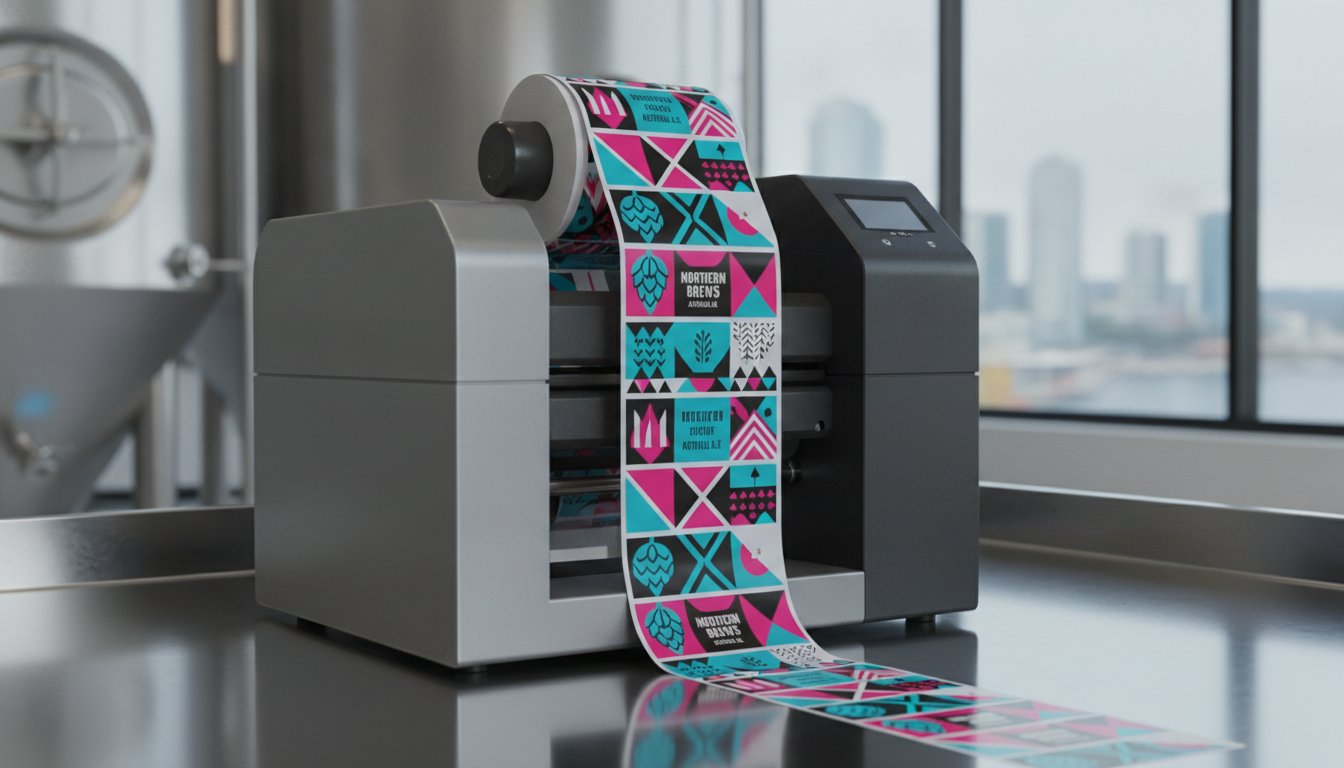
How much revenue does your brewery lose when a seasonal IPA launch is delayed three weeks simply because your labels haven't arrived? In a maturing market where the total number of Canadian breweries has recently shifted to 1,112, staying competitive requires more than just a great recipe; it requires operational agility. You've likely struggled with high minimum order quantities for short-run brews or watched your premium branding peel away in cold storage. Finding the best craft beer label printers Canada provides is no longer just a luxury for large-scale operations. It's a strategic necessity for any brewer who wants total control over their product's presentation and timeline.
We understand that your labels must survive the "ice bucket test" while meeting strict 2026 Front-of-Package labelling regulations. You want professional results without the waste of unused stock. This guide explores how in-house printing eliminates lead times and allows you to react to market trends instantly. We'll break down the technical differences between Memjet technology and pigment-based systems, comparing models from brands like Afinia and VIPColor. You'll learn how to select hardware that handles condensation with ease, ensuring your cans look as good on the shelf as they do in the glass.
Key Takeaways
- Discover how transitioning to an in-house model eliminates the high minimum order quantities (MOQs) that often stifle small-batch seasonal innovation.
- Identify why pigment-based ink is the essential standard for maintaining label integrity against condensation and ice bucket immersion at 0°C.
- Compare the technical differentiators of craft beer label printers Canada offers, such as the high-speed output of colour label printers using Memjet technology.
- Realize the long-term fiscal benefits of decentralized production by calculating your specific cost-per-label including ink, media, and depreciation.
Table of Contents
-
Why Canadian Craft Breweries are Switching to In-House Label Printing
-
Key Features to Realize When Choosing a Craft Beer Label Printer
-
Comparing the Top Craft Beer Label Printers Available in Canada
-
Durability Standards: Ensuring Labels Survive Ice Buckets and Condensation
Why Canadian Craft Breweries are Switching to In-House Label Printing
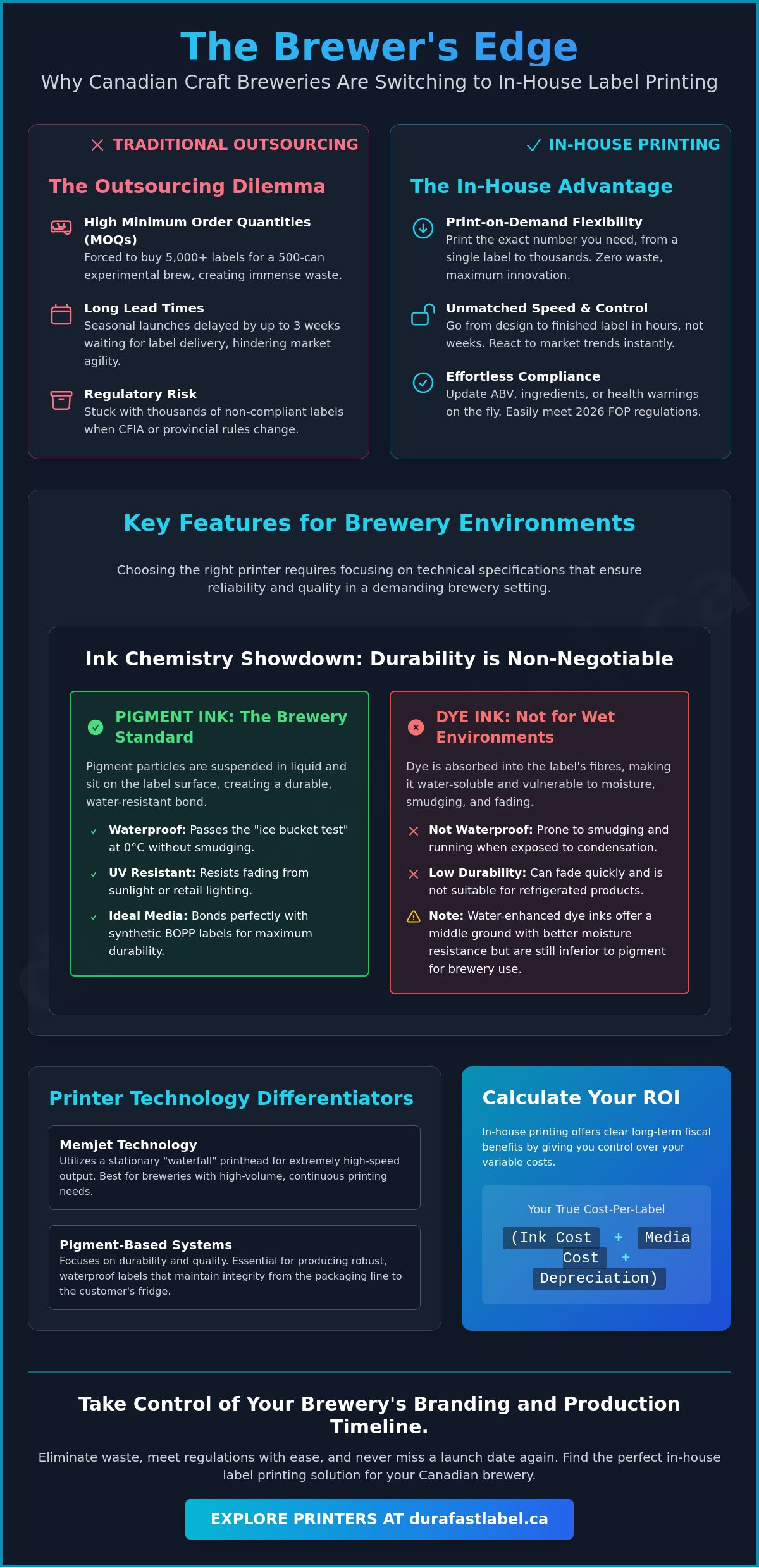
Why are so many Canadian brewmasters moving away from traditional third-party print houses? The answer lies in a fundamental shift toward a decentralized production model. In-house printing means taking the final stage of packaging into your own facility, allowing you to treat label production with the same precision as your fermentation schedule. Looking at the history of craft beer in Canada, we see a trajectory of independence and local control. Modern craft beer label printers Canada provides allow breweries to maintain that independence by removing the middleman from the packaging process.
The traditional outsourcing model is built on high-volume efficiency, which often conflicts with the experimental nature of craft brewing. Outsourcing typically demands a minimum order quantity (MOQ) of 5,000 labels per SKU. If you're brewing a small 600-litre batch of an experimental peach sour, you're forced to pay for thousands of labels that will never see a can. This "waste tax" directly erodes your margins and discourages innovation. By bringing production in-house, you gain the agility to launch a seasonal brew in 24 hours instead of waiting three weeks for a courier to deliver a pallet of pre-printed rolls.
Eliminating the Burden of Minimum Order Quantities
When you're forced to purchase 5,000 labels for a 500-can taproom exclusive, your cost-per-unit skyrockets. This is a hidden drain on Canadian brewery margins that many owners simply accept as a cost of doing business. It isn't. By investing in colour label printers, you gain the freedom to print exactly what you need. This shift also solves the logistical headache of inventory storage. Instead of dedicating valuable square footage to racks of pre-printed labels for twenty different SKUs, you can stock a few rolls of blank labels and use them for any recipe in your rotation. You're no longer paying to store paper; you're printing on demand.
Regulatory Compliance and Label Agility
Canadian labelling laws, governed by the CFIA and provincial boards, are notoriously precise and subject to change. Whether it's the 2026 Front-of-Package nutrition labelling requirements or a sudden change in provincial health warnings, being stuck with ten thousand non-compliant labels is a financial disaster. In-house craft beer label printers Canada breweries utilize allow for instant updates. You can adjust ABV declarations, ingredient lists, or allergen warnings on the fly without scrapping a single cent of inventory. This setup also simplifies variable data printing. You can integrate batch numbers and "canned on" dates directly into the primary label design, ensuring your packaging is as fresh as the liquid inside.
Key Features to Realize When Choosing a Craft Beer Label Printer
How do you distinguish between a printer that looks good on paper and one that survives the humidity of a Canadian brew house? Selecting the right hardware requires looking beyond the initial purchase price and focusing on technical specifications that impact long-term reliability. As highlighted by the Canadian Craft Brewers Association, the economic realities of the industry demand equipment that maximizes resources while maintaining high quality. When evaluating craft beer label printers Canada offers, you must prioritize ink chemistry, throughput speed, and physical media handling to ensure your packaging line remains efficient.
Pigment Ink vs. Dye Ink for Brewery Environments
The most critical decision involves ink chemistry. Pigment ink is generally considered the non-negotiable standard for craft beer. Technically, pigment particles are suspended in a carrier liquid and sit on the surface of the media, typically a synthetic BOPP (Biaxially Oriented Polypropylene). This creates a bond that is naturally resistant to moisture and UV light. Conversely, standard dye ink is absorbed into the media fibres. While dye provides vibrant colours, it is prone to smudging and fading when exposed to condensation or ice buckets. For certain applications, water-enhanced dye inks provide a viable middle ground, offering better moisture resistance than standard dye while maintaining a lower cost-profile for dry-shelf products.
Print Speed and Production Volume Requirements
Your weekly throughput determines whether you need a desktop or industrial model. Print speed is measured in "ips" (inches per second). A printer running at 6 ips is sufficient for small batches, but high-volume flagship brews often require 12 ips to keep pace with canning lines. There is a direct relationship between print resolution, measured in DPI, and production speed; higher resolution settings often slow the ips rate. For breweries requiring maximum throughput without sacrificing quality, high-speed Memjet technology is the gold standard. It utilizes a stationary printhead that spans the width of the web, allowing for rapid, full-colour output that keeps your production schedule on track.
Beyond speed, consider ink tank capacity and media handling. Cartridges with larger "ml" volumes significantly lower your total cost per label by reducing the frequency of replacements and the cost-per-drop of ink. Physical design also plays a role. An internal label unwinder protects the media from environmental debris and dust, which is common in active production facilities. If you have limited space, an internal system is ideal; however, an external unwinder allows for larger label rolls, reducing downtime. If you are unsure which configuration fits your facility, you can speak with our technical team for a specific recommendation based on your floor plan. Balancing these factors ensures you invest in industrial label printers that actually solve your logistical hurdles.
Comparing the Top Craft Beer Label Printers Available in Canada
Selecting the right hardware for your facility requires a clear understanding of how different models handle the specific rigours of a brewery environment. The market for craft beer label printers Canada provides is generally divided into two categories: high-speed Memjet systems and rugged, versatile inkjet models. Choosing between them depends on whether you value raw throughput for flagship products or flexibility for diverse, short-run batches. By analyzing these units through a "baseline and delta" lens, you can identify which technical specifications justify the investment for your specific production volume.
VIPColor VP750: The High-Speed Choice for Flagship Cans
The VIPColor VP750 is designed for breweries that need to move from digital files to thousands of finished cans in a single shift. The main difference between the VIPColor VP700 and the VP750 is the ink chemistry. While the VP700 utilizes standard dye inks, the VP750 uses water-enhanced dye inks. This technical delta is critical for the Canadian market because it allows the labels to resist the condensation and moisture of refrigerated storage. Other than this ink variation, both models share a high-performance 12 ips print speed, allowing you to produce enough labels for a full pallet of beer in minutes. To help you decide, you can explore our full range of colour label printers to see how these speeds impact your bottom line.
Another physical design advantage of the VP750 is its internal label unwinder. Unlike systems with external unwinders, this configuration keeps the media roll enclosed within the printer's chassis. This protects the label stock from environmental debris and dust, which is often prevalent in active production areas. For a deeper look at the entry-level options in this series, read our guide on the VIPColor VP550 Memjet Color Label Printer: The Ultimate Business Guide for 2026.
Afinia L502: The Rugged Solution for Small Batches
If your brewery focuses on frequent, experimental releases, the Afinia L502 serves as an ideal baseline for in-house production. The only difference between the L502 and many industrial competitors is its duo-ink technology. This feature allows you to switch between dye and pigment ink sets by simply changing the printhead and cartridges. You can use dye ink for vibrant taproom posters and pigment ink for "ice bucket ready" can labels. While it operates at a slower ips than the VIPColor series, its industrial build quality is specifically designed to withstand the environmental challenges of a brew house. For nano-breweries, Epson ColorWorks models provide a similar reliable baseline, focusing on consistent pigment output for those who don't require Memjet-level speeds but demand professional durability.
Durability Standards: Ensuring Labels Survive Ice Buckets and Condensation
What happens to your branding when a customer plunges your can into a bucket of ice and water? If you have selected the wrong combination of media and adhesive, the result is often a pulpy, smudged mess that detaches from the container. High-quality craft beer label printers Canada breweries utilize are only half of the equation; the substrate you feed into the machine is equally vital. To maintain a professional image, your labels must survive the "Ice Bucket Challenge," which tests ink stability and adhesion at 0°C. Achieving this requires a technical understanding of synthetic materials and the chemical bond they form with specific ink types.
Choosing the Right Media: BOPP vs. Paper
Using paper labels for craft beer is a fundamental mistake. Paper is an organic fibre that absorbs moisture, leading to "flagging" where the edges curl up, or total disintegration in humid environments. Instead, you should prioritize BOPP (Biaxially Oriented Polypropylene). This plastic-based film is entirely waterproof and resistant to the oils and alcohols often present in production areas. When you shop inkjet-compatible labels for your brewery, you will find three primary variations. White BOPP provides a clean, high-contrast base for vibrant designs. Silver BOPP allows you to create metallic effects without the cost of foil stamping. Clear BOPP is the preferred choice for achieving the "no-label look" on premium glass bottles, making the branding appear as if it were printed directly on the glass.
Adhesives and Cold-Temp Performance
The success of a label often depends on two technical metrics: application temperature and service temperature. Application temperature is the ambient heat required at the moment the label is applied to the can. In many Canadian warehouses, this can be quite low. If you apply a standard adhesive to a cold, wet can during the filling process, it will fail to "wet out" and bond. You need an aggressive, permanent adhesive designed for cold-temp applications. Service temperature refers to the range the label can withstand after the bond has set, typically from -20°C to 80°C for most craft beer environments.
The main difference between a successful label and a failure is how the adhesive interacts with condensation. While section two detailed the benefits of pigment ink, those benefits are only realized when paired with a synthetic substrate. Pigment ink particles lock into the top coat of the BOPP media, ensuring the design does not bleed when the can "sweats" upon removal from a fridge. For extreme durability scenarios, such as long-distance shipping in non-climate-controlled containers, you might consider a label finisher to add a protective laminate. This adds a physical barrier against abrasion and moisture. If you are struggling with labels peeling in your cold room, you can request a media sample kit to test different adhesives on your specific containers before committing to a full order.
Calculating the ROI of In-House Beer Label Production
Does the initial capital expenditure of a digital press outweigh the long-term savings? To answer this, you must look beyond the sticker price and perform a rigorous cost-per-label analysis. While previous sections established the technical superiority of pigment inks and BOPP media, their financial impact is realized through the elimination of the "waste tax" associated with unused outsourced stock. When evaluating craft beer label printers Canada breweries use, your ROI calculation should include three primary variables: ink consumption per ml, media cost per linear foot, and hardware depreciation over a five-year window.
The "Soft ROI" is equally significant. This represents the value of market responsiveness. If a competitor launches a similar seasonal brew, the ability to pivot your branding and hit the shelves in 48 hours provides a competitive edge that is difficult to quantify but vital for growth. By reducing your inventory of pre-printed rolls, you also free up cash flow that was previously tied up in storage. Efficiency in your packaging hall is the ultimate goal.
Software for Professional Label Design
Hardware is only effective if your digital workflow is seamless. Loftware NiceLabel is frequently the preferred choice for Canadian breweries looking to automate their production. The main difference between NiceLabel and basic design tools is its ability to create standardized templates that pull data from your existing spreadsheets. This reduces human error during the labelling process. Other than this, Bartender software remains a powerful alternative, specifically for managing complex variable data like ABV percentages and batch-specific "canned on" dates. If you operate multiple taprooms or production facilities, cloud-based software allows you to centralize your branding, ensuring that a label printed in Halifax matches the one printed in Vancouver perfectly.
Final Checklist for Your Canadian Brewery Setup
Before finalizing your investment, ensure your chosen system can handle your peak production weeks, not just your yearly average. A printer that meets your needs in January may create a bottleneck during the Canada Day long weekend rush. Consider the following components for a complete industrial setup:
-
Consumables Strategy: Maintain a safety stock of high-capacity ml ink cartridges and, if using thermal transfer for secondary packaging, a variety of thermal transfer ribbons.
-
Label Rewinders: For high-speed canning lines, a dedicated label rewinder is essential to create tight, machine-ready rolls.
-
Technical Support: Ensure your vendor understands the specific humidity and temperature challenges of a Canadian brew house.
Transitioning to an in-house model is a strategic move that empowers you to take full control of your brand's physical presence. If you are ready to see the specific numbers for your facility, you can Contact DuraFast Label for a custom ROI analysis and printer recommendation. Our team can help you compare the delta between different craft beer label printers Canada offers to find the exact match for your throughput requirements.
Take Control of Your Brewery’s Packaging Future
Transitioning to in-house production is more than just a cost-saving measure; it's a commitment to operational independence. By selecting the right craft beer label printers Canada offers, you've seen how to bypass restrictive minimum orders and launch seasonal brews with zero lead time. Whether you prioritize the rapid 12 ips output of a VIPColor VP750 or the versatile duo-ink technology of an Afinia L502, the goal remains the same: professional-grade labels that withstand the rigours of Canadian cold storage. You no longer have to let a third-party print schedule dictate your product launch dates.
As an authorized dealer for VIPColor, Afinia, and Epson, we provide the expert guidance needed to navigate moisture-resistant media and pigment ink selections. Our Canadian-based support and shipping ensure your production line remains efficient and your supplies arrive when you need them. If you're ready to stop paying a "waste tax" on unused labels and start printing on demand, we're here to help you build a more agile and profitable business.
**Browse our selection of craft beer label printers and start printing in-house today ** to secure your brewery's competitive edge. We look forward to helping you streamline your operations.
Frequently Asked Questions
What is the best craft beer label printer for a small Canadian brewery?
The Afinia L502 is the most recommended model for small operations due to its industrial build and duo-ink flexibility. It allows you to switch between dye and pigment ink sets depending on whether you're printing taproom menus or can labels. For those starting out, evaluating the best craft beer label printers Canada offers often leads to this model because it balances professional durability with a manageable footprint.
Do in-house printed beer labels really survive ice buckets?
Yes, in-house labels survive ice buckets provided you use pigment-based ink on synthetic BOPP media. Pigment particles create a physical bond with the media's top coat that doesn't dissolve in water. This combination ensures your branding remains intact at 0°C; however, using standard dye ink on paper will result in smudging and label detachment within minutes of immersion.
What is the difference between pigment and dye ink for beer labels?
The main difference is that pigment ink is composed of solid particles that sit on the label surface, while dye ink is a liquid that's absorbed into the material. Pigment ink is the industry standard for durability and moisture resistance. Dye ink offers superior colour vibrancy for dry-shelf products but lacks the longevity required for refrigerated cans or bottles that experience heavy condensation.
How much does it cost to print a beer label in-house?
Your cost-per-label is determined by the specific ink coverage of your design and the volume of your ink cartridges. Larger ml cartridges significantly lower the cost of every drop of ink. While we don't quote fixed prices due to fluctuating media costs, printing in-house typically eliminates the high markup and shipping fees associated with short-run outsourced orders, providing a lower total cost of ownership.
What label design software do most Canadian breweries use?
Most Canadian breweries utilize Loftware NiceLabel or Bartender for their labelling workflows. These platforms allow you to manage a centralized library of templates and automate variable data like batch numbers or ABV percentages. Loftware is particularly effective for multi-location breweries that need to maintain brand consistency across different production facilities while using their craft beer label printers Canada systems.
Can I print on silver or clear labels with a standard inkjet printer?
You can print on silver or clear labels with a standard inkjet printer as long as the media has an inkjet-receptive coating. This coating is essential because ink cannot bond directly to raw metallic or plastic surfaces. Using clear BOPP allows you to achieve a "no-label look" on glass bottles, while silver BOPP provides a metallic finish that mimics expensive foil stamping at a fraction of the cost.
How fast can an industrial label printer produce a batch of 1,000 labels?
An industrial printer running at 12 ips (inches per second) can produce a batch of 1,000 standard 4-inch labels in approximately five to six minutes. This high throughput is achievable with Memjet technology found in models like the VIPColor VP750 . Slower desktop units running at 6 ips will take twice as long, which is still significantly faster than waiting weeks for a third-party print house to ship your order.
Do I need a label finisher or laminator for my beer cans?
You don't strictly need a label finisher for most beer applications if you're using pigment ink on BOPP. However, a finisher or laminator is beneficial if your cans will face heavy abrasion during long-distance transport or if you want to create custom die-cut shapes. Lamination adds a physical barrier that protects the ink from scratches and provides an extra layer of moisture protection for premium flagship products.