Choosing a Jewellery Tag Printer: The Professional Guide for Canadian Retailers
3rd Jun 2026
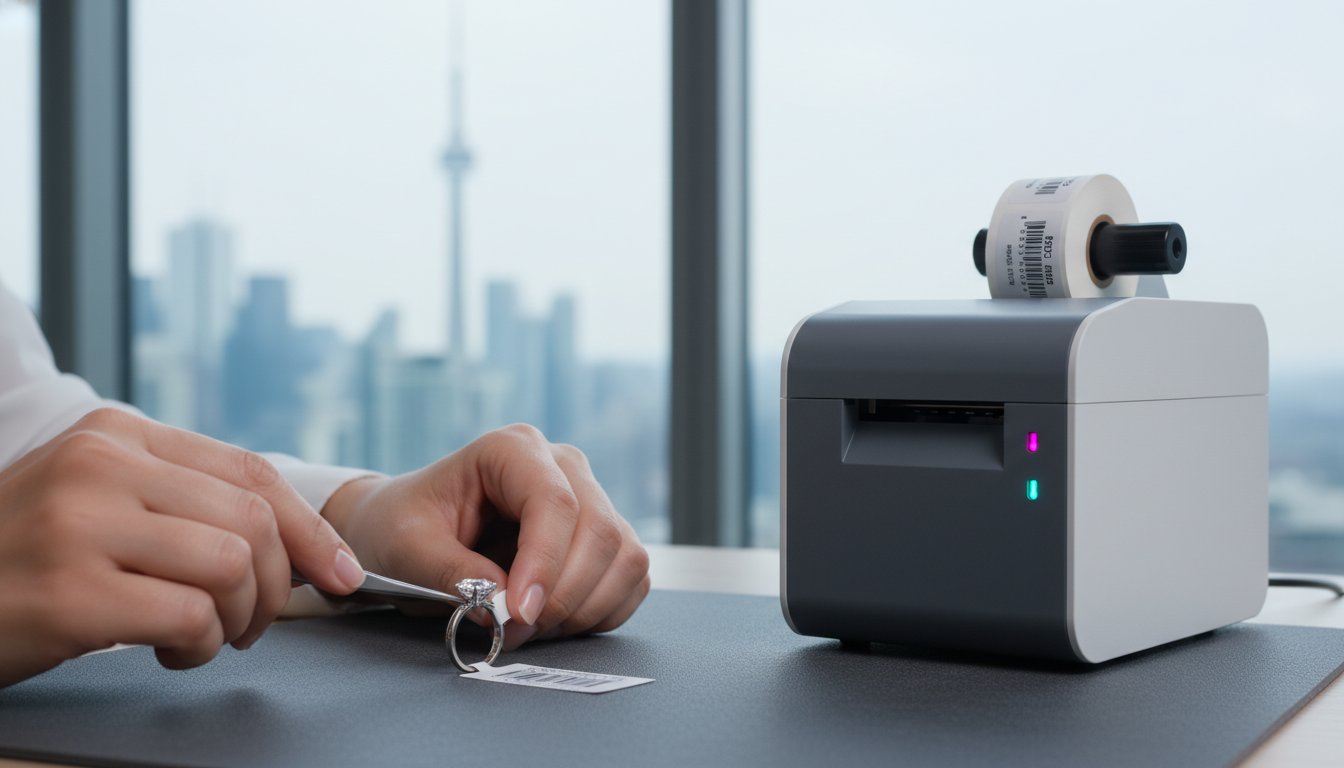
With Canada's online jewellery market projected to reach $3 billion by the end of 2026, the pressure to maintain a professional brand image across every channel is immense. Is your current labelling system helping you scale, or is it holding you back? For many retailers, choosing a jewellery tag printer is a critical decision that directly impacts both brand perception and inventory accuracy. You've likely experienced the frustration of tags fading after an ultrasonic bath or the struggle to align text on tiny barbell labels. These logistical hurdles can lead to costly inventory errors and a diminished customer experience.
It's a common challenge, but your labels shouldn't be the weakest link in your business. We believe that your in-house printing should be as polished and reliable as the pieces in your display cases. This guide will show you how to select the perfect jewellery tag printer to enhance your brand, secure your inventory, and streamline your operations. We'll explore the essential features required for durability and professional aesthetics, giving you the confidence to take full control of your production process.
Key Takeaways
- Realize why durability is essential for labels that must survive oils, perfumes, and intensive ultrasonic cleaning without fading.
- Understand the strategic trade-offs when choosing a jewellery tag printer, comparing industrial thermal transfer reliability with the vibrant branding of colour inkjet technology.
- Identify why 300 DPI resolution and precision sensors are critical for maintaining legibility on tiny rat-tail and barbell tags.
- Scale your operations accurately by selecting hardware that aligns with your daily print volume and physical workspace requirements.
- Maximize your efficiency by using professional tools like Bartender software and label rewinders to automate data entry and organize large inventory batches.
Understanding the Unique Challenges of Jewellery Tagging
Jewellery retail is an environment where the smallest details dictate the perceived value of a luxury item. While a standard label might work for a generic cardboard box, it fails when attached to a 14k gold necklace or a precision-cut gemstone. The primary hurdle in choosing a jewellery tag printer is finding a solution that balances microscopic physical dimensions with high-density information requirements. You need to fit a barcode, price, and quality mark on a surface area that's often less than two centimetres wide. This isn't just about aesthetics; it's about ensuring your inventory remains scannable and compliant with Canadian precious metal marking standards. For instance, items marked as "gold" must meet the minimum 9-karat quality requirement, and your tags must carry this data clearly to remain professional and transparent with your clientele.
The Aesthetic Impact of Professional Tags
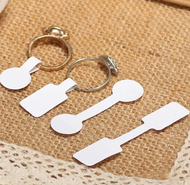
How does a tag influence a customer's decision? A crisp, perfectly aligned label suggests that the retailer cares about every facet of their business. In the luxury market, brand storytelling is only as strong as its weakest touchpoint. If a tag is smudged or crooked, it creates a subtle dissonance with the brilliance of the gemstones it accompanies. Using professional jewellery and ring labels ensures that the edges remain clean and the text stays sharp, reinforcing the quality of the piece. It turns a simple price marker into a silent ambassador for your brand's commitment to excellence. We've seen how a well-designed tag can elevate a boutique's display from standard retail to a high-end experience simply by maintaining visual consistency across every tray.
Durability Requirements: Ultrasonic and Chemical Resistance
Durability in this industry isn't just about surviving a shipping box. It's about surviving the showroom floor and the maintenance bench. Jewellery is frequently handled, exposing tags to skin oils, lotions, and perfumes that can dissolve standard inks. Even more challenging is the intensive cleaning process. Many Canadian retailers use ultrasonic cleaners to maintain the sparkle of their inventory. If you use the wrong printing technology, a single dip in a cleaning solution can leave you with a blank, unreadable tag. This is where Thermal-transfer printing becomes a vital asset for your store.
By using a resin-based ribbon that bonds with specialized synthetic materials, you create a label that is virtually archival. It resists chemicals, heat, and friction, ensuring your barcodes remain scannable even after years of display. Choosing a jewellery tag printer that handles these specific environmental stressors is the first step toward a more efficient, professional operation. In-house production also offers the agility to print exactly what you need. Whether you are adjusting prices for fluctuating gold markets or creating custom promotional tags for a seasonal sale, having the right equipment on-site prevents delays and eliminates the high costs of pre-printed inventory. It empowers you to manage your stock with the same precision you use to grade your diamonds.
Choosing Between Thermal Transfer and Colour Inkjet Technology
Determining the right technology for your store involves balancing high-volume utility with luxury aesthetics. For most Canadian retailers, the decision when choosing a jewellery tag printer comes down to two distinct paths: the industrial reliability of thermal transfer or the vibrant versatility of colour inkjet. Each serves a specific strategic purpose, and your choice should align with how you want your brand to be perceived at the point of sale.
Thermal Transfer: The Durable Workhorse
Thermal transfer remains the industry standard for a reason. This process involves a precision printhead melting resin-based ribbons directly onto synthetic thermal transfer labels. This bond is incredibly durable. It ensures that barcodes remain scannable for years, even after repeated handling or exposure to cleaning chemicals. If your primary goal is inventory security and strict adherence to global barcode standards, this is your reliable workhorse. The monochrome output is sharp, professional, and widely available across Canada in various tag shapes.
Colour Inkjet: Elevating the Boutique Experience
Boutique branding is undergoing a revolution thanks to modern colour label printers. High-end brands like VIPColor utilize Memjet technology to produce high-speed, high-resolution output on a tiny scale. Why settle for plain black and white when you can print seasonal logos or colour-coded pricing for specific collections? Using pigment-based inks provides the moisture and fade resistance necessary to keep your branding looking fresh under bright showroom lights. It allows you to create a cohesive luxury experience that starts the moment a customer picks up a piece of jewellery.
We generally advise against direct thermal printers for this specific application. Since direct thermal stock reacts to heat and light, tags can quickly darken or fade when placed under halogen display lamps or near sunny windows. It’s an unnecessary risk that can lead to unreadable prices and a frustrated sales team. Instead, focus on technologies that guarantee longevity and clarity.
Beyond the initial hardware investment, always evaluate the total cost of ownership. This includes the ongoing expense of ribbons, ink cartridges, and specialized label stock. A printer that seems affordable upfront might have higher consumable costs over its lifespan, especially if you have high inventory turnover. If you're unsure which technology fits your specific volume and branding goals, reach out to our team for a tailored recommendation that prioritizes your long-term efficiency.
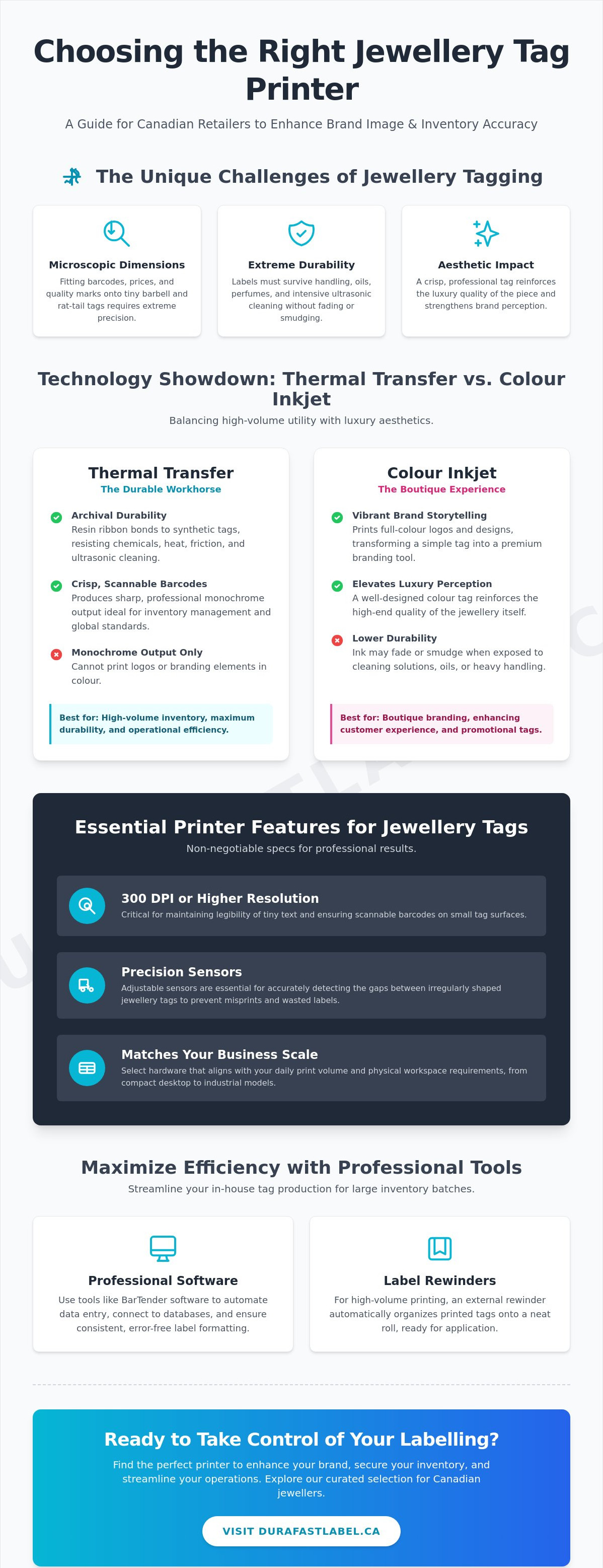
Essential Features to Look for in a Jewellery Tag Printer
What specific technical capabilities transform a standard label maker into a professional asset for your storefront? When choosing a jewellery tag printer, you must look beyond the basic spec sheet and focus on the mechanical precision required for high-value retail. Because jewellery tags are among the smallest labels in any industry, the margin for error is nearly non-existent. A printer that lacks the right sensor technology or resolution won't just produce poor results; it will actively disrupt your workflow through wasted materials and unreadable data.
High DPI: Why Resolution Matters for Micro-Barcodes
Standard 203 DPI (dots per inch) printers are the workhorses of shipping docks, but they often falter in the boutique. When you're printing on a surface only 2mm tall, a lower resolution can result in blurry edges and "filled-in" barcodes that your scanner simply won't recognize. We recommend a minimum of 300 DPI, or even 600 DPI for ultra-fine details. This level of clarity is essential for "micro-printing" critical material specifications. Precision is paramount when you're ensuring your labels comply with the Precious Metals Marking Act. High-resolution printing allows you to fit quality marks, like "14k Gold" or "Sterling Silver," alongside a scannable barcode without sacrificing legibility.
Calibration and Sensor Accuracy for Unique Shapes
Jewellery tagging involves working with irregular shapes, such as rat-tail or barbell designs. These tags often feature narrow bridges or transparent sections that confuse standard fixed sensors. A professional printer should feature adjustable "gap" or "black mark" sensors that can be positioned to find the exact start of each label. This prevents the printer from skipping tags or misaligning the text, which is a common source of frustration. Reliable feed control is particularly important when using specialized jewellery and ring labels, as it ensures every print job starts and ends exactly where it should, reducing expensive media waste.
RFID Integration for Premium Inventory Security
For retailers managing high-value collections, security and efficiency are top priorities. Modern RFID labels are changing the way Canadian jewellers conduct stock-taking. Instead of scanning every ring individually, an RFID-enabled printer allows you to encode a tiny chip inside the tag while simultaneously printing the visual information. This technology enables you to take a full inventory of a display case in seconds without ever opening the glass. It adds a layer of invisible security and operational speed that traditional barcodes can't match, making it a strategic choice for businesses looking to modernize their inventory management.
Finally, consider how the printer fits into your existing environment. Connectivity options like Ethernet or Wi-Fi are vital for integrating the device into your retail POS system, allowing you to print tags directly from your sales counter or back office. Look for models that prioritize ease of maintenance, such as those with user-replaceable thermal printheads. The ability to swap a printhead in seconds ensures your labelling operations never grind to a halt during your busiest sales seasons.
Matching Your Printer to Your Canadian Business Scale
Does your boutique process ten items a day or ten thousand? Choosing a jewellery tag printer requires an honest assessment of your current output and your three-year growth plan. A device that struggles to keep up with your pace will become a bottleneck, while an over-powered machine might occupy valuable counter space that could be better used for customer consultations. Beyond the hardware, you must ensure you have a steady supply of thermal ribbons and labels within Canada to avoid cross-border shipping delays or unexpected customs fees.
Desktop Solutions for Independent Artisans
For many local boutiques and independent makers, space is at a premium. Compact models like the Zebra ZD series provide a small footprint that fits neatly on a retail counter or a small back-office desk. These machines are designed for ease of use, allowing staff who aren't technical labelling experts to produce professional results with minimal training. They offer high-resolution quality at an accessible price point, making them an ideal entry point for businesses focusing on wearable, versatile pieces and curated collections. Since these models are often quieter and more aesthetically pleasing, they don't feel out of place in a refined retail environment.
Industrial Workhorses for Manufacturers
If your operation involves mass production or high-volume national distribution, industrial label printers are the standard. These metal-framed machines are built for longevity in environments where durability is paramount. They feature significantly larger roll capacities, which means your team spends less time reloading media and more time on high-speed production. This efficiency is vital when you're preparing thousands of tags for a new product launch or seasonal inventory update. The robust internal components are designed to handle the friction of resin ribbons and synthetic tags without frequent maintenance breaks.
Portability is another factor to consider for the modern Canadian retailer. If you frequently attend trade shows or pop-up markets in different provinces, a lightweight desktop model provides the flexibility to print custom price tags on the fly. This agility allows you to respond to market trends or local demand instantly. Regardless of your scale, having access to local technical support ensures that any operational hurdles are resolved quickly. If you're ready to find the right equipment to match your specific business volume, contact our team for a personalized consultation today. We can help you weigh the benefits of footprint versus throughput to ensure your investment delivers long-term value.
Maximizing Efficiency with In-House Tag Production
How do you ensure your newly acquired hardware reaches its full potential within your daily operations? Choosing a jewellery tag printer is only the first step toward operational excellence. To truly realize the benefits of in-house production, you must look at the ecosystem surrounding the device. By integrating professional software and the right accessories, you transform a simple printing task into a streamlined, error-proof workflow that protects your brand and your bottom line. We believe that efficiency is found in the details of how you manage your data and your materials.
Software and Automation: Reducing Human Error
Manual data entry is the enemy of inventory accuracy. If your staff is re-typing prices and SKU numbers for every batch of tags, mistakes are inevitable. We recommend integrating professional label software like Bartender to automate this process. By linking your printer directly to your inventory database, you ensure that the information on the tag always matches your system records. This connection prevents costly pricing discrepancies and simplifies the task of updating labels when metal market prices shift. Additionally, using "lockable" templates allows you to maintain strict brand consistency across multiple boutique locations. It ensures that every tag, regardless of who prints it, meets your exact standards for alignment and font usage. Pairing this with a barcode scanner for immediate post-print verification ensures that every label leaving your back-office is perfectly readable.
The Long-Term Value of Canadian-Based Support
Sourcing your equipment and consumables from a Canadian provider offers significant fiscal and logistical advantages. When you partner with DuraFast Label Company Canada, you avoid the unpredictable nature of customs delays and the volatility of currency fluctuations that come with cross-border ordering. Maintaining a consistent supply of brand-specific consumables, such as high-quality thermal ribbons, is essential to prevent production downtime during peak seasons like the winter holidays or wedding months. Leverage DuraFast Label Company Canada’s expertise to optimize your specific jewellery workflow and resolve technical hurdles before they impact your sales floor.
For retailers looking to push their branding even further, the VIPColor VP550 represents a premium colour solution that brings boutique-level aesthetics directly to your workbench. To keep these high-speed operations organized, we suggest using label rewinders. These accessories neatly collect printed tags into manageable rolls, making them easy to store or transport to the showroom floor. By combining high-performance hardware with smart automation and local expertise, you empower your business to handle growth with confidence and professional precision.
Elevating Your Boutique with Precision Labelling
Selecting the right hardware is about more than just printing prices; it's about securing your inventory and reinforcing your brand's luxury status. Whether you prioritize the industrial durability of thermal transfer or the vibrant seasonal branding of colour inkjet, your choice will dictate your operational efficiency for years to come. High-resolution output and precision sensors ensure that your tags remain professional, legible, and compliant with Canadian standards. When you're choosing a jewellery tag printer, focusing on technical specs like DPI and sensor accuracy prevents wasted media and unreadable barcodes.
As an authorized dealer for industry leaders like Zebra, VIPColor, and Afinia, DuraFast Label Company Canada provides the specialized jewellery label stock and local expertise you need to succeed. We maintain a full inventory of ribbons and synthetic tags right here in Canada to ensure your production never slows down due to customs delays. Our team acts as a strategic partner, helping you implement a labelling system that grows with your business while maintaining the highest aesthetic standards. Find the Perfect Jewellery Tag Printer at DuraFast Label Company Canada to streamline your workflow and enhance your presentation today. We look forward to supporting your long-term success.
Frequently Asked Questions
What is the best resolution for a jewellery tag printer?
A minimum resolution of 300 DPI is essential for professional jewellery tagging, though 600 DPI is preferred for ultra-fine details. Standard 203 DPI printers often produce fuzzy barcodes on tiny tags, which leads to scanning failures at the POS. High-resolution output ensures that even 2mm tall text remains crisp and legible, which is critical for meeting Canadian marking regulations and maintaining a luxury brand image.
Can I print on both sides of a jewellery tag?
You can certainly print on both sides of a jewellery tag by utilizing fold-over designs like barbell or rat-tail labels. These tags are engineered with two printable areas that fold together, effectively doubling your available space for branding and technical data. This layout allows you to display your logo on one side while keeping prices and barcodes on the other, ensuring a clean and organized presentation.
Do I need special ink for labels that go in an ultrasonic cleaner?
To survive the intensive cleaning of an ultrasonic bath, you must use resin-based thermal transfer ribbons or pigment-based inkjet inks. Standard dye-based inks will dissolve or smudge when exposed to cleaning chemicals and vibrations. Pairing these durable inks with synthetic label stock creates a permanent bond that remains archival for years, which is a key factor when choosing a jewellery tag printer for a high-end boutique.
What is the difference between rat-tail and barbell jewellery tags?
Rat-tail tags feature a long, non-adhesive tail that loops around rings or bracelets, whereas barbell tags have two printable wings connected by a narrow bridge. Barbells are often preferred for rings because they sit more flush against the band and offer a symmetrical look. Rat-tails provide more flexibility for thicker items like heavy chains or watches where a longer loop is necessary for a secure fit.
Can I use a standard inkjet printer for jewellery labels?
Standard home or office inkjet printers are not suitable for jewellery labels because they cannot handle synthetic media or provide smudge-proof results. These consumer devices typically use dye-based inks that bleed on the specialized materials required for durability. Choosing a jewellery tag printer designed specifically for the industry ensures you have the precision sensors and specialized ink chemistry needed to produce professional, long-lasting tags.
How does RFID technology help with jewellery inventory?
RFID technology enables you to conduct a full inventory of your display cases in seconds without ever opening the glass. By encoding a tiny chip within the tag, you can use a handheld reader to capture hundreds of items simultaneously. This significantly reduces the time spent on daily stock-taking and provides an extra layer of security for high-value collections that are frequently handled by staff and customers.
What software is recommended for designing jewellery tags?
We recommend professional labelling software like Bartender or Loftware NiceLabel for designing your jewellery tags. These platforms allow you to create precise templates that align perfectly with tiny tag dimensions and irregular shapes. More importantly, they enable you to link your printer to your existing inventory database, which automates the population of prices and descriptions to eliminate human entry errors across your storefront.
Are there weatherproof tags for outdoor jewellery displays?
Weatherproof tags are available in materials like polylith or Tyvek, which are ideal for outdoor displays or items stored in high-humidity environments. These synthetic materials resist UV fading, moisture, and tearing, ensuring your branding remains intact even under harsh showroom lights or at outdoor pop-up markets. Using thermal transfer technology with these materials provides the highest level of environmental resistance for your long-term inventory needs.