Buyer’s Guide to Premium Wax Ribbon Rolls in Canada (2026)
22nd Sep 2026
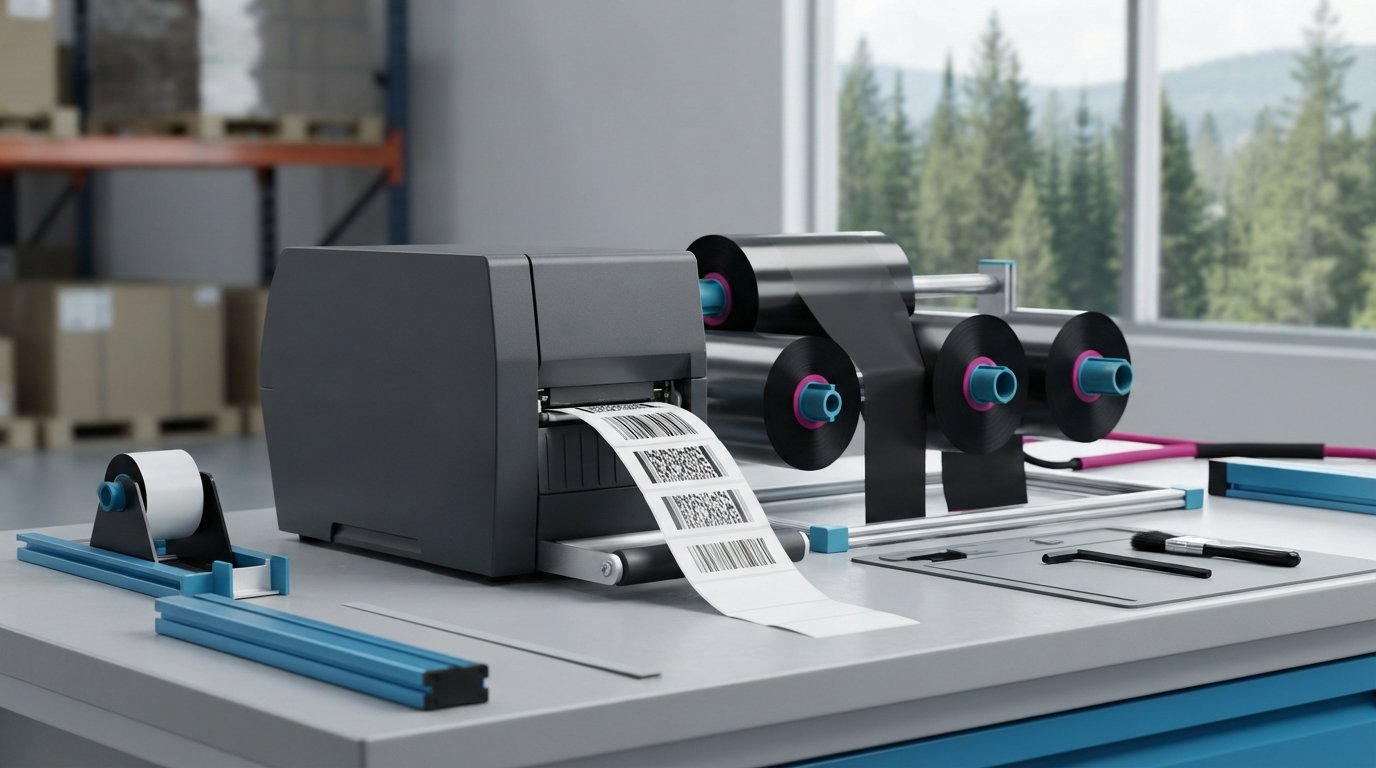
Upgrading to expensive wax-resin ribbons isn't always the smartest fix for unreadable shipping barcodes. For high-volume distribution centres, investing in reliable premium wax ribbon rolls Canada logistics hubs depend on bridges the performance gap between fragile economy wax and costly specialty formulations. You already know the operational headache of scuffed labels causing scanning failures during transit, abrasive low-grade ribbons wearing out thermal printheads prematurely, and unpredictable cross-border delivery delays that disrupt warehouse schedules.
Fortunately, maintaining scan compliance at rapid sorting speeds doesn't require overspending on industrial consumables. In this guide, you'll discover how to select the ideal premium wax ribbon rolls for your thermal transfer printers across Canadian warehousing and logistics facilities. We examine how resin-enhanced formulations provide durable, high-contrast printing, clarify coated side out (CSO) versus coated side in (CSI) printer configurations, and detail how consistent nationwide supply keeps your packaging lines running efficiently.
Key Takeaways
- Learn how resin-enhanced wax formulations deliver crisp barcode edge acuity and scuff resistance without the higher cost of wax-resin alternatives.
- Ensure seamless printer operation by matching your specific hardware to the correct core size and coated side out (CSO) or coated side in (CSI) winding direction.
- Identify the ideal paper substrates, from uncoated vellum to semi-gloss stocks, that maximize ink transfer and scanning readability at high sorting speeds.
- Discover how backcoated antistatic ribbons shield delicate thermal printheads from friction, dramatically reducing premature equipment wear.
- Sourcing premium wax ribbon rolls Canada operations depend on from a dedicated nationwide supplier eliminates cross-border delivery delays and unexpected customs fees.
What Distinguishes Premium Wax Ribbon Rolls from Standard Formulations?
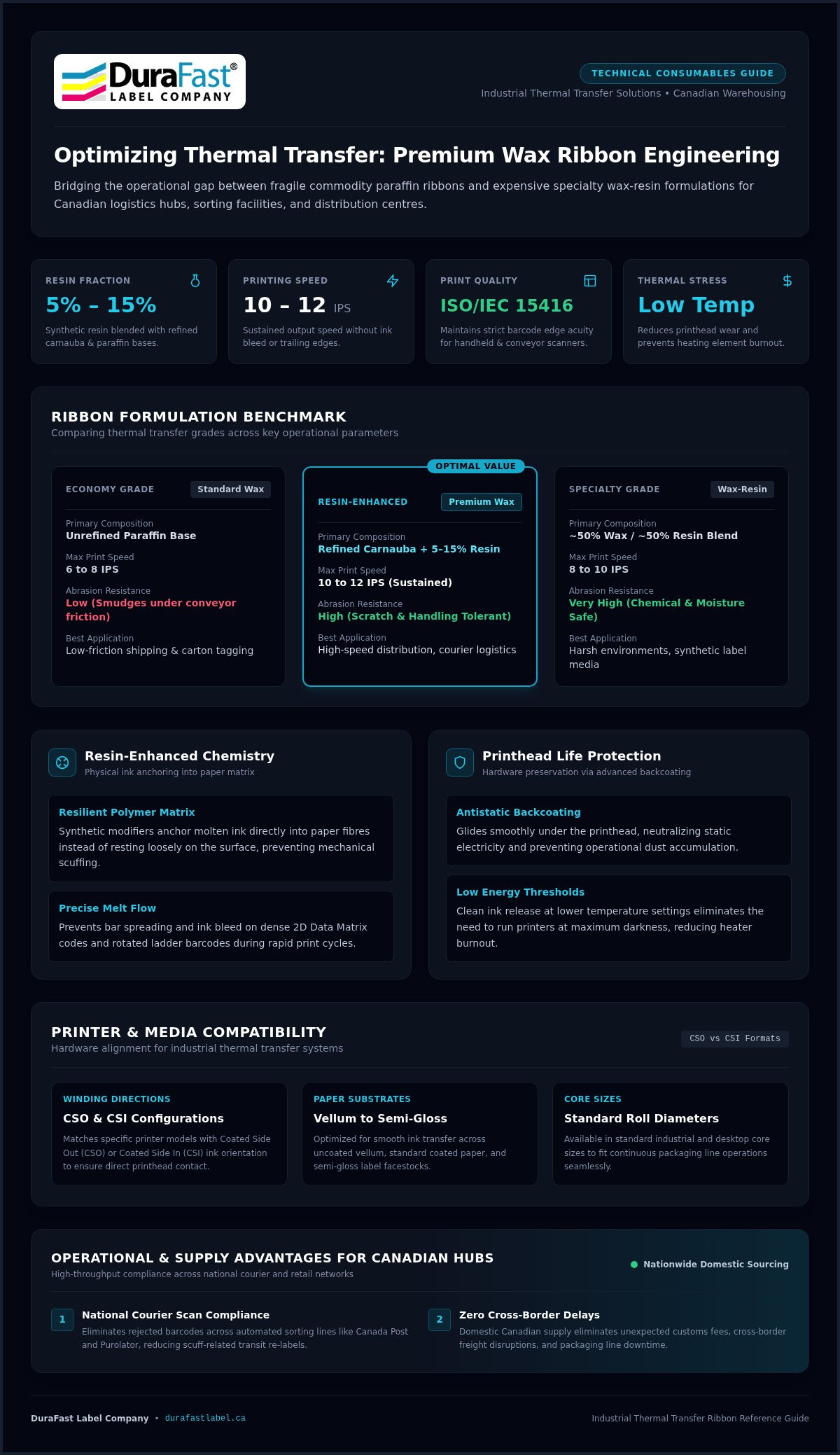
Why do standard wax ribbons often fail on modern, automated packing lines? Traditional commodity ribbons rely almost entirely on unrefined paraffin wax. While paraffin melts easily, it yields soft, fragile print images prone to smudging under friction. In contrast, premium wax represents a resin-enhanced thermal transfer formulation that incorporates proprietary synthetic modifiers. By blending a controlled resin fraction (typically 5% to 15%) into refined carnauba and paraffin bases, these ribbons provide significantly higher optical density, intense blackness, and sharp edge acuity.
During the thermal-transfer printing process, tiny heating elements on the printhead melt the formulation onto passing label stock. Because premium wax melts at low temperatures, it doesn't force operators to push printer darkness settings to their maximum limits. This efficient heat response lowers mechanical and thermal stress across the print mechanism, ensuring high-speed output without compromising print clarity. For logistics operations investing in premium wax ribbon rolls Canada wide, this chemical balance prevents unreadable shipping barcodes while maintaining dependable supply chain throughput.
The Chemistry of Resin-Enhanced Wax
Synthetic resin modifiers fundamentally transform how molten ink anchors to paper fibers. Rather than resting loosely on the surface, the resin binds the wax structure into a resilient matrix that resists mechanical abrasion and handling scuffs. This precise melt flow delivers exceptional line definition, which is vital when printing compact 2D Data Matrix codes or rotated ladder barcodes. Warehouses can safely run industrial printers at sustained speeds of 10 to 12 inches per second (ips) without experiencing ink bleed or bar spreading.
Printhead Protection and Heat Management
Operating thermal printheads at excessive darkness levels drastically accelerates heating element burnout. Premium wax formulations preserve hardware by transferring cleanly at low energy thresholds. Additionally, quality rolls incorporate an advanced antistatic backcoating that glides smoothly beneath the printhead. This layer neutralizes static electricity and prevents dust accumulation, keeping printheads clean. To learn more about preserving your hardware, review our guide to thermal printhead lifespan strategies.
Premium Wax vs. Standard Wax vs. Wax-Resin: Choosing the Right Grade
How do you know if your operation is overpaying for ribbon durability it doesn't actually need? Selecting thermal consumables often feels like a trade-off between fragile economy prints and premium-priced synthetic formulations. While economy wax handles simple dust jackets or indoor retail shelf tags, automated handling systems quickly abrade unenhanced wax. Premium wax fills this gap perfectly. By adding a targeted resin component, it delivers near-wax-resin sharpness on standard paper facestocks without forcing your facility into a higher pricing tier.
Sourcing premium wax ribbon rolls Canada wide allows high-throughput distribution hubs to lower total cost per print significantly. Standardizing on resin-enhanced wax ensures reliable read rates through national courier sorting networks like Canada Post and Purolator, all while avoiding the budget strain of unnecessary specialty ribbons.
Performance Benchmarks Across Ribbon Formulations
Thermal formulations behave quite differently under physical stress:
- Standard Wax: Best suited for low-friction shipping and general carton tagging. Running standard wax over 6 to 8 ips often causes trailing edges, and labels readily smear under parcel conveyor friction.
- Premium Wax: Engineered for sustained output speeds up to 10 or 12 ips. It offers excellent scratch tolerance and maintains optical density to meet the strict ISO/IEC 15416 barcode print quality standard on handheld scanners.
- Wax-Resin: Formulated with roughly equal parts wax and resin to resist moisture, moderate chemical exposure, and persistent surface rubbing.
When to Step Up to Wax-Resin or Full Resin
Standard paper media rarely warrants the expense of pure resin formulations. You should only step up to intermediate wax-resin or full-resin formulations when your operational environment exceeds the limits of paper. These boundary conditions include outdoor exposure, cold-storage condensation, industrial solvents, or slick synthetic face stocks like polypropylene. For a deeper breakdown of matching synthetic media with specialized films, review our comprehensive Canadian thermal transfer ribbon guide.
If you're re-evaluating your warehouse workflows or suspect you're overpaying for specialty formulations on everyday corrugated cartons, feel free to connect with our technical team for tailored advice on optimizing your print setup.
Printer Compatibility: Matching Roll Dimensions, Cores, and Winding
Few warehouse setbacks cause more immediate downtime than loading a fresh ribbon roll only to find it won't transfer ink onto your label. Avoiding mechanical jams and unreadable print requires matching ribbon physical specifications directly to your printer hardware. Ensuring that product identifiers remain legible across Canadian supply chains supports mandatory compliance under the federal Consumer Packaging and Labelling Act, making hardware compatibility an operational necessity rather than a minor detail.
When ordering premium wax ribbon rolls Canada facilities rely on, follow four critical sizing parameters:
- Verify winding orientation: Confirm whether your printer requires ink coated on the outside or inside of the film carrier.
- Match inner core dimensions: Align 0.5-inch desktop cores or 1-inch industrial spindle configurations accurately.
- Size ribbon width past label backing: Select a ribbon roughly 4 to 6 mm wider than the backing liner to shield your rubber platen roller from bare paper friction.
- Maximize roll length: Choose the largest roll diameter your printer chamber supports to eliminate frequent, mid-shift roll changes.
Coated Side Out (CSO) vs. Coated Side In (CSI)
Thermal printers route ribbons differently depending on the chassis design. Zebra, TSC, and Godex hardware typically require Coated Side Out (CSO) rolls, where the ink layer faces away from the core. Conversely, legacy Datamax and SATO equipment often utilize Coated Side In (CSI) configurations. If you aren't sure which style you have on hand, perform a simple tape test: press a piece of standard adhesive tape against the ribbon face and peel it away. If black ink pulls onto the tape, that surface is the coated side.
Desktop vs. Industrial Roll Capacities
Desktop thermal printers utilize compact 0.5-inch (12.7 mm) notched cardboard or plastic cores holding ribbon lengths between 74 metres and 110 metres. While compact, these shorter lengths suit moderate packing benches. Heavy distribution environments instead run rugged 1-inch (25.4 mm) cores with high-capacity 300-metre or 450-metre rolls. If your facility handles thousands of cartons per shift, pairing long-run consumables with dedicated high-volume industrial label printers ensures steady throughput without stopping assembly lines for constant changeovers.
Substrate Compatibility: Pairing Premium Wax with the Correct Label Media
Even the finest ribbon cannot perform if it isn't matched to an appropriate label facestock. Premium wax relies on the microscopic porosity of paper fibres to form an enduring physical bond. When ink transfers onto paper, the molten resin-wax blend penetrates the porous surface, locking securely in place as it solidifies. Non-porous synthetic films like polypropylene, polyester, and vinyl lack this fibrous structure. Because wax cannot cross-link or bite into slick synthetic polymers, attempting to run premium wax on poly films results in immediate flaking and complete ink wipe-off.
For operations distributing goods across Canada, utilizing high-grade premium wax ribbon rolls Canada wide ensures clean, dark transfers on paper substrates ranging from rough vellum to flood-coated colour labels used for zone-picking and inventory segregation.
Optimising Output on Uncoated and Coated Papers
Paper smoothness directly governs how crisp your barcode edges appear under an optical scanner. Uncoated vellum stocks offer superior mechanical anchorage, absorbing the molten blend deeply for exceptional durability. Super-calendered semi-gloss papers, by contrast, feature clay coatings that keep the ink closer to the surface. Printing on semi-gloss demands slightly higher head temperature and precise tension to prevent ribbon slippage, but it yields razor-sharp edge contrast. You can explore fully tested, matched paper media across our certified thermal transfer label stocks.
Logistics, Shipping, and Retail Applications
Resin-enhanced wax serves as the primary workhorse across several demanding distribution environments:
- Outbound parcel shipping: Standard logistics carton labels withstand high-speed sorting conveyors, parcel drop chutes, and rough trailer rides across national carrier networks.
- Retail and warehouse racking: Long-term shelf-edge tags, bin location markers, and pallet routing slips maintain high scanning accuracy over extended inventory cycles.
- Cold-storage warehousing: Dry winter conditions and refrigerated staging areas often make standard wax fragile and chalky. Premium wax retains structural elasticity in chilled facilities, resisting flaking during cross-dock transfers. Keep in mind that ribbon rolls stored in unheated Canadian staging bays should condition at room temperature for 24 hours prior to loading.
Need assistance verifying substrate compatibility before placing a volume order? Contact our media specialists today to request sample test rolls tailored to your specific label materials.
Sourcing Premium Wax Ribbon Rolls in Canada: Operational and Supply Advantages
Why let cross-border supply chains complicate your essential warehouse consumables? Ordering thermal transfer supplies from foreign vendors regularly introduces customs delays, currency fluctuations, and surprise brokerage fees on arrival. Sourcing premium wax ribbon rolls Canada wide through an established domestic distributor eliminates these border bottlenecks completely. You receive predictable billing in Canadian currency alongside transparent transit times that keep fulfillment schedules intact.
Beyond simplified logistics, domestic sourcing ensures strict batch-to-batch formulation consistency. Sourcing through random third-party marketplace sellers often results in mixed production lots with varying ink melt points. When ribbon chemistry changes unexpectedly, your floor technicians must constantly recalibrate printer heat and darkness settings to avoid faint or blurred barcodes. A dependable domestic supplier provides uniform coatings across every carton, maintaining standardized printer profiles year-round.
National Distribution and Supply Chain Predictability
Canadian logistics operations need dependable replenishment across every province, especially during intense fourth-quarter peak shipping volumes. Partnering with a nationwide distributor ensures strategic inventory buffering, shielding your facility from material shortages when parcel volumes spike. Accessing an extensive domestic catalogue of high-yield thermal transfer ribbons means your shipping docks maintain a continuous stock of compatible rolls without requiring massive on-site storage footprints.
Technical Consultation and Media Validation
Modern distribution centres frequently operate mixed equipment fleets containing thermal printers from brands like Zebra, Honeywell, Datamax, SATO, and Godex. Determining optimal ribbon grades and precise roll dimensions across diverse machine models can challenge even experienced floor managers. Rather than guessing and risking downtime, you can leverage expert technical evaluation to validate your specific media pairings before committing to bulk case purchases.
Validating ribbons against your exact paper stocks guarantees ANSI-grade barcode legibility under automated sortation scanners. If you're managing multi-brand printer fleets or optimizing label durability across high-speed packaging lines, request expert media consultation to secure matched samples and technical recommendations for your facility.
Elevate Your Facility's Throughput with Dependable Thermal Media
Securing clear, scuff-resistant barcode printing doesn't mean stretching your operating budget on specialty resins. By choosing resin-enhanced wax formulations, your warehouse achieves crisp edge acuity at lower printhead temperatures, safeguarding heating elements from premature burnout. Matching your printer hardware with the proper core dimensions and winding direction ensures your packing benches stay productive across every shift.
Reliable logistics depend on a stable supply chain. Partnering with a dedicated domestic distributor gives you direct access to premium wax ribbon rolls Canada distribution centres count on, backed by comprehensive nationwide stock holding and broad compatibility across all major industrial printer architectures. If you're ready to eliminate cross-border shipping friction, verify paper substrate compatibility, and maintain rigorous scan compliance, connect with our Canadian labelling specialists to find your ideal ribbon match. Taking control of your packaging operations starts with running the right media across your lines.
Frequently Asked Questions
What makes a wax ribbon "premium" compared to standard economy wax rolls?
Premium wax blends proprietary synthetic resin modifiers into refined carnauba and paraffin waxes rather than relying on pure paraffin. This chemical addition enhances optical density, sharpens barcode edge definition, and provides superior mechanical scratch resistance. Because the formulation melts cleanly at lower print temperatures, it achieves rich black scans at high operational speeds without straining your thermal printhead heating elements.
Can I use premium wax ribbons on synthetic polypropylene or polyester labels?
No, premium wax formulations aren't suitable for non-porous synthetic film substrates like polypropylene or polyester. Wax chemistry relies on the natural absorption of porous paper fibres to anchor securely. On smooth synthetic films, molten wax cannot penetrate the plastic barrier, resulting in immediate flaking, smudging, or total wipe-off. Synthetic labels require intermediate wax-resin or full-resin ribbons to guarantee chemical adhesion.
How do I know if my thermal printer requires coated side out or coated side in ribbon?
You can identify whether your printer requires Coated Side Out (CSO) or Coated Side In (CSI) ribbon by testing the roll with regular adhesive tape. Press a piece of standard sticky tape against the outer surface of your ribbon roll and peel it away. If black ink pulls onto the tape, it's CSO; if no ink transfers, the coated surface faces inward (CSI). Most Zebra and Godex units use CSO, whereas legacy SATO models often require CSI.
Will switching to premium wax ribbons require adjusting my thermal printer dark settings?
Yes, you'll typically need to decrease your printer's darkness or heat settings when switching to premium wax. Because resin-enhanced wax melts cleanly at lower energy thresholds than commodity alternatives, keeping darkness set too high can cause ink bleed, fuzzy barcode lines, or premature burn lines across heating elements. Dialling back darkness saves energy while preserving sharp line edges and extending thermal printhead service life.
What core size do I need when ordering wax ribbons for desktop label printers?
Desktop thermal transfer printers almost universally require ribbon rolls mounted on 0.5-inch (12.7 mm) inner cores. These rolls typically feature notched ends that lock into compact spindle mechanisms, supporting lengths between 74 metres and 110 metres. Industrial floor models, by contrast, use standard 1-inch (25.4 mm) cores. Always double-check your machine manual or spindle width before ordering to prevent fitment issues at the packing bench.
Why do my printed wax barcodes smudge during warehouse handling, and how does premium wax fix this?
Standard wax barcodes smudge because unrefined paraffin sits loosely on paper surfaces, making it vulnerable to conveyor friction and hand sorting. Sourcing high-grade premium wax ribbon rolls Canada warehouses rely on eliminates this issue through resin modifiers that cross-link within paper fibres. This creates an abrasion-resistant barrier that resists friction across Canadian parcel courier networks without requiring costly full-resin ribbons.
Are premium wax ribbon rolls compatible with major printer brands like Zebra, Honeywell, and SATO?
Yes, premium wax ribbon rolls are fully compatible with major printer brands, provided you match the exact core diameter, roll width, and winding orientation. When ordering premium wax ribbon rolls Canada facilities use across mixed hardware fleets, established domestic suppliers offer slit rolls tailored for Zebra, Honeywell, TSC, SATO, and Godex architectures. Expert matching ensures consistent density across both desktop packing stations and floor-standing industrial printers.