BS5609 Chemical Drum Labels: Sizes, Specifications and Certification
24th Oct 2026
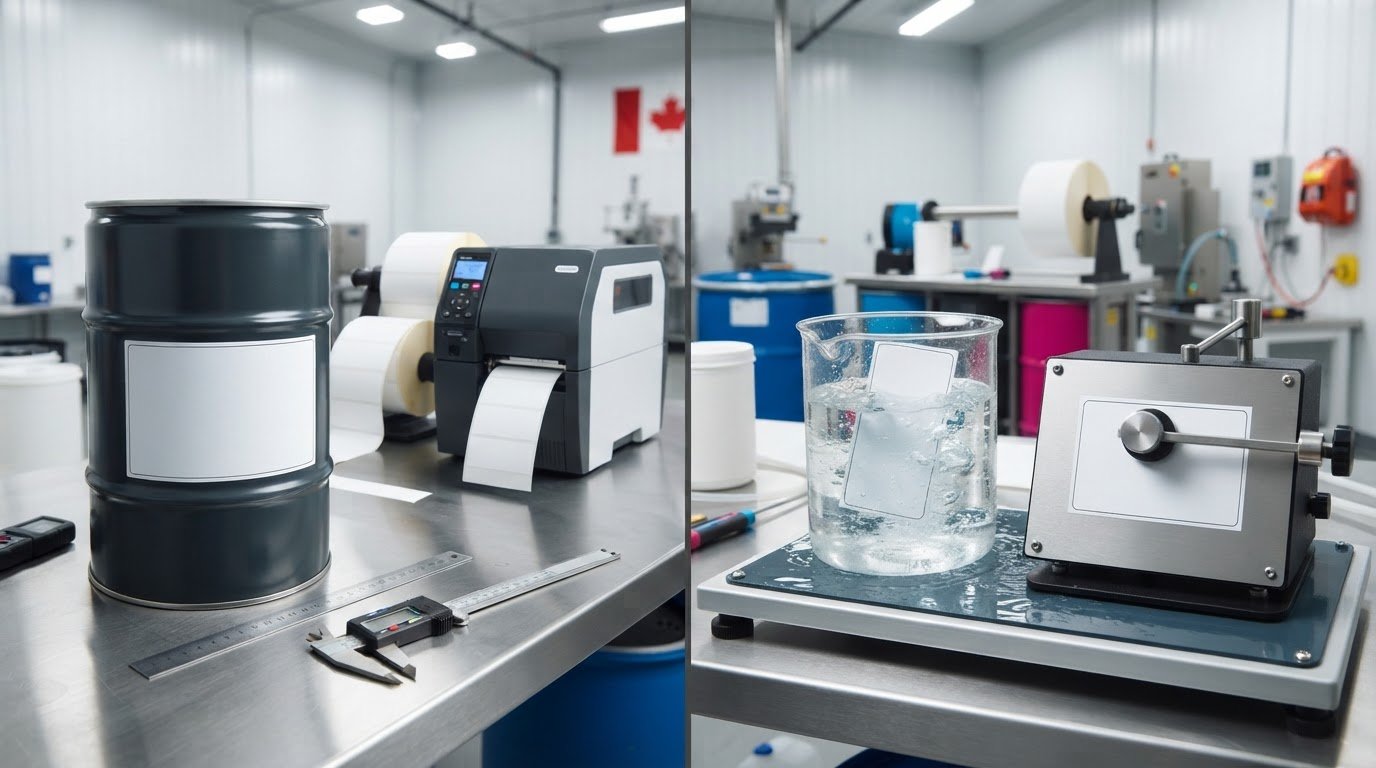
A waterproof label isn’t automatically a BS 5609 label. BS 5609 is a specific durability standard for pressure-sensitive labels used in marine conditions: Part 2 assesses the label material and adhesive, including through 90 days of saltwater immersion, while Part 3 evaluates the durability and legibility of the printed label. Rolls of BS5609-certified chemical drum labels must meet the applicable requirements for both the material and the finished print.
It’s understandable to look for a waterproof label when a drum may face moisture, but water resistance alone doesn’t establish marine-use performance. The right choice depends on the label size, the drum surface, the print system and whether the finished label needs to withstand saltwater exposure, abrasion and weathering. This guide explains how BS 5609 certification differs from waterproofing, what the standard’s parts cover, and which size and print specifications matter when selecting labels for chemical drums in Canada.
Key Takeaways
- Water resistance alone doesn’t establish marine-use durability; understand how BS 5609 evaluates label material and the finished print.
- Match label dimensions and roll format to your drum, printer, and required hazard information.
- Consider the drum’s surface and expected exposure, since adhesion and legibility matter alongside the label material.
- Understand how BS 5609 relates to GHS and IMDG requirements when chemical drums are shipped by sea.
- Choose a print system and compatible label stock with the finished label’s durability requirements in mind.
Is A Waterproof Label The Same As A BS5609 Label?
No. A waterproof label isn’t automatically a BS 5609 label. Waterproofing describes resistance to water, while BS 5609 sets durability criteria for printed, pressure-sensitive labels used on chemical drums shipped by sea. A label can resist splashes yet fail after extended saltwater exposure, abrasion or weathering. The distinction matters when packaging must retain readable hazard information in marine conditions.
BS 5609 separates material testing from finished-print testing. Part 2 evaluates the blank label material and adhesive, including saltwater immersion for 90 days. Part 3 assesses the printed label, including print permanence, abrasion resistance and legibility after marine exposure. A durable, coated label stock alone doesn’t establish that the final combination of stock, adhesive and printing meets the relevant requirements.
GHS information must remain readable. Chemical labels include hazard pictograms, a signal word, hazard and precautionary statements, a product identifier, and supplier contact information. GHS uses nine pictograms, and the signal word is either DANGER or WARNING. If abrasion or saltwater exposure obscures these details, water resistance alone does not establish that the print will remain durable.
Industrial conditions can place different demands on a label than marine transport. A drum may face moisture, temperature changes, handling friction, or contact with metal, plastic, painted, or coated surfaces. These conditions affect both adhesion and legibility. Match the label material and adhesive to the container surface and expected exposure instead of treating “waterproof” as a complete performance specification. For example, a label that adheres to a clean plastic drum may perform differently on painted metal.
What alternatives are available if a label roll is not BS 5609 certified? For drums that won’t face marine transport, choose a label suited to the actual environment, container surface and required information. For marine exposure, a non-certified roll doesn’t provide evidence of BS 5609 performance. A separate label application, such as inkjet card grading labels, has no bearing on chemical-drum certification.
How should BS 5609 chemical drum labels be stored and applied? Keep rolls clean and dry, and apply labels to a clean, dry surface so dirt or moisture doesn’t interfere with adhesion. Product instructions recommend applying labels above 10 °F. Before production, consider whether the drum’s surface and the expected saltwater, abrasion and weather exposure match the label’s intended use.
Chemical drum label sizes and print specifications
Label dimensions should fit both the drum and the information that must remain legible. Common listed formats include 4″ × 6″, 4″ × 4″ and larger panels such as 8.375″ × 13.875″. A 55-gallon drum may need a broad label area for hazard details, product identification and handling information. The container’s shape and surface also affect placement, especially on curved or coated drums.
Roll format matters as much as the face size. A listed continuous roll is 4 inches wide, with a 2-inch inner core and a 4-inch outside diameter. Confirm that the printer accepts the media width, core and roll diameter. For example, the Afinia L502 supports media widths from 2 inches to 8.5 inches and rolls up to 8 inches in outside diameter.
Labels are available individually or on sheets, and case quantities affect handling and storage. Examples include:
- Matte BOPP stock, 4″ × 6″, with 1,000 labels per case.
- Matte BOPP stock, 8.375″ × 5.875″, with 2,000 labels per case.
- GHS/BS5609 material sheets, 8.375″ × 5.375″, with 2,000 labels per case.
- GHS/BS5609 material sheets, 8.375″ × 10.875″ or 8.375″ × 13.875″, with 1,000 labels per case.
Choose a layout that fits the required content without making text or barcodes difficult to read. The British Standard’s Part 3 concerns the final printed label, so compliance depends on the printed result and printing system, not simply the blank stock.
For thermal transfer printing, a resin-based ribbon is recommended for abrasion and chemical resistance. The label stock, adhesive, ribbon and printer form a combination; changing one component can affect the finished print. Confirm that each component is suited to the intended environmental exposure. Inkjet and laser systems generally need specially certified stock and inks to meet BS 5609 requirements. The Afinia L502, for example, is described as tested and certified for compliant printing with pigment-based inks.
Pre-printed labels can suit designs with fixed information, while on-demand printing can accommodate changing product details. Choose based on what varies between batches and what the printer can produce on the selected stock. For help aligning printer, ink or ribbon choices with label dimensions, discuss your label and printing requirements.
What is the British Standard 5609 (BS 5609) certification?
For Canadian shippers, BS 5609 connects label performance with dangerous-goods packaging transported by sea. The British Standard sets durability criteria for printed, pressure-sensitive, adhesive-coated labels used on chemical drums. Its four parts address different aspects of label qualification, from the base material to the finished print. This matters in merchant shipping, where environmental exposure can threaten essential identification.
Are BS 5609 labels required for shipping dangerous goods from Canada by sea? BS 5609 isn’t itself a standalone legal requirement, but it is effectively mandatory for labels on marine-transported dangerous goods under GHS and IMDG requirements. The transport route and applicable dangerous-goods rules matter, not simply the country where a drum is filled.
The International Maritime Dangerous Goods Code governs dangerous-goods transport by sea and covers packaging, labelling, stowage, segregation, handling and emergency response. Under IMDG, dangerous goods use diamond-shaped labels with two colours to identify their classifications. The system has nine classifications, helping people identify hazards during transport and handling. A clear colour label supports recognition, but its appearance alone doesn’t demonstrate BS 5609 durability.
GHS communicates chemical hazards through label elements, including pictograms, signal words, hazard statements and precautionary statements. Product identifiers and supplier contact information also help connect a drum’s contents with the responsible supplier. BS 5609 addresses the label’s ability to remain attached and readable in marine conditions. GHS content and BS 5609 performance therefore serve different purposes: one communicates hazards, while the other evaluates label durability.
Which label materials and adhesives are BS 5609 certified? Polyester (PET), polyethylene (PE) and polypropylene (PP) are common materials that can pass BS 5609 testing. Certification applies to tested material and adhesive combinations, rather than automatically covering every grade of those plastics. The drum surface also matters: metal, plastic, painted or coated containers can affect adhesion.
Parts 2 and 3 are especially relevant to labels applied to chemical packaging. Part 2 concerns blank label material and adhesive; only materials approved under Part 2 can proceed to Part 3 testing. Part 3 assesses the printed label, including whether text and barcodes remain legible and print adhesion holds after marine exposure. A stock’s performance cannot establish that every printer, ink or print setting produces an equivalent result.
For manufacturers planning international transport, distinguish between the required content of a hazard label and evidence that its printed construction can withstand the intended conditions. Match the drum surface, adhesive, label stock, and printing system to the shipment environment. This keeps compliance decisions focused on the complete label, not simply the word “waterproof” or a single material name.
BS 5609 requirements for marine-use labels
For marine use, BS 5609 Sections 2 and 3 address label material and printed-label performance. To verify a roll’s certification, compare its documentation and test results with the specific material, adhesive and printing system.
Certification Claims and Label Sections
BS 5609 certification relates to tested label components and performance, not every label carrying a similar description. This distinction helps you assess whether the roll and printed result suit marine handling.
Section 2 covers blank label material and adhesive, including exposure to salt spray, sunlight and temperature cycling. Only materials approved under Section 2 can proceed to Section 3 testing. A stock that passes this stage has demonstrated relevant material performance, but that alone doesn’t establish that text or barcodes printed on it will remain legible.
Section 3 assesses the final printed label, including print adhesion and legibility after marine exposure and abrasion. The distinction matters when a manufacturer changes the printer, ink or printing process. A Section 2 material result doesn’t automatically establish Section 3 performance for a different finished print. Treat claims about the label material and printed label as separate evidence.
Verifying Certification and Test Results
Verification means matching the evidence to the exact label construction and its claimed BS 5609 section. This helps prevent a general durability claim from being mistaken for marine-use test results.
Review documentation for the label material and adhesive, then identify whether it covers Section 2, Section 3 or both. Compare the product description with the roll being used; a different material or adhesive is a different construction. For printed rolls, look for evidence that the printing system and finished label were included in the relevant Section 3 assessment.
BS 5609 Sections 2 and 3 address labels intended to remain adhered and legible during three months of seawater immersion. The International Maritime Dangerous Goods (IMDG) Code also requires dangerous-goods labels to withstand three-month marine immersion. That exposure requirement makes abrasion resistance and continued hazard-information legibility practical concerns, not just material specifications.
Keep the distinction between label testing and shipment requirements clear. BS 5609 evaluates label durability; IMDG addresses dangerous-goods transport by sea, including packaging and handling. A roll’s certification claim doesn’t, by itself, establish that every part of the shipment meets IMDG requirements. For example, confirm the label’s tested construction and printed performance align with the intended marine use.
BS5609 certification for chemical packaging labels
BS 5609 certification evaluates whether chemical packaging labels can withstand demanding exposure, rather than relying on a material name alone. For procurement teams comparing BS5609-certified chemical drum label rolls, the key question is whether testing covers the exact label construction and printing method intended for use.
Part 2 evaluates blank label material and adhesive. Its testing includes tensile strength, abrasion resistance, adhesive strength, and stability under ultraviolet exposure and temperature changes. These measures address distinct failure points: the face stock may tear, the adhesive may release, or environmental exposure may affect the material. A pressure-sensitive label must perform as a combined construction, not just as a durable-looking surface.
Polyester (PET), polyethylene (PE) and polypropylene (PP) are common materials that pass BS 5609 testing. However, the material name alone doesn’t establish certification for every grade, adhesive or drum surface. A plastic label may behave differently on a metal, plastic, painted or coated container. Consider the drum’s surface alongside the exposure and handling conditions the label must withstand.
Certification evidence should connect the tested materials with the relevant part of the standard. Independent laboratories such as UL and Smithers conduct BS 5609 certification tests. Their role is to assess performance against test requirements, not to make every product using a similar material interchangeable. Compare the test documentation with the specific stock and adhesive used in your packaging operation.
Part 3 concerns the finished printed label. A material’s test results don’t establish the permanence or legibility of every print produced on it. Printing method, ink or ribbon, and label stock work together. For example, a change in ink or printing equipment can create a different finished label from the one represented by a prior test. This distinction matters where hazard details and identification must remain readable after exposure.
For a sound purchasing decision, treat certification as evidence about a defined label construction, not a general promise attached to a roll category. Match the tested material and adhesive to the drum surface, then match the printing process to the finished-label requirements. That keeps resistance claims tied to relevant tests and avoids assuming that a waterproof description proves BS 5609 performance.
Need to assess a label construction for chemical packaging? Discuss your BS 5609 label requirements and the material, adhesive and printing combination involved.
DuraFast Label Company Canada: VIPColor Label Printers
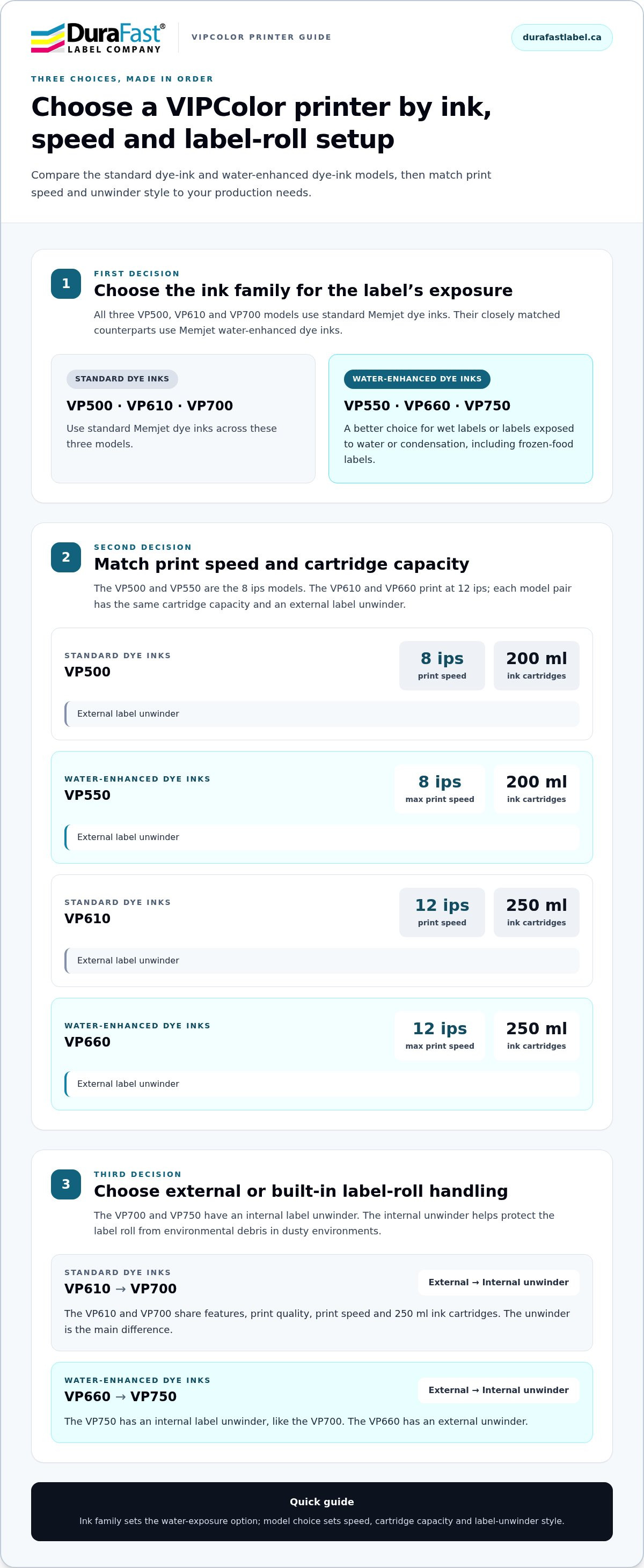
DuraFast Label Company Canada offers VIPColor Label Printers for businesses producing colour labels in-house. Choose a printer based on required output and the label material, ink and printing process needed for your application. A printer or ink choice alone doesn’t establish BS 5609 certification; the complete printed-label combination must meet the relevant requirements.
For labels exposed to moisture, the VIPColor VP550, VP660 and VP750 use Memjet water-enhanced dye inks. The VP550 prints at up to 8 ips and uses 200 ml cartridges; the VP660 prints at up to 12 ips and uses 250 ml cartridges. The VP750 shares the VP660’s print speed and cartridge size, with an internal label unwinder. These ink features don’t replace verifying BS 5609 performance for the intended label construction.
Contact DuraFast Label Company Canada to discuss your label printing requirements.
Build a Consistent Label Production Plan
Make purchasing and production repeatable. Record the approved label construction, printer, and print materials, then review that record whenever the supplier, stock, or production method changes. This provides a clear basis for aligning future orders with your packaging and transport needs, whether managing certified label stocks or sourcing protective coverings from packaging suppliers like Duboxx Packaging LLC to safeguard drums in transit.
For teams comparing equipment options, DuraFast Label Company Canada offers VIPColor and Afinia label printers. The right choice depends on your production workflow and the label requirements you’ve established. Treat the printer as one part of the system, alongside the label roll and the finished print. That approach helps you assess bs5609 certified chemical drum labels rolls against the specific process you plan to use.
Share your application and printing priorities to discuss a suitable direction. Contact DuraFast Label Company Canada about your label printing setup. With a clear plan for materials and production, you can move forward with greater confidence.
Frequently Asked Questions
Does BS5609 Only Matter For Sea Transport?
BS 5609 focuses on label durability in marine conditions, but its performance criteria can also inform decisions for harsh industrial environments. For example, a drum stored outdoors or handled around moisture and abrasion may need more than basic water resistance. Whether certification is needed depends on the transport route and the label’s expected exposure. Separate the need for marine-use certification from the broader goal of choosing a label suited to its working conditions.
What is BS5609 Certification?
BS 5609 is a British Standard for pressure-sensitive labels used on chemical drums in marine conditions. It addresses how label materials and printed labels perform under exposure that can affect adhesion and readability. For a practical example, a label’s face material may remain intact while its printed product identifier fades. Certification evidence should therefore match the type of label performance being claimed, rather than rely on a general description such as “waterproof.”
Who Conducts the Certification?
Independent laboratories, including UL and Smithers, conduct BS 5609 certification tests. Their testing assesses defined label materials or printed-label performance against the relevant requirements. This is different from a printer manufacturer describing a machine’s capabilities: certification applies to tested constructions and results. For procurement records, retain documentation that identifies the tested material and the applicable section, so the evidence can be compared with the label roll and printing process used in production.
What does BS 5609 certification require for chemical drum labels?
BS 5609 requires relevant label materials and finished prints to withstand demanding marine exposure while remaining adhered and legible. The tests address factors such as saltwater, abrasion and weathering. In practical terms, inspect whether the label’s hazard text, product identifier and barcode remain readable, not only whether the face stock looks intact. The material, adhesive and printing method matter together, particularly when a drum surface or production process changes.
Where can I buy BS 5609 certified chemical drum label rolls in Canada?
DuraFast Label Company Canada is a Canadian online retailer of label printers and supplies, including GHS labels. It offers the Afinia L502 Printer with Pigment Inks for GHS BS5609 Chemical Labels for in-house production. If you need ready-printed rolls, assess documentation for the exact label construction and finished print. A printer suitable for chemical labels is a production option, not by itself proof that a particular roll is certified.
What sizes, core diameters, and roll lengths are available?
One listed continuous roll is 4 inches wide, with a 2-inch inner core and a 4-inch outside diameter; its specified length is 85 feet. Other chemical-label formats include 4″ × 6″, 4″ × 4″ and larger sheets. These dimensions aren’t universal specifications for every printer or certified material. Match the label width and roll geometry to the printer’s media limits, and leave enough label area for required content.
What is the difference between BS 5609 Section 2 and Section 3 certification?
Section 2 evaluates blank label material and adhesive; Section 3 evaluates the finished printed label. The distinction helps identify where evidence applies. For instance, a material may pass Section 2, but the printing system and resulting text or barcode still matter for Section 3. When reviewing a supplier’s paperwork, match the section covered to your use: blank stock performance or durability of the completed print.