Blood Bag and Cryogenic Specimen Label Standards for Blood Banks
21st Nov 2026

A blood bag label has to preserve traceability and readable identification, while a cryogenic specimen label must remain legible through cold handling. In Canada, blood operators align blood and blood component labels with the ISBT 128 Standard: Technical Specification; the blood bag and cryogenic specimen label standards also need to account for barcode readability and label durability in their intended conditions.
It’s understandable to focus first on the information printed on a label. But a correctly formatted barcode or component detail is useful only if it remains readable on the container. Cold exposure, condensation and handling all affect which label materials and printing methods suit a workflow.
This article explains the role of ISBT 128 formats in blood unit identification, the information blood labels carry, and the practical factors that affect barcode performance and cold durability. You’ll also learn how to assess label and printer compatibility for your application, so you can make a more informed decision without confusing label design with the standards that govern blood information.
Key Takeaways
- Identify the information that supports blood unit traceability, including donation and facility details.
- Understand how barcode format and print quality affect reliable scanning.
- Learn what to consider when choosing labels for cold and cryogenic handling.
- See how ISBT 128 formats help organize blood bag label information.
- In Canada, information required by the Blood Regulations on a label or circular of information must be in English or French, according to Department of Justice Canada.
Blood unit identification and donor traceability
Blood unit identification connects a donation to its source, component and intended use. Blood bag and cryogenic specimen label standards therefore rely on clear identifiers and consistent label placement.
Red blood cell container identification
For red blood cell containers, the label should display the ABO/Rh blood group prominently in large, bold type, with serological verification. It should identify the facility associated with the donation and state whether the unit is intended for autologous, directed, emergency release or research use. These details distinguish the unit and its purpose during handling.
A donation identification number provides a further traceability anchor. It uses 13 characters and is globally unique for 100 years. Keep its sequence intact wherever it is reproduced, so staff can follow the same donation identifier across records and labelled containers. For example, a transposed character can make a correct unit difficult to match with its associated information.
Canada’s Blood Regulations also include a transition rule for registration numbers. According to Department of Justice Canada, the transition rule for paragraph 64(1)(b) applies to registration numbers starting six months after the day on which these Regulations come into force. This timing concerns registration numbers, not the donation identification number.
Identifier layout depends on the marked item and its purpose. The same general distinction between item and identifier appears in inkjet card grading labels, a separate labelling application; blood containers require their own identification workflow.
Preventing label failure and specimen mix-ups
Label failure, misidentification and specimen mix-ups can disrupt traceability and create uncertainty about a unit’s identity or intended use. Prevention depends on keeping the donation number, facility, blood group and use designation readable and correctly associated with the container.
Use a consistent sequence during identification: associate the donation with its identifier, apply the label to the correct container, then review the printed details for accuracy and legibility. Keep the ABO/Rh result visually clear, and preserve every character in the 13-character donation number. Compare the label’s intended-use designation with the unit’s documented purpose before the container moves to its next handling step.
As a practical check, confirm that the facility name is identifiable, the donation number’s characters are distinct, and the intended-use wording is present. A smeared, incomplete or detached label can undermine these checks. If a specimen or blood unit cannot be confidently matched to its identification, stop the routine hand-off and follow the establishment’s identification procedure rather than guessing from nearby labels.
Consistency matters across containers and records. Keep identifier sequencing stable, don’t rely on colour or position alone, and ensure printed information is readable at the point of use. These steps help staff catch discrepancies before a unit proceeds through the workflow.
Barcode readability and scanning
In Canada, blood operators align blood and blood component labelling with the ISBT 128 Standard: Technical Specification. According to Department of Justice Canada, information required under section 60 of the Blood Regulations on a label or circular of information must be in English or French.
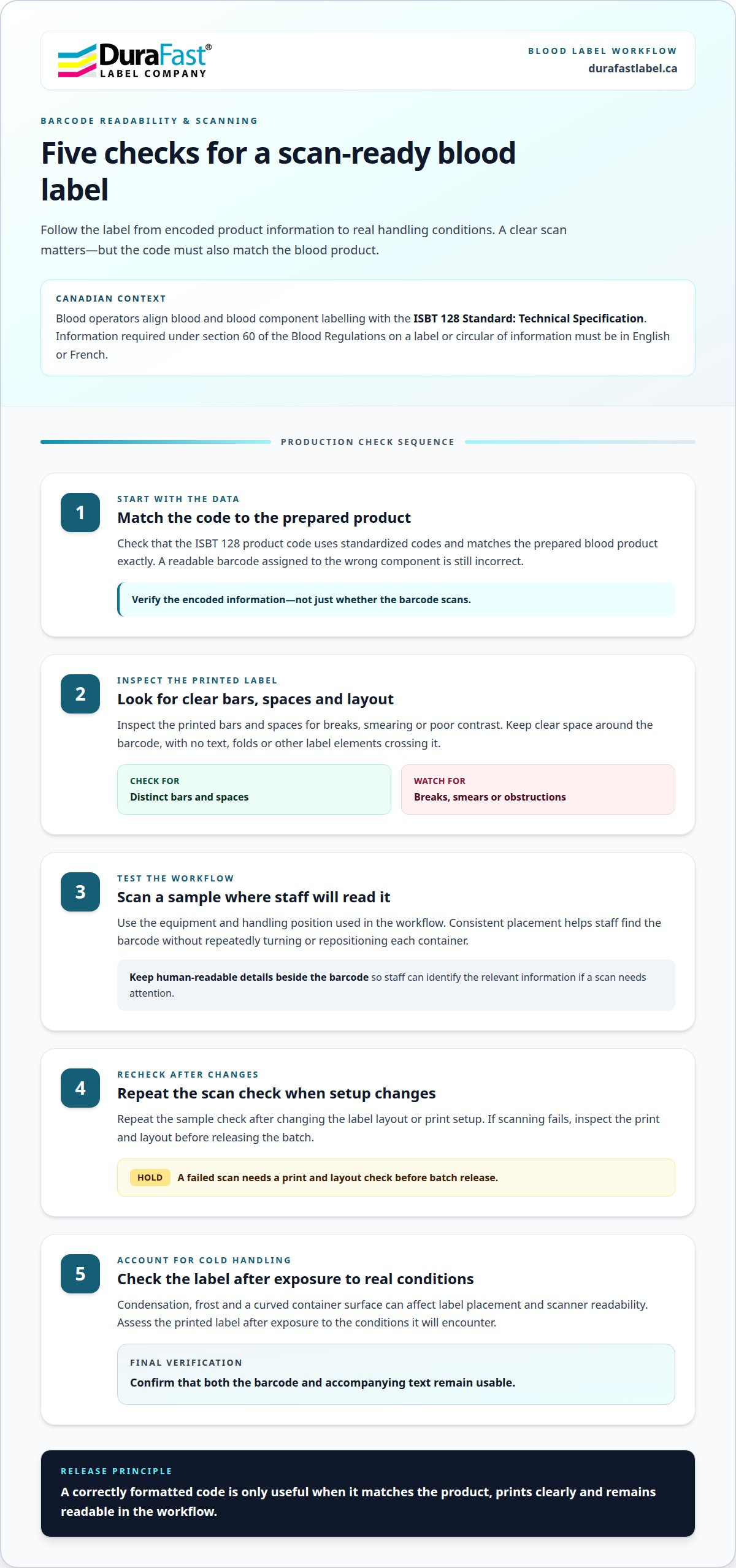
Reliable scanning requires a barcode that prints clearly, remains unobstructed and corresponds to the correct data. A barcode that scans poorly can slow identification or interrupt the connection between a container and its records. Keep the printed code legible, and treat scan performance as a workflow check rather than assuming a correctly formatted design will always scan.
Start with the information encoded. The ISBT 128 product code should use standardized codes and match the prepared blood product exactly. A mismatch between the code and the product can undermine identification, even if the barcode itself scans. For example, a readable code assigned to the wrong component is still incorrect.
During print setup, check the label layout, print clarity and placement on the container. Leave enough clear space around the barcode, without text, folds or other label elements crossing it. Then scan a printed sample using the equipment and handling position used in the workflow. If scanning fails, inspect the print and layout before releasing the batch.
- Confirm that the encoded product information matches the prepared component.
- Inspect printed bars and spaces for breaks, smearing or poor contrast.
- Scan a sample label in the position where staff will read it.
- Repeat the check after changing the label layout or print setup.
These checks support legibility and traceability, but they don’t replace required identification information. Keep human-readable details alongside the barcode so staff can identify the relevant information if a scan needs attention. Consistent placement also helps staff find the code without repeatedly turning or repositioning each container.
For cold workflows, include actual handling conditions in the scan check. Condensation, frost or a curved container surface can affect label placement and scanner readability. Assess the printed label after exposure to the conditions it will encounter, and confirm that both the code and accompanying text remain usable.
Printer selection is one part of a dependable label workflow. If you’re assessing equipment for label production, discuss label printer options for your application.
Cold and cryogenic label durability
Cold storage can challenge label adhesion, print clarity and barcode readability. For blood and cryogenic specimens, assess the label on the actual container and within the intended handling workflow.
Cryogenic labelling standards
For blood and blood components, Canadian operators align labels with the ISBT 128 Standard: Technical Specification and Canadian guidance for uniform labelling. These sources address blood labelling; they do not establish a single cryogenic specimen-label rule for every laboratory. For specimens, use the identifiers and label format defined by the laboratory’s approved procedure.
A specimen label should include the patient and specimen identifiers required by the procedure, along with any other fields needed to distinguish the sample. For example, a tube holding one patient’s specimen must remain distinguishable from another tube handled in the same batch. Keep essential text readable after applying the label to the container.
For information required by Canada’s Blood Regulations on a blood label or circular of information, English or French must be used, according to Department of Justice Canada under section 60. This requirement concerns blood-related information under those Regulations; it should not be treated as a blanket rule for every cryogenic specimen label.
Temperature and storage conditions
There is no single temperature range that applies to every blood component and cryogenic specimen. Select and validate labels for the actual storage conditions, considering the container surface, exposure to moisture or condensation, and handling during transfer. For example, assess a label for a frozen specimen within that specimen’s real storage and retrieval workflow.
Validation should examine the complete label, not just the adhesive. A practical sequence is to print representative labels, apply them to the intended container, expose them to planned storage and handling conditions, then inspect adhesion, text and barcode scanning. Record the label material, print settings and results so the laboratory can reproduce the tested setup.
Include transitions around storage. A container may move from a cold environment into a room where condensation forms, or be handled while wearing gloves. Check whether label edges lift, print smears or the barcode becomes difficult to scan after these steps. Repeat the assessment if the container or label configuration changes.
- Test the intended label on the actual container, such as a tube or blood bag.
- Assess readability and barcode scanning after the relevant storage and handling steps.
- Document the tested label and printing configuration for consistent use.
These checks help establish whether a label suits a particular workflow, but they don’t replace applicable blood labelling requirements or laboratory procedures.
ISBT 128 blood bag label formats
ISBT 128 and Canadian blood labelling requirements concern blood and blood components. Cryogenic specimen labels are a separate application, so don’t assume blood bag formats automatically define specimen labelling.
ISBT 128 format requirements
The ISBT 128 Standard: Technical Specification provides standardized blood product codes, while some options are determined nationally. The Canadian Guidelines for the Uniform Labelling of Blood and Blood Components Using ISBT 128 describe the options selected for Canada by Canadian Blood Services and Héma-Québec. A product code must match the prepared product exactly.
That distinction matters when adapting a format for a particular component. A code that scans correctly can still identify the wrong product if its assigned value doesn’t match what was prepared. During setup, map the selected code to the component, then compare a printed sample with the product information before using that format.
For cryogenic specimens, follow the laboratory’s applicable procedures and specimen identification fields. A research specimen label and a blood component end label serve different purposes. Don’t apply a blood product code simply because both labels need durable identification.
Canadian blood component labelling
In Canada, all manufactured blood components released for issue to hospital customers have a standard-format end label applied to the container or bag. The label should show the component’s expiration date and time, which vary by component type. The relevant Canadian format helps organize information for the intended blood product.
Review component-specific details rather than copying one label layout across every product. Applicable special attributes can include irradiation, leukoreduction, CMV-negative status, pathogen reduction or frozen status. Plasma or pooled component labels should state an accurate volume or quantity.
A useful format review follows the information from product preparation through to the final label:
- Match the ISBT 128 product code to the prepared component.
- Check the component’s expiration date and time.
- Include applicable special attributes, such as irradiation or frozen status.
- State an accurate volume or quantity for plasma or pooled components.
Each step addresses a different identification need. For example, the product code identifies the component, while an applicable attribute communicates a treatment or status. Expiration information depends on the component, so don’t assume one template fits every product.
Canadian ISBT 128 options also reflect national selection, rather than a single universal choice for every jurisdiction. For cryogenic specimens, the blood component format is not a substitute for the laboratory’s specimen-label procedure. Keep the intended use clear, and assess the chosen specimen format against its own identification and storage workflow.
Separating these systems helps prevent format confusion: apply Canadian blood component labelling to blood products, and follow the relevant laboratory procedure for cryogenic specimens.
You can also compare available label formats by size and printer core. Check that the selected format suits the intended bag and printing setup.
What Canadian standards govern blood bag labels and blood components?
Canadian blood labelling draws on the Blood Regulations and the ISBT 128 Standard: Technical Specification. The Canadian Guidelines for the Uniform Labelling of Blood and Blood Components Using ISBT 128 describe options selected for use in Canada by Canadian Blood Services and Héma-Québec. Together, these requirements and formats guide how blood components are identified for handling and issue.
According to Department of Justice Canada, information required by the Blood Regulations on a label or circular of information must be in English or French under section 60. This applies to the required information, not necessarily every optional field. A practical label review should therefore consider the language of required text alongside the applicable component format.
According to Department of Justice Canada, establishments distributing blood under section 81 must label it under section 83 to indicate, as applicable, that required testing is incomplete or that all test results are not yet available. This status information matters at distribution. The label should communicate the applicable testing status clearly, rather than suggesting that results are complete when they are not yet available.
Manufactured blood components released for issue to hospital customers have a standard-format end label applied to the container or bag. The component label should also show its expiration date and time, which vary by component type. Applicable attributes can include irradiation, leukoreduction, CMV-negative status, pathogen reduction or frozen status. Plasma or pooled component labels should state an accurate volume or quantity.
For an operational review, consider each field against the specific product and its release stage. For example, a plasma component needs an accurate quantity, while a component with an applicable special attribute needs that status reflected. The product code should use ISBT 128 standardized codes and match the prepared product exactly. The format options are nationally determined, so Canadian guidance matters when selecting the appropriate layout.
- Match the selected ISBT 128 code to the prepared component.
- Include the component’s expiration date and time.
- Show applicable attributes, such as frozen status or irradiation.
- State the accurate volume or quantity for plasma or pooled components.
- Apply the required testing-status indication when section 81 distribution conditions apply.
These checks bring the format, component details and applicable regulatory information together. They also distinguish blood component labelling from cryogenic specimen identification, which follows the relevant laboratory procedure rather than an assumed blood bag format.
For help choosing label-printing equipment for your workflow, discuss your label printing requirements.
Collection is another point to include in a label review. The guidance checklist asks whether blood containers are labelled in accordance with section 63 of Canada's Blood Regulations at the time of collection. That question belongs alongside checks made for component identity, required information and later distribution status, so the review accounts for the label at the point specified by the checklist as well as for the product’s subsequent handling.
A reviewer can record collection-time labelling as a separate checkpoint and assess it independently from status information applied at distribution.
DuraFast Label Company Canada: Dymo LabelWriter label printers
DuraFast Label Company Canada offers reliable label printers, including VIPColor, Afinia and Toshiba models. These options give Canadian organisations a choice of equipment for different label-production workflows, including routine identification and barcode printing.
For blood bags or cryogenic specimens, printer selection is only one part of the process. The label format, materials and performance in actual storage conditions must also suit the intended use. A printer alone doesn’t establish that a label meets blood labelling requirements or will remain readable during cryogenic handling.
Consider the label format, printing volume and workflow before choosing equipment. DuraFast Label Company Canada offers label printers to support different in-house production needs.
Contact DuraFast Label Company Canada to discuss your label-printing needs.
Put your label workflow into practice
Use blood bag and cryogenic specimen label standards as a framework for reviewing your workflow, not as a printer specification. A useful next step is to map each label’s purpose, required information, container and storage conditions. This gives your team a clearer basis for assessing equipment and print output without confusing printer capability with regulatory compliance.
DuraFast Label Company Canada offers VIPColor, Afinia and Primera label printers. The right equipment depends on your label-production needs, while blood component formats and specimen procedures remain specific to their intended use. Keep those decisions aligned as your workflow changes.
Contact DuraFast Label Company Canada to discuss your label-printing requirements. A thoughtful review can help you move forward with a clearer plan.
Frequently Asked Questions
What label materials and adhesives withstand liquid nitrogen and ultra-low temperatures?
Choose label stock and adhesive designed specifically for cryogenic storage. A general freezer label may not suit liquid nitrogen exposure. Performance depends on the container surface, when the label is applied, and whether it encounters direct immersion, vapour-phase storage or condensation during retrieval. Test the complete printed label on the intended tube or vial throughout the laboratory’s storage and handling cycle, then assess adhesion, legibility and barcode scanning.
Which Canadian suppliers sell compliant blood bag and cryogenic specimen labels, and what do they cost?
DuraFast Label Company Canada offers label printers, including VIPColor, Afinia and Primera models, for in-house label production. Printer availability alone doesn’t establish that a particular label meets blood or cryogenic requirements. Evaluate the label against its intended format and storage conditions. Cost depends on factors such as label stock, adhesive, size, order volume and whether labels are printed in-house or supplied preprinted. Compare options in Canadian dollars.