Best Barcode Software for Canadian Businesses: 2026 Roundup and Buying Guide
19th Jun 2026
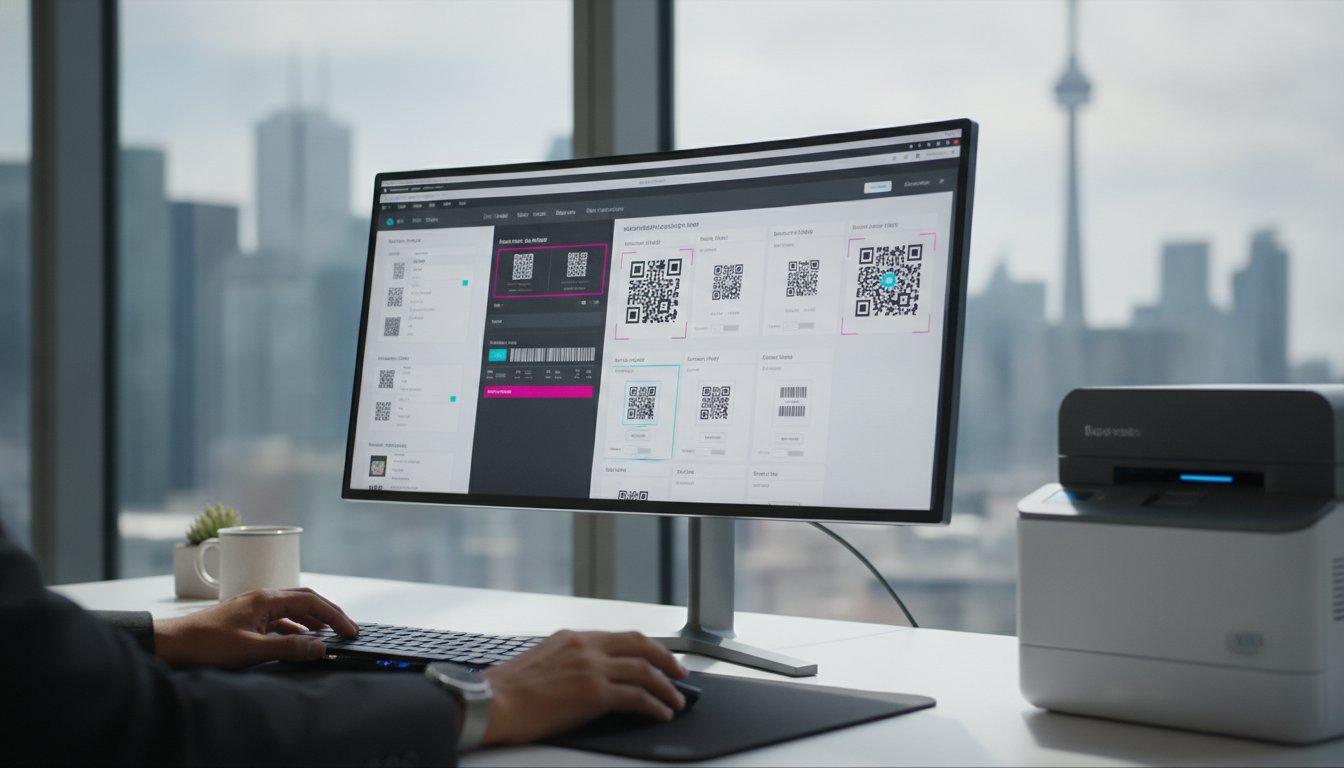
Is your current labelling system ready for the "Sunrise 2027" deadline, or is it holding your inventory management hostage with outdated 1D limitations? Most Canadian business owners realize that barcode software should be the strategic brain of their production line. However, it's common to feel frustrated by the high cost of perpetual licenses or the technical friction between your design suite and your thermal printers. You shouldn't have to struggle with variable data errors or hardware compatibility issues when trying to scale your operations.
This guide will help you discover the ideal barcode software to streamline your inventory, ensure GS1 compliance, and maximize your printer's performance. We'll show you how to achieve error-free scanning at the retail level while maintaining seamless integration with your existing hardware. We provide a detailed comparison of the latest 2026 releases from industry leaders like Loftware NiceLabel and TEKLYNX, focusing on the technical differences that matter for your specific SKU count and workflow requirements.
Key Takeaways
- Learn why professional barcode software acts as a secure bridge between your database and physical labels, far surpassing the security risks of free online generators.
- Identify essential features for operational efficiency, such as staff-friendly design interfaces and seamless connectivity to SQL, Oracle, or CSV data files.
- Evaluate the "Big Three" solutions—BarTender, Loftware NiceLabel, and TEKLYNX—by comparing their 2026 perpetual and subscription licensing models.
- Understand how to synchronize your software with hardware using native drivers to ensure GS1 compliance and high-resolution output on colour label printers.
- Follow a strategic audit process to select a scalable labelling suite that eliminates the need for costly system re-learning as your SKU count grows.
What is Barcode Software and Why Does Your Business Need a Professional Suite?
What exactly is barcode software? It's best to think of it as the vital bridge connecting your digital product database to your physical inventory. While a Barcode might look like a simple arrangement of lines and spaces, it's actually a sophisticated data carrier. Professional software translates complex information into a format that scanners can read instantly, ensuring your logistical chain remains unbroken. It manages everything from the symbology type to the precise dimensions required by your specific printer hardware.
In 2026, the industry has moved decisively toward Subscription as a Service (SaaS) models. While perpetual licenses were once the standard, many Canadian businesses now prefer cloud-integrated suites. These modern systems offer automatic updates and remote management across multiple sites. This shift helps with fiscal responsibility by turning a large upfront capital expense into a predictable operational cost, ensuring you always have access to the latest security patches and compliance standards without needing a massive IT budget.
Why do you need a professional suite instead of a basic design tool? It's primarily about eliminating the high cost of human error. When staff manually type product details or lot numbers, mistakes are inevitable. A professional suite automates this process by pulling data directly from your source files. This ensures every label is accurate, reducing the risk of rejected shipments and the operational waste of constant re-prints.
The Evolution of Labelling: From Static to Dynamic
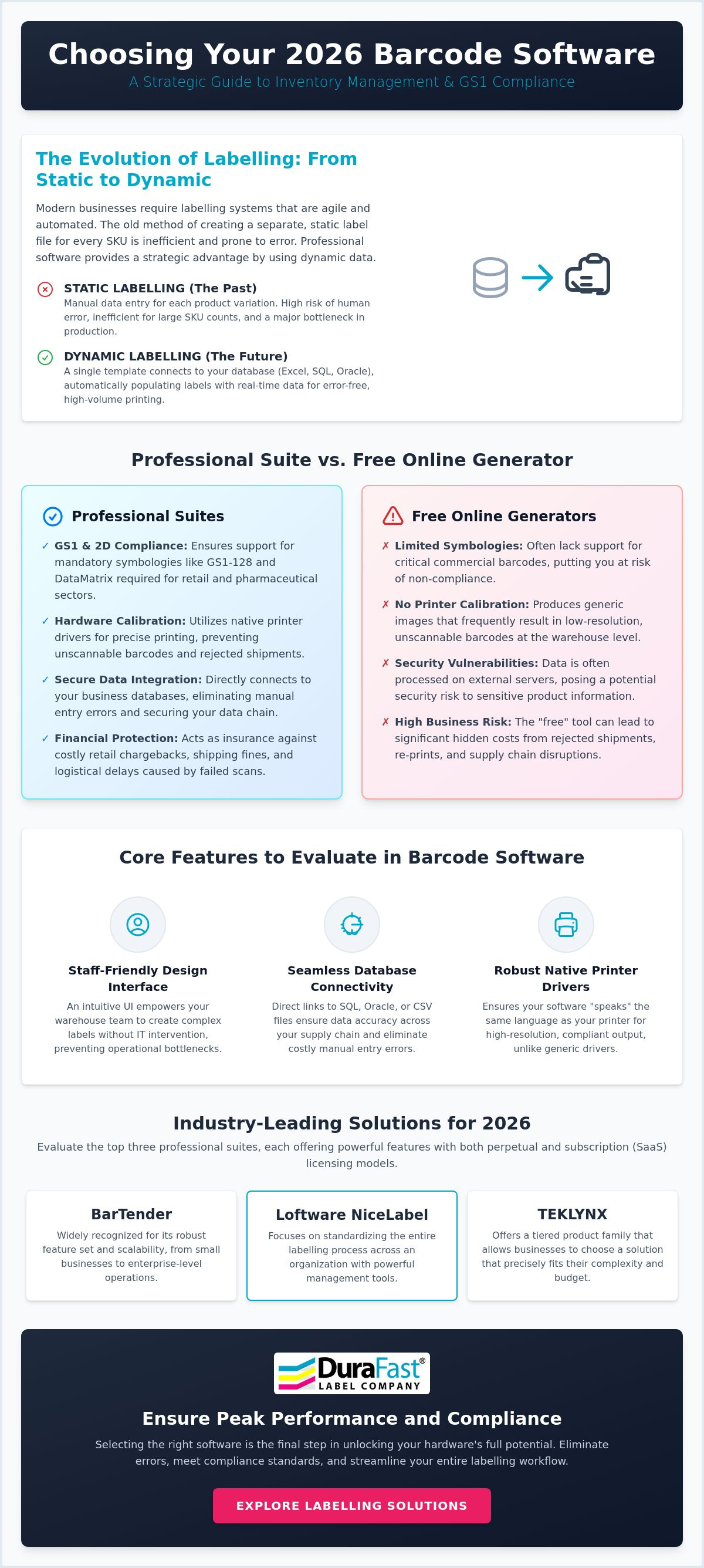
Early labelling relied on static images, which meant creating a separate file for every single SKU. This approach isn't sustainable for modern businesses managing hundreds of products. Modern software utilizes variable data fields, allowing you to design a single template that changes its content based on the item being printed. It pulls information directly from your Excel sheets or ERP systems in real time. Dynamic labelling is the automated population of label fields based on real-time data. This capability ensures that your production rhythm isn't throttled by manual data entry hurdles.
Professional Suites vs. Free Generators
Free online generators might seem like a quick fix, but they pose serious risks to commercial operations. These tools often lack support for essential symbologies like GS1-128 or 2D DataMatrix codes, which are mandatory for retail and pharmaceutical compliance. Additionally, free tools aren't calibrated to your specific colour label printers or thermal units. This often results in "unscannable" barcodes that lead to rejected shipments at the warehouse level.
Many business owners discuss the frustration of retail chargebacks when labels fail to scan. A modest investment in a professional suite like BarTender or Loftware NiceLabel pays for itself almost immediately. You're not just buying a design tool; you're buying insurance against shipping fines and logistical delays. Professional software ensures that the lines, spaces, and quiet zones are mathematically perfect for your hardware, preventing the technical friction that leads to operational downtime.
Core Features to Evaluate When Choosing Barcode Software
How do you determine if a specific barcode software package is the right fit for your facility? The decision often hinges on whether your warehouse staff can realize complex designs without requiring a degree in computer science. A user-friendly interface is essential; if the design process is too cumbersome, it leads to bottlenecks and increased reliance on your IT department. You need a system that balances sophisticated technical capabilities with a pragmatic, approachable layout for daily users.
Database connectivity is another critical pillar of a professional operation. The ability to link your labelling templates directly to SQL, Oracle, or simple CSV files ensures that your data remains accurate and synchronized across your entire supply chain. This connectivity prevents the manual entry errors that often plague growing businesses as their SKU counts increase. Additionally, you must verify that the software provides robust printer driver support. Professional suites "speak" the native language of your hardware, whether you use Zebra thermal units or Epson colour label printers. Using native drivers instead of generic Windows print drivers ensures barcode clarity and prevents the pixelation that causes scan failures at the retail level.
Comprehensive symbology support is non-negotiable in 2026. Your software should handle a wide array of formats, including traditional linear codes and 2D variants like Data Matrix and QR codes. According to Gartner Peer Insights on Barcode Software, scalability and the ability to handle emerging 2D standards are top priorities for enterprise users. Choosing a suite with a deep library of symbologies ensures your business remains agile as global shipping requirements evolve.
Compliance and Canadian Standards
Automation and Workflow Integration
Operational efficiency is often found in the details of automation. For example, "conditional printing" allows you to set rules where specific warning labels only print if a certain data field is triggered in your database. To protect your operations from accidental errors, you can implement print-only stations. These prevent unauthorized staff from making design changes while allowing them to execute print jobs accurately. Solutions like Loftware NiceLabel PowerForm software take this a step further by automating complex workflows and integrating directly with your production line hardware.
If you are unsure which specific features are most relevant to your current hardware setup, you can speak with one of our consultants to audit your existing workflow and identify the most efficient software path forward.
Roundup: The Top 3 Barcode Software Solutions for 2026
Selecting a professional suite requires a clear understanding of the functional deltas between product tiers. In 2026, the industry leaders offer distinct advantages based on your organization's scale and data complexity. At DuraFast Label Company Canada, we focus on providing the specific technical specifications needed to assist in product selection. While we have already established the importance of moving beyond static labels, this roundup highlights the differentiators that impact your daily production rhythm and database synchronization.
BarTender by Seagull Scientific
BarTender remains a standard for businesses requiring high-precision driver support for their labelling operations. The main difference between BarTender Professional and the Enterprise edition is that the latter provides centralized management and mobile printing across your entire network. While the Professional version serves as a robust baseline for local database linking, the Enterprise delta includes sophisticated SDK integration for automated environments. Other than this expanded network control, both versions utilize the same intuitive "What You See Is What You Get" designer to ensure mathematical accuracy in every barcode.
Loftware NiceLabel
NiceLabel is engineered for businesses prioritizing remote management through a cloud-based infrastructure. The only difference between their standard designer and the Label Management System (LMS) is the ability to maintain centralized version control and secure approval workflows. This structure is ideal for organizations with multiple facilities across Canada that must synchronize their branding and compliance standards. Other than this centralized focus, NiceLabel remains highly compatible with local hardware, ensuring your industrial label printers operate at peak efficiency without the need for local server overhead.
TEKLYNX (Label Matrix and Codesoft)
TEKLYNX provides a tiered approach to help you distinguish between entry-level and enterprise needs. The main difference between Label Matrix and Codesoft is the support for complex database connections and high-volume automation. Label Matrix serves as the baseline for straightforward tasks, whereas Codesoft is the delta designed for intricate manufacturing environments. The only difference for most users will be the specific level of integration required for their ERP systems. Other than this technical depth, TEKLYNX remains a reliable choice for high-speed industrial label printers requiring consistent and reliable data streams.
Hardware Compatibility: Syncing Software with Your Printer
Does your barcode software communicate effectively with your hardware, or is it creating a bottleneck in your production line? Achieving professional results requires more than just a good design; it requires a software suite that utilizes native drivers rather than generic Windows print drivers. The main difference between these driver types is how they handle the rendering of narrow bars and quiet zones. Generic drivers treat your label like a standard document, which often leads to fuzzy edges and unreadable barcodes. In contrast, native drivers allow the software to send raw printer language directly to the device, ensuring the mathematical precision required for GS1 compliance.
When running high-speed batches, your software must manage the ips (inches per second) data stream to prevent the printer from stuttering. Industrial printers often operate at speeds of 10 to 12 ips, and if the software cannot process variable data fast enough, the printhead will pause. Other than this data processing speed, you must consider the role of physical components like internal label unwinders. An internal unwinder is ideal for dusty environments to protect media from environmental debris, but it requires the software to maintain a steady feed. The only difference between an internal and an external label unwinder is the media capacity, with external units supporting larger rolls for high-volume jobs.
Thermal Transfer vs. Direct Thermal Drivers
Professional suites allow you to precisely control the heat settings for thermal transfer ribbons Canada businesses rely on for durability. The main difference between a standard setup and a high-performance one is the ability to calibrate heat for specific ribbon types, such as wax, wax-resin, or full resin. Correct software calibration prevents premature wear on thermal printheads, which are a significant maintenance cost. For Canadian environments involving condensation or frozen foods, you can adjust driver settings to ensure the ink bonds perfectly to the substrate, preventing smudging during distribution.
Optimizing for Memjet and Inkjet Technology
Managing colour label printers requires a software suite capable of sophisticated ink management and colour matching. The main difference between standard inkjet and Memjet Technology in the software interface is how the system monitors ink levels in high-capacity cartridges, such as 250ml or 200ml tanks. Other than this volume tracking, your software allows you to toggle between standard dye and water enhanced dye inks. This is a critical distinction; water enhanced dye inks are necessary for wet labels or products stored in refrigerated units. Your software ensures that the high-resolution requirements of prime product labels are met without slowing down the ips (inches per second) transmission rate.
If you need assistance determining which driver configuration or ml (millilitre) tracking setting is best for your hardware, you should contact the technical support team at DuraFast Label Company Canada for a compatibility audit.
Conclusion: How to Select and Implement Your Barcode Solution
How do you synthesize these technical specifications into a functioning production line? The transition to a modern labelling system is most successful when you follow a logical hierarchy of needs. You must audit your data architecture first, then your hardware capabilities, and finally select the software that bridges the two. This methodical approach ensures that your chosen barcode software supports your operational goals without introducing unnecessary technical friction or compatibility hurdles.
We consistently encourage businesses to select a scalable version of their chosen suite. It's much more efficient to unlock advanced features within an existing platform than to "re-learn" an entirely new software environment as your SKU count grows. By choosing a professional solution early, you protect your production rhythm from the disruptions associated with system migrations. Partnering with a Canadian specialist like DuraFast Label Company Canada provides the added benefit of local technical support and a reliable supply chain, ensuring you never face downtime due to software licensing hurdles or media shortages.
The Implementation Checklist
Before you finalize your purchase, work through these three essential steps to ensure a smooth deployment:
- Step 1: Identify your primary symbology. Determine if your industry requires standard UPC codes, GS1-128 shipping labels, or 2D formats like DataMatrix for pharmaceutical or cannabis compliance.
- Step 2: Map your data source. Verify that your software can link directly to your existing Excel sheets, SQL databases, or ERP systems to eliminate the risk of manual entry errors.
- Step 3: Choose a license model that fits your 2026 budget. Decide whether a one-time perpetual license or a flexible SaaS subscription provides the best long-term fiscal value for your specific business model.
Why Source Software and Hardware Together?
Why risk compatibility issues by sourcing your system components from multiple vendors? Sourcing your barcode software and hardware from a single provider ensures "one-stop" support for your entire operation. This strategy eliminates the technical friction that often occurs when software and printers don't communicate correctly. At DuraFast Label Company Canada, we provide blank labels for sale that are pre-tested with industry-leading software suites to ensure optimal ink adhesion and barcode clarity.
DuraFast Label Company Canada acts as your strategic partner in operational seamlessness, providing the industrial reliability your business requires to grow. We help you navigate the intricate logistical challenges of production and distribution with pragmatism and confidence. If you're ready to optimize your inventory management and ensure total compliance, consult with a specialist at DuraFast Label Company Canada today to find your ideal solution.
Future-Proof Your Labelling Strategy for 2026 and Beyond
How will your business adapt as the global 2D barcode transition approaches? Investing in a professional suite today ensures you're ready for evolving retail compliance while protecting your bottom line from costly shipping fines. We've explored how the right barcode software acts as a strategic data bridge, reducing human error and maximizing the performance of your thermal or colour inkjet printers. You've seen that selecting between BarTender, Loftware, or TEKLYNX depends on your specific SKU volume and multi-site requirements.
As an authorized reseller of these industry-leading platforms, DuraFast Label Company Canada offers expert guidance on hardware-software compatibility. We provide Canadian-based support and maintain local inventory to ensure your production line never stops. You don't have to navigate these technical hurdles alone. Browse Professional Barcode Software at DuraFast Label Company Canada and take control of your operational efficiency today. We look forward to helping you realize a more reliable and seamless production cycle.
Frequently Asked Questions
What is the best barcode software for small businesses in Canada?
BarTender Professional is often the best choice for small Canadian businesses due to its intuitive interface and robust database linking. It allows you to realize complex designs without specialized IT training. Another strong contender is TEKLYNX Label Matrix, which provides a simplified entry point for businesses with basic label requirements. Both options ensure your barcode software grows alongside your SKU count.
Can I use Excel to print barcodes without specialized software?
You can use Excel to generate barcodes, but it's not recommended for commercial production. Excel requires specific barcode fonts that are prone to scaling issues and data corruption. Professional barcode software ensures that your barcodes remain mathematically accurate and compliant with industry standards. Using a dedicated suite eliminates the risk of "unscannable" labels that lead to retail chargebacks.
What is the difference between BarTender and NiceLabel?
The main difference between BarTender and NiceLabel is their architectural focus. BarTender is widely recognized for its superior native drivers and "What You See Is What You Get" designer. NiceLabel, particularly their LMS, is built for cloud-first environments. It's the ideal choice for businesses with multiple Canadian locations that need centralized control over their label templates.
Do I need a subscription, or can I buy a perpetual license for barcode software in 2026?
You have both options available in 2026. While many developers like Loftware have transitioned to Subscription as a Service (SaaS) models, TEKLYNX still offers a Single-User Perpetual License. Subscriptions provide the benefit of lower upfront costs and automatic updates. Perpetual licenses appeal to businesses that prefer a one-time capital expenditure for their barcode software needs.
Will my barcode software work with any thermal printer?
Professional barcode software is designed to work with most major thermal printers, including Zebra, Honeywell, and Toshiba. However, the best results are achieved when the software includes native drivers for your specific model. These drivers allow the software to communicate directly with the printer's processor, ensuring better barcode clarity and faster print speeds than generic Windows drivers.
How do I ensure my barcodes meet GS1 Canada standards?
Ensuring GS1 Canada compliance is easiest when using professional software with built-in GS1 templates. These templates automatically format the Application Identifiers and calculate the necessary check digits for you. Using these pre-configured tools prevents the formatting errors that often occur when trying to build complex GS1-128 or DataMatrix codes from scratch.
Is there a free barcode software that is reliable for shipping labels?
Reliable free barcode software for commercial shipping is virtually non-existent. Most free tools lack the necessary security protocols and don't support the GS1-128 symbology required by major Canadian carriers. A modest investment in a professional entry-level suite pays for itself by preventing shipping fines and ensuring your labels scan correctly every time.
What happens if my barcode software license expires?
If your subscription license expires, the software will typically revert to a restricted "demo" mode or stop printing entirely. For perpetual licenses, the software continues to function, but you'll lose access to technical support and critical security updates. It's vital to track your renewal dates to ensure your production line doesn't face unexpected downtime.