Afinia L901 vs VIPColor VP700: Which Industrial Memjet Printer Wins in 2026?
29th Aug 2026
What if the two fastest printers on your shortlist share the exact same Memjet DNA but deliver completely different results for your bottom line? When comparing the Afinia L901 vs VIPColor VP700, it's easy to get lost in the identical 12 ips print speeds and 1600 dpi resolutions. You likely already know that moving to in-house production is the only way to escape the high cost of outsourcing and the frustration of production bottlenecks. However, choosing the wrong hardware can lead to label durability issues or a footprint that doesn't fit your facility's layout.
We understand that your goal is to achieve a lower cost-per-label while ensuring your packaging stands up to damp or cold Canadian environments. This guide will help you realize which high-speed solution truly fits your production line. We'll compare the technical benchmarks, hardware configurations, and total cost of ownership for both models. We'll also examine how the Afinia L901 Plus excels in seamless inline integration with its water-resistant ink, while the VIPColor VP700 offers a compact footprint for standalone efficiency, ensuring your professional colour labels look their best.
Key Takeaways
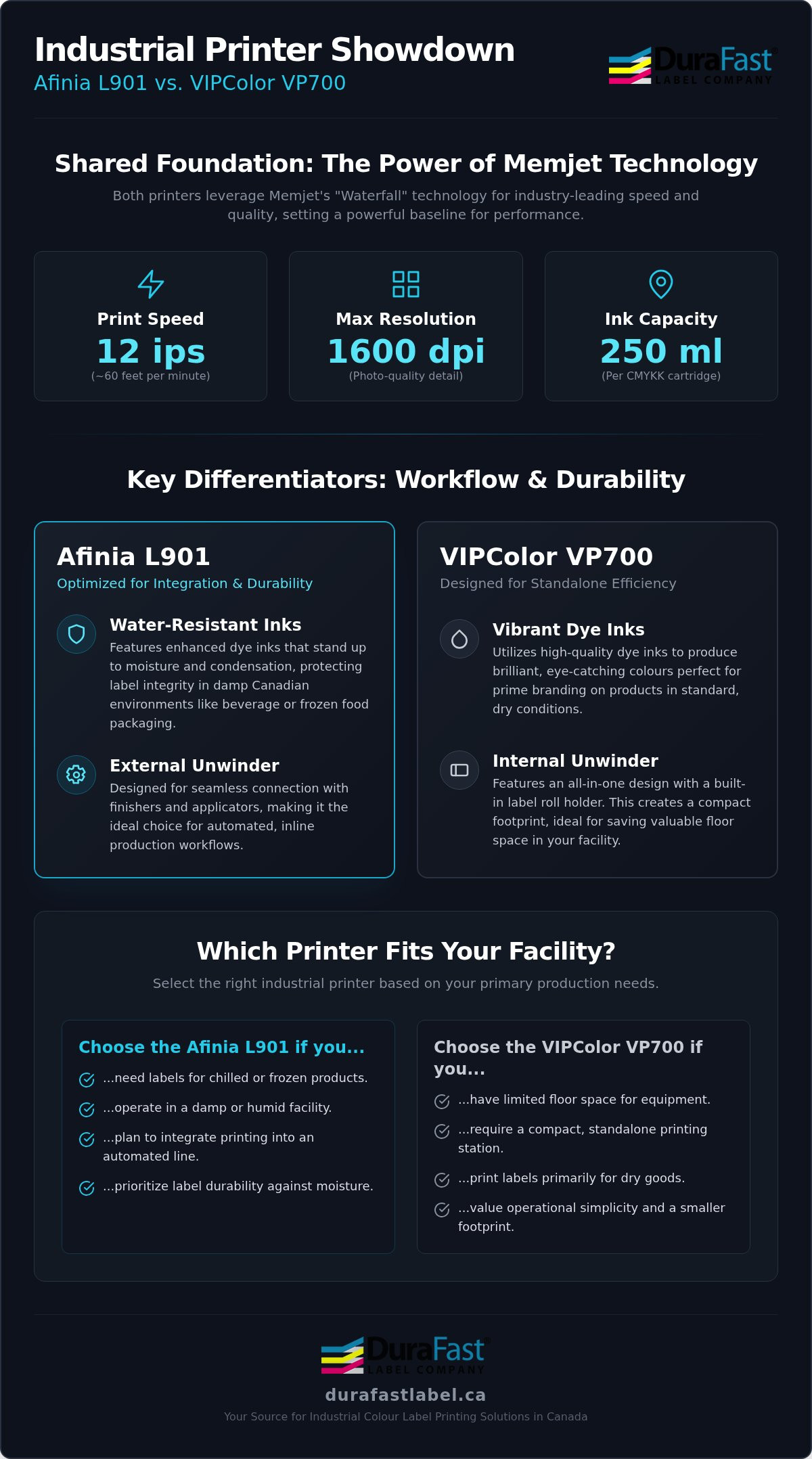
- Both printers utilize Memjet technology to achieve 12 ips speeds, but your choice should be dictated by your specific workflow and label durability requirements.
- Realize the importance of ink chemistry, specifically how the Afinia L901 Plus uses water-resistant technology to protect labels from condensation and moisture.
- Evaluate the spatial footprint of your facility by comparing the VIPColor VP700's internal label unwinder against the Afinia’s external configuration.
- The Afinia L901 vs VIPColor VP700 comparison highlights which printer is better suited for seamless inline integration versus a compact, standalone setup.
- Gain a clear understanding of the total cost of ownership by analyzing the impact of 250 ml ink tanks on long-term production efficiency.
The Industrial Memjet Heavyweights: Afinia L901 and VIPColor VP700
The 1600 dpi revolution has fundamentally changed how Canadian businesses approach their packaging. For years, high-volume prime product labels were the exclusive domain of commercial print houses. Now, the Afinia L901 vs VIPColor VP700 debate centres on which machine can best bring that professional quality directly to your warehouse floor. These aren't your typical desktop units; they're heavy-duty systems designed for high-capacity output. The main difference between these industrial powerhouses and standard inkjet models is the stationary printhead. While traditional printers move the head back and forth, these machines move the media under a fixed array, allowing for speeds that keep up with even the most demanding production lines.
What is Memjet Technology?
The secret behind these speeds is Memjet printing technology. It uses a "Waterfall" mechanism where over 70,000 ink nozzles fire simultaneously across the entire width of the page. This allows you to achieve a staggering 1600 x 1600 dpi resolution without sacrificing throughput. When you use high-quality dye inks, the result is vibrant, eye-catching branding that rivals traditional offset printing. It's a game-changer for businesses that need crisp text and photographic detail on every label. This technology ensures that even at 12 ips, the ink coverage remains consistent and professional.
The Shift to In-House Production in Canada
Why are so many Canadian facilities moving away from outsourced printing? It's about control. Relying on external print houses often means dealing with long lead times and minimum order quantities that lead to label obsolescence. If your branding changes or a regulation updates, you're stuck with thousands of useless labels. By integrating colour label printers like the L901 or VP700, you print only what you need. This reduces waste and ensures your inventory is always current. You gain the agility to respond to market shifts instantly, which is vital for staying competitive in 2026. Whether you're dealing with wet labels for beverages or industrial stickers for dusty warehouses, having the equipment on-site simplifies your logistics.
Scaling beyond entry-level desktop units is a significant milestone for any growing company. If your current printer can't keep pace with your finishing equipment, you've likely hit a production bottleneck. These industrial label printers are designed to bridge that gap. They offer the reliability required for multi-shift operations and the capacity to handle large 250 ml ink tanks, minimizing the time your staff spends on maintenance and setup. Choosing between these two giants isn't just about speed; it's about finding the hardware that aligns with your specific operational flow.
Technical Benchmarks: Speed, Resolution, and Ink Capacity
In the Afinia L901 vs VIPColor VP700 comparison, technical specifications look nearly identical on paper. Both machines offer a top speed of 12 inches per second (ips) and a maximum resolution of 1600 x 1600 dpi. However, how these machines manage these benchmarks during a long production run is what separates a smooth operation from a series of costly interruptions. It's not just about how fast the printer can go; it's about how long it can maintain that pace without manual intervention.
Print Speed and Throughput Efficiency
How does 12 ips translate to your daily output? At full speed, you're printing approximately 60 feet of labels every minute. For a standard 4x6 shipping label, that's thousands of units per hour. Most Canadian logistics centres find that the 12 ips mode is perfect for high-volume industrial jobs where speed is the priority. If you require the absolute highest quality for prime branding, switching to 6 ips allows the printer to hit the full 1600 x 1600 dpi resolution. It's a strategic trade-off. You choose between maximum throughput or maximum detail based on the specific job requirements for your colour-label-printers.
Ink Management and Cartridge Capacity
Both the L901 and the VP700 utilize five individual 250 ml ink cartridges in a CMYKK configuration. This high capacity is essential for industrial environments because it drastically reduces downtime. You won't find yourself swapping cartridges every few hundred labels. When analyzing inkjet printing economics, the larger tank size significantly lowers the total cost of ownership compared to entry-level units with small tanks. The only difference you'll notice in maintenance is how the L901 handles printhead cleaning while inline. This feature allows the L901 to service the printhead without breaking the web, which is a massive advantage if you're integrated with a finisher.
Media Handling and Versatility
Versatility is key for Canadian businesses that handle everything from frozen food to industrial chemicals. These machines support a maximum print width of 8.5 inches and work seamlessly with a wide range of blank labels for sale. Whether you need matte paper for a rustic look, semi-gloss for retail, or high-gloss synthetic for wet environments, the Memjet heads deliver consistent results. If you aren't sure which media thickness your specific finishing line requires, you can request a media compatibility test from our specialists. This ensures you don't face jamming issues or poor ink adhesion on specialized stocks like those used for frozen food condensation or dusty warehouse environments. When evaluating the Afinia L901 vs VIPColor VP700 for your specific application, these technical benchmarks provide the foundation for a reliable in-house printing strategy.
Hardware Architecture: Internal vs. External Unwinders
How much floor space can you spare for your labelling operation? While the internal components of the Afinia L901 vs VIPColor VP700 share a similar Memjet lineage, their physical footprints are designed for very different environments. The main difference between these two machines is the location of the label unwinder. This hardware choice affects everything from how often you clean your printhead to how easily you can integrate the printer into an existing finishing line. Understanding these spatial dynamics is essential before you commit to a specific model for your Canadian facility.
The VIPColor VP700: Compact and Enclosed
The VP700 features an internal label unwinder, meaning the roll is housed entirely within the printer's chassis. This design is a better choice for businesses operating in dusty or industrial environments where environmental debris can settle on exposed media. By keeping the labels enclosed, you reduce the risk of dust reaching the printhead, which prevents premature wear and ensures consistent output.
- Space Efficiency: The self-contained design is ideal for tight workspaces or mobile production carts.
- Ergonomics: Accessing the roll is straightforward, making it suitable for high-frequency roll replacements in standalone setups.
- Protection: The enclosed path guards against humidity and airborne contaminants common in many Canadian warehouses.
The Afinia L901: Built for Inline Integration
In contrast, the Afinia L901 utilizes an external configuration where the media sits on a separate unwinder behind the machine. This layout is specifically designed for automated, continuous production lines. Because the media isn't locked behind a chassis door, the L901 allows for a "straight-through" paper path. This is the only difference that truly matters if you plan on connecting your printer to label rewinders and finishers.
The external setup facilitates seamless media changes without disturbing the alignment of the finishing equipment. It allows the printer to act as a modular component in a larger system, rather than a standalone island. If your goal is to realize a fully automated workflow, the L901's architecture provides the necessary flexibility. While it requires a slightly larger footprint, the ergonomic benefit of not having to open a side door to thread media through a cramped internal path is significant for operators running multi-shift schedules. This makes the L901 a superior choice for high-volume facilities that prioritize operational seamlessness over a compact footprint.
Operational Costs and Total Cost of Ownership (TCO)
How do you calculate the actual value of your investment when the hardware prices vary so significantly? While the initial purchase price is a major factor, the true cost of ownership is found in the daily operation of the Afinia L901 vs VIPColor VP700. For a high-volume Canadian production line, the price-per-label often matters more than the machine's upfront cost. You need to realize that a printer with a lower entry price might incur higher maintenance or consumable expenses over a three-year lifecycle. Conversely, a higher initial investment in a model like the L901 Plus can lead to long-term savings through increased durability and reduced label waste.
Ink Consumption and Efficiency
Memjet technology is designed to optimize ink droplets, firing millions of microscopic drops per second to ensure vibrant coverage without over-saturation. This precision reduces waste and ensures that your inkjet color label printers operate at peak efficiency. When you compare the cost of VIPColor ink cartridges to Afinia equivalents, you'll find that both utilize 250 ml tanks to keep costs low. These high-capacity tanks are a financial lifesaver for large-scale production. They allow you to purchase ink in bulk, which significantly drops the cost-per-ml compared to smaller, desktop-class cartridges. This efficiency is what allows in-house printing to beat the prices offered by external print houses.
Durability and Application Specifics
Does your product face harsh environments? This is where the choice between standard dye inks and water-enhanced dye inks becomes critical. The Afinia L901 Plus features Watershield technology, which provides enhanced resistance to moisture and UV exposure. This is the better choice if your labels will be introduced to water or stored in cold environments where condensation for frozen foods is a constant threat. Standard dye inks are perfect for dry retail goods, but they may smudge when exposed to damp warehouse conditions or refrigerated transport.
Maintenance also plays a role in your TCO. Both machines require periodic printhead replacements, but the L901’s ability to service the head without stopping the line prevents costly downtime. If your labels need to maintain their professional look in industrial settings or cold storage, investing in the "Plus" versions of these machines ensures your branding remains intact. To get a detailed cost-per-label analysis based on your specific artwork, you should contact our consulting team for a custom quote today. Understanding these logistical hurdles now prevents expensive surprises later in your production cycle.
The Verdict: Selecting the Best Fit for Your Canadian Facility
Deciding between the Afinia L901 vs VIPColor VP700 ultimately comes down to your facility's physical layout and your specific durability requirements. While both machines utilize the high-speed technology established in previous sections to deliver 12 ips speeds, they serve different operational roles. The main difference is that one is optimized for standalone versatility in challenging environments, while the other is engineered for high-speed, automated finishing lines. Realizing which one fits your workflow requires looking beyond the spec sheet to your daily production hurdles.
Choose the VIPColor VP700 if...
The VP700 is the better choice if you require a compact, standalone unit that can thrive in a typical Canadian warehouse. Because it features an internal label unwinder, your media remains protected from dust and environmental debris. This enclosed design is a significant advantage if your production centre isn't a climate-controlled clean room. It's also the only difference that matters if floor space is at a premium. You'll find the setup simple and user-friendly, making it ideal for businesses that run diverse batch sizes and need to swap rolls quickly without reconfiguring an entire line.
Choose the Afinia L901 if...
The L901 is the superior option if inline integration with finishers is your top priority. Its external unwinder and straight-through paper path allow it to sit perfectly at the head of an automated finishing system. If you're running continuous, high-volume industrial labelling, the L901’s ability to service the printhead without breaking the web prevents costly production stops. Additionally, you should choose the L901 Plus model if your labels will be introduced to water or cold storage, as the Watershield technology provides the enhanced durability needed for frozen foods.
Ready to Scale Your Production?
Transitioning to in-house production is a strategic move that requires more than just a piece of equipment; it requires a partner who understands the logistical challenges of the Canadian market. DuraFast Label Company Canada supports your growth by providing authorized hardware sales, localized support, and a robust inventory of consumables. We can help you perform a personalized cost-per-label analysis to ensure your new printer delivers the fiscal responsibility your business demands. Browse our full range of industrial label printers today!
Organizing a sample print or a demo is the best next step to see these machines in action. By testing your specific artwork on the actual media you intend to use, you can verify the colour accuracy and ink adhesion before making a final commitment. Contact DuraFast Label Company Canada to realize the full potential of your labelling process.
Mastering Your In-House Labelling Strategy
Choosing between the Afinia L901 vs VIPColor VP700 is about more than just matching technical specs; it's about aligning your hardware with your facility's long-term operational goals. We've explored how the L901 excels in automated finishing lines while the VP700 offers superior protection in standalone, dusty environments. By understanding these hardware distinctions and the impact of ink chemistry on your total cost of ownership, you can now make a decision that ensures both fiscal responsibility and production efficiency.
DuraFast Label Company Canada is committed to being more than just an equipment vendor; we are your strategic partner in growth. As an authorized Canadian dealer, we maintain a comprehensive local stock of Memjet inks and printheads to ensure your production never skips a beat. Our expert technical support is tailored specifically for the unique challenges of Canadian businesses, helping you overcome logistical hurdles with ease. If you're ready to lower your cost-per-label, compare industrial label printers and request a quote at DuraFast Label Company Canada. We look forward to helping you scale your production with confidence.
Frequently Asked Questions
What is the main difference between dye inks and water-enhanced dye inks?
The main difference is the level of resistance to moisture and environmental exposure. Standard dye inks provide exceptional colour vibrancy for retail goods but can smudge if they get wet. Water-enhanced dye inks, like those in the Afinia L901 Plus, provide a protective barrier against condensation for frozen foods or damp environments. This makes the "Plus" models a better choice for Canadian facilities handling chilled products or industrial goods.
Can the VIPColor VP700 be integrated with an external rewinder?
Yes, the VIPColor VP700 can be integrated with an external rewinder. Even though it features an internal label unwinder to protect media from dust, the output side is designed to pair seamlessly with finishing equipment. This allows you to create finished rolls for automatic applicators. Most Canadian businesses use this configuration to balance the compact footprint of the printer with the high-volume needs of a continuous production line.
How often do I need to replace the Memjet printhead on these models?
Printhead longevity varies based on your specific print volume and maintenance habits. Typically, a printhead is replaced after it has processed several litres of ink, though regular cleaning cycles help maintain nozzle health. Because the Afinia L901 vs VIPColor VP700 both use the same core technology, their replacement intervals are comparable. Keeping your warehouse environment clean and using high-quality blank labels are the best ways to maximize the life of this component.
Are Afinia L901 and VIPColor VP700 labels interchangeable?
Yes, labels for these models are generally interchangeable because both machines utilize the same Memjet technology requirements. As long as the media is inkjet-receptive and the roll dimensions, such as core size and outer diameter, match the printer's specifications, you can use the same stock. We provide a wide range of compatible blank labels for sale that work across both platforms, ensuring you don't have to manage separate inventories for different machines.
What is the maximum print speed in inches per second for these printers?
Both the Afinia L901 and the VIPColor VP700 reach a maximum print speed of 12 inches per second (ips). This high-speed mode operates at 1600 x 800 dpi resolution, which is ideal for industrial applications. If you require the highest quality for prime branding, you can switch to 6 ips. This slower mode increases the resolution to 1600 x 1600 dpi, ensuring every detail on your colour labels is crisp and professional.
Do these industrial printers support GHS or WHMIS label compliance?
These specific Memjet models are not typically used for GHS or WHMIS compliance because they use dye-based inks. GHS labelling usually requires pigment-based inks and BS5609-certified media to withstand harsh chemicals and seawater exposure. If you require GHS compliance, we recommend looking at pigment inkjet models like the Afinia L502. The L901 and VP700 are better suited for prime product packaging and high-volume retail labels where colour vibrancy is the priority.
What kind of maintenance is required for high-speed Memjet printers?
High-speed Memjet printers require regular printhead cleaning and service station maintenance to prevent nozzle clogs. It's essential to keep the printer in a clean environment to avoid environmental debris from entering the paper path. The Afinia L901 offers a unique advantage here, as it can perform maintenance cycles while inline without breaking the label web. This reduces downtime and helps you realize a more efficient workflow during long, continuous industrial print runs.
Is there a significant difference in power consumption between the L901 and VP700?
There is no significant difference in power consumption between these two models. Since they are built on the same core Memjet engine, their electrical requirements during operation and standby are nearly identical. Both are designed to be energy-efficient for industrial environments. Your choice between the Afinia L901 vs VIPColor VP700 should be based on hardware architecture and integration needs rather than energy costs, as neither will noticeably impact your facility's utility bills.