Afinia L801 vs. L901: Choosing the Best Printer for You
23rd Jul 2026
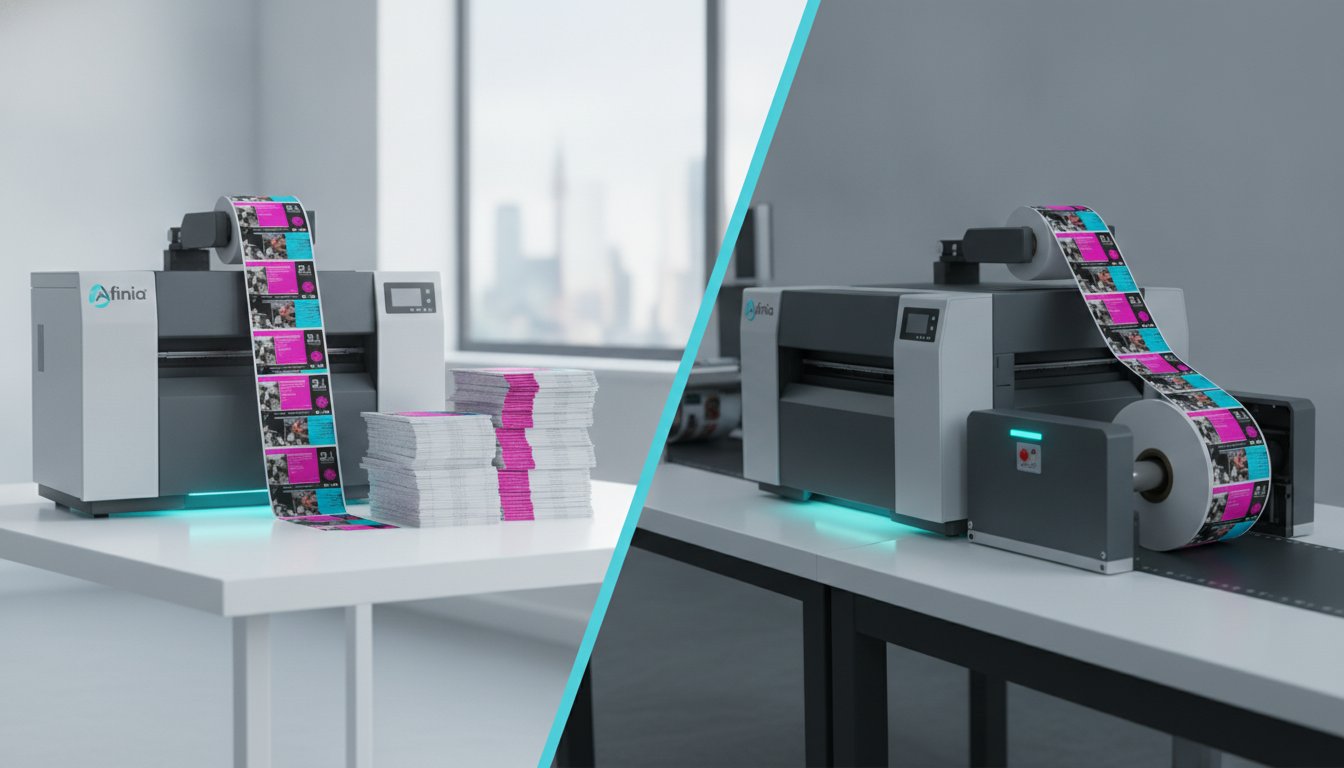
Can a lower upfront equipment cost actually lead to higher operational expenses over time? If you've ever dealt with a stalled production line because of printhead cleaning or high ink costs during a massive run, you know that uptime is your most valuable asset. Many business owners ask, "What is the difference between Afinia L801 and L901 printers?" when they're looking to scale their in-house labelling without sacrificing reliability. It's a vital question because choosing the wrong hardware can result in avoidable downtime and integration headaches.
We're here to help you navigate this decision by highlighting the critical technical and operational differences between the Afinia L801 and L901 series. You'll learn how to determine which industrial label printer fits your production workflow while maximizing your total cost of ownership. We'll explore specific metrics like the 12 inches per second print speed and 1600 dpi resolution shared by both models. We will also focus on the L901’s unique ability to perform maintenance on-the-fly and the benefits of Watershield inks for moisture resistance. This guide provides the clarity you need to ensure your labels stay professional and your finishing equipment stays perfectly synced.
Key Takeaways
- Understand how shared Memjet technology delivers professional 1600 dpi resolution and high-speed output across both the L801 and L901 series.
- Learn why "Plus" models featuring Watershield water-enhanced dye inks are the preferred choice for labels exposed to moisture, refrigeration, or condensation.
- Discover what is the difference between Afinia L801 and L901 printers regarding maintenance, specifically how the L901’s "on-the-fly" servicing prevents production line stoppages.
- Compare hardware configurations and footprints to determine whether an internal or external label unwinder best fits your facility's production floor space.
- Identify the ideal model for your specific workflow, whether you require the batch-production flexibility of the L801 or the seamless inline integration of the L901.
Introduction to Afinia Memjet Label Printers
Are you struggling with high minimum order quantities or long lead times from your current label supplier? Many Canadian businesses find that bringing production in-house is the most effective way to reclaim control over their supply chain and realize significant cost savings. The Afinia L801 and L901 series represent the pinnacle of high-speed colour label printers, utilizing advanced technology to deliver professional-grade results at a fraction of the cost of outsourced printing. While they share a similar foundation, understanding what is the difference between Afinia L801 and L901 printers is essential for selecting the right tool for your specific production environment. The L801 is generally classified as a commercial-grade solution designed for batch printing, whereas the L901 is built for more rigorous industrial applications and continuous integration.
The Power of Memjet Technology
The engine behind these machines is Memjet printing technology, which differs significantly from traditional thermal transfer or scanning inkjet systems. Instead of a printhead that moves back and forth, Memjet uses a stationary "waterfall" printhead that spans the entire width of the media. This hardware configuration allows for incredible speeds of up to 12 inches per second (ips). Because the head remains fixed, it can fire millions of 1.2 picolitre ink droplets every second with extreme precision. This results in vibrant colour reproduction and a stunning 1600 x 1600 dpi resolution that rivals offset printing. It is a massive leap forward for businesses that previously relied on slower, lower-resolution thermal systems.
Why Speed and Quality Matter for Canadian SMEs
For small to medium enterprises across Canada, the ability to print labels on demand eliminates the logistical hurdle of managing large, expensive inventories. Why wait weeks for a shipment from an external print house when you can produce exactly what you need in minutes? Transitioning to an in-house system allows you to react to market changes instantly while maintaining a low total cost of ownership. The benefits include:
- Reduced Lead Times: Launch new products or seasonal variations across Canada without the delays associated with third-party vendors.
- Eliminated MOQs: Print five labels or five thousand without the financial penalty of minimum order requirements or wasted stock.
- Brand Consistency: Ensure every product on the shelf looks identical with professional-grade 1600 x 1600 dpi output that captures fine text and complex graphics.
By choosing an Afinia printer, you are investing in a solution that scales with your growth. Whether you are labelling craft beverages in British Columbia or shipping artisanal foods from Ontario, these printers provide the reliability and speed necessary to keep your production lines moving without interruption. This diagnostic approach to your printing needs ensures that you don't just buy a machine, but rather implement a strategic asset for your business.
Ink Systems and the 'Plus' Advantage: Watershield™ Technology
Does your product face refrigeration, moisture, or frequent handling by customers? Standard inkjet labels often fall short in these demanding conditions, leading to smudged graphics and a diminished brand image. When evaluating what is the difference between Afinia L801 and L901 printers, the ink formulation is just as vital as the hardware speed. Both the L801 and L901 utilize five high-capacity 250ml ink cartridges (CMYKK), but the real distinction lies in the choice between standard dye inks and the "Plus" models featuring Watershield™ technology.
The standard Afinia models use traditional dye inks that deliver exceptional vibrancy on a wide range of media. However, these inks are susceptible to water damage. The "Plus" versions of both the L801 and L901 utilize "Niagara" water-enhanced dye inks. This chemistry allows businesses to produce labels that resist moisture and condensation without the need for expensive lamination. This capability is essential for the growing trend of extreme personalization, where durable, short-run labels must perform in real-world retail and shipping environments.
Watershield™ for Environmental Resilience
Watershield™ technology significantly improves the durability of your output by preventing ink migration when labels are introduced to water. This makes the L801 Plus and L901 Plus the better choices for chilled beverages, frozen food packaging, and chemical products. Beyond moisture resistance, these water-enhanced dye inks offer improved UV resistance for labels exposed to sunlight in retail windows. You will also notice deeper black levels and a wider colour gamut, which are critical for maintaining premium branding on high-end consumer goods.
Cost-Per-Label Efficiency in High-Volume Runs
Achieving a low total cost of ownership (TCO) requires a thorough understanding of your ink consumption. Both printer series use 250ml tanks to minimize the frequency of replacements during long production runs. Total ink consumption varies significantly based on the percentage of design coverage on your specific label artwork. By utilizing high-capacity Afinia ink cartridges, Canadian businesses can maintain predictable margins even as production volumes scale. If you aren't sure which ink formulation suits your specific substrate, you can request printed samples from our team to test in your own environment. This diagnostic approach helps you avoid costly trial and error on the production floor.
The Main Difference: Printhead Servicing and Maintenance
How much does a five-minute stoppage cost your production line? When you are running high-volume jobs, even minor interruptions can ripple through your entire schedule. While both machines deliver the same high-speed output, what is the difference between Afinia L801 and L901 printers in a live environment? The answer lies in how each system manages its Memjet printhead. Every inkjet system requires periodic servicing to clear microscopic debris and maintain nozzle health, but the way these two models handle that maintenance determines their suitability for your specific workflow.
L801 Maintenance: The Commercial Standard
The L801 is a reliable workhorse for batch production. It's designed for businesses that print labels in rolls to be applied later. However, it faces a logistical hurdle known as "breaking the web." When the L801 needs to perform a maintenance cycle, it must stop the print job entirely. The internal cutter engages to slice the label stock so the printhead can move to its service station. Once the cleaning is complete, you must manually re-thread the label material through the printer. This manual intervention is perfectly acceptable for a Canadian warehouse running distinct batches, but it becomes a bottleneck during 24/7 production cycles.
L901 Industrial Advantage: Inline Integration
The L901 was engineered to eliminate this downtime. It features "on-the-fly" maintenance technology, which allows the printhead to service itself without stopping the media. The printhead assembly is designed to move out of the way for cleaning while the label web continues to pass through the machine. This makes the L901 the essential choice for integration with digital label finishers and presses. By removing the need to re-thread the web, you eliminate the label waste and labour costs associated with frequent stoppages. If your goal is to maximize uptime in a continuous production environment, these industrial label printers offer a level of seamlessness that the commercial-grade L801 cannot match.
Choosing the L901 means your production line stays active. It's a strategic investment for businesses that realize the value of operational continuity. For those running high-volume, inline systems, the L901 is not just a faster option; it's the only logical choice to prevent the logistical hurdles of manual re-threading. This diagnostic approach to maintenance ensures your facility remains efficient, your costs stay predictable, and your output remains consistent regardless of the run length.

Hardware Configurations: Footprint and Environmental Resilience
How much space do you have on your production floor, and how clean is the air in your facility? When asking what is the difference between Afinia L801 and L901 printers, you must look beyond the internal specs to the physical hardware design. The L801 features an open commercial design that makes it easy to access the media path, but it leaves the printhead more exposed to the environment. In contrast, the L901 is housed in a rugged, enclosed industrial chassis. This enclosure is not just for aesthetics; it provides a critical barrier against environmental debris and dust that can clog nozzles and degrade print quality over time.
Unwinders, Rewinders, and Finishers
Managing your media efficiently is the key to unattended printing. The L801 typically relies on an external label unwinder, which increases the overall footprint but allows for larger roll capacities. You can choose standard or XL unwinder options depending on your batch sizes. If your facility has limited space, you might consider the VIPColor VP550 Memjet Color Label Printer as an alternative, as it offers a smaller footprint with similar technology. For Afinia users, adding a rewinder is essential for high-speed runs, allowing you to collect finished labels neatly for use in applicators.
Protecting Your Investment in Industrial Settings
Dusty environments, such as woodworking shops or busy shipping hubs, require the L901's superior sealing to maintain uptime. Static and media tension must also be managed carefully to ensure consistent print quality at 12 ips. The L901's solid steel construction is specifically engineered to dampen the vibrations of a factory floor, ensuring that the precision of the Memjet printhead is never compromised by heavy machinery operating nearby. To further protect your hardware, always source high-quality blank labels for sale that are designed for inkjet systems. Using inferior materials can lead to adhesive bleed, which gums up the internal components and leads to costly repairs.
If you are unsure which chassis design fits your specific environmental challenges, speak with our technical team today for a personalized assessment. We can help you determine if the open access of the L801 or the protective enclosure of the L901 is the better choice for your facility.
Choosing the Right Afinia Printer for Your Canadian Business
How do you determine which printer will provide the best return on investment for your facility? While both machines offer incredible 1600 dpi quality, the decision rests on your specific production rhythm and future scaling plans. When deciding what is the difference between Afinia L801 and L901 printers for your specific facility, the choice ultimately comes down to your integration requirements and production volume. The L801 Plus offers a lower entry point for businesses focused on batch production, while the L901 Plus is a strategic asset for those moving toward fully automated, high-volume labelling.
When to Choose the Afinia L801 Plus
The L801 Plus is an exceptional choice if you primarily print in batches and don't mind occasional manual intervention. It serves as a high-speed colour label printer that allows you to manage diverse product lines without a massive initial investment. If your labels are applied by hand or using a standalone applicator rather than an inline system, the L801 Plus provides all the vibrancy and moisture resistance you need. It is the pragmatic solution for Canadian SMEs that require professional results but don't yet operate continuous, re-threaded production lines.
When to Invest in the Afinia L901 Plus
The L901 Plus becomes the essential choice when your production runs are continuous and uptime is your primary metric. This model is specifically engineered to integrate with digital finishers like the DLP-2200, allowing for lamination, die-cutting, and waste removal in a single pass. If you are operating in a demanding industrial environment where dust or vibrations are present, the L901's enclosed chassis protects your investment far better than an open design. For businesses that also manage high-volume barcode-only shipping labels, you can refer to our comprehensive guide to thermal label printers to see how these systems can work together in your warehouse.
Before you make your final selection, use this checklist to evaluate your needs:
- Monthly Volume: Does your volume justify the L901's efficiency, or is the L801's batch capacity sufficient?
- Finishing Requirements: Do you plan to integrate with an inline finisher now or in the near future?
- Environmental Factors: Is your production floor prone to dust or debris that requires an enclosed industrial housing?
- Labour Costs: Have you calculated the cost of manual re-threading versus the L901's on-the-fly maintenance?
Choosing the right hardware is a diagnostic process that ensures your operational challenges have high-quality, accessible solutions. By selecting the model that aligns with your workflow, you take control of your production and set the stage for long-term growth. Whether you choose the commercial flexibility of the L801 Plus or the industrial power of the L901 Plus, you are investing in a system that values both quality and fiscal responsibility.
Optimize Your Labelling Strategy for Long-Term Success
Choosing between these two industrial powerhouses depends on your specific production rhythm and integration goals. While both systems deliver stunning 1600 dpi resolution at speeds of 12 ips, the choice hinges on your need for continuous uptime versus batch flexibility. Understanding what is the difference between Afinia L801 and L901 printers? is the first step toward realizing a more efficient and cost-effective labelling process. The L901’s ability to perform on-the-fly maintenance and its rugged, enclosed chassis make it the superior choice for high-volume, inline finishing.
DuraFast Label provides expert Canadian technical support to ensure your equipment remains a reliable asset for years to come. We maintain a full inventory of Afinia ink and specialized blank labels to keep your production moving without delay. With fast shipping across Canada, your facility can transition to a more professional in-house solution sooner than you think. If you're ready to lower your total cost of ownership and eliminate production bottlenecks, Shop Afinia Label Printers at DuraFast Label Canada to find your perfect match. Take control of your production today and empower your business to reach new heights of performance.
Frequently Asked Questions
What is the main difference between the Afinia L801 and L901?
The primary distinction lies in how each system handles printhead maintenance. What is the difference between Afinia L801 and L901 printers for your daily operations? The L801 is a commercial batch printer that must stop and cut the label stock to clean its printhead, whereas the L901 is an industrial machine capable of "on-the-fly" servicing. This allows the L901 to maintain a continuous media flow, making it the ideal choice for high-volume, automated environments.
Does the Afinia L801 Plus use the same ink as the L901 Plus?
No, the ink cartridges for these two models are not interchangeable. While both the L801 Plus and L901 Plus utilize five high-capacity 250ml tanks and Niagara water-enhanced dye inks, the internal chips and hardware configurations are model-specific. It's essential to stock the correct cartridges for your specific unit to ensure proper communication between the ink system and the printer firmware.
Can the Afinia L901 print on-the-fly without stopping?
Yes, the L901 is specifically engineered for continuous, on-the-fly maintenance. The printhead assembly is designed to move out of the media path for cleaning while the label web continues to pass through the machine. This eliminates the need to re-thread the material, which maximizes your operational uptime and prevents the labour costs associated with frequent manual interventions during long production runs.
Is Watershield™ ink really waterproof for Canadian winter shipping?
Watershield™ technology provides significant moisture resistance, making it highly effective for Canadian winter shipping conditions. While it isn't a replacement for pigment inks in GHS chemical applications, it prevents smudging and bleeding when labels face condensation or melting snow. This ensures your product branding remains professional and legible even when exposed to temperature fluctuations and damp environments during transit across Canada.
What is the print speed of the Afinia L801 in inches per second?
The Afinia L801 delivers impressive print speeds of up to 12 inches per second (ips). At this maximum speed, the printer maintains a sharp 1600 x 800 dpi resolution. If you require the highest possible quality, you can operate the printer at 6 ips to achieve a stunning 1600 x 1600 dpi. This speed allows Canadian businesses to complete large batch runs quickly without sacrificing professional-grade output.
Do I need an external unwinder for the Afinia L901?
Yes, the L901 typically requires an external label unwinder to manage the large roll diameters used in industrial settings. This hardware configuration ensures consistent media tension and allows for the high-volume, unattended printing that industrial facilities demand. Using an external unwinder also provides the stability necessary to maintain print precision during continuous, high-speed runs.
How do the ink costs compare between the L801 and L901?
The per-millilitre ink costs are very similar because both printers utilize 250ml cartridges. However, the L901 often proves more cost-effective in high-volume settings by reducing media waste. Because the L901 doesn't need to "break the web" for maintenance, you save the label stock that would otherwise be lost during the re-threading process required by the L801.
Which Afinia printer is better for inline digital label finishing?
The Afinia L901 is the only choice for seamless inline digital label finishing. Since it services its printhead without stopping the media, it can stay perfectly synchronized with finishers like the DLP-2200 for continuous lamination and die-cutting. The L801 is better suited for roll-to-roll batch production where the finished rolls are moved to a separate finishing station later.