Afinia L502 vs VIPColor VP550: Which Mid-Range Label Printer Wins for Your Canadian Business?
31st Aug 2026
The most expensive label printer isn't always the one with the highest price tag; it's the one that produces labels that fail in the field. You might think that choosing between the Afinia L502 vs VIPColor VP550 is a simple matter of comparing raw print speeds, but for a Canadian business, the real test happens in the back of a cold delivery truck or a damp warehouse. It's frustrating to watch your brand's professional colour and 1600 dpi imagery smudge away because of winter moisture or condensation. We understand that you're looking for a way to reduce your cost-per-label while maintaining a premium look that scales with your growth.
This guide breaks down the critical differences in ink durability, operational efficiency, and hardware resilience to ensure your investment pays off. You'll discover how the Afinia L502's flexible ink options compare to the high-speed Memjet technology of the VIPColor VP550. We'll examine how these machines handle the logistical hurdles of in-house labelling to help you eliminate production bottlenecks and keep your operations running seamlessly throughout 2026.
Key Takeaways
- Compare the 8 ips print speed of the VP550 with the 5 ips capacity of the L502 to identify which machine best supports your daily production throughput.
- Understand how the Afinia L502's Duo Ink system allows you to swap between dye and pigment inks, providing the durability needed for wet or cold Canadian shipping environments.
- Evaluate the Afinia L502 vs VIPColor VP550 based on your specific requirements for 1600 dpi resolution versus the need for a rugged, all-steel industrial design.
- Learn how media handling features, such as internal versus external label unwinders, impact your workspace footprint and protect your labels from environmental debris.
- Determine which model offers the best cost-per-label for your business by using our prescriptive decision matrix tailored for the 2026 Canadian market.
Navigating the Mid-Range: Why Compare the Afinia L502 and VIPColor VP550?
Why are these two models dominating the conversation for Canadian SMEs in 2026? The mid-range category represents a vital investment for businesses producing between 5,000 and 50,000 labels per month. It's the "sweet spot" where industrial reliability meets desktop accessibility. A modern label printer in this class isn't just a peripheral; it's a production hub that dictates your workflow efficiency. Choosing between the Afinia L502 vs VIPColor VP550 means deciding how your brand interacts with its environment and its budget. We view our role as a strategic partner in your growth, ensuring your hardware selection supports long-term fiscal responsibility rather than just filling a temporary gap.
The In-House Advantage for Canadian Entrepreneurs
Are you tired of waiting weeks for a third-party print shop to deliver a corrected batch? Moving to an in-house colour label printer setup eliminates those lead times immediately. This transition allows you to realize significant savings by printing only what you need, when you need it. Maintaining a professional brand image is easy with 1600 dpi resolution that rivals commercial presses. For Canadian entrepreneurs, this flexibility is vital. Whether you're launching a limited-run seasonal product or adjusting bilingual text to meet federal regulations, having control over your timeline ensures you never miss a market opportunity. It's a move that prioritizes operational seamlessness by reducing waste and inventory costs.
Core Technologies: Memjet vs. HP Thermal
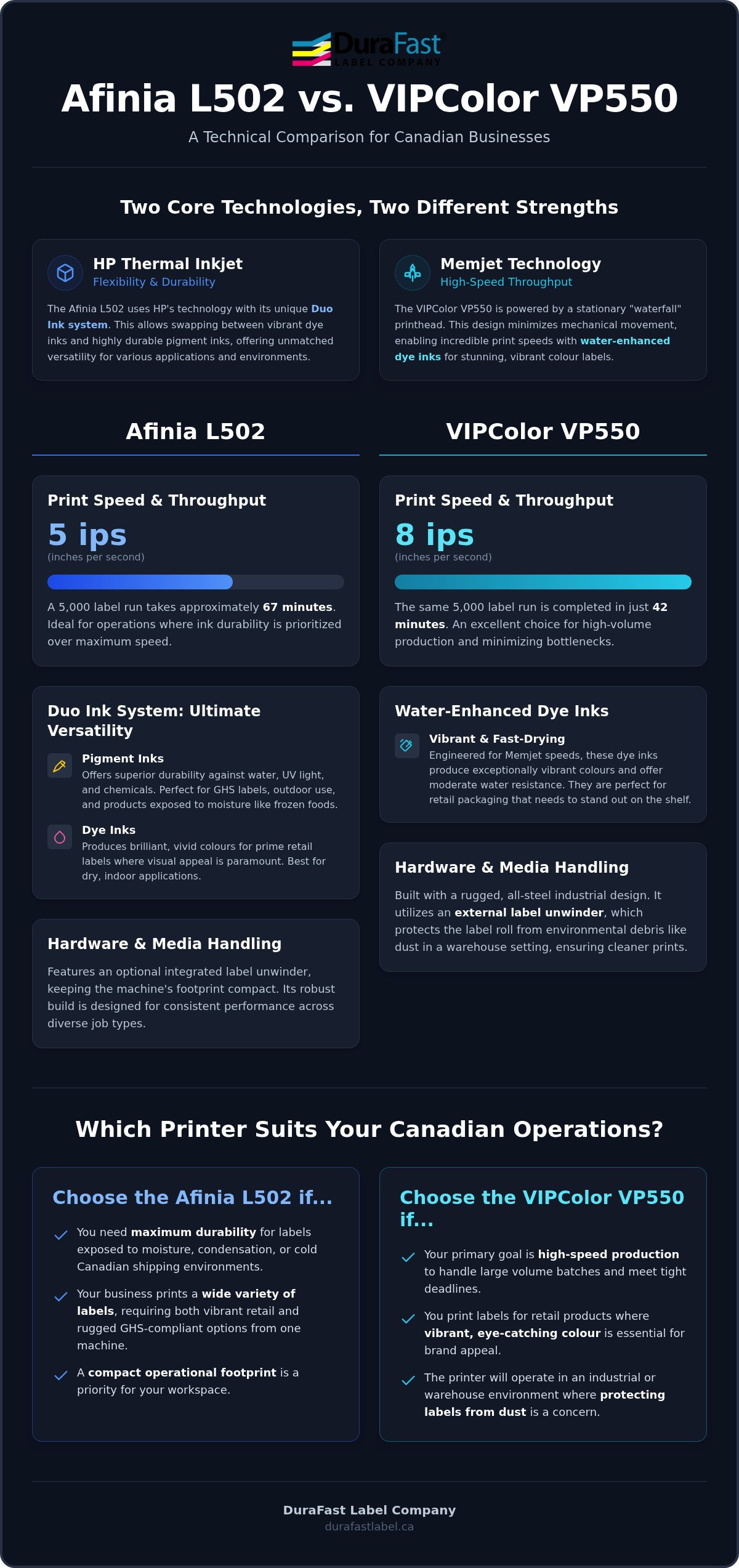
The technical foundation of these machines determines their practical strengths. The VIPColor VP550 utilizes Memjet technology, which is a fixed printhead system designed for high-speed output. This model relies on water-enhanced dye inks that produce vibrant, eye-catching colours for retail packaging. In contrast, the Afinia L502 uses HP Thermal Inkjet technology featuring the unique Duo Ink system. This allows you to swap between dye-based and pigment-based ink heads depending on the specific job requirements. While dye inks provide aesthetic brilliance, pigment inks offer the rugged durability required for GHS compliance or harsh shipping conditions. Understanding the Afinia L502 vs VIPColor VP550 comparison starts with recognizing if you need the "waterfall" speed of Memjet or the chemical resilience of HP's pigment system. Both machines offer professional results, but they solve different logistical hurdles.
Speed and Production Throughput: Calculating Your Daily Efficiency
How fast do you really need to go to keep your production line moving? In the comparison of the Afinia L502 vs VIPColor VP550, raw velocity is often the first metric business owners examine. While the VIPColor VP550 boasts a top speed of 8 inches per second (ips), the Afinia L502 operates between 2.4 and 5 ips. This difference is significant when calculating daily throughput for large-scale operations. If your business is scaling rapidly, understanding how these speeds translate into labels-per-shift is essential for avoiding production bottlenecks during peak Canadian retail seasons.
Memjet Speed: The VIPColor VP550 Advantage
The 8 ips capability of the VP550 is a game-changer for high-volume batches. Because it utilizes a stationary Memjet printhead, the machine can maintain high-resolution 1600 x 1600 dpi output without the mechanical delays of a moving carriage. For a typical run of 5,000 four-inch labels, the VP550 completes the task in roughly 42 minutes of active print time. The hardware is designed to handle these continuous runs without overheating, ensuring that your workflow remains steady. This efficiency allows a single operator to manage multiple tasks while the printer handles the bulk of the production. If you are unsure which speed fits your current volume, you can speak with our team to run a cost-and-time analysis for your specific label sizes.
Afinia L502: Steady Performance for Diverse Needs
While the Afinia L502 is slower on paper, it prioritizes ink flexibility and consistent quality over raw velocity. Operating at 5 ips for most standard jobs, it finishes that same 5,000-label run in approximately 67 minutes. This extra time is often a worthy trade-off for businesses that require the "Duo Ink" versatility mentioned previously. The HP Thermal technology ensures the print quality remains sharp across a wide variety of media, from matte paper to high-gloss synthetics. In many cases, "slower" is actually better for complex label designs that require precise ink placement to maintain brand integrity.
Addressing the Bottleneck Myth
Speed is not the only metric for efficiency. It's a common myth that the fastest printer always wins. Real-world efficiency includes media changes, ink cartridge swaps, and daily maintenance. A printer that runs at 8 ips but requires frequent cleaning cycles might actually produce fewer labels per shift than a 5 ips machine that runs reliably for hours. Consider these daily output estimates for a standard 8-hour shift:
- VIPColor VP550: Realistically produces 15,000 to 20,000 labels depending on size and resolution settings.
- Afinia L502: Realistically produces 8,000 to 12,000 labels while offering greater resilience for varied environments.
Choosing the right hardware requires balancing these throughput numbers against your actual daily demand. If your primary goal is clearing massive backlogs quickly, the VP550 is the superior choice. However, if your production is steady and requires varied ink types, the L502 provides the industrial reliability your Canadian business needs.
Ink Chemistry and Durability: Water-Enhanced Dye vs. Duo Ink
Selecting the right printer often comes down to where your product ends up. In the comparison of the Afinia L502 vs VIPColor VP550, the ink chemistry defines the label's lifespan. Dye-based inks are known for their vibrant colour saturation, making them ideal for high-end retail packaging. However, standard dye inks often fail when introduced to water. Pigment-based inks offer superior environmental resilience, resisting UV exposure and chemical abrasion. The main difference between these two machines is how they bridge the gap between aesthetic appeal and industrial durability.
The Power of Water-Enhanced Dye for the Cold Chain
The VIPColor VP550 utilizes a specialized "water-enhanced" dye ink. Unlike traditional dye inks that smudge at the first sign of moisture, this formulation is engineered to withstand condensation. This is a critical advantage for the Canadian cold chain. When products move from a chilled warehouse to a delivery truck, temperature fluctuations create moisture. These inks ensure your branding remains crisp and professional rather than peeling away. For businesses in the beverage or frozen food sectors, using VIPColor VP550 labels ensures that your media is perfectly matched to this unique ink chemistry. It's a reliable solution for maintaining brand integrity during the harsh Canadian shipping route.
Afinia L502: The Versatility of Pigment Ink for GHS
What if your needs change month to month? The Afinia L502 offers a unique "Duo Ink" system that allows you to swap between dye and pigment printheads. This versatility is essential for businesses that produce both prime retail labels and industrial safety stickers. If you require BS5609 compliance for chemical labelling, pigment ink is the only choice. It provides the longevity needed to survive heavy UV exposure and contact with oils or solvents. By pairing the machine with Afinia L502 labels designed for industrial use, you create a labelling solution that won't fail in dusty or wet environments. This flexibility allows you to use a single printer for diverse applications, from high-gloss retail stickers to rugged GHS-compliant tags.
Choosing between these systems requires a diagnostic look at your product's journey. If your labels face constant moisture but need high-impact colour, the water-enhanced dye of the VP550 is a better choice. If you need a machine that can adapt to chemical labelling one day and retail packaging the next, the L502's Duo Ink system provides the necessary fiscal responsibility. Both printers empower you to take control of your production, but they do so through very different chemical strengths.
Operational Logistics: Hardware Footprint and Media Handling
When you're designing a production centre, every square centimetre of bench space matters. The physical configuration of your hardware dictates how smoothly your team can manage media changes during a high-pressure shift. In the comparison of the Afinia L502 vs VIPColor VP550, the most striking logistical difference is the unwinder configuration. The L502 is designed with a rugged, all-steel industrial body that houses an internal label unwinder. This enclosed design is a major benefit if your workspace is prone to "environmental debris" or dust, as it keeps the label roll protected from contaminants before it reaches the printhead.
The VIPColor VP550 typically requires a slightly larger footprint to accommodate its high-capacity ink tanks and external media handling. While an external unwinder takes up more room on the table, it often allows for easier access when reloading large media rolls. If your workflow involves constant roll swaps for different product sizes, the open access of the VP550 might save your operators valuable minutes. However, for businesses operating in tighter quarters or dusty warehouse environments, the compact and shielded nature of the L502 provides a distinct advantage in maintaining printhead health.
Workspace Organization in the Production Centre
Efficiency doesn't end when the ink hits the paper. To truly scale your in-house production, you should consider how the printed rolls are handled. Integrating label rewinders and finishers can automate the post-print process, allowing you to move directly from the printer to the application line. The VP550’s industrial reliability makes it a natural fit for these automated setups, especially when running continuous batches. We recommend mapping out your labelling station to ensure that media flows logically from the unwinder through the printer and onto a rewinder without creating physical obstructions for your staff.
Media Compatibility and Consumables
Calculating the Total Cost of Ownership (TCO) requires looking beyond the initial purchase price. You must account for ink volume and media waste. The VP550 uses large ink tanks (ml) that are designed for long, uninterrupted runs, which typically results in a lower cost-per-label for high-volume users. The L502 uses smaller cartridges but offers the "Duo Ink" flexibility we discussed earlier. Regardless of which model you choose, using brand-specific inkjet labels is the best way to prevent clogs and ensure consistent results. If you're struggling to determine which hardware footprint fits your current facility, you can contact our specialists for a comprehensive workspace audit.
Ultimately, the choice between these two machines depends on your specific logistical hurdles. Does your environment require the protected, internal unwinder of the L502, or do you have the space to leverage the high-capacity throughput of the VP550? Both machines are built for longevity, but matching the hardware configuration to your physical workspace is the key to achieving operational seamlessness.
The Decision Matrix: Which Printer Suits Your Canadian Operations?
Choosing between the Afinia L502 vs VIPColor VP550 ultimately depends on whether you value raw throughput or application versatility. The main difference between these two models is the balance they strike between speed and ink chemistry. While the VP550 is a powerhouse for high-volume retail branding, the L502 offers the industrial flexibility required for diverse product lines. As a strategic partner in your growth, we recommend evaluating your most common logistical hurdles before making a final investment for your 2026 production goals.
Scenario 1: You Prioritize High-Speed Product Branding
If your business focuses on fast-moving consumer goods that require vibrant, high-resolution retail labels, the VIPColor VP550 is the clear winner. It leverages Memjet technology to produce stunning 1600 dpi imagery at 8 ips, ensuring your brand stands out on crowded Canadian shelves. This model is ideal for companies that need to clear large backlogs quickly without sacrificing the professional look that consumers expect. For a deeper technical dive into maximizing this hardware's potential, you can consult the VIPColor VP550 Ultimate Guide.
Scenario 2: You Require Industrial Durability and Compliance
Does your product line include chemicals, horticultural supplies, or items destined for outdoor environments? The Afinia L502 is the superior choice for these demanding applications. The Duo Ink system allows you to produce pigment-based WHMIS labels that remain legible even when introduced to water, UV exposure, or chemical abrasion. Its all-steel construction and internal unwinder provide the resilience needed for dusty production centres. While it operates at a lower ips than the VP550, the longevity of the prints ensures you stay compliant with federal safety regulations.
Scaling your production as your business grows often involves moving from a single printer to a multi-unit production centre. For the Canadian SME looking for the best ROI, the decision should be prescriptive. If you're printing for the cold chain or high-end retail, the VP550’s speed and water-enhanced dye inks offer the best value. If your operations span from prime retail to industrial safety, the L502’s versatility is unmatched. By selecting the hardware that matches your product’s environmental journey, you ensure a scalable workflow that supports your long-term fiscal responsibility.
Empowering Your In-House Production for the 2026 Market
Choosing between the Afinia L502 vs VIPColor VP550 isn't just about comparing technical specs; it's about securing your operational future. You've seen how the VIPColor VP550 dominates high-volume retail with its 8 ips speed, while the Afinia L502 offers unmatched versatility through its Duo Ink system. Whether you need the vibrant clarity of water-enhanced dye for the cold chain or the chemical resilience of pigment inks for compliance, the right choice ensures long-term fiscal responsibility.
As an authorized Afinia and VIPColor Canadian partner, we're here to be your strategic resource for scaling in-house production. We provide expert technical support and maintain an extensive inventory of supplies to prevent any disruption to your workflow. With fast shipping on all ink and label supplies across Canada, you can focus on growing your brand while we handle the logistical details. Are you ready to reduce your cost-per-label and take full control of your packaging? Browse our full range of Colour Label Printers at DuraFast Label Canada to find your ideal solution. We're excited to help you achieve a more professional brand image and a truly scalable production workflow.
Frequently Asked Questions
What is the main difference between the Afinia L502 and VIPColor VP550?
The main difference between the Afinia L502 vs VIPColor VP550 is the underlying print technology and ink chemistry. The VP550 utilizes Memjet technology for high-speed output at 8 ips, while the L502 features a Duo Ink system that allows you to swap between dye and pigment inks. This makes the VP550 a better choice for high-volume retail branding, whereas the L502 is more suitable for diverse industrial applications requiring chemical resilience.
Can I use pigment ink in the VIPColor VP550 for GHS labels?
No, you cannot use pigment ink in the VIPColor VP550; it is designed specifically for water-enhanced dye inks. While these inks offer some moisture resistance for the cold chain, they don't meet the rigorous BS5609 standards required for GHS chemical labelling. If your business requires certified chemical durability, the Afinia L502 with its pigment printhead is the appropriate hardware solution for maintaining compliance in industrial settings while ensuring your labels don't smudge.
Which printer has a lower cost-per-label for Canadian businesses?
The VIPColor VP550 typically offers a lower cost-per-label for high-volume users because of its larger ink tanks and efficient Memjet printhead. These ml capacities reduce the frequency of cartridge swaps during long production runs, promoting fiscal responsibility. However, the true ROI depends on your waste levels and media types. For businesses requiring short runs of durable labels, the Afinia L502 prevents the financial loss associated with labels that fail in wet or dusty environments.
Does the Afinia L502 require an external label unwinder?
The Afinia L502 does not require an external label unwinder because it features a built-in internal unwinder within its all-steel chassis. This design keeps your label rolls protected from dust and environmental debris, which is essential for maintaining printhead health in industrial production centres. While you can add external accessories to handle oversized rolls, the standard internal configuration keeps the machine's footprint compact and efficient for most mid-range labelling needs without requiring additional bench space.
Are the inks for these printers resistant to water and condensation?
Both printers offer moisture resistance, but they achieve it through different chemical means. The VP550 uses water-enhanced dye inks that are engineered to resist smudging when exposed to refrigerator condensation or damp shipping conditions. The L502 provides even greater protection when equipped with pigment inks, which are chemically bonded to the media to resist water, oils, and UV exposure. Choosing the right ink chemistry depends on whether your labels face light moisture or total immersion during distribution.
Which printer is easier to maintain in a dusty warehouse environment?
The Afinia L502 is easier to maintain in a dusty warehouse environment because of its industrial, all-steel construction and enclosed internal unwinder. These features shield the internal components and the label media from airborne contaminants that could otherwise clog printhead nozzles. While the VP550 is a rugged machine, its high-speed Memjet head is more sensitive to debris, requiring a cleaner workspace to ensure consistent 1600 dpi quality and to prevent disruption during peak production seasons.
What is the maximum print resolution for the VIPColor VP550?
The maximum print resolution for the VIPColor VP550 is 1600 x 1600 dpi. This high-definition output allows you to print intricate graphics, small font sizes for bilingual Canadian text, and sharp barcodes that scan reliably every time. This resolution is achievable even at high speeds, providing a professional brand image that rivals commercial print shops. Maintaining this quality requires using brand-specific inkjet labels to ensure the ink drops land precisely without bleeding or feathering on the media.
Do I need specialized software like Bartender to run these printers?
While you don't strictly need specialized software to run these printers, using a program like Bartender or Loftware is highly recommended for professional operations. These tools allow you to manage complex barcode requirements, automate serial numbers, and ensure your labels meet Canadian bilingual regulations with ease. Using professional design software helps you maximize the hardware's capabilities, reducing media waste and ensuring that your in-house labelling workflow remains scalable as your production demands increase throughout 2026.