Afinia L502 Dye vs Pigment Ink: Choosing the Right Technology for Your Labels
4th Jul 2026
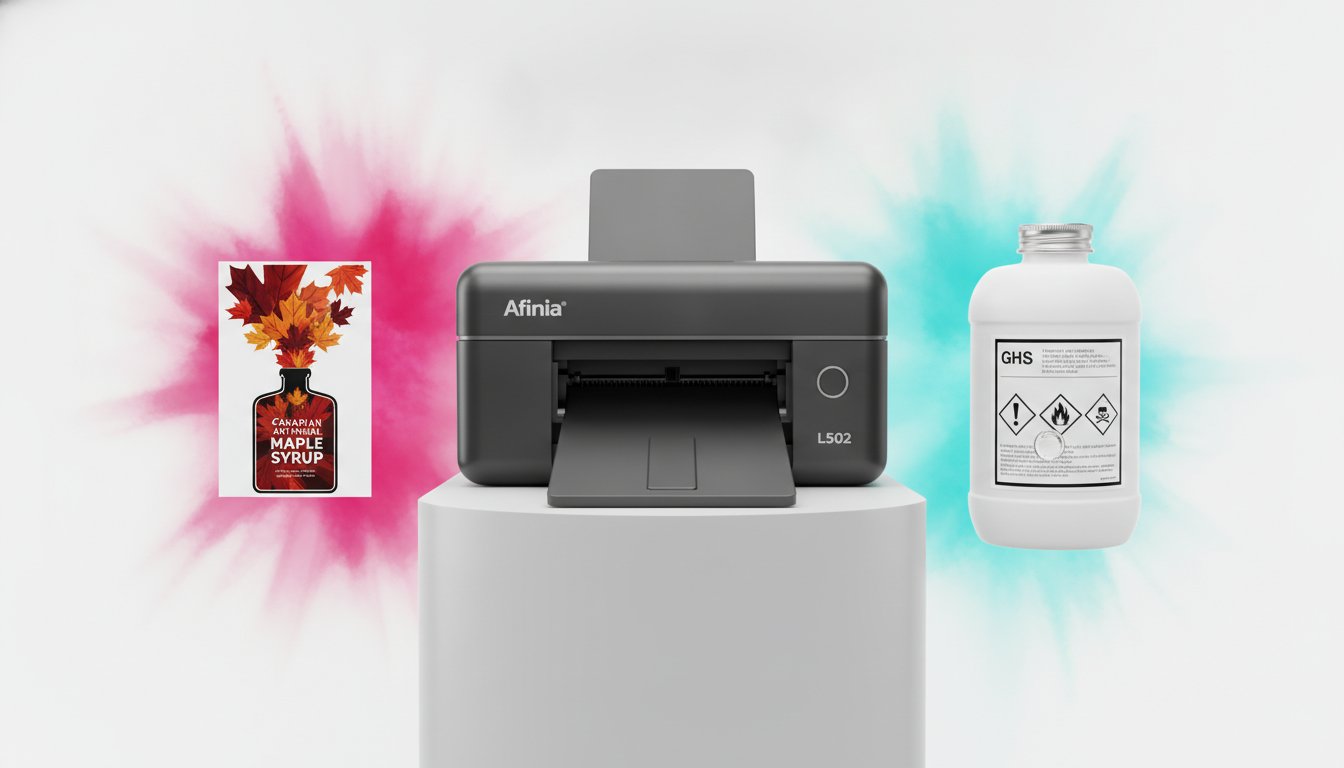
Could a single ink choice be the difference between a product that flies off the shelf and a shipment rejected for safety non-compliance? If you're managing in-house production, you likely realize that the versatility of your equipment is your greatest asset. However, the decision between Afinia L502 dye vs pigment ink often creates a bottleneck in the planning process. It's common to worry about wasting expensive label stock on smudged prints or failing to meet the latest BS 5609:2024 standards for marine environments.
We understand that your goal is to balance visual appeal with industrial-grade reliability. This article will help you master the technical differences between these ink types to ensure your labels meet both your branding and durability requirements. We will explore how the L502’s DuraPrime™ Duo Ink Technology allows you to switch between chemistries; helping you achieve vibrant retail colours and GHS-compliant chemical labels without investing in two separate printers.
Key Takeaways
- Understand how DuraPrime™ Duo Ink Technology enables the L502 to serve as a versatile production tool by supporting interchangeable ink chemistries for different business needs.
- Identify when to utilize water-enhanced dye inks to maximize retail shelf appeal through vibrant colour reproduction and high-impact visual depth on prime product labels.
- Evaluate the technical performance of Afinia L502 dye vs pigment ink to ensure your industrial labels meet strict GHS and BS 5609:2024 durability standards for chemical resistance.
- Analyze critical performance metrics, including cost-per-label and print speeds, to select the most fiscally responsible ink set for your specific application requirements.
- Learn the proper maintenance protocols for switching printheads to prevent nozzle clogging and maintain operational seamlessness during transitions between ink types.
Understanding Afinia L502 DuraPrime Duo Ink Technology
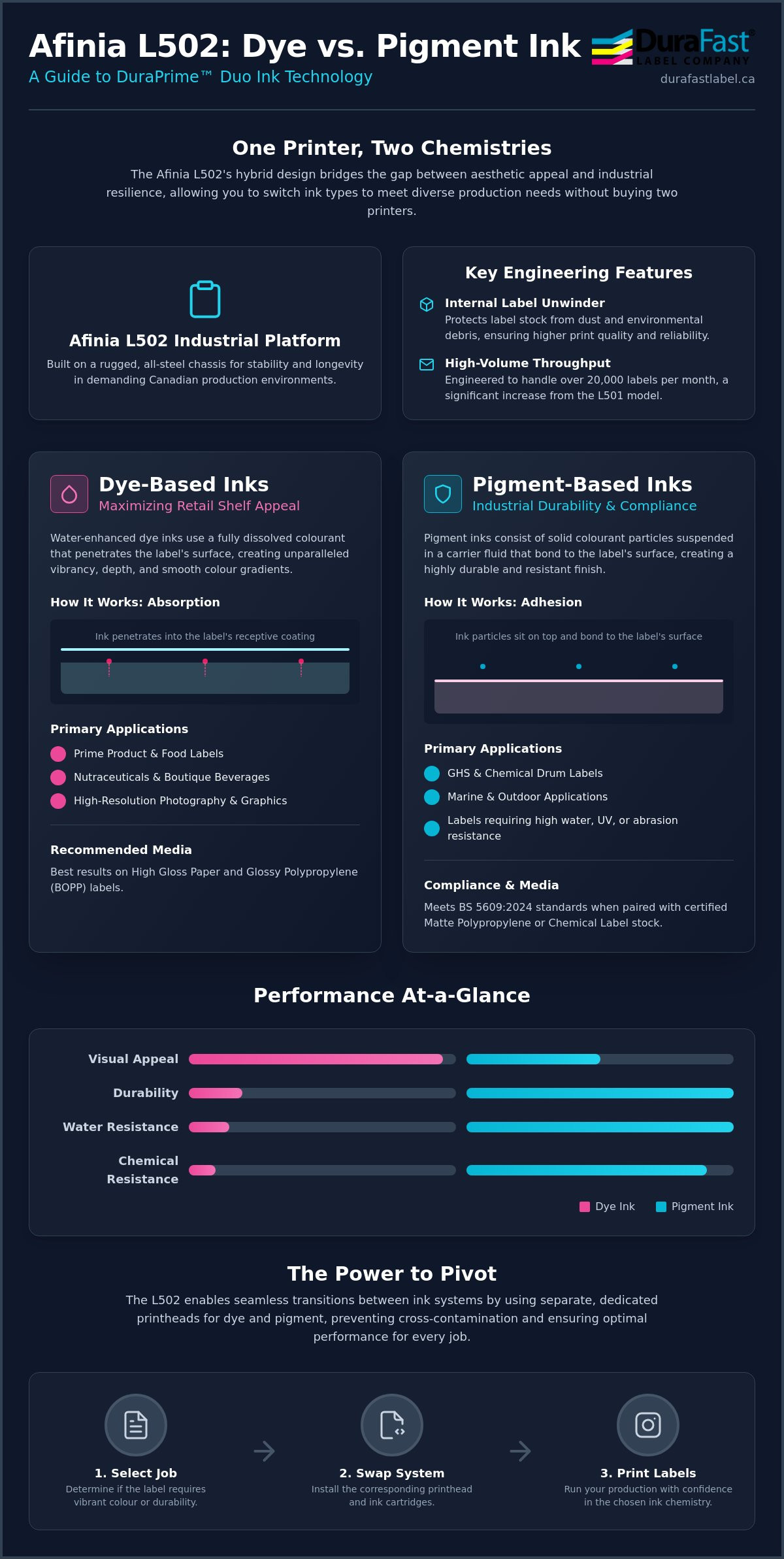
The Afinia L502 is a hybrid production hub designed to bridge the gap between aesthetic appeal and industrial resilience. At the heart of this machine is the DuraPrime™ Duo Ink Technology. This system allows users to pivot between two distinct ink chemistries within a single hardware platform. While many colour label printers force you to choose one technology at the point of purchase, the L502 offers a flexible path forward. It's a strategic solution for businesses that need to scale their operations without doubling their equipment footprint.
The main difference between the L502 and its predecessor, the L501, is the significant boost in performance metrics. The L502 is engineered to handle over 20,000 labels per month; this is a substantial increase from the 2,500 to 15,000 label range of the older model. This throughput is supported by improved ips (inches per second) ratings, ensuring that high-volume runs don't create bottlenecks in your facility. For businesses that require both retail-ready packaging and rugged industrial marking, this printer provides a strategic advantage by consolidating equipment costs and simplifying training protocols.
The Baseline: All-Steel Industrial Design
Reliability in a Canadian warehouse or production floor depends on the physical integrity of the hardware. The L502 features a rugged, all-steel industrial chassis that stabilizes the printing process during high-speed operation. Unlike plastic-heavy desktop models, this build quality ensures longevity and precision over years of service. A key feature of this design is the internal label unwinder. By housing the media inside the printer, the L502 protects the label stock from environmental debris and dust that can often compromise print quality or damage sensitive components. This makes it a preferred choice among industrial label printers where durability and uptime are non-negotiable.
The Delta: Dye vs Pigment Interchangeability
How does the L502 manage to be two printers in one? The secret lies in the interchangeability of the printheads. The printer hardware remains consistent, but the user can swap the entire ink delivery system based on the job at hand. This is the primary factor in the Afinia L502 dye vs pigment ink debate. To switch applications, you simply install the corresponding printhead and ink set. This flexibility is rooted in the chemical composition of the Ink being used. Dye-based inks are liquid-centric for colour depth, while pigment inks utilize solid particles for surface-level resilience. By requiring separate printheads for each type, Afinia ensures that there is no cross-contamination between chemistries. This delta in technology allows you to produce vibrant prime labels in the morning and GHS-compliant chemical labels in the afternoon without the fiscal burden of maintaining multiple hardware investments. Understanding the Afinia L502 dye vs pigment ink requirements is the first step in optimizing your in-house production workflow.
Afinia L502 Dye Inks: Maximizing Retail Shelf Appeal
Are you struggling to capture the attention of busy shoppers in a crowded retail environment? The visual impact of your packaging often dictates your brand's first impression. When evaluating the Afinia L502 dye vs pigment ink debate for retail applications, dye-based chemistry is the clear winner for aesthetic depth. These inks are water-based solutions where the colourant is fully dissolved, allowing the liquid to penetrate the inkjet-receptive coating of your media. This absorption creates a smooth, continuous tone that is ideal for high-resolution photography and complex gradients found on prime product labels.
Because the colourant sits within the media rather than on top of it, the resulting print exhibits a level of clarity and "pop" that pigment inks cannot replicate. This makes dye ink the preferred choice for sectors like nutraceuticals, gourmet foods, and boutique beverages. If your business prioritizes vibrant branding to drive sales, choosing the dye ink set ensures your labels look professional and polished under standard retail lighting.
Compatible Media for Dye Ink
To achieve the best results with dye inks, you must pair them with the correct substrate. High gloss paper and glossy polypropylene inkjet labels provide the optimal canvas for these inks to shine. The smooth surface of these materials enhances the natural reflective properties of the dye, resulting in deep blacks and saturated colours. For premium applications, clear or metallic polyester media can be used to create sophisticated "no-label" looks or eye-catching reflective accents. While matte paper is an option, it is typically reserved for short-term retail use where fiscal responsibility is the primary concern.
Visual Performance Metrics
While dye inks offer an expansive colour gamut, they do have technical limitations regarding environmental exposure. These inks are susceptible to UV fading over time and may smudge if they encounter significant moisture without a protective laminate. However, for indoor retail environments with a standard shelf life, these factors are rarely a deal-breaker. Vibrancy is the primary driver for dye ink selection because it ensures your product stands out against competitors. If you aren't sure which media will best showcase your brand's colours, you can request a media sample pack to test the saturation levels on your specific designs.
Afinia L502 Pigment Inks: Industrial Durability and GHS Compliance
How can you ensure your hazardous material labels remain legible after months of exposure to harsh chemicals or salt water? While dye inks excel in colour vibrancy, the Afinia L502 dye vs pigment ink decision for industrial settings is driven by molecular stability. Pigment ink consists of solid particles of colour suspended in a liquid carrier. Unlike dye, which dissolves into the media, these particles bond to the surface of the label stock. This creates a print that is fundamentally more resistant to external stressors like UV radiation, abrasion, and chemical solvents.
For businesses operating in the logistics or manufacturing sectors, this technology isn't just a preference; it's often a legal requirement. Pigment inks provide the longevity needed for warehouse tracking and outdoor storage, where sun-fading can render a barcode unreadable within weeks. By choosing pigment-based chemistry, you're investing in operational seamlessness and reducing the risk of logistical errors caused by degraded labels.
GHS BS5609 Chemical Labels
Does your business ship chemicals internationally? If so, your labels must survive the 90-day seawater immersion test required by the BS 5609:2024 standard. The Afinia L502, when paired with pigment inks and weatherproof-ul-certified-labels, provides a compliant solution for GHS labelling. This is critical for Canadian businesses that must adhere to WHMIS requirements alongside international shipping regulations. Using matte polypropylene media ensures the pigment particles have a stable base to adhere to, preventing smudging or peeling even in the most extreme marine environments.
Industrial Use Cases in Cold Environments
Condensation and extreme temperatures pose a significant threat to label integrity. In frozen food production or cold storage facilities, labels often face moisture that would cause standard dye inks to bleed or run. Pigment ink is superior for these environments because the particles remain trapped on the surface, maintaining high-contrast legibility even when the substrate is damp. This durability extends to high-friction warehouse settings where labels are frequently bumped or scraped by machinery. Pigment ink utilizes solid particles of colourant to provide a physical barrier against abrasion and environmental moisture. Whether you're managing a dusty distribution centre or a wet-pack facility, this technology ensures your marking remains clear throughout the entire product lifecycle.
Comparative Analysis: Dye vs Pigment Performance Metrics
Which technology provides the best return on investment for your specific volume? While the initial hardware cost is identical, the operational delta in the Afinia L502 dye vs pigment ink comparison lies in performance metrics like ink consumption and throughput speed. Dye inks typically allow for higher print speeds on glossy media because the liquid carrier evaporates and penetrates the substrate almost instantly. In contrast, pigment ink may require density adjustments or slightly lower ips (inches per second) settings to ensure the solid particles bond correctly to the surface without tracking.
Drying time is another critical factor for immediate handling. Dye labels are often ready for rewinding or application the moment they exit the printer. Pigment inks, while smudge-resistant, occasionally benefit from a brief curing period depending on the ink saturation and the specific media type used. If your workflow involves immediate application to products, dye ink offers a slight edge in speed-to-market.
The Cost-Efficiency Factor
The L502 utilizes high-capacity cartridges that contain 26ml of ink for yellow, cyan, and magenta, and 52ml for the black cartridge. This split configuration is a major advantage over tri-colour cartridges because it allows you to organize your inventory and replace only the colours you actually use.
- Reduced Waste: You don't have to throw away half-full cartridges just because one colour has run out.
- Scalability: In-house production eliminates the high minimum order quantities and shipping delays associated with outsourcing.
- Predictable Yields: The L502's firmware provides accurate ink tracking, helping you calculate a precise cost-per-label for your fiscal planning.
Choosing Your Configuration
The decision matrix for selecting your ink set is straightforward. If your primary goal is retail shelf appeal and high-impact branding, dye ink is the logical choice. If your labels must survive moisture, chemicals, or outdoor exposure, pigment ink is the only viable option. Many business owners realize that keeping both sets of printheads is the most versatile strategy. This allows you to pivot between applications as your product line evolves. If you are ready to compare these technologies against other colour label printers, our team can provide a detailed breakdown for your specific industry. To receive a customized cost-per-label analysis for your designs, contact our technical consultants today.
Optimizing Your In-House Production with DuraFast Label Company Canada
How can you maintain peak efficiency while toggling between high-impact retail jobs and rugged industrial runs? The hardware flexibility of the L502 is only half of the equation; your operational habits determine the ultimate longevity and reliability of your print system. Mastering the transition in the Afinia L502 dye vs pigment ink workflow ensures that your production line remains seamless and your output remains professional. By following a structured maintenance routine, you can guarantee 100% scan success rates for your barcodes and avoid the fiscal drain of wasted media.
How to Switch Your L502 Ink Set
Transitioning between ink chemistries requires a methodical approach to prevent cross-contamination and ensure printhead health. It is not enough to simply swap the cartridges. You must replace the entire delivery system to maintain the integrity of the technology. Follow these steps for a clean transition:
- Access the printer utility on your computer and select the "Change Printhead" command to move the carriage to the centre.
- Remove the four individual ink cartridges and set them aside in a clean, dust-free area.
- Lift the grey latch on the carriage to release the current printhead.
- Gently wipe the carriage area with a lint-free cloth to remove any environmental debris or stray ink droplets.
- Install the new printhead, lock the latch, and insert the corresponding dye or pigment ink cartridges.
- Always run the internal alignment and calibration utility after a swap to realize the highest possible print precision.
Proper storage of the "off-duty" printhead is the most critical step in this process. You must use the original orange storage cap that came with the printhead to seal the nozzles. This prevents the ink from drying out and causing permanent clogging. If you lose this cap, the printhead will likely fail within days; leading to unnecessary replacement costs.
Sourcing Quality Consumables in Canada
DuraFast Label Company Canada acts as a strategic partner rather than a mere vendor. We understand the intricate logistical challenges of local distribution, from managing WHMIS compliance to optimizing shipping costs. To maintain your manufacturer warranty and ensure operational seamlessness, you should only use genuine Afinia ink cartridges. Pairing these with the correct blank-labels-for-sale is essential for ink adhesion and colour accuracy. If your needs expand beyond colour production into high-volume logistics, you can also explore our latest guide on shipping-label-printers to further streamline your warehouse operations. We are here to help you navigate these technical choices so you can focus on growing your business with confidence.
Future-Proofing Your In-House Label Production
The Afinia L502 stands as a versatile production tool that adapts to your evolving business needs. By leveraging the DuraPrime Duo Ink system, you can successfully navigate the technical requirements of both high-impact retail branding and rugged industrial compliance. The decision in the Afinia L502 dye vs pigment ink comparison ultimately depends on whether your priority is visual vibrancy for the shelf or the surface-level durability required for GHS and BS 5609:2024 standards.
DuraFast Label Company Canada is committed to supporting your long-term operational success. As an Authorized Afinia Label Reseller, we provide the expert technical guidance needed to optimize your in-house printing, alongside the convenience of flat-rate shipping across the country. Our team understands the importance of fiscal responsibility and operational seamlessness in the Canadian market.
Are you ready to secure the reliability of your labelling process? Shop Afinia L502 Ink and Printheads at DuraFast Label Company Canada today to ensure your production remains efficient and compliant. We look forward to helping you achieve better results for your brand.
Frequently Asked Questions
Can I mix dye and pigment ink cartridges in my Afinia L502?
No, you cannot use both types of cartridges at the same time. The chemical compositions are fundamentally incompatible. Mixing them will result in a reaction that permanently damages the delivery system. You must ensure the ink set installed matches the specific printhead type currently in use to maintain operational integrity.
Do I need a different printhead for dye and pigment inks?
Yes, the L502 requires a separate printhead for each ink chemistry. This is the core of the DuraPrime Duo technology. While the printer chassis remains the same, swapping between dye and pigment requires you to change the entire printhead assembly to avoid cross-contamination of the different Afinia L502 dye vs pigment ink formulas.
Which ink is better for labels exposed to sunlight?
Pigment ink is the correct choice for labels facing UV exposure or direct sunlight. Because pigment ink uses solid particles that sit on the surface of the media, it offers superior resistance to sun-fading compared to dye-based colourants. This is essential for outdoor retail displays or industrial products stored in external yards.
Is the Afinia L502 BS 5609 certified with dye ink?
No, dye ink cannot achieve BS 5609 certification. Dye colourants are water-soluble and will bleed or fade when exposed to marine environments. To meet the 90-day seawater immersion requirements for international shipping, you must utilize pigment ink paired with an approved matte synthetic substrate.
How many labels per month is the Afinia L502 designed for?
The L502 is a mid-to-high volume industrial printer designed to produce over 20,000 labels per month. It is a rugged upgrade over entry-level models, providing the physical stability needed for consistent daily production. Its all-steel chassis ensures it can handle the vibrations of high-speed printing without compromising on registration or quality.
What is the maximum print width for the Afinia L502?
The maximum print width is 8.5 inches (215.9 mm). This allows for a wide range of applications, from small prime product labels to large-format chemical drum marking. The printer handles media widths starting at 2 inches, providing the flexibility to organize various product lines on a single machine.
Does the Afinia L502 support GHS chemical labelling?
Yes, the L502 is specifically designed for GHS compliance when configured with pigment inks. This setup ensures that safety pictograms and hazard statements remain legible under harsh conditions. When you understand the Afinia L502 dye vs pigment ink differences, you can successfully produce labels that meet both WHMIS and international safety standards.
Where can I buy genuine Afinia L502 ink in Canada?
You can purchase genuine Afinia ink cartridges and replacement printheads from DuraFast Label Company Canada. We are an authorized reseller providing expert technical support and flat-rate shipping across the country. Buying from an authorized source ensures you receive fresh, genuine consumables that protect your equipment warranty and maintain high scan success rates for your barcodes.