How to Label Cables for Safe and Efficient Installations?
11th Feb 2026
Key Highlights
-
Clear cable labelling reduces safety risks, prevents downtime, and improves maintenance efficiency across electrical, network, AV, and industrial systems.
-
Different cable types require specific labelling formats, such as wrap, flag, heat shrink, or faceplate labels to remain readable and secure over time.
-
Professional label printers like the Brother P-touch EDGE series simplify cable labelling with dedicated modes for wrap, flag, and heat shrink applications.
-
Structured practices such as consistent placement, horizontal orientation, colour coding, and serialization improve troubleshooting speed and accuracy.
-
Durable tape selection is critical, as industrial environments expose labels to heat, abrasion, chemicals, and frequent handling.
-
Cable wrap labels suit most IT and datacom installations, while heat shrink labels are better for permanent, industrial, or high-risk conditions.
-
Sourcing compatible printers and tapes from a specialized supplier supports consistent output, compliance, and long-term reliability.
Cable issues rarely announce themselves upfront. They show up during urgent repairs, last-minute upgrades, or routine maintenance, when time is limited, and every connection matters. Without clear labels, technicians are forced to trace cables manually, increasing the risk of errors, safety incidents, and avoidable downtime across electrical, network, and industrial systems.
Effective cable labelling turns complexity into clarity. When cables are clearly identified using the right formats, durable materials, and consistent systems, teams can work faster, stay compliant, and maintain organized installations that are easier to manage over time. Proper labelling is not just about neatness. It directly impacts safety, efficiency, and long-term reliability.
This guide breaks down how to label cables correctly for real-world applications. You will learn which labelling formats work best for different cable types, how professional label printers simplify the process, and how techniques like colour coding, serialization, and clear placement improve troubleshooting and maintenance outcomes.
Why Is It Important to Know How to Label Cables Properly?
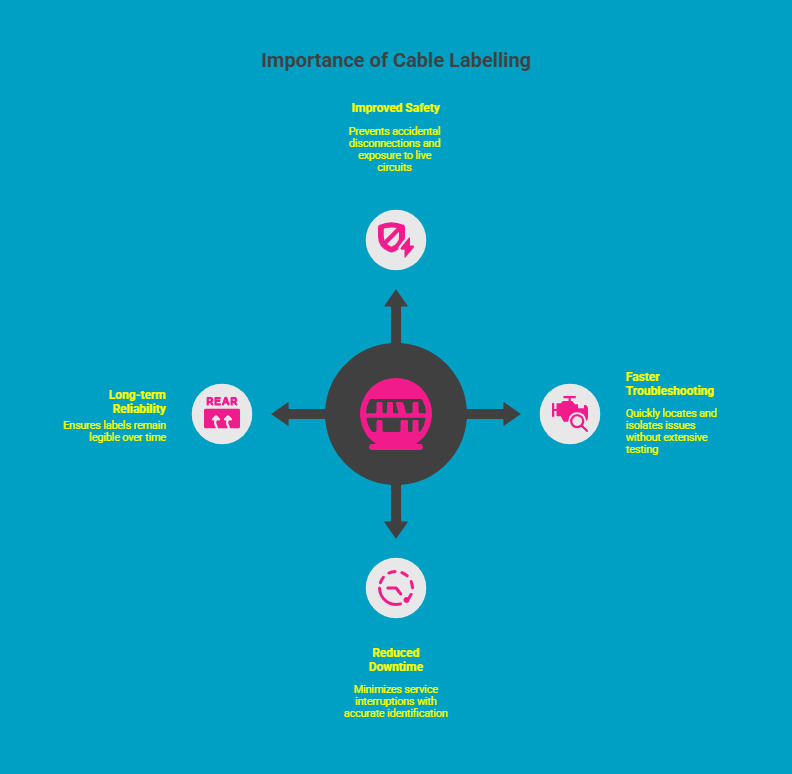
Knowing how to label cables properly is essential for anyone working with electrical, network, or AV systems. Clear, consistent labelling reduces guesswork during installation and maintenance, helping teams work faster while avoiding preventable mistakes. It is not just an organizational habit. It directly affects safety, system uptime, and long-term reliability.
When cables are correctly labelled, technicians can immediately identify circuits, signal paths, and connection points without tracing lines manually. This becomes especially critical in dense racks, control panels, and industrial environments where a single error can interrupt operations or create safety risks.
Key reasons proper cable labelling matters include:
-
Improved safety and compliance: Clear identification helps prevent incorrect disconnections, accidental cross connections, and exposure to live circuits, supporting electrical and datacom standards.
-
Faster troubleshooting and repairs: Labelled cables allow technicians to locate and isolate issues quickly without testing every connection.
-
Reduced downtime: Accurate cable identification shortens maintenance windows and minimizes service interruptions.
-
Long-term readability and reliability: Durable labels remain legible despite heat, movement, abrasion, or frequent handling, ensuring information stays usable over time.
According to industry safety guidelines, misidentified or unlabelled cables are a common cause of accidental shutdowns during maintenance. Consistent, professional cable labelling significantly lowers these risks while improving overall system efficiency.
How to Label Cables Using a Brother P-touch Label Maker?
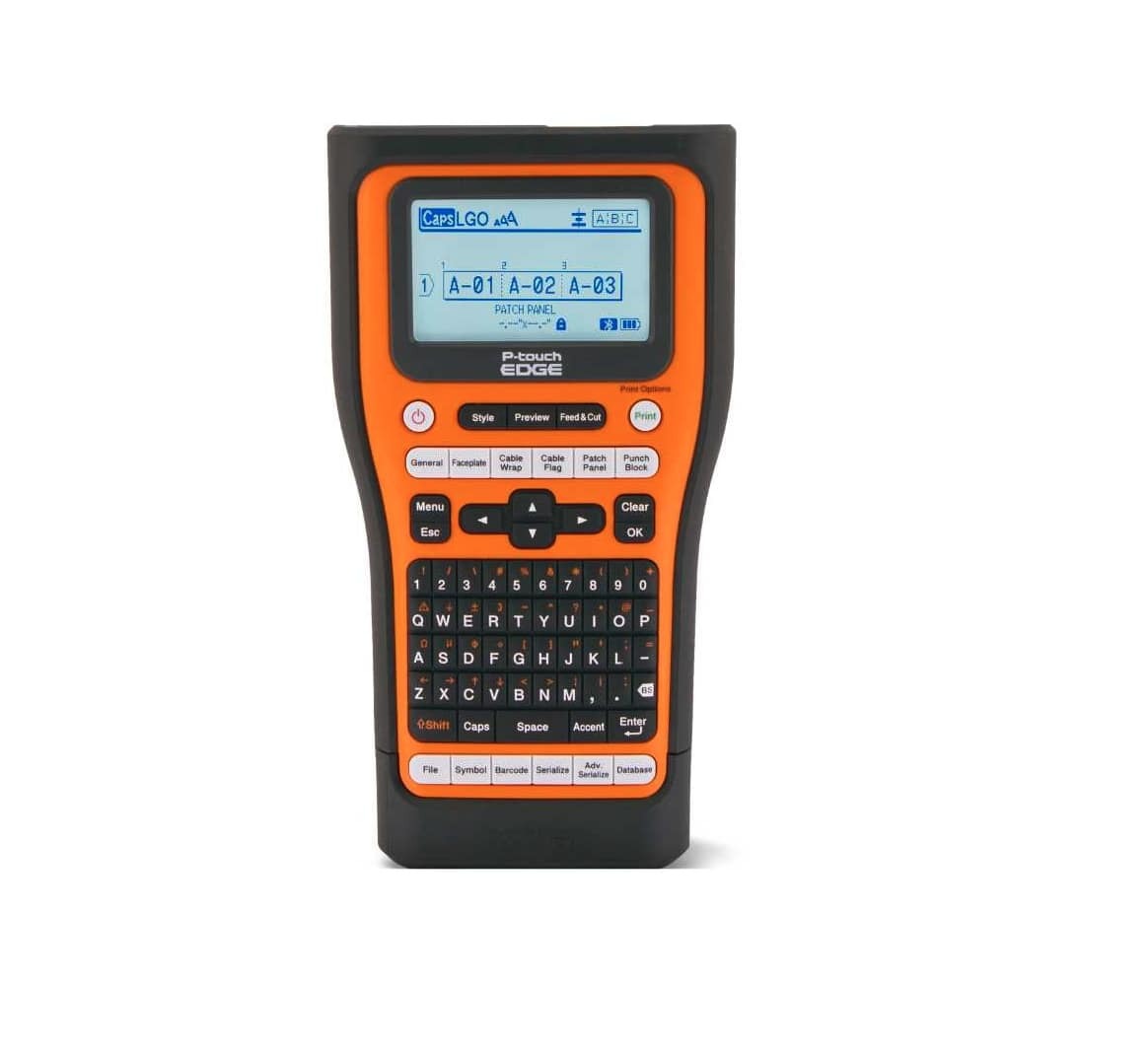
The Brother P-touch EDGE series is designed for professional cable identification where accuracy and durability matter. Unlike general label printers, these models include application-specific modes that format labels correctly for cable wrap, flag, heat shrink, and faceplate use without manual adjustments.
Handheld options such as the Brother PTE560BTVP Handheld Label Printer and the Brother PTE510VP Handheld Label Printer support cable wrap, flag labels, heat shrink tubing, and faceplate labelling up to 24 mm. Dual auto cutters ensure consistent output, while preset modes reduce setup errors across repeat jobs.
Workflow for labelling cables with a Brother P-touch printer:
-
Set up the printer
Load the correct tape cartridge for the application. The printer detects the tape type automatically. -
Select the labelling mode
Choose wrap, flag, heat shrink, or faceplate mode based on cable size and use case. -
Enter label content
Add identifiers such as cable IDs, port numbers, barcodes, or serial numbers. -
Preview alignment
Confirm text size, spacing, and orientation before printing. -
Print and apply
Apply wrap labels with overlap or position heat shrink tubing before shrinking. -
Save templates
Store frequently used formats for consistent future work.
This process delivers clear, durable cable labels that support efficient installation, maintenance, and compliance.
How to Label a Cable Depending on Application Type?
Different cable types experience different levels of handling, heat, movement, and environmental exposure. Selecting the correct labelling format and tape type helps ensure labels remain readable, secure, and fit for purpose throughout the installation lifecycle.
|
Cable Type |
Recommended Labelling Format |
Ideal Tape Type |
Why This Works |
Typical Use Case |
|---|---|---|---|---|
|
Small gauge wires |
Wrap around |
TZe Flexible ID |
Conforms tightly to thin cables and protects text with an overlapping laminate to prevent lifting |
Telecom closets, IT racks, patch panels |
|
Fibre optic and thin leads |
Flag labels |
TZe Flexible or Standard |
Avoids stress on delicate fibres while keeping identifiers visible in dense layouts |
Data centres, fibre distribution frames |
|
Power cables |
Heat shrink |
HSe heat shrink tubing |
Shrinks permanently onto cables for maximum durability against heat, abrasion, and chemicals |
Industrial electrical panels, control systems |
|
Large cable bundles |
Self laminating |
Industrial laminate tapes |
Clear overwrap seals printed text from moisture, dirt, and UV exposure |
Outdoor installations, industrial fields |
|
Faceplates and patch panels |
Straight print |
Standard TZe |
Provides clean alignment and strong adhesion for quick port and panel identification |
Offices, server rooms, network cabinets |
Matching the label format and tape type to the cable’s size, environment, and handling requirements prevents slipping, peeling, and fading, ensuring long term clarity and reliability in professional installations.
How to Label Wires and Cables in Professional Installations?
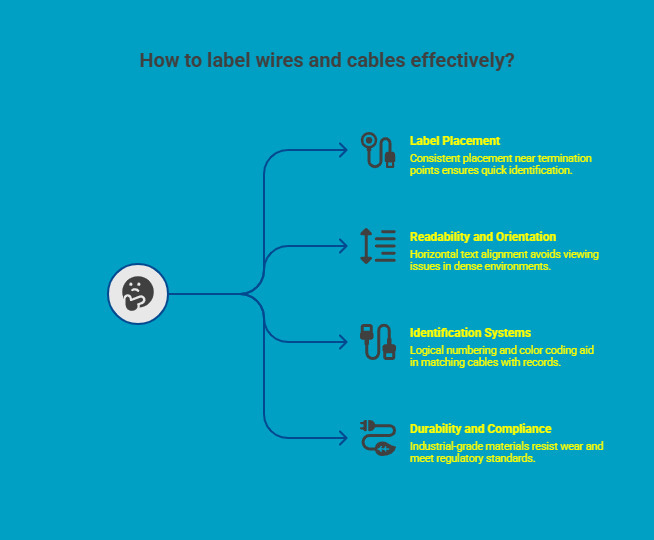
In professional installations, cable labelling must support fast identification, safe handling, and long-term maintenance. Labels should be easy to read at a glance and remain reliable even after years of use, routine servicing, or system changes. A clear structure and consistent method matter more than excessive detail.
1. Start with correct label placement
Labels should be applied close to termination points, but not hidden by connectors, ties, or strain reliefs. Consistent placement across all cables creates a predictable layout that allows technicians to trace lines quickly in panels, racks, and trays.
2. Focus on readability and orientation
Text should be printed horizontally and aligned in the same direction throughout the installation. This avoids twisting cables or adjusting viewing angles, which is especially important in dense or overhead environments.
3. Use structured identification systems
A logical numbering or serialization scheme helps teams match cables with drawings, patch schedules, and maintenance records. Colour coding can be added to indicate function or voltage level, but it should be applied consistently and sparingly to avoid visual clutter.
4. Plan for durability and compliance
Professional environments expose labels to heat, friction, cleaning agents, and handling. Using durable, industrial-grade tapes ensures labels resist smudging, fading, and peeling. Many regulated settings also require specific font sizes, contrast levels, and placement rules, making material choice a compliance consideration, not just a preference.
This approach keeps cable identification clear, consistent, and dependable from installation through long-term operation.
What Cable Labelling Formats Can You Create Using P-touch EDGE Models?
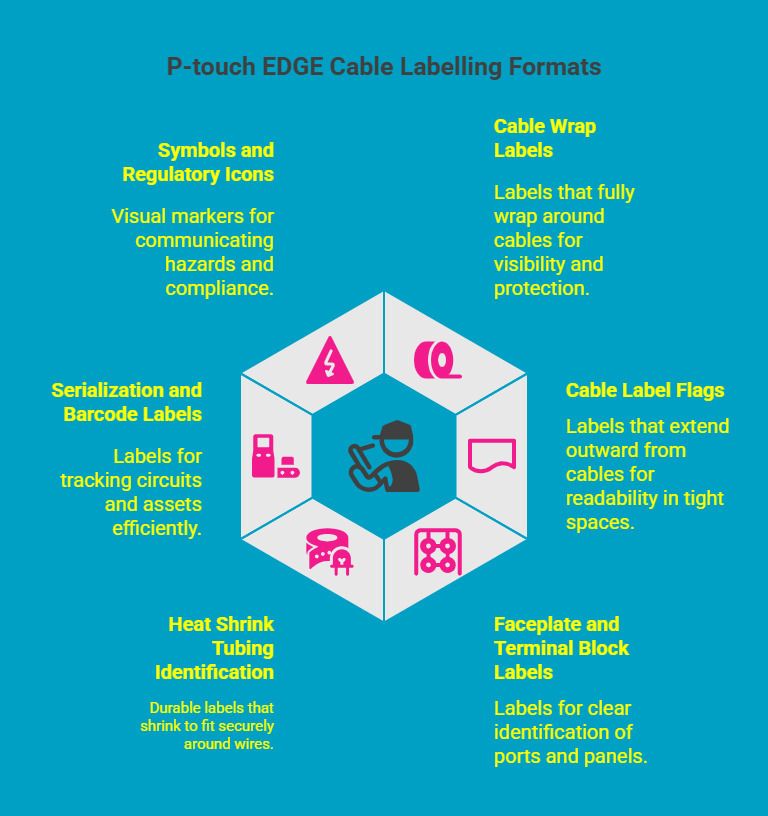
P-touch EDGE label makers are built for real-world cable identification, not generic office labelling. A single device supports multiple cable labelling formats, allowing technicians to switch between applications without changing tools or workflows. This flexibility is especially valuable on mixed job sites where power, data, and control cables coexist.
Below are the key cable labelling formats supported by P-touch EDGE models and when to use each one.
1. Cable wrap labels
Cable wrap labels are designed to wrap fully around the cable with a clear overlap that protects the printed text. This format keeps information visible from any angle and prevents labels from slipping or peeling. It is widely used for network cables, control wiring, and structured cabling systems.
2. Cable label flags
Flag labels extend outward from the cable rather than wrapping around it. They are ideal for fibre optic cables, thin leads, and densely packed terminations where space is limited. Flag labels improve readability without increasing cable thickness or interfering with connections.
3. Faceplate and terminal block labels
These labels provide clear identification for ports, wall plates, patch panels, and terminal blocks. Clean, consistent faceplate labelling helps technicians quickly match cables to endpoints, reducing tracing time during installation or maintenance.
4. Heat shrink tubing identification
Heat shrink labels are printed on shrinkable tubing that tightens securely around the wire when heated. This format offers long term durability and resistance to abrasion, moisture, and chemicals. It is commonly used in industrial, electrical, and high-vibration environments.
5. Serialization and barcode labels
P-touch EDGE models support sequential numbering and barcode printing. This allows installers to track circuits, assets, and equipment efficiently while supporting documentation, audits, and maintenance records.
6. Symbols and regulatory icons
Built-in symbol libraries include electrical, safety, and compliance icons. These visual markers help communicate hazards, voltage levels, or functional warnings clearly, even in environments where text alone may be overlooked.
Together, these formats allow one P-touch EDGE printer to handle cable identification, panel labelling, and compliance marking across a wide range of professional installations without compromising clarity or durability.
What Are Cable Label Stickers and When Should You Use Them?
Cable label stickers are basic adhesive labels used for quick identification in low-impact environments. They are often the starting point for teams learning how to label cables in offices or temporary setups where conditions remain stable, and labels are not exposed to stress.
Because these stickers rely entirely on surface adhesion, they perform best when cables remain dry, clean, and relatively undisturbed.
Best use cases include:
-
Temporary field testing or short-term installations
-
Indoor office cabling and workstation setups
-
Low voltage or non-critical connections
That said, cable label stickers are not designed for long-term reliability. In environments involving heat, moisture, movement, or abrasion, they may peel or fade. As you move beyond basic scenarios and refine how to label cables for professional or industrial use, more durable formats become necessary.
What Are Cable Label Tags and How Are They Different From Adhesive Wrap Labels?
Cable label tags identify cables using clips, ties, or loops instead of adhesive. They are typically used when labelling cables that must account for frequent changes, relocation, or reuse.
Tags provide flexibility, but that flexibility comes with trade-offs.
They are best suited for:
-
Rental or shared equipment
-
Temporary or mobile installations
-
Environments with ongoing cable reconfiguration
Compared to adhesive wrap labels:
-
Advantages: Reusable, easy to remove, and repositionable
-
Limitations: Bulkier appearance and less secure attachment
For permanent infrastructure, adhesive wrap labels remain the preferred option. They sit flush against the cable, stay in place over time, and present a cleaner, more professional finish.
When Should You Use Cable Wrap Labels vs Heat Shrink Labels?
Understanding how to label cables correctly often comes down to choosing between wrap labels and heat shrink labels based on durability requirements.
Cable wrap labels are widely used in IT, AV, and datacom environments because they balance durability with ease of application. When paired with flexible ID tapes such as Brother FLe tapes, they conform smoothly around cables and resist slipping once laminated.
Cable wrap labels are ideal when:
-
A fast application is required without specialized tools
-
Cables are installed indoors or in controlled environments
-
Clear readability and rework flexibility are important
Heat shrink labels, on the other hand, are designed for permanence. Once applied and shrunk, they form a tight seal around the cable.
Heat shrink labels are best used when:
-
Cables are exposed to chemicals, heat, or abrasion
-
Installations are industrial, electrical, or safety-critical
-
Long-term, tamper-resistant identification is required
In practice, wrap labels are preferred for most professional network installations, while heat shrink labels are reserved for harsher conditions where permanence outweighs flexibility.
You can learn more about these flexible wrap solutions here:
https://www.durafastlabel.ca/brother-fle-tapes/
What Options Exist for Custom Cable Labels for Professional Branding?
As organizations mature their approach to how to label cables, custom cable labels become an important part of standardization and brand presentation.
Customization goes beyond aesthetics. It improves consistency, speeds identification, and supports structured maintenance workflows.
Common custom label options include:
-
Company logos and brand colour schemes
-
QR codes linking to wiring diagrams or asset records
-
Barcodes and serial numbers for tracking systems
-
Rack, patch panel, and faceplate identifiers
For contractors and service teams, custom cable labels signal professionalism while reducing confusion during handovers, audits, and future maintenance work.
Where Can You Buy Supplies for Cable Labelling?
Consistent cable labelling depends on more than just the printer. The quality and compatibility of tapes, adhesives, and materials directly affect label durability, readability, and long-term performance. Using mismatched or low-grade supplies often leads to peeling, fading, or rework on-site.
DuraFastLabel.ca is a specialized Canadian supplier focused on professional and industrial labelling solutions. Their product range supports electrical, datacom, networking, AV, and industrial environments where reliable identification is critical.
Available cable labelling supplies include:
-
Brother PTE510VP Handheld Label Printer for on-site cable wrap, flag, and faceplate labelling
-
Brother PTE560BTVP Handheld Label Printer with advanced connectivity, templates, and industrial features
-
Brother FLe flexible ID tapes designed for curved surfaces and wrap around cable applications
-
Heat shrink and industrial laminate tapes for high temperature, high abrasion, and demanding environments
Sourcing printers and tapes from a single, specialized supplier helps ensure material compatibility and consistent output across installations. For teams that need product guidance, bulk ordering, or application-specific recommendations, DuraFast Label also provides direct support through its contact team.
This approach reduces trial and error, shortens setup time, and supports professional, standardized cable labelling across projects.
Conclusion
Clear cable labelling is a practical safeguard, not an afterthought. When the right formats, materials, and tools are used, teams reduce errors, work faster, and maintain systems with confidence long after installation. Whether managing dense network racks or industrial control panels, consistent labelling improves safety, compliance, and long-term reliability.
By applying the techniques outlined in this guide and using professional-grade printers and tapes, organizations can turn complex cabling into an organized, dependable infrastructure that supports efficient operations and easier maintenance over time.
FAQs
What type of labels are best for cable wrapping?
The best way to label wires is to use durable wire labels sized correctly for the type of cable. Clear printed information, consistent wire identification, and placement near the ends of the cable ensure easy identification during cable management and maintenance procedures.
Are heat-shrink labels better than wrap-around labels?
Heat-shrink labels and wrap-around labels serve different purposes. Wrap-around labels work best for standard network and data cables, while heat shrink labels are better for permanent installations or harsh environments where durability and resistance to heat, moisture, or abrasion are required.
How do I keep cable labels from peeling off?
To prevent cable labels from peeling, clean the cable surface before application and use laminated or heat-shrink labels designed for the environment. Avoid standard paper labels, and ensure labels are applied with proper tension and fully adhered around the cable.
Can I print cable labels with barcodes or serial numbers?
Yes. Many professional label printers support barcodes and serial numbers for cable identification. Barcode and serialized labels improve traceability, reduce manual errors, and support structured cabling standards, especially in data centres, network rooms, and industrial installations.
Are Brother P-touch label tapes waterproof and chemical-resistant?
Brother P-touch laminated label tapes are waterproof and resistant to chemicals, abrasion, and fading. These properties make them suitable for cable labelling in server rooms, industrial environments, and areas exposed to cleaning agents, oils, or moisture.
How do I label cables in harsh environments?
To label cables in harsh environments, choose cable markers or wire markers made for harsh conditions. Heat-resistant laminates, stainless steel tags, and labels rated for extreme temperatures protect printed information and support workplace safety in demanding installations.
What type of label works best for different types of cables?
The right kind of label depends on the type of cable and its environment. Wrap labels suit network wiring, cable tags help with reusable systems, and heat shrink or stainless steel labels handle harsh conditions and long-term wire marking.
Where should wire labels be placed on a cable?
Wire labels should be placed near the ends of the cable without covering connectors or cable ties. Consistent placement improves wire identification, supports industry standards, and allows technicians to trace connections quickly in a mess of cables.
Are cable tags better than cable ties for labelling?
Cable tags are useful for temporary identification and reuse, while cable ties with labels work better for fixed cable management. Tags offer flexibility, but adhesive wire labels provide cleaner wire marking for permanent installations.
How do label size and printable area affect cable labelling?
Label size and printable area determine how much detailed information can be displayed. Choosing the correct size ensures printed information remains readable, supports easy identification, and prevents clutter on smaller cables or dense bundles.