Thermal Transfer Ribbons Canada: The Complete Reference for Business Labelling
16th Jun 2026
Choosing the cheapest thermal transfer ribbon isn't a cost-saving measure; it's a gamble with your brand's reputation. You've likely experienced the frustration of labels that smudge during transit or printheads that wear out months earlier than they should. Finding the right thermal transfer ribbons Canada offers can be particularly challenging when you need specific sizes that aren't always stocked locally. We understand that your labels are a vital link in your supply chain; they need to remain legible from the factory floor to the final delivery.
This guide will help you master the technical nuances of ribbon selection so you can achieve durable, high-quality results for every industrial application. You'll learn how to match ribbon chemistry to your specific substrate and discover how to source reliable supplies that withstand Canadian winters. We'll also cover the latest 2026 toxic substance regulations and WHMIS standards to keep your operations fully compliant and efficient. By the end of this reference, you'll have a clear strategy for selecting the wax, resin, or hybrid ribbons that best support your business growth.
Key Takeaways
- Understand how matching ribbon chemistry to your specific substrate prevents smudging and protects your thermal printheads from premature wear.
- Navigate hardware compatibility with ease by identifying the correct core sizes and using our cross-reference guide for thermal transfer ribbons Canada.
- Master the requirements for GHS-compliant labelling and high-speed logistics to ensure your barcodes remain scannable in harsh environments.
- Optimize your procurement strategy by realizing the operational value of high-performance ribbons and the logistical advantages of carton-quantity sourcing.
Table of Contents
-
What Are Thermal Transfer Ribbons and Why Does Chemistry Matter?
-
Choosing the Right Ribbon Chemistry: Wax, Wax-Resin, and Resin
-
Ribbon Compatibility and Cross-Referencing for Major Printer Brands
-
Application-Specific Guidance: From Logistics to GHS Compliance
What Are Thermal Transfer Ribbons and Why Does Chemistry Matter?
Have you ever wondered why some labels remain crisp for years while others fade into illegibility within weeks? The answer often lies in the specific chemistry of the ribbon you've selected. At its core, a thermal transfer ribbon is a sophisticated delivery system consisting of a thin polyester film coated with specialized ink layers. When the heated elements of your printhead make contact with the ribbon, the ink melts and bonds permanently to the label surface. This thermal-transfer printing technology provides a level of durability that direct thermal methods simply can't match. For businesses sourcing thermal transfer ribbons Canada, understanding this mechanism is the first step toward reducing operational waste and protecting your hardware investments.
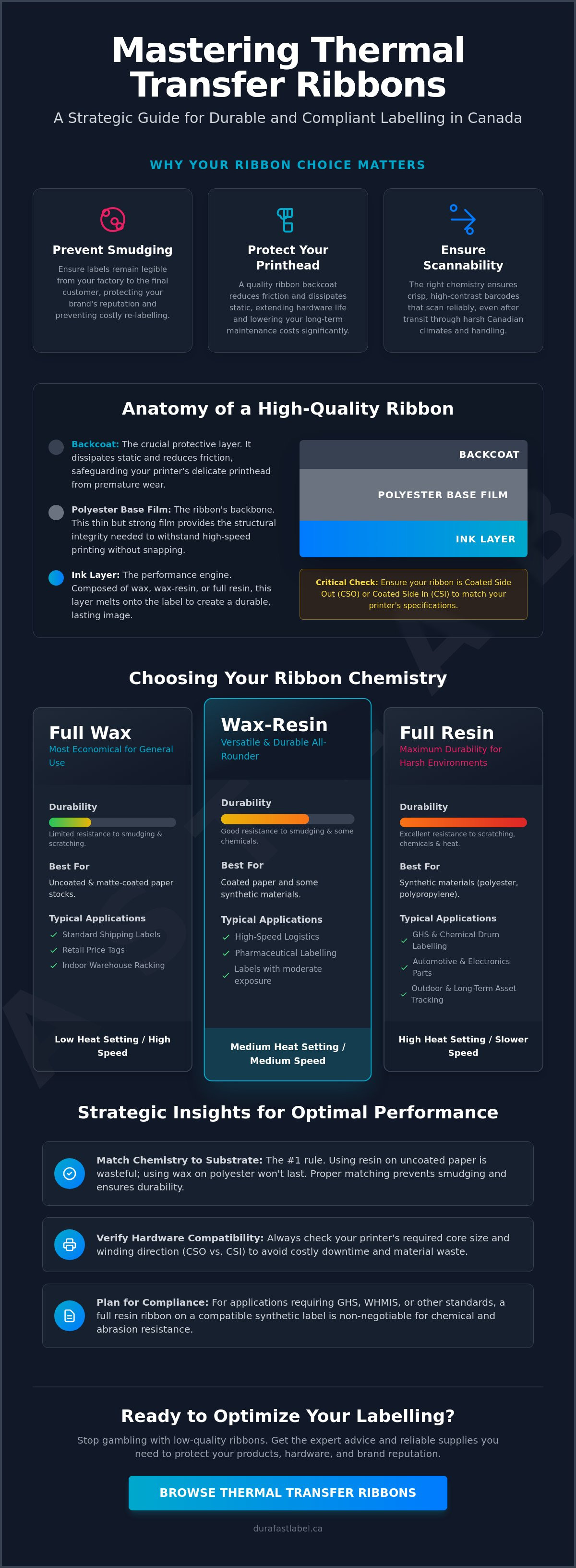
One of the most vital yet overlooked components of a ribbon is the backcoating. This layer sits directly between the polyester film and your printer's delicate components. Its primary job is to dissipate static and reduce friction as the ribbon moves at high speeds. Without a high-quality backcoat, the abrasive nature of the film would grind down your printhead, leading to premature failure. Since a replacement printhead for a Zebra or Honeywell industrial printer can cost hundreds of dollars, the ribbon you choose directly impacts your long-term maintenance costs. High-performance ribbons allow you to run your equipment at lower heat settings, which further extends the lifespan of your hardware.
Our diverse Canadian climate presents unique challenges for label consistency. From periods of high humidity and dampness experienced across various regions, moisture can interfere with how ink adheres to certain paper stocks. Conversely, the extreme dry cold common in many parts of the country can increase static electricity during high-speed printing runs. Selecting the right ribbon chemistry ensures that your barcodes remain scannable and your text stays sharp, regardless of the temperature fluctuations inside your warehouse or during transit across the provinces.
Thermal Transfer vs. Direct Thermal: A Quick Comparison
Is the extra step of using a ribbon truly necessary for your application? Direct thermal printing uses heat-sensitive paper that darkens when triggered by the printhead. It's a convenient choice for short-term shipping labels that only need to last a few days. However, direct thermal labels are prone to fading or turning entirely black when exposed to sunlight, friction, or heat. If you're archiving records or shipping products that might sit in a warm delivery truck, thermal transfer is the superior choice. While the initial cost of ribbons is an added factor, the reliability prevents the significant labour costs associated with re-labelling products that have lost their data.
The Anatomy of a High-Quality Ribbon
A premium ribbon consists of three critical layers: the backcoat, the polyester base film, and the ink layer. The base film provides the structural integrity needed to withstand the tension of industrial-grade printers without snapping. The ink layer is where the performance varies, typically categorized into wax, wax-resin, or full resin formulas. To ensure your printer functions correctly, you must know if your machine requires "ink-side out" (CSO) or "ink-side in" (CSI) ribbons, which refers to which side of the polyester film carries the pigment. Using the wrong configuration won't just result in a blank label; it can cause ink to melt directly onto your printhead, leading to an expensive cleanup or repair.
Choosing the Right Ribbon Chemistry: Wax, Wax-Resin, and Resin
How do you determine which ribbon chemistry is right for your specific operation? It isn't just about price; it's about the interaction between the ink and your label material. Choosing the wrong combination often results in illegible barcodes that fail at the scanning stage. When sourcing thermal transfer ribbons Canada, you'll typically choose between three main categories: wax, wax-resin, and resin. Each is designed for a specific set of substrates and environmental stressors. Matching the 'burn temperature' of your printer to the ribbon's melting point is essential for achieving a crisp, professional finish.
When to Choose Wax Ribbons
Wax ribbons are the most economical choice for general-purpose applications. They are best suited for printing on uncoated or matte-coated paper stocks where longevity isn't the primary concern. You'll commonly see these used for:
-
Standard shipping labels for e-commerce.
-
Retail price tags and shelf marking.
-
Indoor warehouse racking labels.
While wax is cost-effective, it has limited resistance to smudging and scratching. If your labels will face outdoor exposure or heavy handling, the ink may rub off, rendering your data useless.
The Versatility of Wax-Resin Ribbons
Think of wax-resin as the 'all-rounder' of the labelling world. These ribbons contain a blend of wax and synthetic resin, which allows them to bond to a wider variety of materials, including glossy paper and polyolefin labels. For Canadian logistics companies, this added durability is crucial. It provides enhanced resistance to moisture and light abrasion, ensuring that labels survive the friction of conveyor belts and the humidity of cross-country transport. If you need to balance high print speeds with image clarity, this chemistry offers a reliable middle ground that won't compromise your operational efficiency.
Resin Ribbons for Extreme Environments
When failure isn't an option, industrial-strength resin ribbons are required. These are essential for applications involving polyester, polyimide, or other synthetic substrates. Resin is the only chemistry that provides true resistance to solvents, alcohol, and extreme temperature fluctuations. This is particularly critical for GHS compliance for workplace labels, where chemical drum identification must remain legible even after exposure to harsh substances. You'll also find resin ribbons in automotive parts manufacturing and medical device tracking, where durability is a regulatory necessity. If your business handles hazardous materials or high-heat processes, you can browse our professional-grade resin options to ensure your labels meet every safety standard.
Remember that your printer settings play a major role in the final output. Wax ribbons melt at lower temperatures, allowing for faster printing with less wear on the printhead. Resin requires higher heat to achieve a bond, which may necessitate slower print speeds to maintain quality. Finding the sweet spot between your hardware's capabilities and your ribbon's melting point is the key to a seamless production cycle. Many businesses rely on specialized thermal transfer ribbons Canada suppliers to provide these high-durability blends that survive the rigours of the national supply chain.
Ribbon Compatibility and Cross-Referencing for Major Printer Brands
Finding the right fit for your hardware shouldn't feel like a guessing game. While many rolls look identical, the physical specifications differ significantly between brands and models. When you're searching for thermal transfer ribbons Canada, the first thing to check is the core diameter. Desktop printers typically use a 0.5-inch core, while Industrial Label Printers require a 1-inch core to handle larger roll capacities. Using the wrong core size isn't just an inconvenience; it can lead to tension issues that cause the ribbon to wrinkle or snap mid-print. Ensuring a precise match between the ribbon core and the printer spindle is the most effective way to avoid unnecessary downtime.
Desktop vs. Industrial Ribbon Configurations
Beyond the core size, roll length determines how often your team needs to pause production for a changeover. Desktop rolls are usually shorter, ranging from 74m to 110m, to fit within compact housings. Industrial models are built for endurance, often accommodating 300m or 450m rolls. You must also identify your printer's winding direction. Does your machine require Ink-Side Out (CSO), like most Zebra models, or Ink-Side In (CSI), which is common for older SATO or Datamax units? Brother and Godex desktop printers often have specific internal clearances, so double-checking the outer diameter of the roll is a simple way to prevent mechanical jams.
Why does ribbon width matter so much? A common mistake is buying a ribbon that matches the exact width of your label. In reality, your ribbon should always be slightly wider than the label backing. This ensures the ribbon's backcoating covers the entire width of the label, protecting the printhead from direct contact with the abrasive edges of the paper. This small adjustment can significantly extend the life of your equipment and reduce the frequency of printhead replacements.
Brand-Specific Requirements
Not all printheads use the same technology. For instance, many Toshiba printers utilize near-edge technology, which requires specialized ribbons designed to release ink at a much faster rate than standard flat-head printers. If you're using a Zebra ZT series, you'll need a cross-reference guide to match the specific wax or resin blend to your printer's speed settings. We provide high-quality thermal transfer ribbons Canada for diverse brands including Honeywell, SATO, and TSC. By choosing a supplier that understands these brand-specific nuances, you ensure that your hardware runs at peak efficiency without the need for constant recalibration. This pragmatic approach to sourcing allows you to maintain high-performance standards regardless of the printer brand on your warehouse floor.
Application-Specific Guidance: From Logistics to GHS Compliance
How do you ensure your logistics operation keeps pace with high-volume demand without sacrificing label quality? For many businesses, the standard 4x6 shipping label is the backbone of the warehouse. Using high-performance wax or wax-resin thermal transfer ribbons Canada allows for rapid printing speeds while maintaining the crisp barcode edges necessary for automated sortation. This prevents the costly delays associated with "no-reads" at distribution centres. When your throughput increases, the right ribbon ensures your hardware doesn't become a bottleneck.
When dealing with hazardous materials, the stakes are significantly higher. GHS compliant labelling requires a specific combination of full resin ribbons and BS5609-certified synthetic materials to ensure the label remains attached and legible even after months of saltwater immersion or chemical exposure. It's essential to conduct thorough testing of your specific ribbon and label combination to guarantee compliance with Canadian safety regulations. A failure in legibility here isn't just an operational hurdle; it's a significant safety risk that can lead to regulatory fines.
What happens to your labels when the temperature drops? In the Canadian food industry, cold storage environments can cause standard inks to flake or peel. Specialized ribbons for food safety are engineered to remain stable at sub-zero temperatures, ensuring that date codes and tracking information stay intact from the freezer to the retail shelf. This level of reliability is what separates a professional labelling strategy from a reactive one that constantly battles with re-labelling labour costs.
Compliance Labelling in Canada
Meeting UL/CSA standards for industrial equipment marking requires a level of durability that general-purpose ribbons cannot provide. These labels must often survive decades of heat, friction, and outdoor exposure while remaining perfectly scannable. By choosing a resin ribbon designed for polyester substrates, you ensure your equipment markings meet national safety requirements and protect your long-term liability. This is particularly important for manufacturers who export goods and must meet rigorous international scannability standards.
Specialized Tags and Stakes
In the horticultural sector, durability is tested by constant UV exposure and moisture. Using resin ribbons on Tyvek thermal transfer tags or Polylith stakes ensures that plant names and pricing don't wash away in the greenhouse or fade under the summer sun. Best practices for nursery pot stake printing involve using a high-burn temperature to "lock" the ink into the synthetic material, preventing the "ghosting" effect often seen with cheaper alternatives. If you're ready to upgrade your industrial labelling setup, you can shop our full range of thermal transfer ribbons to find the perfect match for your specific environmental challenges.
How to Optimize Sourcing and Costs for Ribbons in Canada
Is the cheapest roll of ribbon actually saving you money? While a lower upfront price is tempting, it often masks the hidden costs of accelerated printhead wear and the labour required for re-labelling. By evaluating the total cost of ownership, you'll find that premium **thermal transfer ribbons Canada ** offer better long-term value. High-quality backcoatings reduce the friction that leads to expensive hardware replacements; this ensures your production line remains operational without frequent, unplanned maintenance stops. We believe that a strategic partnership with a reliable supplier is the most effective way to balance fiscal responsibility with industrial reliability.
Reducing Your Price Per Label
Calculating your total cost of ownership (TCO) requires looking beyond the initial invoice. Consider the impact of ribbon length on your daily operations. Using longer rolls, such as 450m industrial options, significantly reduces the downtime associated with frequent changeovers. You can also streamline your inventory by using versatile wax-resin ribbons for multiple applications. This reduces the number of unique SKUs you need to manage and allows you to buy in larger carton quantities, which maximizes shipping efficiency across the country. These small adjustments lead to a more predictable and lower price per printed label.
How do you ensure a new ribbon will perform as expected before committing to a bulk purchase? We encourage businesses to request free sample ribbons to verify compatibility with their specific label stocks and printer settings. This diagnostic step prevents the frustration of ordering a full pallet of supplies that doesn't bond correctly with your substrate. If you have unique requirements, such as custom ribbon widths for specialized medical or automotive tags, leveraging our expertise ensures you receive a solution tailored to your exact technical specifications.
The DuraFast Advantage for Canadian Businesses
Our commitment to your growth extends beyond being a mere vendor; we act as a strategic partner in your production process. We provide national reach, shipping high-performance thermal transfer ribbons Canada to every province with a focus on logistical speed. If your team encounters print quality issues or ribbon breakage, our technical support is available to help you troubleshoot and resolve the problem quickly. By accessing a complete ecosystem of printers, software, and consumables, you gain the confidence that every component of your labelling system is optimized for maximum resource efficiency and longevity.
Secure Your Supply Chain with Reliable Labelling
Are you ready to eliminate the operational friction caused by poor-quality labels? Achieving a resilient labelling process requires more than just buying a roll of ink; it demands a strategic alignment between your printer, your substrate, and your ribbon chemistry. By prioritizing high-performance thermal transfer ribbons Canada, you don't just get a clearer print. You protect your expensive printheads from premature wear and ensure your products remain compliant and scannable from the warehouse floor to the customer's door.
DuraFast acts as your strategic partner in growth, providing an extensive inventory of wax, wax-resin, and resin chemistries designed for industrial reliability. We offer expert technical support for all major brands and fast national shipping to keep your Canadian operations running without interruption. It's time to take control of your production results and realize the fiscal benefits of a professional-grade consumable strategy. We look forward to helping your business achieve the durable, high-quality results your brand deserves.
Shop our full selection of Thermal Transfer Ribbons for Canadian businesses here.
Frequently Asked Questions
Can I use any thermal transfer ribbon in my Zebra printer?
No, you must ensure the ribbon matches your Zebra printer's specific mechanical requirements. Most Zebra models require "ink-side out" (CSO) ribbons and specific core sizes, such as 0.5-inch for desktop units or 1-inch for industrial ZT series. Additionally, the ribbon chemistry must be compatible with your label material to prevent smudging or poor adhesion. Using a ribbon that doesn't match these technical specs can lead to wasted materials and potential printhead damage.
What is the difference between ink-in and ink-out ribbons?
Ink-in (CSI) ribbons have the pigment coated on the inside of the roll, while ink-out (CSO) ribbons have the coating on the exterior. Most printers are designed to work with only one configuration to ensure the ink side faces the label during the printing process. If you load the wrong type, the ink won't transfer to the label; instead, it may melt onto your printhead. Always check your printer's manual to confirm which winding direction your hardware supports.
Why does my thermal transfer ribbon keep snapping during printing?
Ribbon breakage is typically caused by excessive printhead heat or incorrect tension settings in your printer. If your "burn temperature" is set too high for the ribbon type, the heat can melt the polyester base film along with the ink. Reducing your darkness settings or increasing the print speed can often resolve this issue. You should also verify that the ribbon path is clear of any adhesive buildup that might be creating unnecessary friction or drag.
Do I need a special ribbon for GHS-compliant chemical labels?
Yes, achieving GHS compliance requires a high-performance resin ribbon paired with BS5609-certified synthetic label stock. Standard wax or wax-resin blends won't survive the harsh chemical exposure or saltwater immersion required by these safety standards. This specific combination ensures that vital safety information remains legible even in extreme conditions. Choosing the right thermal transfer ribbons Canada for hazardous materials is a critical step in meeting national workplace safety regulations and protecting your liability.
How do I know if my ribbon is wax or resin?
You can identify the ribbon type by performing a simple scratch test or checking its required heat settings. Wax ribbons smudge easily when rubbed with a fingernail and melt at very low temperatures. Resin ribbons are extremely durable and won't smudge under friction; they also require much higher "burn" settings to transfer the ink. If your printer needs to be set to a high darkness level to get a clear image, you're likely using a resin or wax-resin blend.
Will using a third-party ribbon void my printer's warranty?
No, using high-quality third-party thermal transfer ribbons Canada does not void your printer's warranty. Canadian businesses are free to choose the consumables that best fit their budget and performance needs. The key is to ensure the third-party ribbon features a high-quality backcoating to protect the printhead from abrasion and static. As long as the ribbon is physically compatible and used correctly, your hardware warranty remains intact while you benefit from more flexible sourcing options.
How wide should my thermal transfer ribbon be compared to my labels?
Your ribbon should always be slightly wider than the label and its backing liner. This ensures the ribbon's protective backcoating covers the entire width of the label material as it passes under the printhead. If the ribbon is narrower than the label, the abrasive edges of the label stock will make direct contact with the printhead elements. This leads to premature wear and expensive repairs; choosing a slightly wider ribbon is a simple way to extend your hardware's life.
Can I reuse a thermal transfer ribbon once it has been through the printer?
No, thermal transfer ribbons are single-use consumables and cannot be reused. During the printing process, the ink is physically transferred from the polyester film onto the label surface. This leaves a "negative" image of your print on the used ribbon where the ink is now missing. If you attempted to run the ribbon through the printer a second time, you would have significant gaps in your print where the ink was already depleted. Always dispose of used ribbons responsibly after a single pass.