How RFID Label Printers Are Changing Supply Chain Management
2nd Feb 2026
In today’s high-velocity logistics and retail environment, gaining complete visibility and control throughout the supply chain is no longer optional—it’s a strategic necessity. At DuraFast Label Company, we are seeing major shifts as companies invest in advanced tagging, tracking, and printing technologies. One of the most transformational developments is the adoption of RFID label printers, which allow businesses to embed radio-frequency identification (RFID) tags directly into labels, enabling automated scanning, real-time visibility, and tighter inventory control.
In this blog, we’ll explore what RFID label printers are, how they work, and the ways they are changing supply chain management. We’ll show you how integrating RFID labelling into your workflow can drive efficiency, accuracy, and competitive advantage—and point you to the relevant hardware options we carry.
What are RFID Label Printers?
An RFID label printer is a thermal transfer or thermal-transfer/print mechanism that integrates the printing of text, barcodes or graphics with the embedding of an RFID inlay (micro-chip plus antenna) into a label structure. Unlike standard barcode or QR code labels that require line-of-sight scanning, RFID tags can be read remotely, often in bulk, and without orientation.
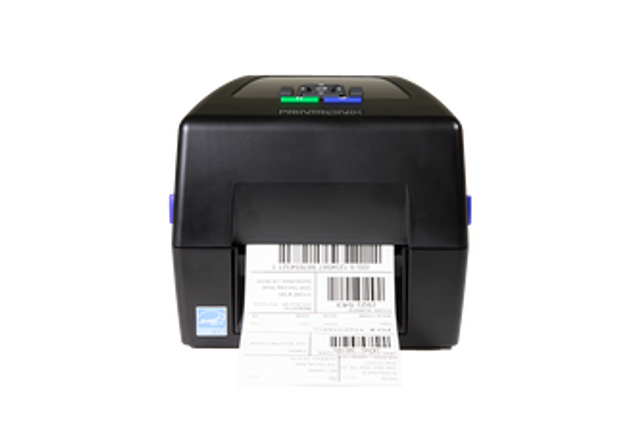
For example, one of our solutions is the Printronix T800 UHF RFID Thermal Transfer Label Printer 300 DPI Kit. This kind of machine prints standard label content and simultaneously encodes the RFID tag embedded in the media.
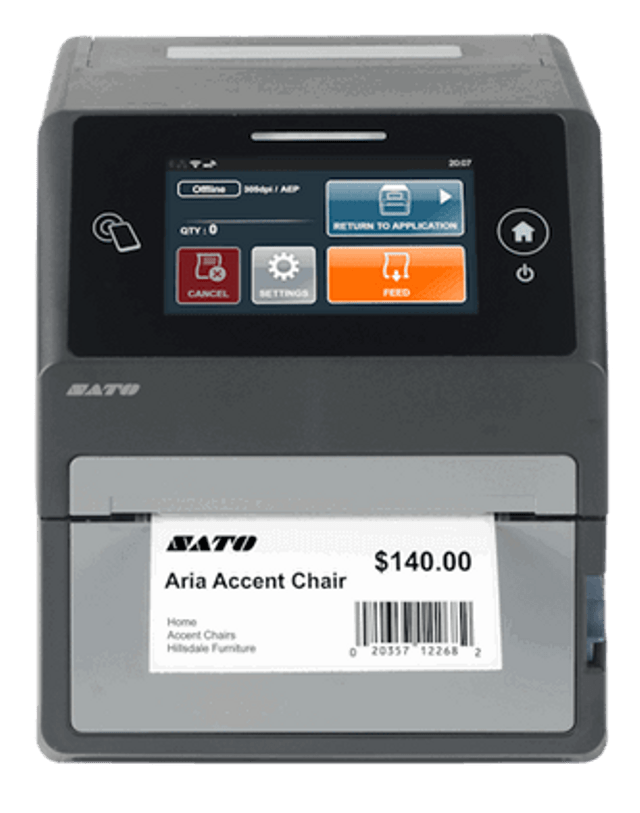
Another example is the SATO WWCT04441 NCN CT4-LX HF RFID Cutter Thermal Transfer Desktop Printer. This type of printer supports high-frequency (HF) RFID media and may incorporate features like an internal cutter, rewinder, and inline encode/print functions.
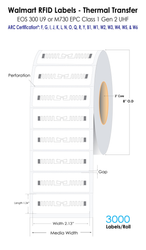
In addition to hardware, we also supply compatible media such as RFID labels (2.13″ × 1.24″) for thermal-transfer printing, which allow clients to produce tagged labels in-house.
Why RFID in the Supply Chain Matters
Real-Time Visibility & Inventory Tracking
RFID technology gives businesses real-time data about item location, status, and movement—far beyond conventional barcode systems. One key benefit: no line-of-sight required, and reading multiple tags at once.
This means companies can monitor pallets, cases and even individual items as they move through production, storage, transit and retail. The result: fewer lost or misplaced goods, better inventory accuracy, and reduced stock-outs or overstock situations.
Efficiency Gains and Labour Reduction
RFID systems accelerate processes such as goods receipt, picking, shipping, and returns. By automating scanning and data entry, manual errors drop, and labour time is freed up for higher-value tasks. For logistics operations, this means faster shipments, fewer delays and improved throughput.
Enhanced Traceability and Compliance
In regulated industries (pharmaceutical, food, electronics), being able to trace each item through its lifecycle is critical. RFID tags carry unique identifiers and can be linked to databases for full item-level traceability.
Additionally, they help support anti-counterfeiting and recall readiness.
Improved Asset Utilization
Beyond goods, RFID tagging helps track assets—pallets, containers, equipment—and monitor their usage, location and maintenance status. This helps reduce losses and optimize capital utilization.
How RFID Label Printers Fit into the Workflow
When implementing RFID labels in a supply chain, the printer becomes a critical part of your infrastructure. Here’s how we guide clients to deploy the solution:
- Media Selection – Choose the correct RFID inlay type (UHF vs HF), compatible label stock, and ensure the printer supports encoding and verification.
- Printer Setup – Configure encoder, printer settings (thermal transfer, resolution), and connectivity (USB, network, and inline systems).
- Label Layout – Design label templates with both printed human-readable content (barcodes, text) and the RFID encoded data.
- Encoding & Verification – After printing and encoding, each label should be read/verified to ensure the RFID chip is programmed correctly and readable.
- Integration – Connect to WMS/ERP systems that capture the RFID data stream, enabling real-time inventory visibility and analytics.
- Roll-out – Deploy tagged labels at points in your supply chain: manufacturing, packaging, inbound/outbound logistics, retail floor.
At DuraFast, we provide support and guidance throughout this workflow, ensuring clients get maximum value from their RFID label printers.
Key Use Cases for RFID Label Printers
Logistics & Warehousing
RFID-tagged pallets or cases passing through dock doors can be automatically read, eliminating manual scanning and reducing error-prone workflows. This enhances dock turnaround times, accuracy and data freshness.
RFID printers allow companies to print custom RFID-enabled labels on demand for specific shipments or zones.
Retail and Omni-Channel
Retailers are accelerating item-level tagging: by tagging each product unit, they enable better stock accuracy, faster replenishment and omnichannel fulfilment (click & collect, ship-from-store).
With in-house RFID label printing, brands can print pre-encoded tags custom to SKU, size, and other attributes. This flexibility supports seasonal product changes and reduces reliance on pre-printed labels.
Manufacturing & Quality Control
RFID tags printed and applied during manufacturing carry serial number, lot, and date code information automatically. This empowers manufacturers to track components through production, monitor work-in-progress and improve recall readiness.
Asset Tracking & Return Logistics
Tagged items such as rental equipment, returnable containers or high-value goods can be tracked continuously through their lifecycle. RFID printers allow you to programme unique IDs, print labels and apply them immediately, enabling efficient reverse logistics and asset recovery.
Choosing the Right RFID Label Printer: What to Ask
When selecting an RFID label printer, we recommend evaluating the following criteria:
- Frequency & Protocol: UHF (Ultra-High-Frequency) offers longer range and pallet/case level reading; HF (High-Frequency) is more suited to item-level tagging or near-field use.
- Resolution & Print Technology: Thermal-transfer printers are typically used—look for 300 DPI or higher when small text or dense encoding is required.
- Encoding & Verification: Printer should support inline encoding and verification of RFID chips for print-and-encode workflows.
- Media Support: Ensure the printer accommodates core sizes, roll widths and label materials compatible with RFID inlays.
- Connectivity & Integration: Ethernet, USB, networked printing, printer management software—ease of integration into your existing infrastructure.
- Software & Middleware: Does the solution integrate with your WMS/ERP, and support data capture and analytics for RFID tags?
- Scalability & Cost of Ownership: Factor in tag cost, media cost, maintenance, and future growth into your decision.
Our RFID Solution Portfolio
At DuraFast Label Company, we offer a selection of high-performance RFID printers and compatible media:
- Printronix T800 UHF RFID Thermal Transfer Label Printer 300 DPI Kit– Ideal for high-volume pallet or case labelling in retail (e.g., Walmart/Nordstrom compliance) or distribution centres.
- SATO WWCT04441 NCN CT4-LX HF RFID Cutter Thermal Transfer Desktop Printer– A desktop/pack-station friendly printer for item-level tagging, integration and small format applications.
- RFID labels compatible with thermal-transfer encoding:13″ × 1.24″ RFID labels (3000 roll) – pre-qualified for high read-rates and supply-chain use.
Together, these solutions let us build a complete RFID labelling system—from media, through print-and-encode to data capture and analytics. We pair hardware with training, commissioning and ongoing support to ensure your rollout is successful.
Implementation Best Practices: What We Recommend
- Start with a pilot project: Select a SKU, a zone or a process where RFID tagging delivers clear value (e.g., high-loss items, returns management).
- Define read-points and infrastructure early: Plan where RFID readers and portals will be placed, and how data flows into your system.
- Engage your supply chain partners: Many retailers mandate RFID tagging—coordinate with suppliers, packaging, and logistics teams.
- Train staff and build standard operating procedures (SOPs): Label application (orientation, spacing), reader maintenance, data exceptions.
- Monitor key performance indicators (KPIs): Stock accuracy, time per shipment, error rates, and labour hours. Use them to quantify ROI.
- Maintain media supply consistency: Use the same RFID label stock and ribbon types to ensure consistent encoding and readability.
- Plan for scalability: Ensure your printer hardware and media stock can scale as RFID adoption expands.
Measuring the Impact of RFID Label Printing
When implemented correctly, RFID delivers measurable benefits. Some of the key metrics to track with us include:
- Inventory accuracy improvement (often from~90% to >98 %)
- Reduction in labour hours for stock takes or shipment verification
- Fewer stock-outs or overstock events thanks to real-time visibility
- Shorter shipment processing times and fewer errors in dispatch
- Lower asset loss or misplacement through tagged containers or pallets
By printing and encoding labels in-house, you also gain flexibility—reducing lead times, avoiding minimum order quantities for pre-printed tags, and maintaining full control over tag design and data.
Future Trends in RFID Label Printing
The adoption of RFID continues to accelerate. According to industry reports, the RFID market is growing at a double-digit CAGR.
Emerging trends include:
- Item-level tagging becoming standard in retail and apparel.
- Integration of RFID data into broader Internet of Things (IoT) and blockchain-based traceability systems.
- Smaller and lower-cost inlays making RFID viable for even lower-cost items.
- Inline print-encode-verify systems becoming more affordable and compact for pack-stations.
As these trends mature, having the right label printer infrastructure from today gives organisations a competitive edge.
In summary, RFID label printers represent a paradigm shift in supply chain management and retail tracking—they combine traditional printing with embedded intelligence to deliver real-time visibility, enhanced accuracy, and operational efficiency. By adopting this technology, we at DuraFast Label Company empower our clients to transform how they manage inventory, move goods, and serve customers.
Whether you’re tagging pallets in a distribution centre or applying item-level RFID labels in a retail environment, the right equipment makes a difference. With our portfolio of hardware—from the Printronix T800 UHF kit to the SATO CT4-LX HF printer—and validated RFID media, you’re ready to step into the future of tagging.
If you’re looking to implement an RFID labelling solution, we recommend focusing on RFID label printers, logistics tracking, and item-level tagging as starting points for your roadmap.
We’re here to guide you through every step—from printer selection and media qualification to system integration and staff training.
Contact us at DuraFast Label Company today to discuss how you can deploy RFID label printers in your operation and gain a real-time, high-accuracy supply chain.